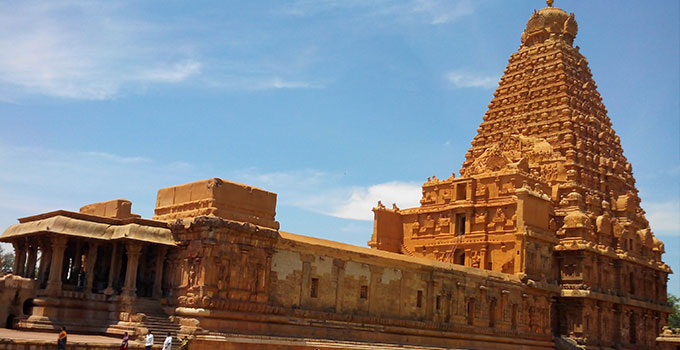
An outstanding example of Chola architecture, this temple dedicated to Lord Shiva is located in Thanjavur in Tamil Nadu. It is one of the biggest Hindu temples in India and is colloquially called Thanjai Periya Kovil (Thanjavur Big Temple). It was called “Dakshina Meru” comparing with Uttara Meru or Mt Kailas; the abode of Lord Shiva.
Built by the Chola Emperor Rajaraja I between 1003 and 1010 it is a designated UNESCO World Heritage site.
Looking back at history
Emperor Rajaraja I called the temple “Rajarajesvaram” meaning “temple of the God of Rajaraja”. Brihadishvara is a Sanskrit word meaning “Big Lord Siva”
The Chalukya and Pallava temple styles flourished from the fifth century onwards as evidenced by the Badami and Mamallapuram temples and similar monuments. The Chola dynasty flourished between 850 and 1280. It was during this period and specifically during the rule of Rajaraja I that this temple was built. It was specifically during this time that the huge ornate gopurams started adorning the temples.
The main temple with its gopurams are from the eleventh century while various additions and renovations took place subsequently . There were damages to the temple in various wars between the Muslim Sultans of Madurai and the Hindu rulers of Thanjavur. These were repaired and shrines of Murugan, Parvati, Nandi and Dakshinamurthy were added. The Thanjavur Maratha rulers took over and maintained the temple subsequently.
Structure
There are several sacred texts giving mythical accounts of the actual building of this temple. The Brihadeeswara Mahatmyam widely attributed to sage Veda Vyasa gives an account of 16 Chola rulers and the temples built by them.
The temple is built on a raised platform and is rectangular in shape with five distinct sections. The Sanctum with the main gopuram or tower called Vimana, the Nandi Mantapam, the Mukhamantapam and the Mahamantapam.
A large pillared and covered verandah surrounds this complex with a circumambulation path in between. This verandah is surrounded by two fortified walls outside. The outer one being higher and built by the French who used the temple as an arsenal.
Come along with me…let us enter the temple
The Maratha Gate
The first gate as we enter the temple complex, built during the Maratha reign and served as a wall of defence. A gopuram with delicate carvings adorns this gate.
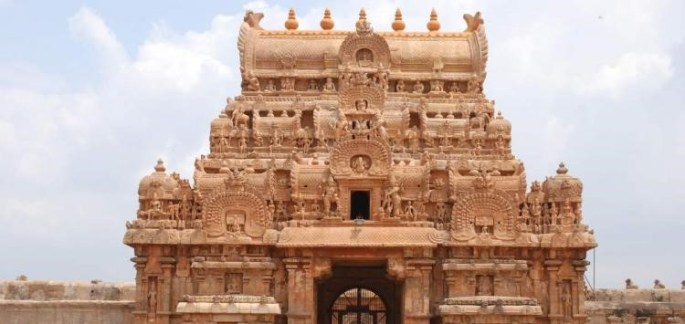
The Maratha Gate
The Keralantaka Gate
Built to commemorate the victory of Rajaraja Chola I ,over the Cheras, this gate is highly decorated with carvings of Gods and Goddesses and is an ideal example of Chola architecture.
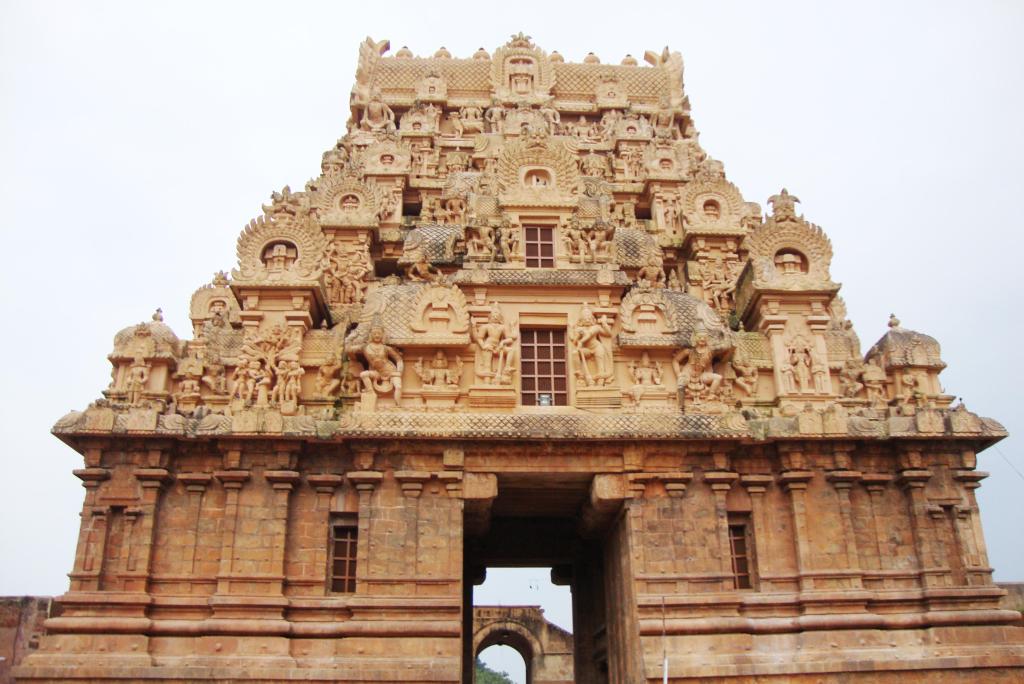
Keralantaka Gate
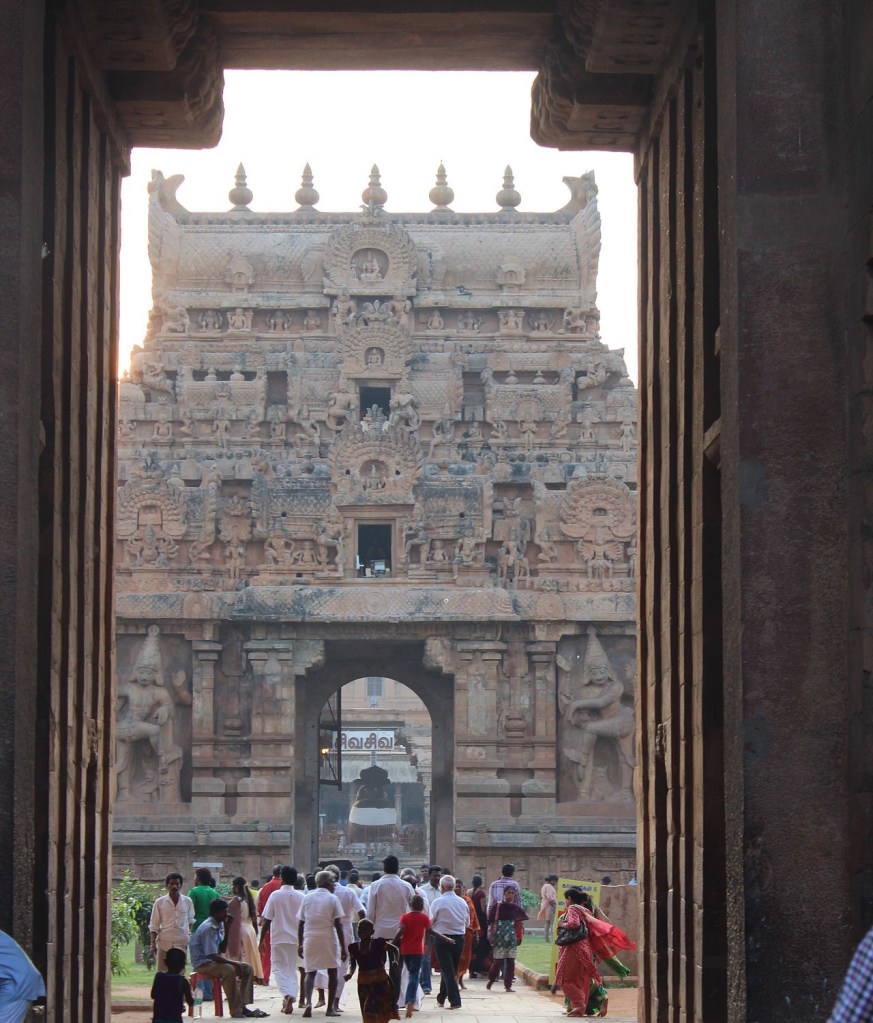
Under the second gate …
Rajaraja Gate
This is the third and final gate and is most ornate of all and marks the entrance to the innermost part of the temple complex. There are carvings at different levels on this gate and there are statues of two doorkeepers on either side of the entrance. Here too, there are carvings depicting various situations described in holy texts.
As you stand here, the Nandi is clearly visible inside the complex.

Rajarajan Gate ( note the two dwarapalakas)
Once you cross these three ornate gates with gopurams, you enter a courtyard with a huge Nandi ( Sacred Bull) and the Nandi Mantapam.
Nandi Mantapam is a raised platform with beautiful paintings on the ceiling and exquisitely carved pillars. A monolithic black Nandi weighing about 20 tons sits in the Nandi Mantapam looking towards the main deity. This Nandi is 16 ft long and 13 ft high.

The monolithic Nandi

The beautiful paintings on the ceiling of Nandi Mantapam
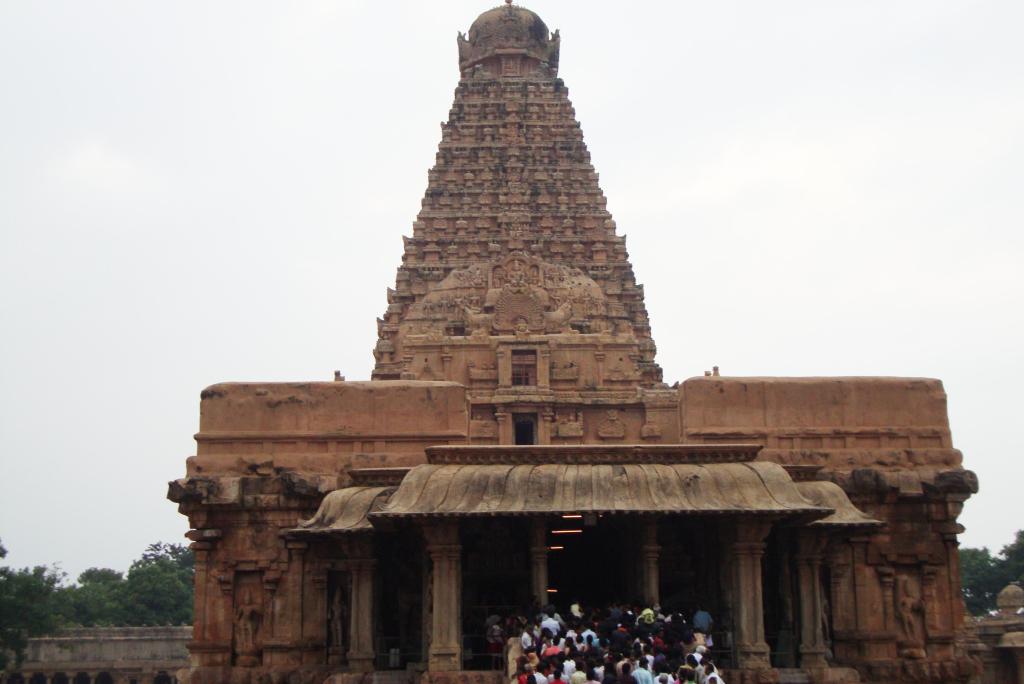
The main temple with gopuram or Vimana
Photography is not allowed in the main temple….
Nandi looks at the main deity inside the Sanctum, symbolic of Nandi guarding the temple.
The main deity is a huge Shiva Linga , 3.7 meters tall . This Linga is believed to house the powers of Brahma, Vishnu and Shiva. The Vimana or the main Gopuram (tower) is just above the sanctum. The space around the Linga and within the towering Vimana is believed to be permeated with the presence of Lord Shiva in subtlest form of space.
Only priests are allowed inside the main sanctum. The walls of the sanctum have beautiful paintings of the Chola period including that of Emperor Rajarajan I.
The exit from the main temple is through the side…

Exit from the main temple
From the pictures above, a fair idea of the beautiful carvings on the temple exteriors would have been obvious.
Most of the carvings and art work relate to various Hindu mythological characters and stories and feature various Gods and Goddesses.
Few more pictures to highlight the great art work on these walls…


The exquisite art work in stone….
The main Gopuram or Vimana is more than 200 ft high and built as 16 levels ; 13 of them tapering upwards. A huge dome or Kumbam measuring around 25 sq ft. sits on top of the tower and and weighs 80 tons. This Kumbam is also monolithic and how it was placed on top is still unclear.

The Vimana

The ornate Kumbam
The Mahamantapam and Mukhamantapam have shrines of eight deities symbolically guarding the eight directions. The walls of the mantapas have mural paintings and carvings mainly relating to Lord Shiva.


Murals on the walls


Stone Carvings
Music and Dance
From the time of the Cholas, the temple and its environs have been the arena of music and dance. Various inscriptions on the walls point to this. Elaborate rituals connected to dance and music have been described. Several endowments were bestowed on artists and many literary and musical compositions praising the deity were written here. The Chola rulers and the temple have long been credited with encouraging the growth of the art forms.
Mysterious facts about this masterpiece in stone
The whole temple is made of granite and the closest granite quarry was 50 kms away and so how all this stone was transported during those days is a mystery.
The design of the Vimana is such that it gives an illusion that it does not cast any shadow.
There were many underground passages through which the royalty moved around but now all those have been sealed.
The Nandi in front is monolithic.
Many inscriptions are found on the walls relating to details of administration of the temple.

Inscriptions
Well, one can never finish talking about such a masterpiece; but I leave it at that.
Hope you all enjoyed this visit to one of the greatest temples in India. See you next week with yet another such marvel. Till then, keep your comments flowing in.
Discover more from Travel-along.in
Subscribe to get the latest posts sent to your email.
 Travel-along.in
Beautifully explained with photos. Enjoyed reading it.
LikeLiked by 1 person
Thankyou 🙂
LikeLike
Great temple. Explained exceptionally well.
We were also blessed to have Sarah’s here few years ago
LikeLiked by 1 person
Blessed to have darshan here few years ago
LikeLiked by 1 person
Thanks sir
LikeLike
Well detailed !
LikeLiked by 1 person
Wow, that’s stunning! I could spend ages just studying and photographing the carvings on each structure!!
LikeLiked by 2 people
Yes…the carvings are amazing. And to think that it was all created during the period in history when no modern tools were used is truly amazing!
LikeLiked by 1 person
Those temples and gates are just mind-bogglingly intricate and ornate. No room for error when you’re carving in stone, but they seem to have done a good job. I’m amazed at how evenly spaced all the characters are. I would not have been the right person for that job – haha.
LikeLiked by 1 person
It’s amazing how they did it without any modern equipment…
LikeLiked by 1 person
S akka i also thought like that.you explained well akka amazing!!!!
LikeLiked by 1 person
Thankyou…
LikeLike