
Lepakshi has been in the news recently , and so ; why not resume the India series with Lepakshi ? With the Ayodhya temple inauguration and the Prime Minister’s visit , Lepakshi has indeed come into focus . Till then , many of you may not have heard of this temple in the sleepy town of Lepakshi in the state of Telengana in India . A 16th century temple enriched with art and architecture of the Vijayanagar Empire has this as yet unexplained phenomenon of the hanging pillar.
The temple itself is dedicated to Lord Veerabhadra (fiery avatar of Lord Shiva) and has shrines dedicated to various Hindu Gods like Vishnu, Devi, Ganesha and Hanuman. Apart from religious attributes, the Lepakshi temple complex is considered an excellent art monument. This is because, most of the walls and ceilings at the temple are covered not only with sculptures, but murals depicting various scenes from Ramayana and Mahabharata.
Since the most intriguing and popular feature is it’s hanging pillar, let us first talk about that…
The hanging pillar
The hanging pillar is one of the pillars of the inner hall of the temple which does not rest on the floor. A clear gap is seen between the floor and the pillar and often people pass a cloth below the pillar to try it out.
The actual reason for this is still unclear and many theories have been put forward. They vary from anti gravity techniques known to the ancestors ,to magnetic causes, to the presence of some rod inside holding it up to the ceiling , to divine intervention ,to the balance of the artwork on the pillar.

The Hanging pillar
Trying to pass a cloth below the pillar
An English engineer is supposed to have tried moving this pillar when the other pillars started shaking and he had to abandon his efforts.
Shifting focus to the main temple….
Legend of Lepakshi Temple
Most Hindu temples are associated with legends and Lepakshi has been associated with the epic of Ramayana. When Ravana, the demon king abducted Sita and was on his way to Lanka with her, Jatayu, the eagle tried to stop him. Ravana attacked Jatayu and the injured Jatayu fell down . When Rama came along and saw the wounded Jatayu, he uttered the words”Le Pakshi” which translates to “rise up bird” and helped him achieve salvation . The word Lepakshi stuck to the place and today we have a huge statue of Jatayu on a rock here.
The temple dates back to 1583 during the reign of the Vijayanagar Empire. Two brothers, Viranna and Virupanna are believed to have built this temple in typical Vijayanagar architectural style. A large number of frescos adorn the ceilings of this temple; some of it faded and peeled off. This temple is designated a monument of national importance by the ASI (Archaeological survey of India) and is on the tentative UNESCO World Heriage Sites list.
Visiting Lepakshi
A 120 km drive from Bangalore on NH 44 and a left turn and then15 km on highway 544E takes one to this temple.
As one reaches the junction to turn off the highway there is a decorative arch with jatayu on the top and a small Nandi in front.

The Jatayu arch at the entrance to Lepakshi town
At Lepakshi, the first structure that one encounters, is a giant Nandi Statue. This is actually called the Basavanna temple.
Nandi (Bull)
The Nandi (Bull) is a monolithic granite bull in sitting posture, 10 mts in length and 6 mts in height . Considered the largest Nandi in India, it is depicted with short horns and decorative bells and ornaments around the neck. A lily pond adds to the beauty of this small temple .
Shiva temples usually have a Nandi statue looking at the sanctum and this Nandi looks at the giant Nagalinga statue located inside the main temple. This Nandi however has its head aloft at a slight angle which makes it unlike most Nandis where a submissive posture is the rule.
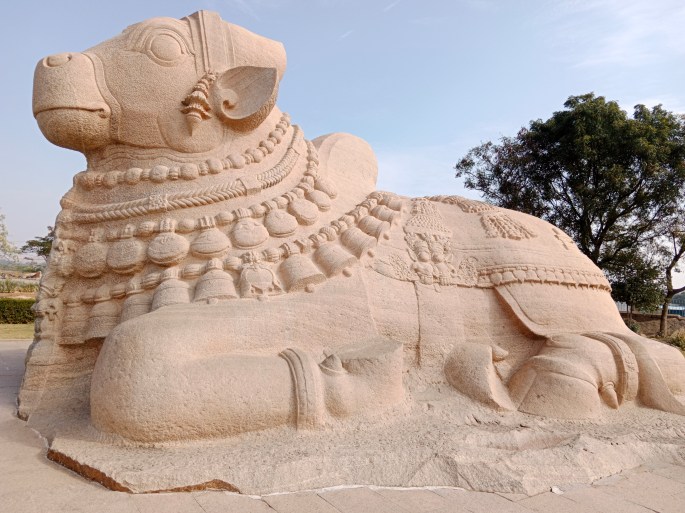
The Giant Nandi


The front view and the lily pond in the complex
A short walk down the road takes one to the main Lepakshi Temple.
The entire temple is built on top of a tortoise (kurma) shaped hill(saila) or Kurmasaila and has towering walls around. A giant banyan tree adorns the entrance and a board explaining the origin of the temple gives one a little perspective of the temple.


The board explaining the history and the outer walls
The main temple is laid out in three parts : the Natya Mantapa ,the Artha Mantapa and the sanctum or Anthrala.
The Natya Mantapa
Located inside the outer fortress wall, this hall has multiple pillars with sculptures of gods, goddesses, horses, lions, musicians and dancers.

The ornate Natya Mantapa

Pillars with beautiful sculptures
Two giant monolithic sculptures greet us inside the temple.
One is a monolithic Ganesha with a protective canopy with pillars and the other is the Nagashivalinga.

The Giant Ganesha
The shivalinga is made of a huge rock while the seven headed serpent or Naga is monolithic and appears to be protecting the linga.
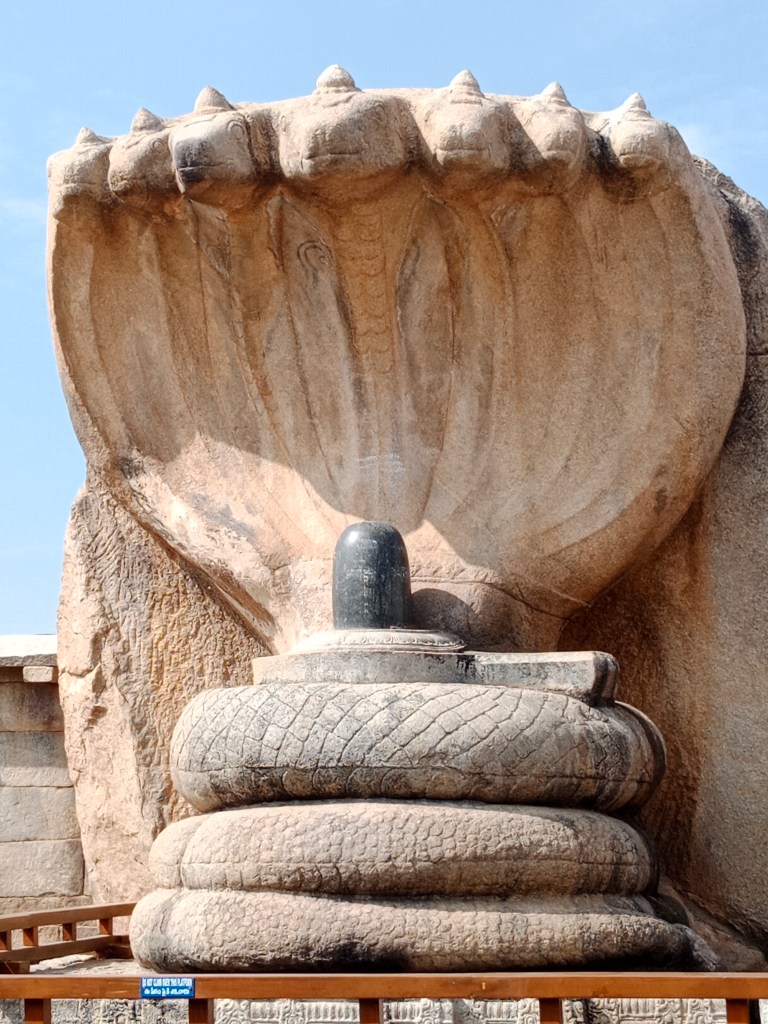
Nagashivalinga (7 hooded serpent sheltering the Shivalinga)
Sita’s footprint
As one circumambulates along the outer walls, one comes across a giant footprint believed to be that of Sita.
Another image that strikes us are two red marks on the wall. Legend has it that Virupanna who built the temple used funds from the treasury without the approval of the king. He was ashamed to face the king and so he gorged out his own eyes and threw it which hit the wall. This spot has two red marks attributed to this incident.


Sita’s footprint and Virupanna’s eyes.
This then brings us to the unfinished Kalyana Mantapa.
After Virupanna punished himself , no further construction was undertaken ; leaving an incomplete Kalyana Mantap. However, the sculptures on the pillars of the Kalyana Mantap are beautiful and exude the art of the Vijayanagar era.


The unfinished Kalyana Mantap
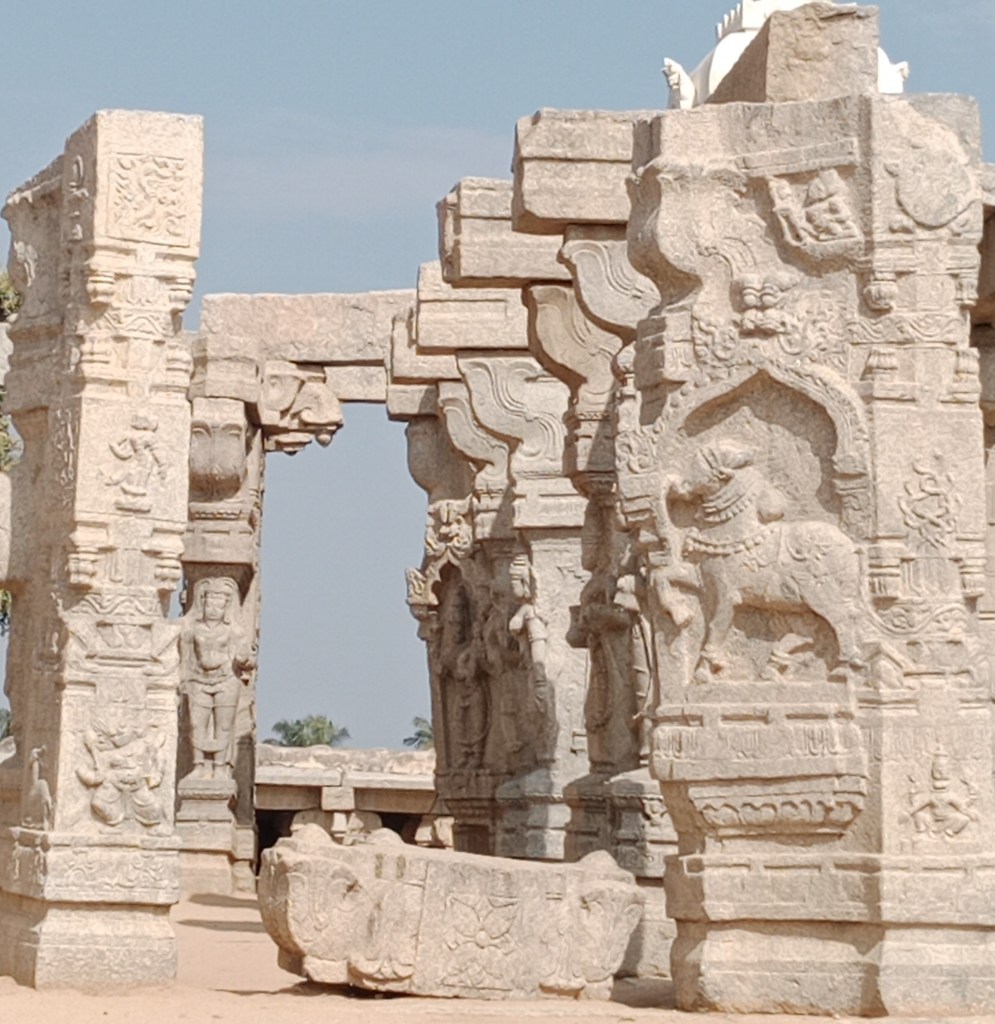
The exquisite art work on the pillars of Kalyana Mantap
The Artha Mantapa
The innermost segment of the temple leading to the main sanctum is the Artha Mantap . The hall itself has multiple pillars decorated with sculptures and the ceiling has murals of various sizes but many of which have faded or have been damaged. The columns are located on an elevated plinth and have eaves overhanging in a curved fashion.
One of the frescos on the ceiling of the Artha Mantapa is supposed to be the largest one in Asia. The paintings depict the costumes of that period but due to age related fading, many of the features are not very clear.
Some pictures…


Sculptures on the pillars of the Artha Mantapa
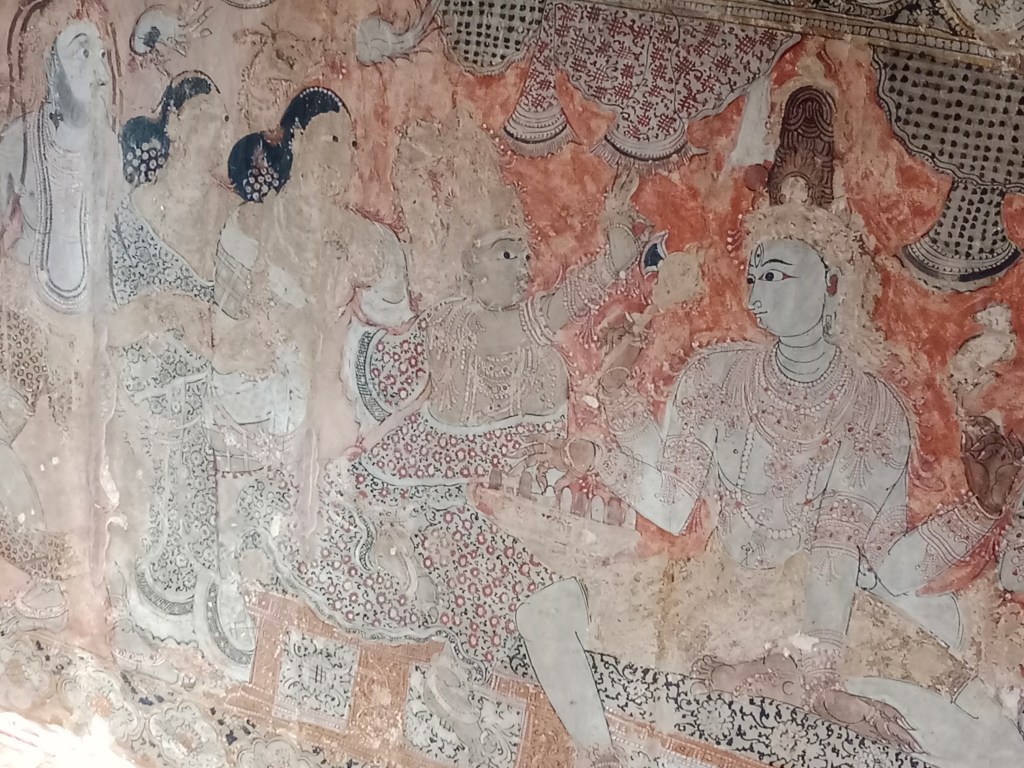
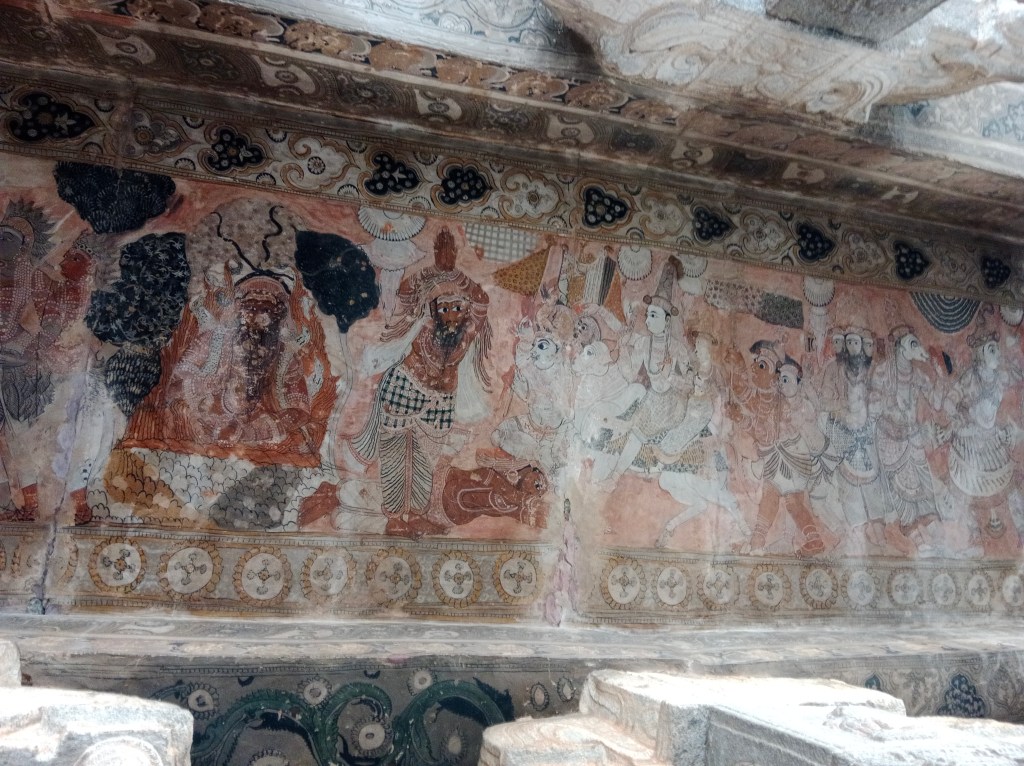
The frescoes


The damaged ceiling and frescoes
The Garbha griha
The Artha Mantapa leads to the sanctum sanctorum or garbha griha where the shrine of Veerabhadra swamy is located. A small cave chamber where saint Agasthya lived when he installed the linga is also seen. The ceiling at the sanctum has the paintings of Virupanna and Virupaksha who constructed the temple.
A shrine dedicated to Durga, the goddess is located just outside the main shrine and has a huge mirror in front so that, one can see the reflection from far.


The side view of the main entrance and the cave chamber
The Giant Jatayu
As explained in the legend, Jatayu is intricately connected with Lepakshi . No wonder then that a huge Jatayu image is constructed on a rocky hillock close to the temple. It is called the Jatayu theme park. The giant Jatayu seems to be overlooking the whole town.
To reach the Jatayu, one has to climb up some steps on a rocky hillock.
Some pictures…
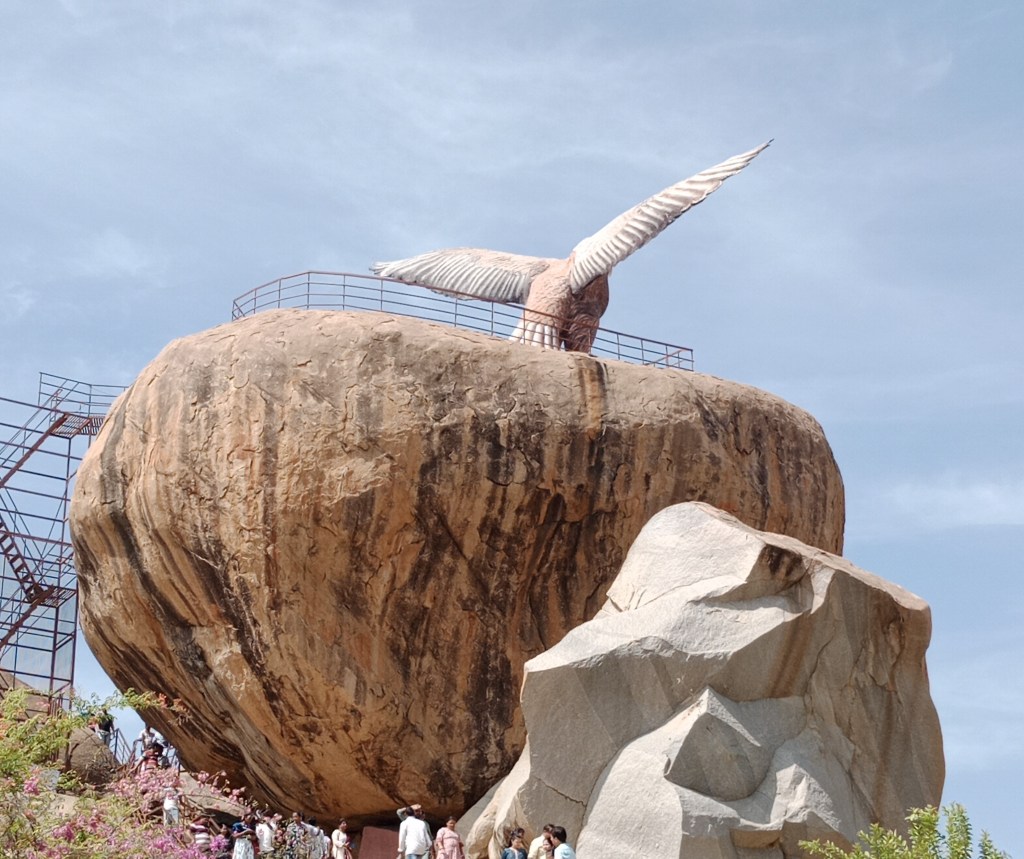
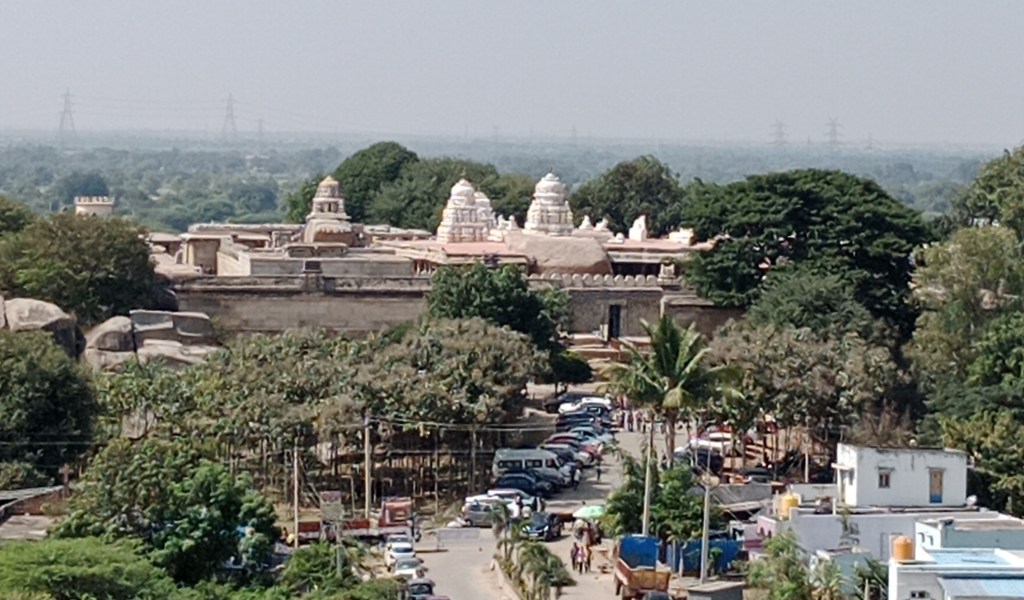
Jatayu park and the view of Lepakshi Temple from there

The giant eagle Jatayu
It was noon by the time we finished walking around the temple and the Jatayu park and we returned to the comfort of our hotel room .
Well, I hope I have kindled your desire to visit this temple and admire its art and architecture.
See you next week from an amazing waterfall of south India…till then,
do give me your feedback and comments….
Discover more from Travel-along.in
Subscribe to get the latest posts sent to your email.
 Travel-along.in