We will soon bid farewell to Bhutan ; but not before we have a round up of Paro and some of the places around.
Chuzom
Enroute Paro from Punakha, we had a short halt at Chuzom which is the place of confluence of two rivers ; Wong Chu and Paro Chu. One can see the confluence of the rivers from a bridge and the single river flowing off the other side.
Such confluence of rivers is considered inauspicious by the Bhutanese and hence four chortens have been built here to ward off the evil. These chortens are of different styles namely Bhutanese, Nepali, Ladakhi and Tibetan.
The two rivers and the Chortens
The other side of the confluence
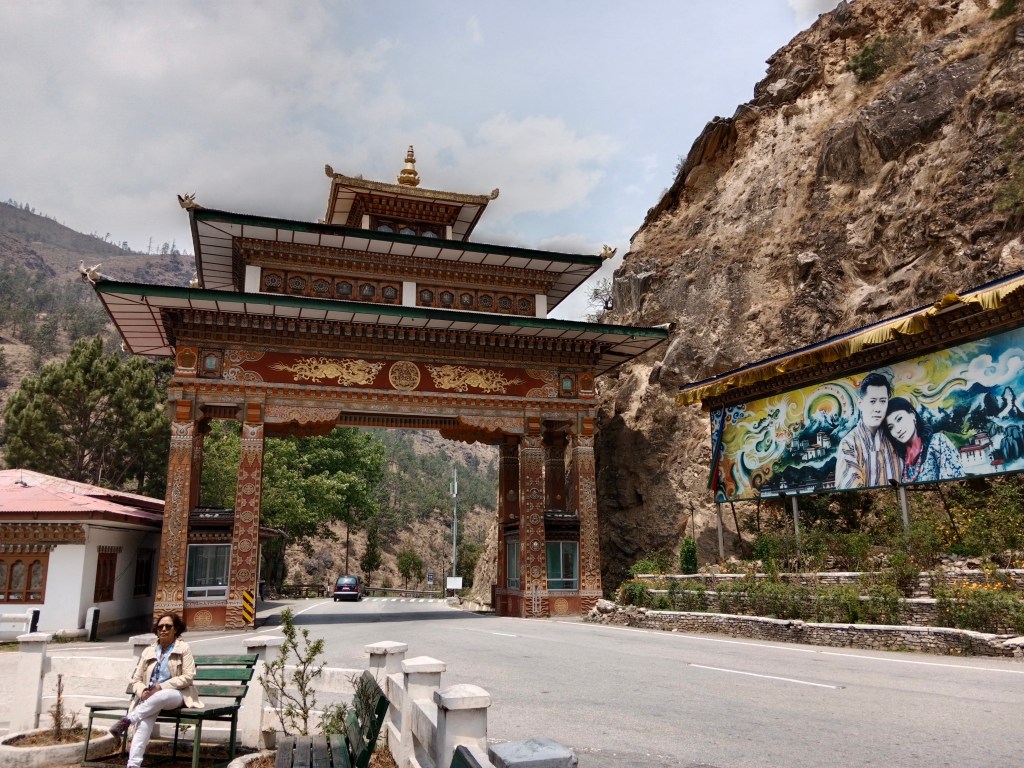
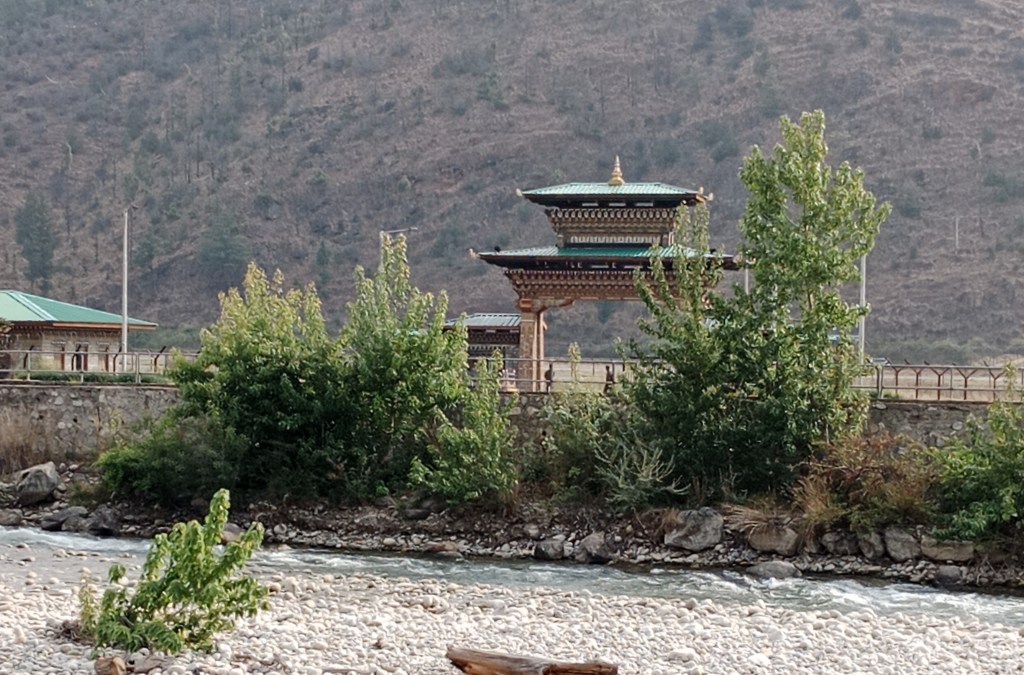
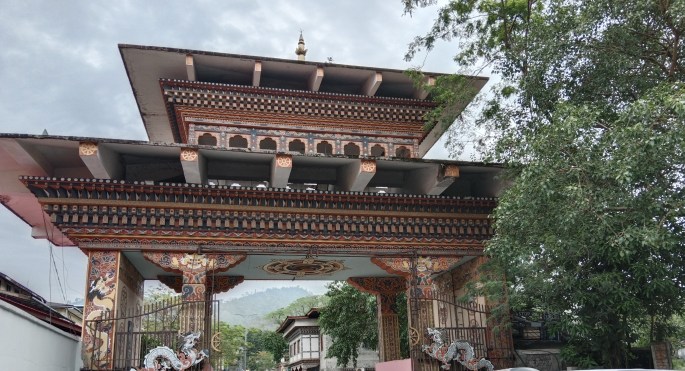
There is also an ornate gate built near Chuzom where the pictures of the king and queen are painted. The spot marks the meeting point of roads to Thimpu, Paro , Haa and Chukkha.
The ornate gate with the picture of the King and Queen
A tribute to Indo Bhutan friendship and the confluence of the roads!
Paro
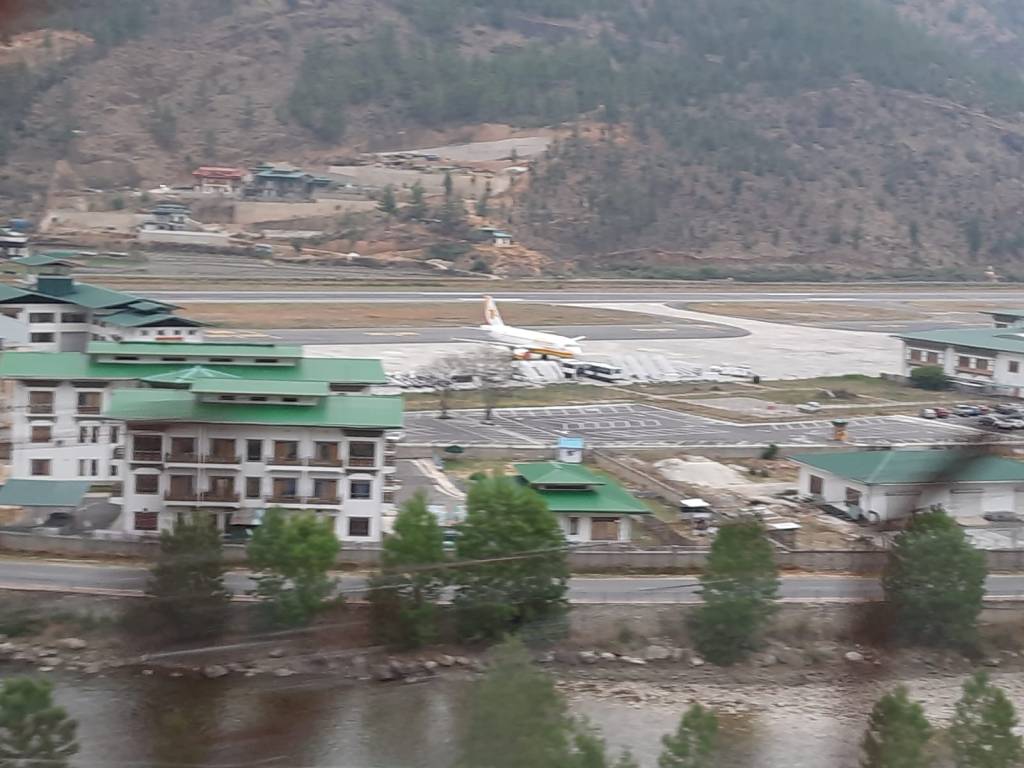
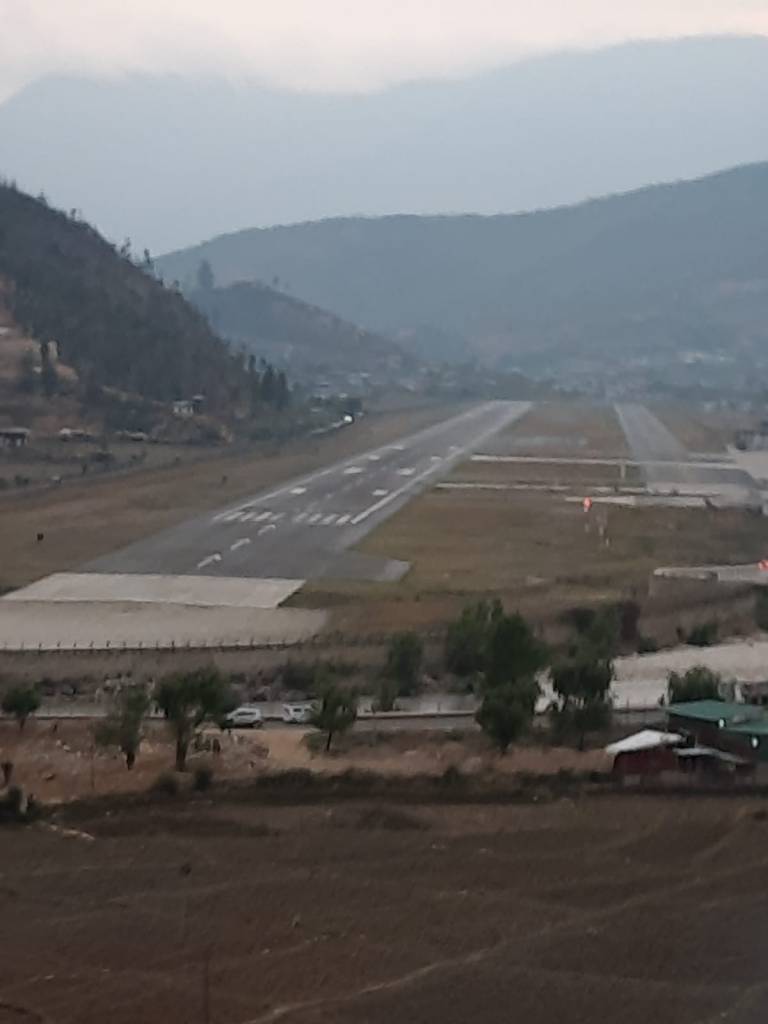
It is a historic town in Bhutan with many historic sites around. It is also home to the only international airport in Bhutan, the Paro International Airport. Located in a valley on the banks of the Paro river and surrounded by mountains ,it is considered one of the most dangerous airports in the world with less than 10 pilots certified to operate from Paro.
It was news to me that the first airstrip was built here in 1968 by the BRO from India. It has been expanded later.
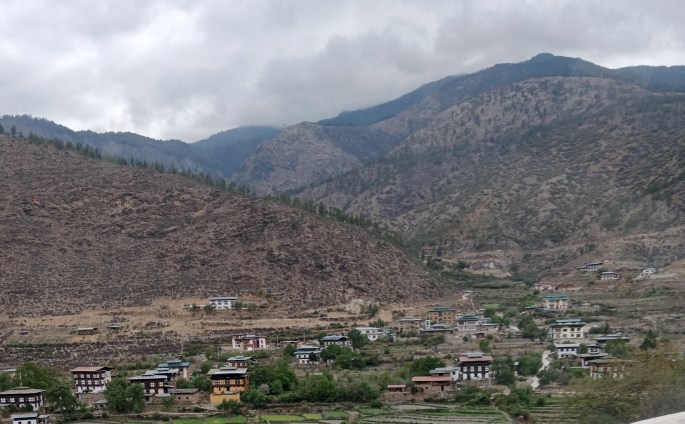
Paro airport with the road and Paro river adjacent to it
The runway between the slopes and view of the entrance from our hotel room
Our hotel at Paro was next to the airport and there was this little stream flowing between the road and our hotel. This was part of the Paro river.
The riverside offered great ambience and enhanced the beauty of the place. Some pictures….
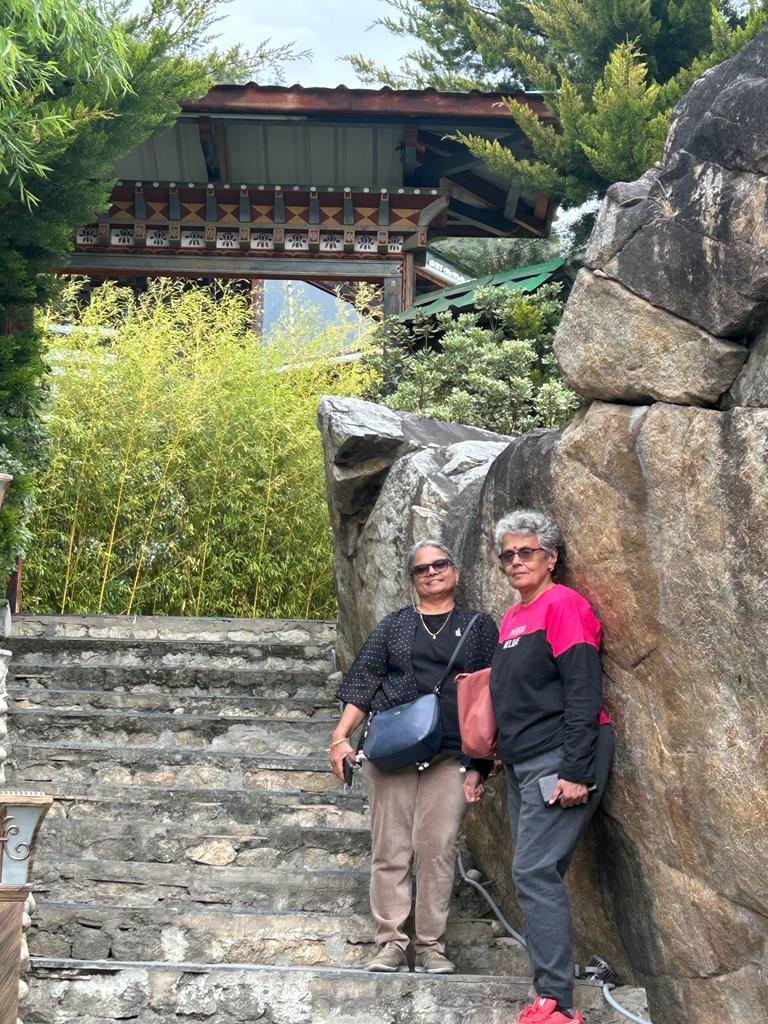
Some pictures from our resort
Tiger’s nest and Paro Dzong
Tiger’s nest, the cliff side monastery near Paro and the beautiful Paro Dzong are the main attractions at Paro. These have already been covered in my previous blogs.
Paro town
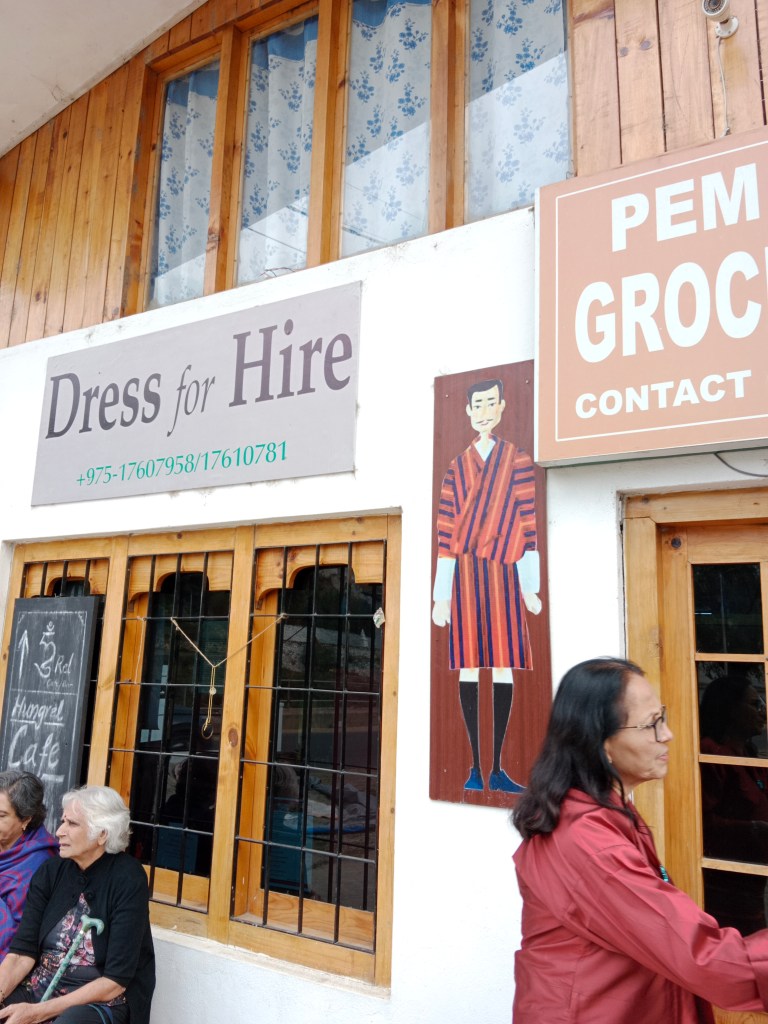
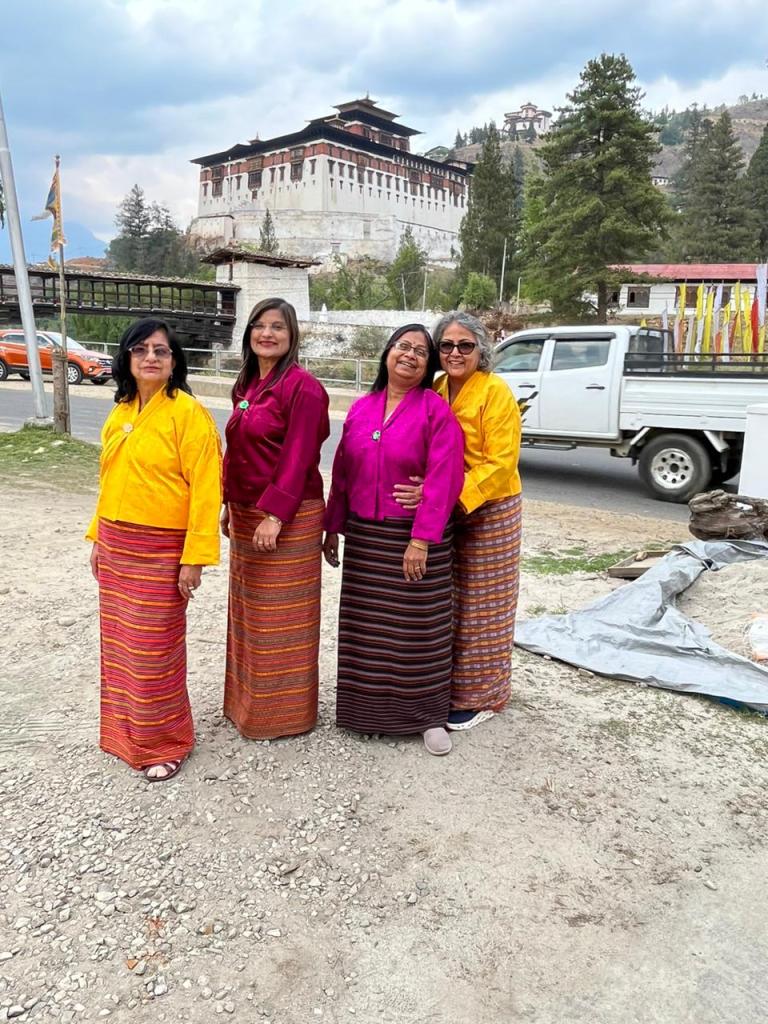
Traditional Bhutanese attire is available for hire here. Some of us tried this out and here are some pictures..
The dress centre and the beautiful ladies in front of the Paro dzong
Bhutanese Cultural Show
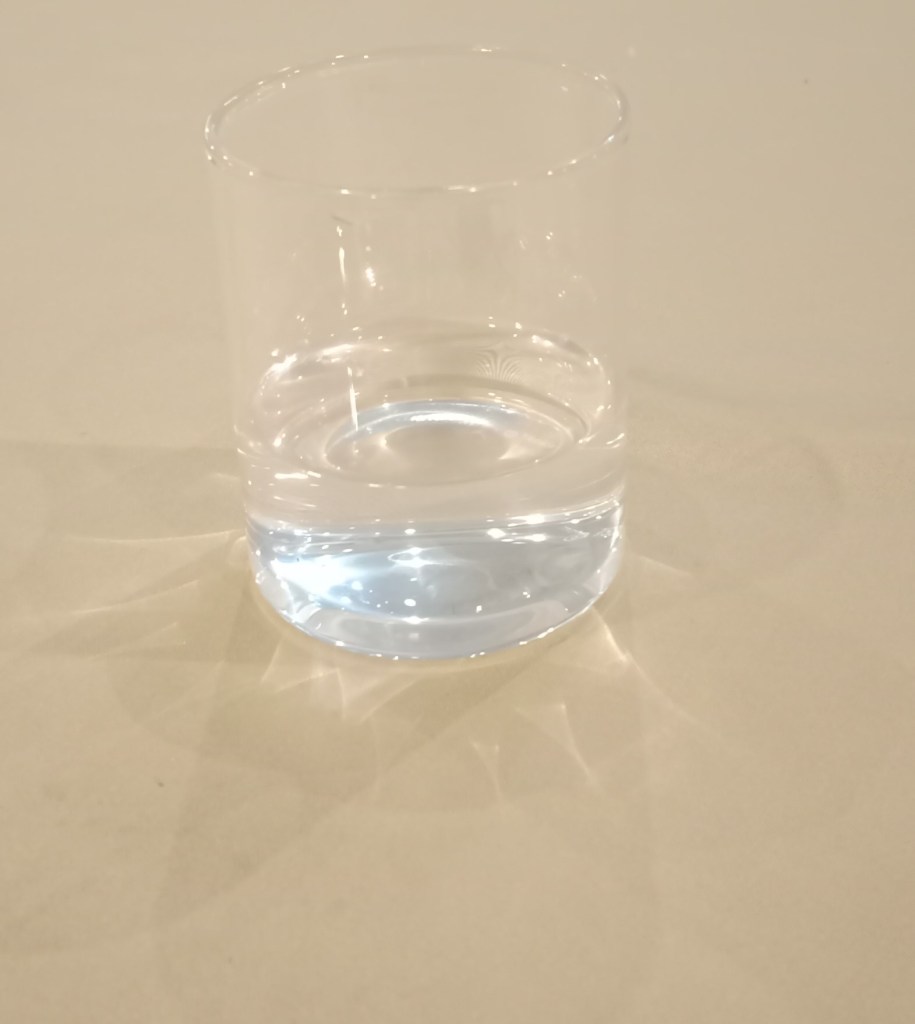
We were treated to some Bhutanese rice wine called Arra. It was clear and transparent like water but did not taste any great!
This was accompanied by a cultural show which showcased the traditional dances of Bhutan. The music was melodious and we also joined the dancers in the end the mark a happy ending to our Bhutan trip. Some pictures…
Arra and the dancers…
A video of the dance performance.
After a very enjoyable stay at Bhutan we were ready to say goodbye to this beautiful country. We drove back from Paro to Phuentsholing and further down to Siliguri. Enroute we again drove through some tea gardens ……
Driving back to Siliguri….
This marks the end of the Bhutan series. The next series is going to be on the famous temples of India. Before that, I will be on a holiday for a couple of weeks and there will be no updates during that time.
So , see you after the break. Till then do give your comments and feedback.
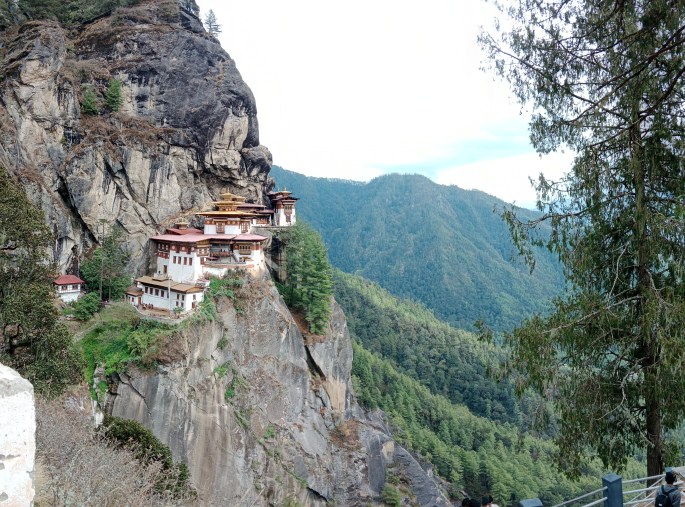
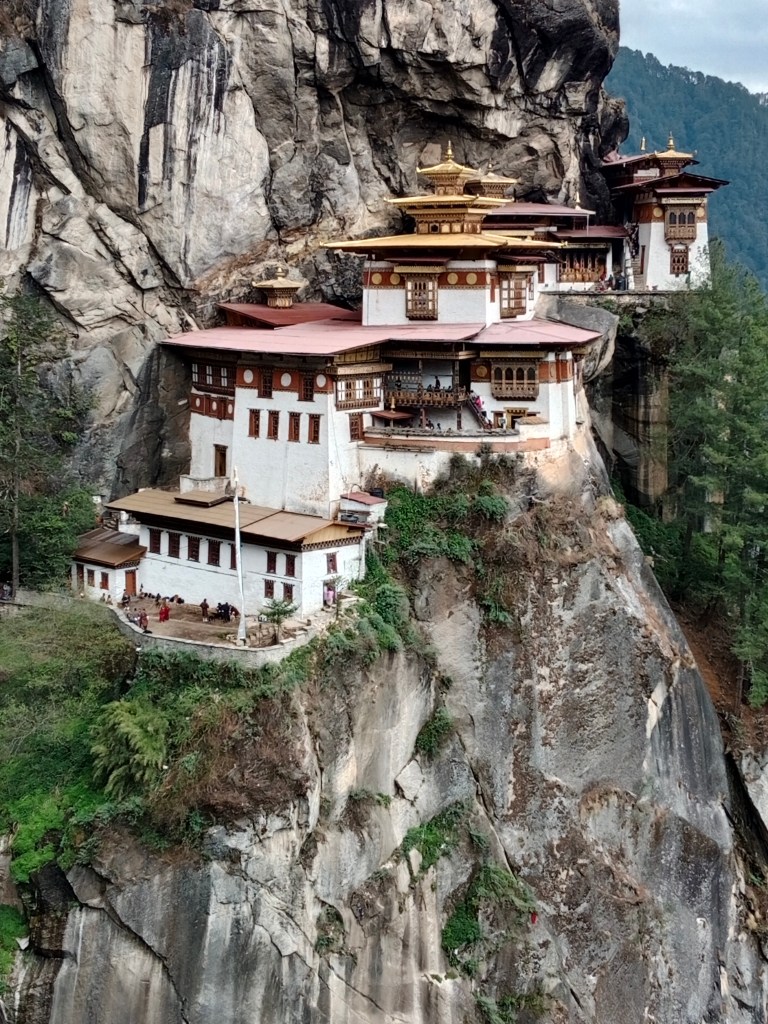
No trip to Bhutan is complete without a visit to this great monastery called Paro Taktsang or Tiger’s nest. Much like the Eiffel tower is to Paris or the Statue of Liberty is to New York, it is an iconic image of Bhutan. Located on a cliff side in the upper Paro valley, this Himalayan Buddhist site is one of the thirteen Tiger’s nest caves in historical Tibet where Padmasambhava practiced and taught Vajrayana Buddhism.
A brief history
Established in the 9th century as a Buddhist meditation cave, it was formally built into a monastery in the 17th century.
Legend has it that the Indian Guru Padmasambhava ( Guru Rinpoche) flew in to this cave on the back of a tigress and meditated here.Guru Rinpoche or the “Second Buddha” is believed to have had eight manifestations and to have banished the demons . He is believed to have brought Buddhism to Central Asia and anointed this place as the site for a future monastery. That explains why this place is so sacred to the locals and why such a monastery was built at this location.
Though we call it Tiger’s nest in English, Taktsang means a tigress’s lair.
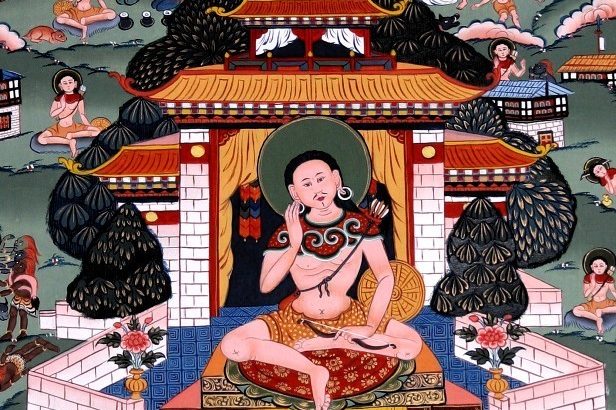
Guru Padmasambhava or Guru Rinpoche ( a mural painting)
Structure
Though the structure itself is beautiful, what adds invincibility to the place making it more attractive to the tourists , is the isolated location on a steep slope overlooking the valley.
The monastery has white walls which stand out against the rocks and surrounding trees. The red and gold borders and circles provide a typical Bhutanese look to the buildings. There are four main buildings here in addition to smaller ones for various purposes. The buildings have rock steps connecting them making it look as if the buildings rose from the cliffs around.
Getting there
The monastery is more than 3000 metres above ground level. No vehicles can go up there and dense forests line both sides of the track. Hiking is the only way to reach the monastery. Ponies can be hired for part of the distance but the last part has to be done on foot. The total hike takes anywhere from 3 to 4 hours one way depending on one’s capability.
Our Hike
When we reached the place and the bus dropped us off at the parking lot, the monastery looked like a small building perched somewhere up on a cliff. It looked a little invincible but we were determined to make it to the top. We were all a little doubtful if we would really be able to reach up there; but the adventurous spirit egged us on…..
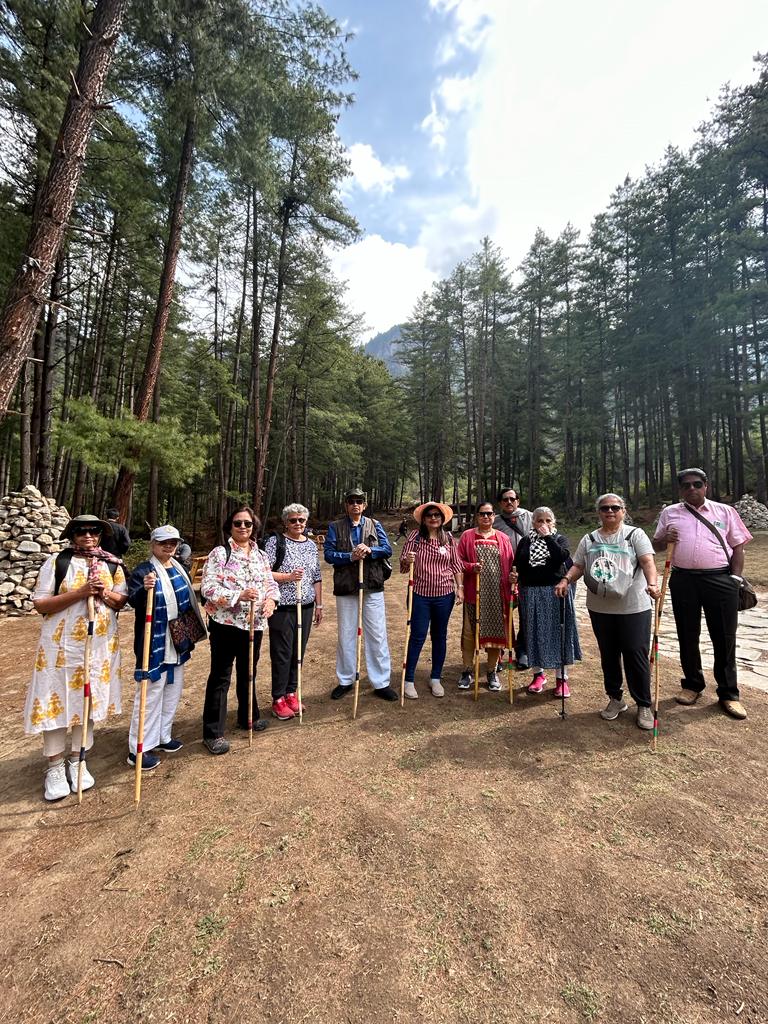
At the parking lot, we hired walking sticks and set off on this wonderful experience.
The first views of the monastery as we started our hike uphill.
Looking at this picture you would realise why we were all apprehensive!!!!!
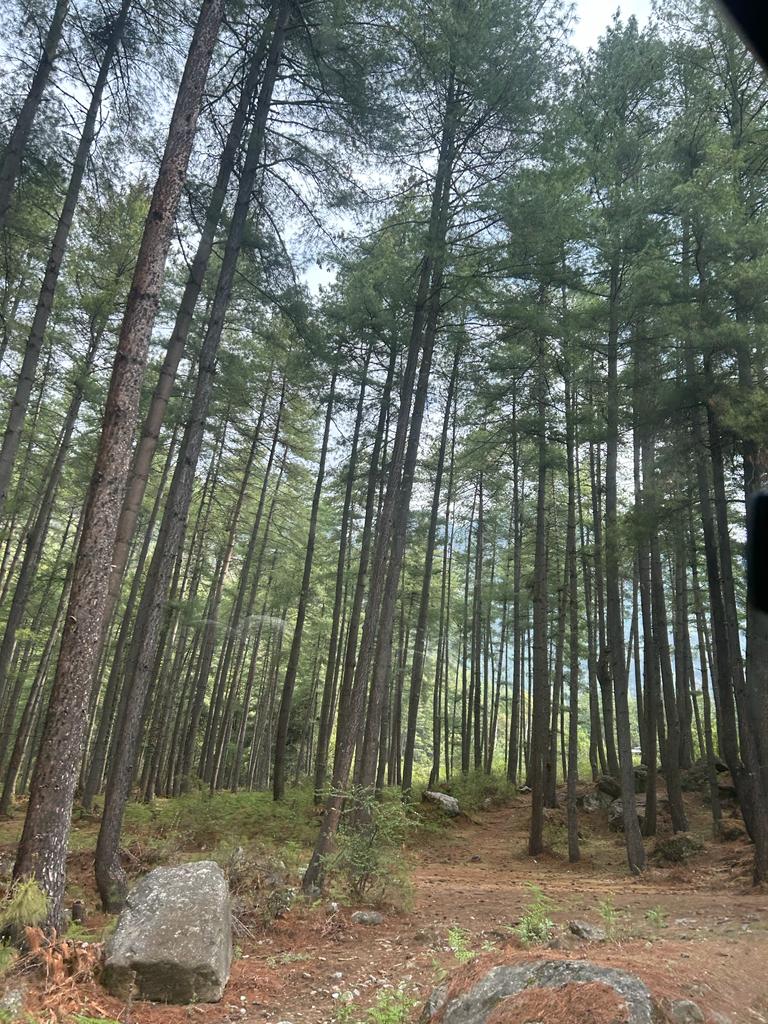
The initial part of the walk was through a forested area with tall trees on either side. At most places the roots had spread out on the floor ….
All set for the hike!!
The initial track
The tall trees and their roots….
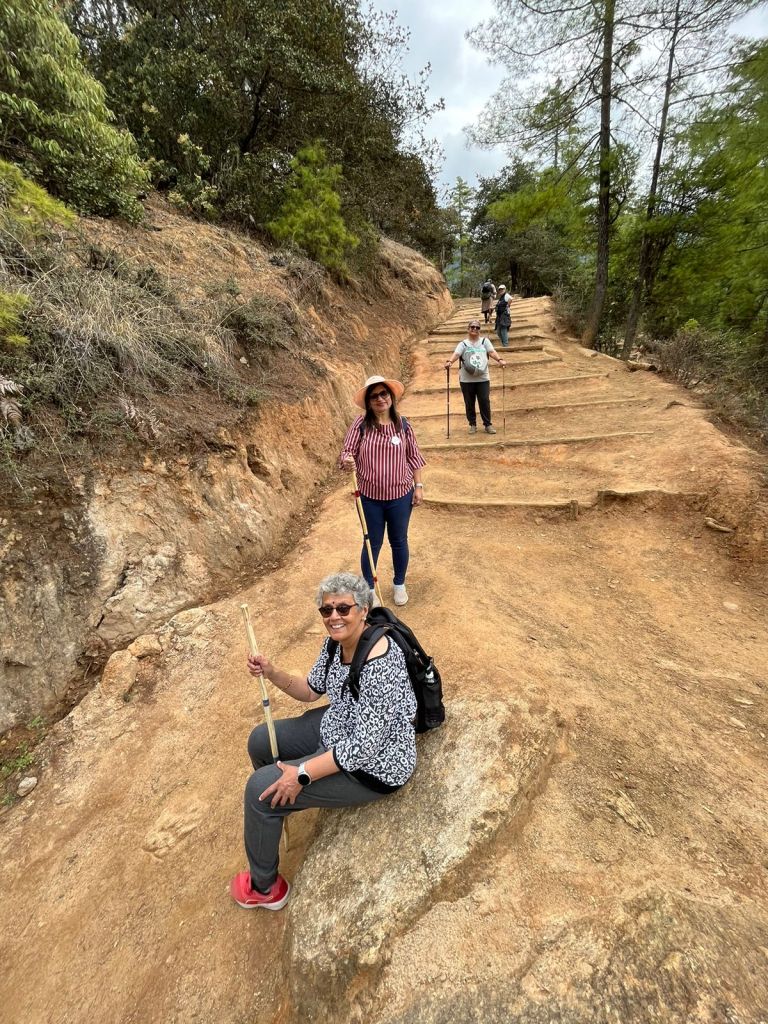
The path is actually a mud road around 10 feet wide with an uphill incline but not very steep.
Winding paths took us around trees and rocks and at one place there was a small stream and a shrine…
A small shrine enroute…
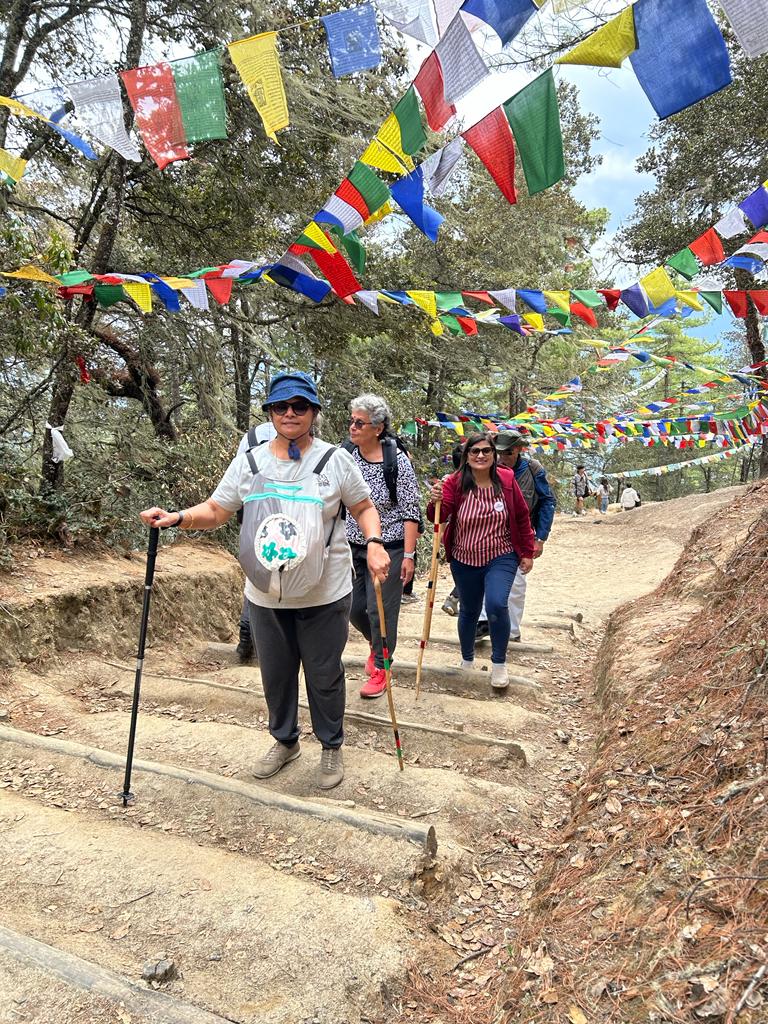
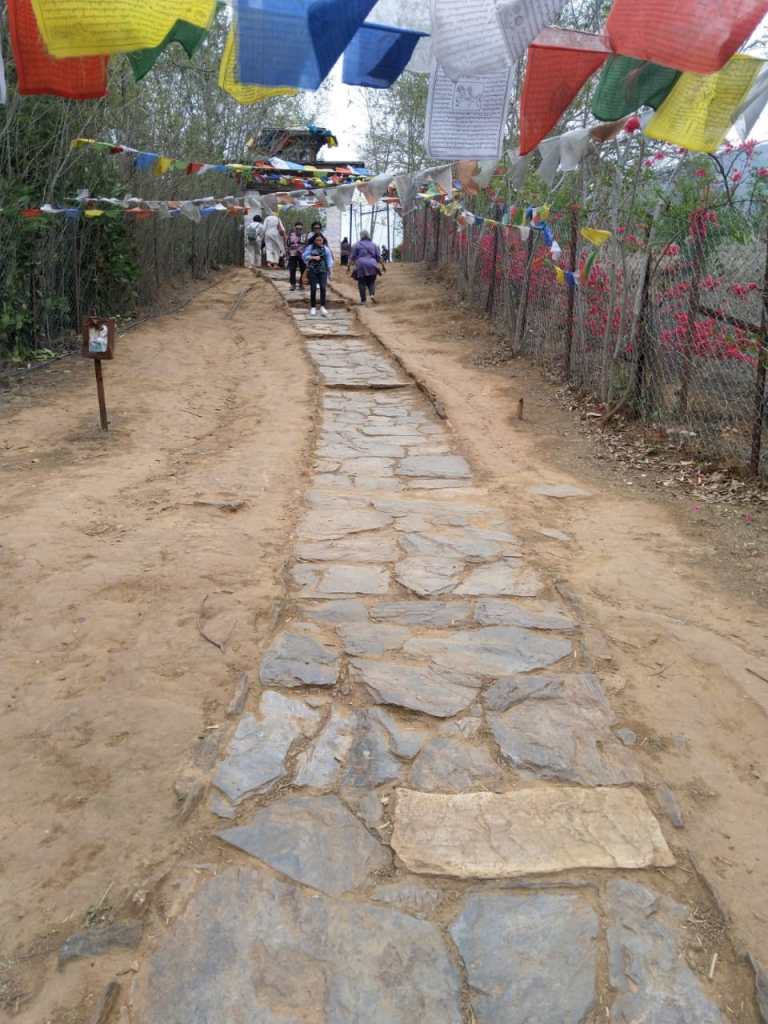
At places there are wooden steps and at places stone steps too and we did not find it very difficult . The company and the walking stick provided the much needed moral and physical support. The colourful prayer flags added to the charm…
The steps and the flags….
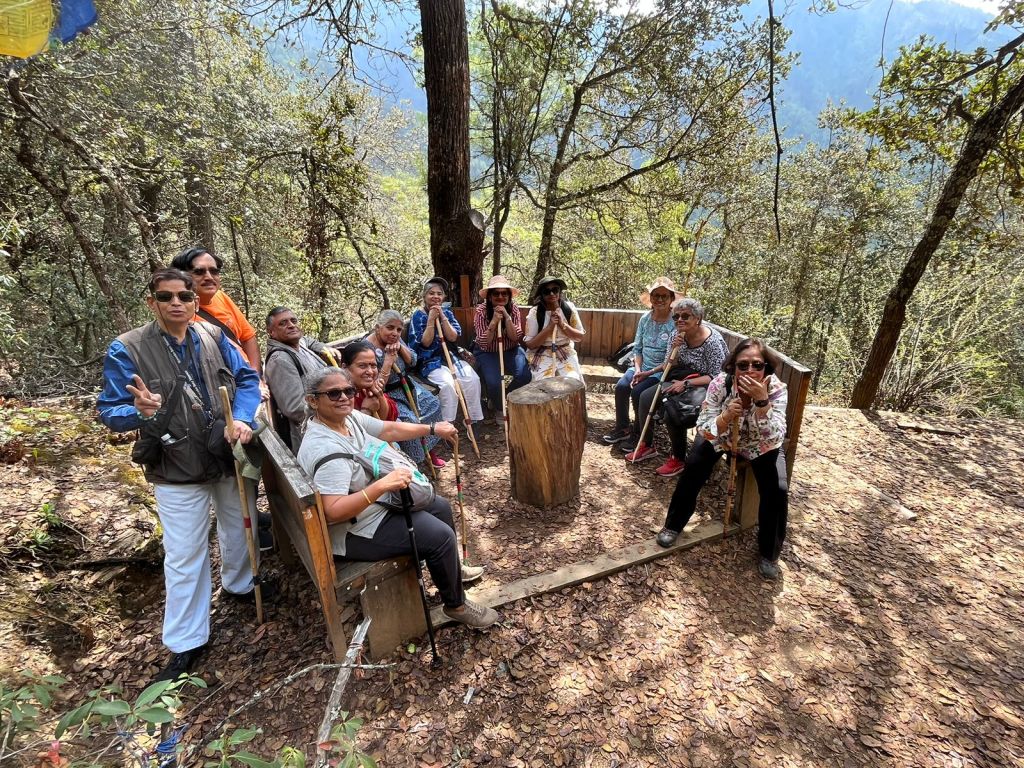
Every now and then there are small resting places strategically built in the shade and we made full use of them…
Taking a breather!!
The Midway Break…
Almost halfway up there is a restaurant where we halted for a short break and some food…
Some rest and food…
Continuing after the break, the path was narrower and there were more stony steps. The views of the valley from above was amazing indeed.
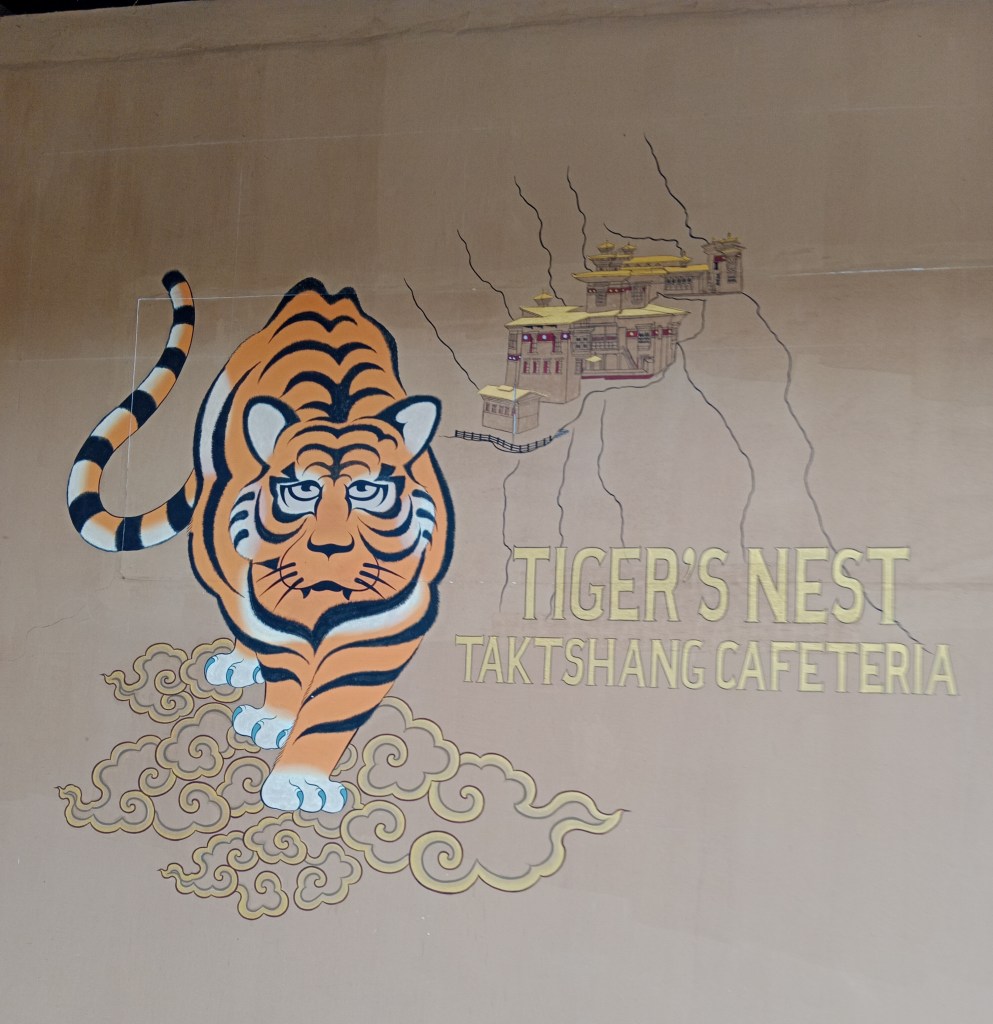
The Paro valley and the Cafetaria seen from above
As we ascended further up, we could see the monastery close up in between the trees.
The foliage parts to show us the monastery…
And finally we reached the view point that gives the best views of the monastery. Some pictures from there….
The hard work was really worth this amazing sight…
One as a memory of this great hike….
After the view point, it is a steep flight of stairs down and again up effectively crossing from one hill slope to the other
The Monastery
The monastery is decorated with Buddhist symbols and the most impressive is that of a tiger in :”The Hall of Thousand Buddhas”.
It is an active monastery today and many monks meditate here.
It was a special day in Bhutan, the death anniversary of Guru Rinpoche and so the monastery was out of bounds for tourists. So we could not enter the actual monastery building.
All along the way, we could see locals climbing up with family and even little children. Most of them greeted us with “Kuzu Zangpo la”, a traditional Bhutanese greetingmeaning Hello ….how are you?
After a short rest, we started our descent down and that was more challenging than the climb. We had to be careful as at many places, it was slippery . Just as on our way up, we rested and took small breaks and enjoyed each other’s company and finally reached the parking lot where the bus awaited us.
Some of us reached our bus a little earlier and rested there for the others to come. The whole trek took around 9 hours with a short lunch break. So we were quite happy just sitting in the bus and resting our backs.
The sheer feeling of having done this challenging climb successfully washed away the tiredness and a feeling of achievement kept us pepped up and happy.
There is just one lesson to learn from this…however tough any task may feel, if your heart tells you to do it….just go ahead and DO IT…..
IF YOU TRY; YOUMAY ACHIEVE ; BUT IF YOU DON’T, YOU NEVER WILL.…..
I leave you with this thought….
See you next week with some more visuals and experiences from Bhutan before we wind up from there. Till then, do keep your comments and feedback coming…
Beautiful Punakha is closely linked with Bhutanese history ; was the old capital of Bhutan and the seat of government till 1955. Located around 72 Kms from Thimpu , it is now the winter capital of Bhutan as it is warmer than Thimpu. Two rivers, Mo Chu and Pho Chu flow through this area making it a very fertile valley suitable for rice farming and Punakha rice is very famous. The Punakha Dzong, one of the most beautiful dzongs in Bhutan is located at the confluence of these two rivers.
A drive from Thimpu to Punakha offers great views of the Himalayas apart from the unique flora and fauna of this region. Dochula pass, which we visited in an earlier episode lies on this route. The area around Punakha is also an excellent birding and wildlife destination as it is home to over 500 species of birds apart from the black bear, panda, leopard and tiger.
The Punakha valley is a fertile region and paddy fields are a common sight here…
Farming activity in Punakha valley
Arriving late evening we checked in to our hotel at Punakha; Hotel Vara. A beautiful hotel located at a slight elevation from the town and overlooking the Mo Chu river, the views of the valley from the hotel were beautiful.
Hotel Vara , Punakha
Next day , after breakfast, we boarded our buses to go around Punakha. Our first halt was at Punakha Dzong about which we have already discussed. After seeing the Dzong, we visited the suspension bridge across the Mo Chu river.
Punakha Suspension Bridge
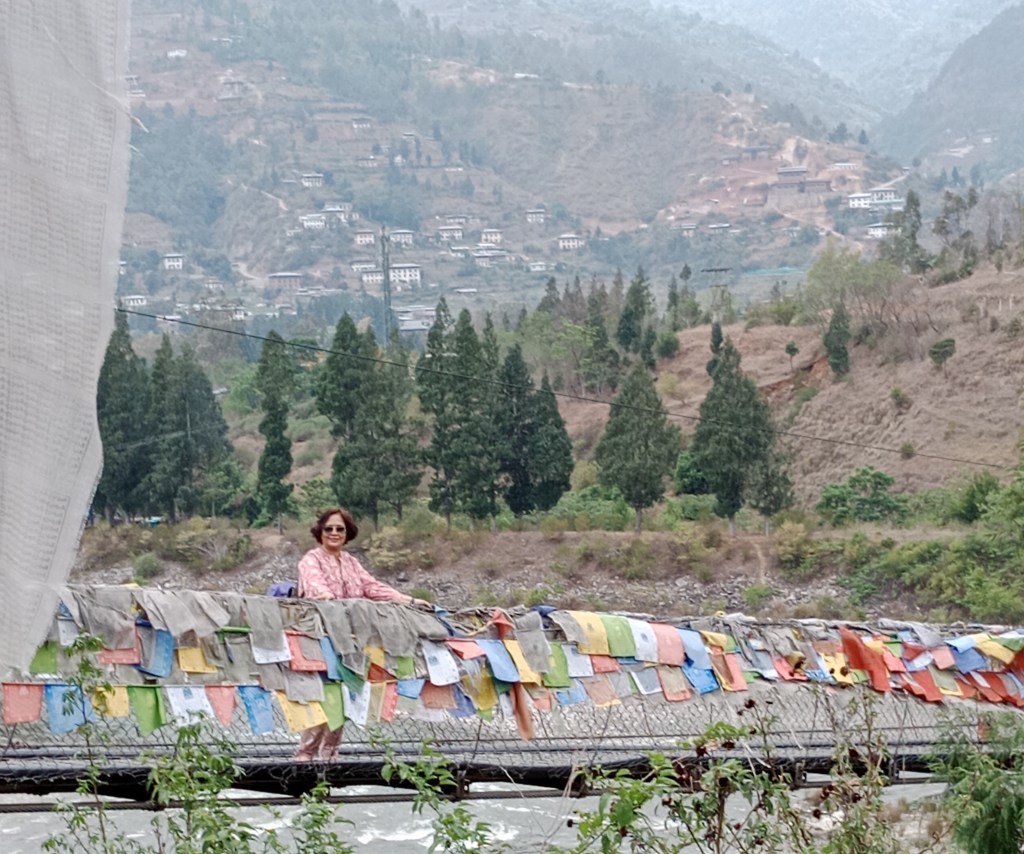
This second longest suspension bridge in Bhutan is about 180 metres in length across the Po Chhu river and connects the two parts of the valley. The bridge is beautifully draped with prayer flags and is a popular photo location. It was built in the 17th century and is anchored by suspension cables which tend to sway in the wind and when we walk on it. The floor is made of wooden planks. Walking across the bridge we reached a small restaurant where we had coffee and rested for a while.
The Suspension bridge from a distance
The coloured flags on the bridge
On the suspension bridge
The restaurant
Riverside Lunch
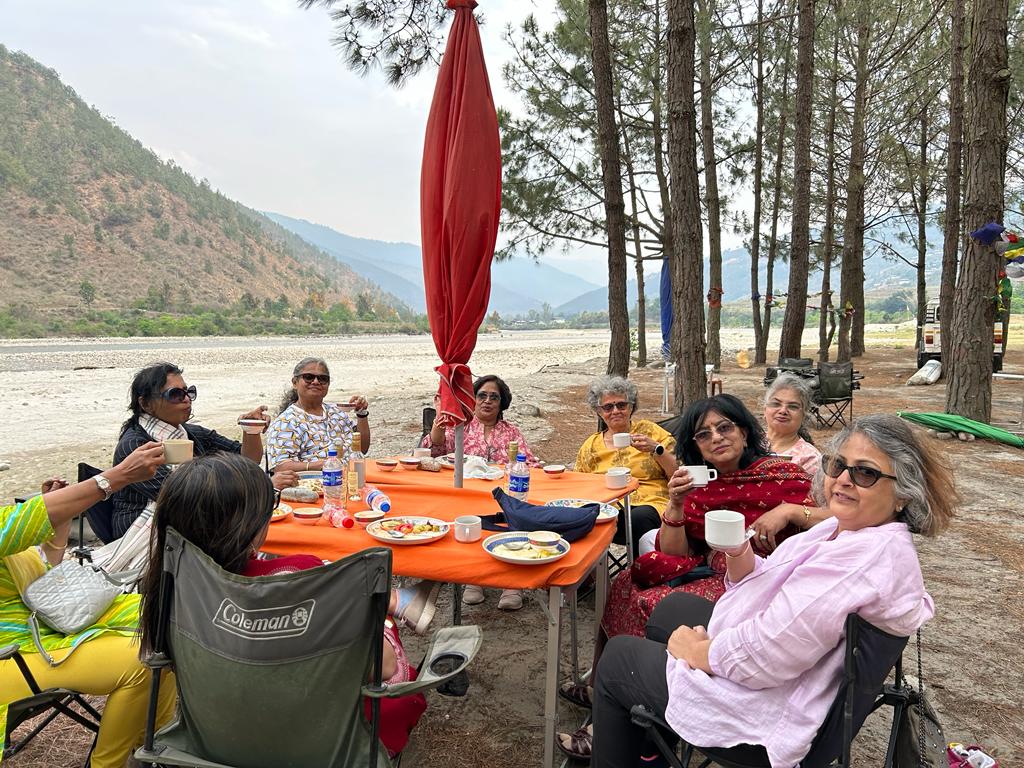
By the time we finished the dzong and the bridge, we were all ready for a nice meal. And what a surprise we had. A riverside lunch was organised . With the sound of the gurgling waters and the gentle breeze blowing in, we really enjoyed the lunch. Some pictures…
An enjoyable riverside lunch…
Post lunch we proceeded to the famous Punakha Nunnery.
Punakha Nunnery
Located on top of a small hillock with beautiful views of the valley, this is a training school for nuns. It also offers life skill training like Thangkha painting ,embroidery and tailoring.
The temple is an example of Bhutanese architecture and design and contains a 14 feet bronze statue of Avalokiteshwara . Statues of Padmasambhava and the Taras are also present apart from the meditation halls. Its unique location makes it visible as one drives into Punakha. Some pictures…
Punakha Nunnery seen from the road as one approaches PunakhaThe Stupa
The main temple
The view from the nunnery with the chortens and the road on the hillside.
River Rafting
Let me now take you through some pictures of a River Rafting session on the Mo Chhu river we had earlier on at Punakha. The rafting was enjoyable and we had a great time. The river was not very rough and we encountered grade two rapids as we rowed along…
The rafts and rafters get ready
Starting off with excitement…
Soon we got used to the rapids
We sang and rowed along….
After the rafting session was over, we all wanted to get back as we were wet and shivering…
What better way to get over this than a warm bonfire?
The bonfire…
A video of the bonfire….
On our last night at Punakha, we had a bonfire at the hotel where we all sang and danced in the warmth of the fire. What an ending to our time at Punakha!!!!
Next we week we are at Paro. See you from Paro, till then, do give me your feedback and comments.
Moving away from Thimpu, our next destination was Punakha. This beautiful and quaint town did really jolt us with its unique and strange practices. Before I get to the practices, let me brief you about the man behind it…Drukpa Kunley ( popularly known as the Divine Madman) the revered saint of the Bhutanese.
Some of the pictures posted below may appear kinky and unconventional . But to explain Punakha ‘s tryst with the phallus and fertility, it is unavoidable…..
The Divine Madman
The Tibetan monk Lama Drukpa Kunley is known here as the divine madman. And this is not without reason. He had rather unconventional and unorthodox ways of teaching Buddhism , often relayed with sexual connotations. He questioned the preconceived ideas of society particularly its hypocrisies. The monastic community was his chief target. His use of the Phallus to subdue demons and enlighten humans was rather bizarre and his phallus was considered so powerful that it was dubbed the “Thunderbolt of Flaming Wisdom.”
“Wine and women are my meditation”….he declared and wrote blasphemous poetry which shocked the regular clergy. He proclaimed that celibacy was not a necessity to the path of enlightenment. He got himself lot of followers particularly women and earned the nickname “Saint of 5000 Women”.
The phallus is considered a symbol of fertility and good luck andeven today, his influence looms large in the form of giant phalluses painted on walls of houses. He is perhaps the only saint in the world exclusively identified with the phallus.
These pictures and models of giant phalluses seen everywhere will seem a little strange to the first time visitor as it did to us.
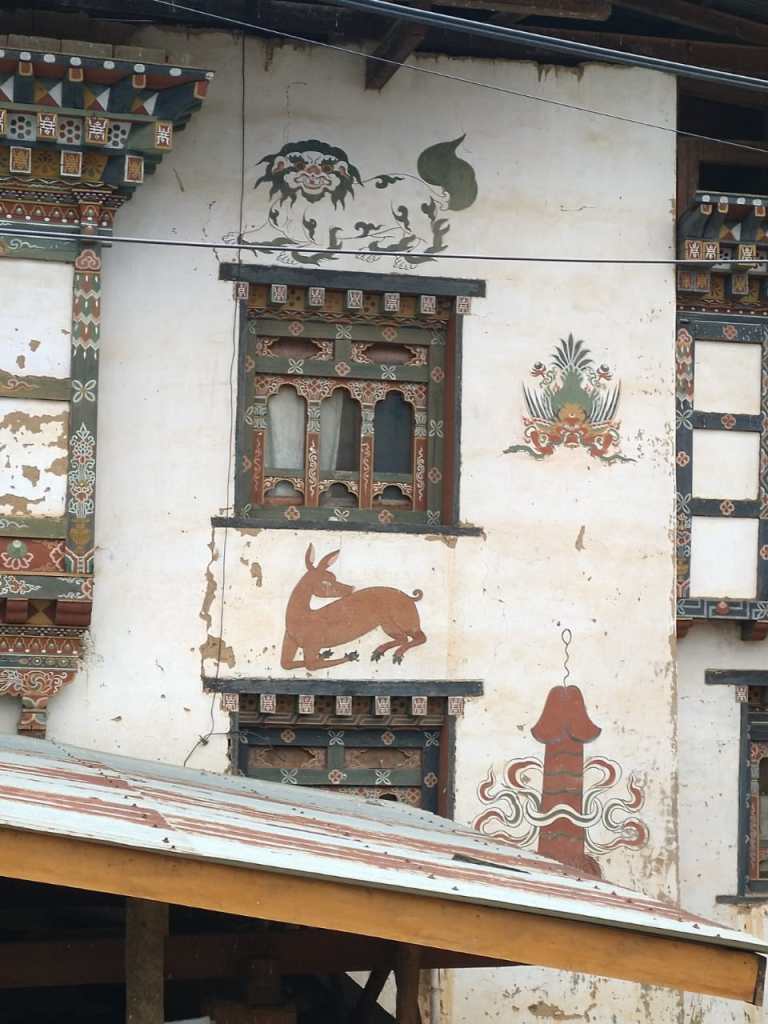
Pictures of animals and chortens painted on the walls are a common site everywhere in Bhutan. But when you reach Punakha, the story is different …..
In such a conventional Buddhist country, this practice seems unbelievable indeed!
Have a look at this strange practice….
Pictures on walls found elsewhere in Bhutan
Phallus paintings so typical of Punakha
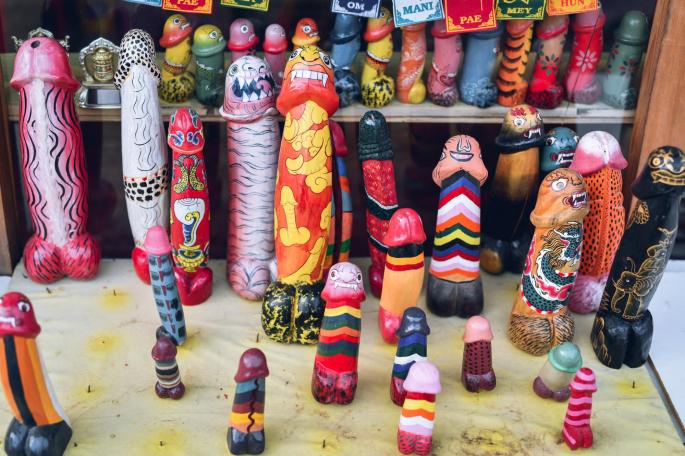
Not only these pictures, you will find phallus models everywhere, from the roof tops to entrances and they form an important gift item and souvenir from here. Phallic art is so inherent to the people of the region and not considered quirky here. In fact, these souvenirs are believed to bring good luck.
Phallic art souvenirs displayed in shops around Punakha.
Punakha is inseparably associated with the word ” Fertility”. On one side ,it is a rather fertile valley with lot of farming around and on the other, it is has associations with human fertility too….
The famous fertility temple known as Chime Lhakhang is located here and infertile couples visit this temple and are believed to have been blessed with off spring…
Chime Lhakhang
This fertility temple is located on a small hillock at Punakha. A small climb will take us to this unique temple.
This temple was built in memory of The Divine Madman and the locals believe that there was a demon who created trouble for the locals and converted himself into a dog to avoid the wrath of the Divine Madman. But he subdued the dog with his phallus and buried it at the site of the black chorten seen at the entrance to the temple.
This temple is visited by devotees from all over the world who seek fertility blessings . After seeking the blessings and offering prayers, the lady is expected to circum ambulate the temple with the phallus model. The temple in fact has an album of pictures with couples who are believed to have benefited from the divine intervention.
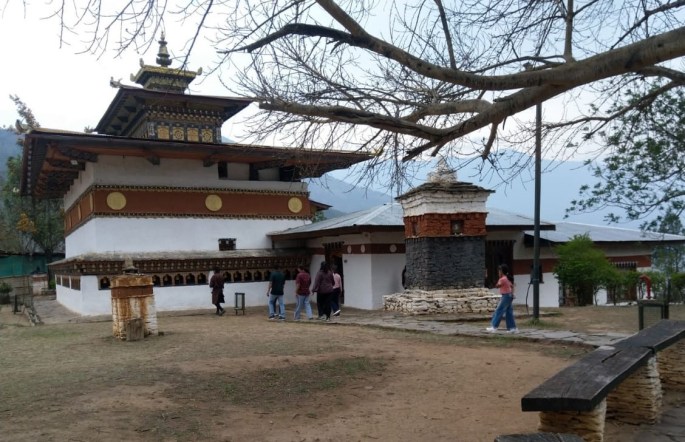
The temple itself is not as grandiose as many of the temples in Bhutan and appears rather simple. Some pictures….
The short path up the hillock and the board explaining the legend of the temple
The unusual black chorten at the entrance associated with the dog demon
A huge prayer wheel at the entrance and many small wheels around the temple
The main temple
A large peepal tree adorns the courtyard with small seats for devotees to rest.
Resting in the courtyard and view of Punakha from the hillock
Photography is prohibited within the temple and images of the deity cannot be shown. There is a statue of Guru Padmasambhava with a reclining statue of Drukpa Kunley beside it.
A 10 inch phallus model made of wood and ivory is kept here near the altar and we were all blessed by the priest with a tap on the head with it.
After some pictures in the courtyard, we proceeded back to the bus to continue our tour of Punakha. See you next week with more pictures and stories from Punakha. Till then, do continue to give your feedback and comments.
Dochu La is colloquially Dochu pass ( La means pass in Dzongkha language). It is a pass in the snow covered Himalayas that lies in Bhutan on the road from Thimpu to Punakha.
The most iconic image of this pass is the 108 Chortens or Stupas built here. We made a stop here on our drive from Thimpu to Punakha . Come along; let me take you through some interesting facts and images of this Eastern Himalayan pass…
The pass is located at an altitude of 10300 feet above sea level on the Thimpu Punakha highway. Due to this altitude, the temperature here hovers around 10 to 12 degrees Celsius. On a clear day, one can get a full 360 degree view of the snow clad Himalayan peaks from here. But very often the place tends to get foggy and hazy hampering the view. Coniferous trees on the hill slopes adds to the natural beauty of the place. Coloured flags that are important to the Buddhists also dot the area. The area has plenty of Rhododenron trees and when they bloom in March, they provide a colourful spectacle.
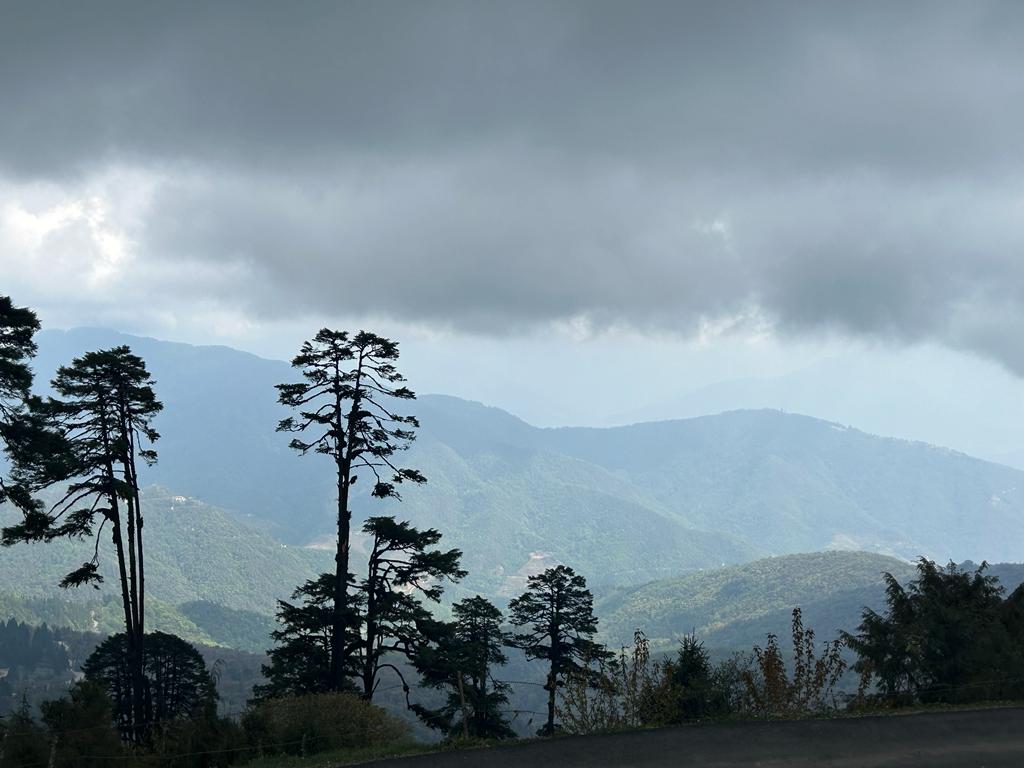
The whole atmosphere here is calm and peaceful with pines covered with mist and fog and occasional patches where one can see beyond the fog. Have a look…
The views of the Himalayas from Dochula Pass
The board that helps identify the peaks on a sunny day
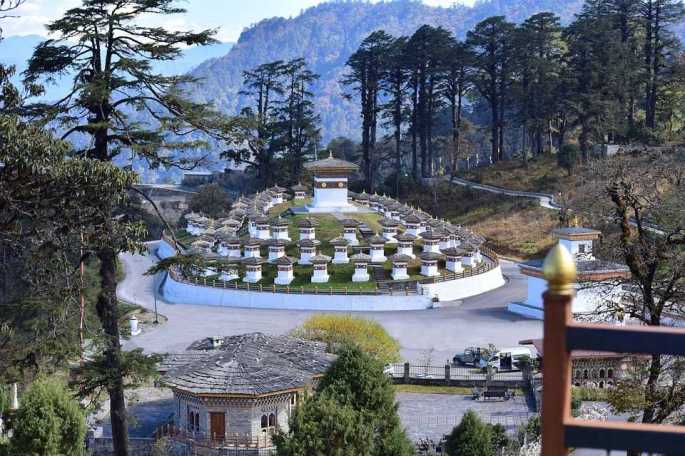
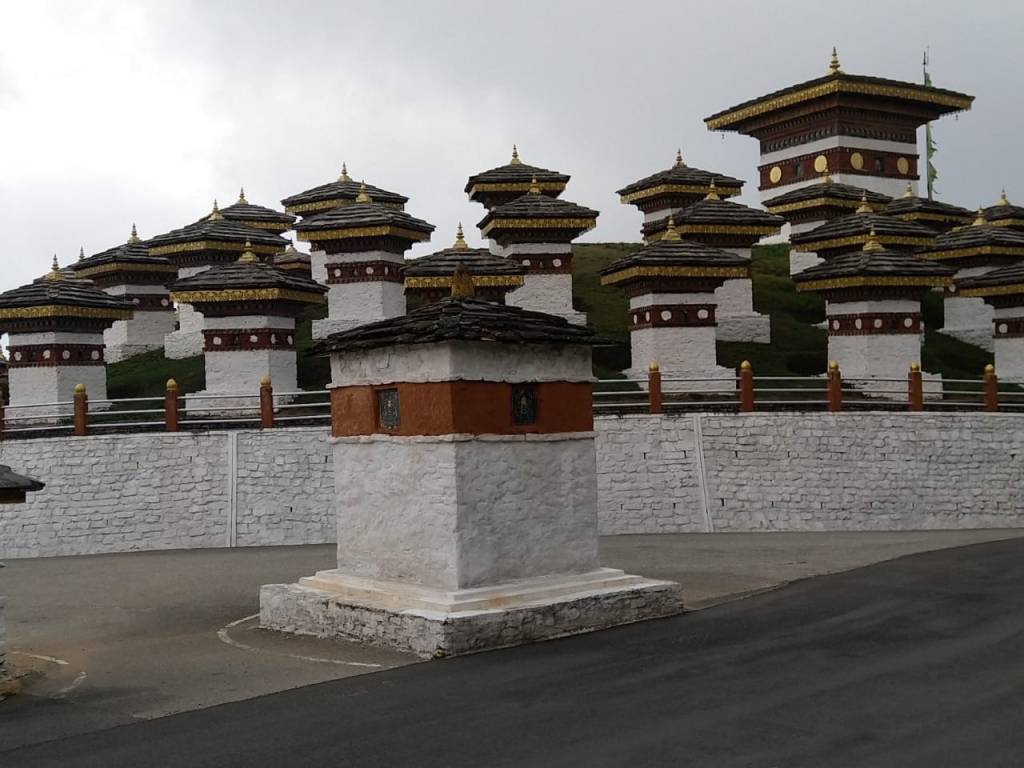
The most striking structure here is the 108 Druk Wangyal Chortens.
The Chortens
Chortens are important monuments or shrines in Bhutanese culture and are also called Stupas. Typically, they are tombs of saints. At Dochula Pass there are 108 such Chortens built in memory of the soldiers who lost their life fighting Assamese insurgents from India in 2003. After the Bhutanese were successful in defeating the insurgents, the Queen mother ordered the building of these Chortens .
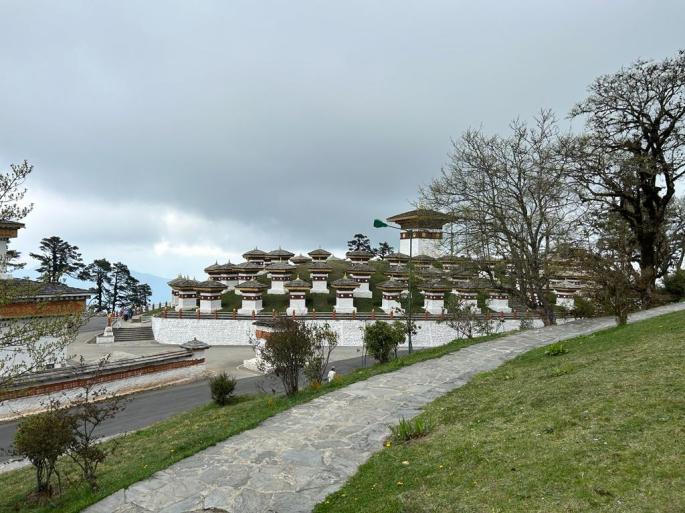
A panoramic view of the chortens at Dochula pass.
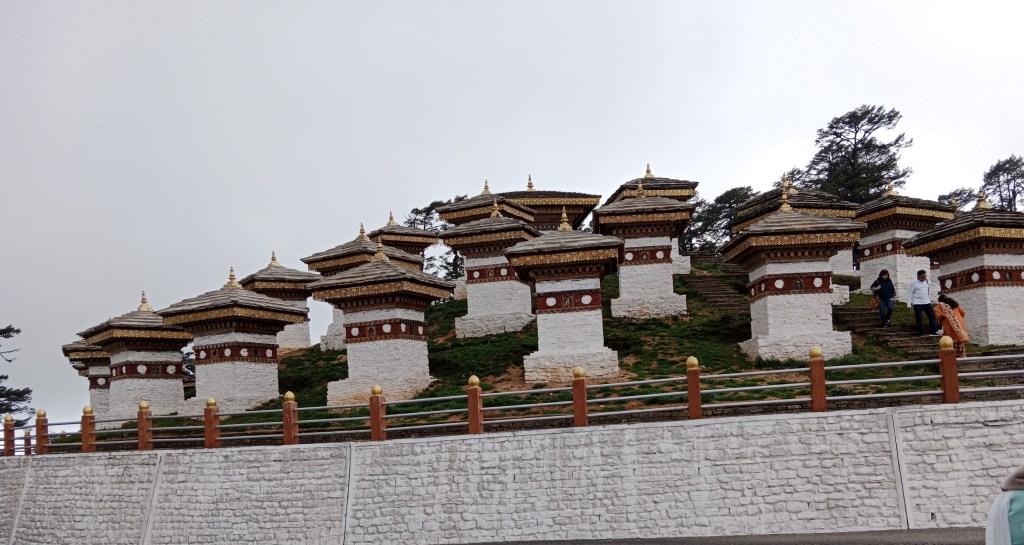
Here the Chortens have been built in three layers around a main Chorten. The first layer has 45 chortens, second has 36 and the topmost has 27; all built around the main structure. A glance at the Chortens does not reveal the strict religious processes that have gone into building them. They have been built in accordance with astrological beliefs.
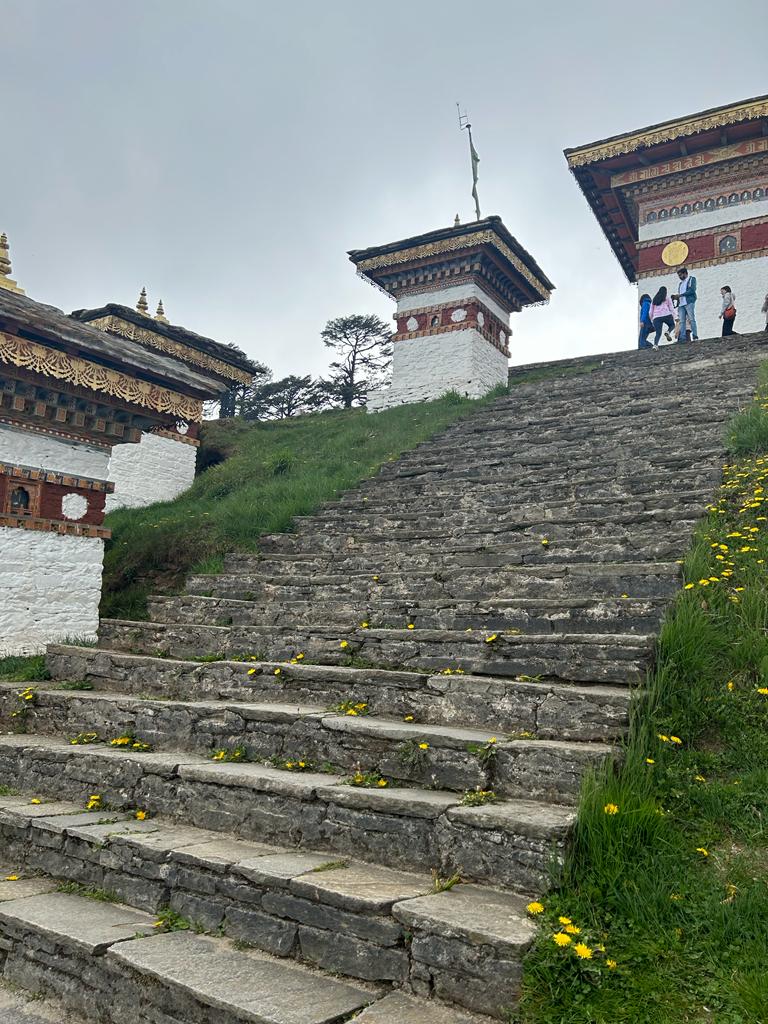
The 108 chortens built in 3 layers
A flight of stairs takes us to the top where the main chorten is located
At the main Chorten
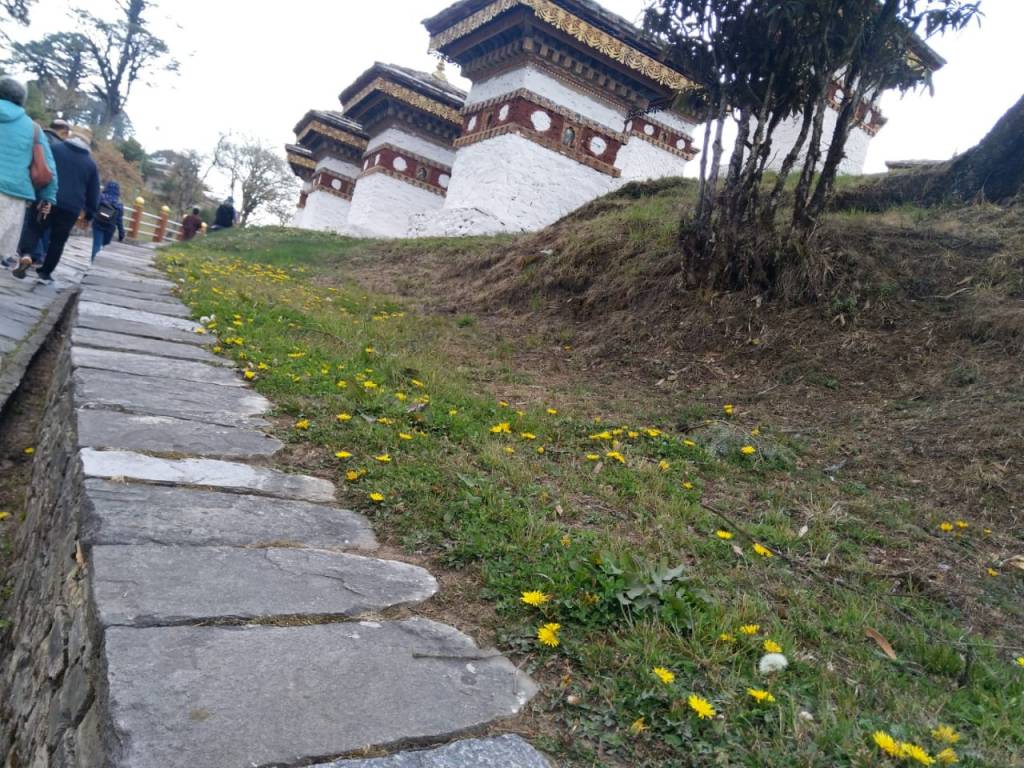
A nice paved walking track takes us around the chortens
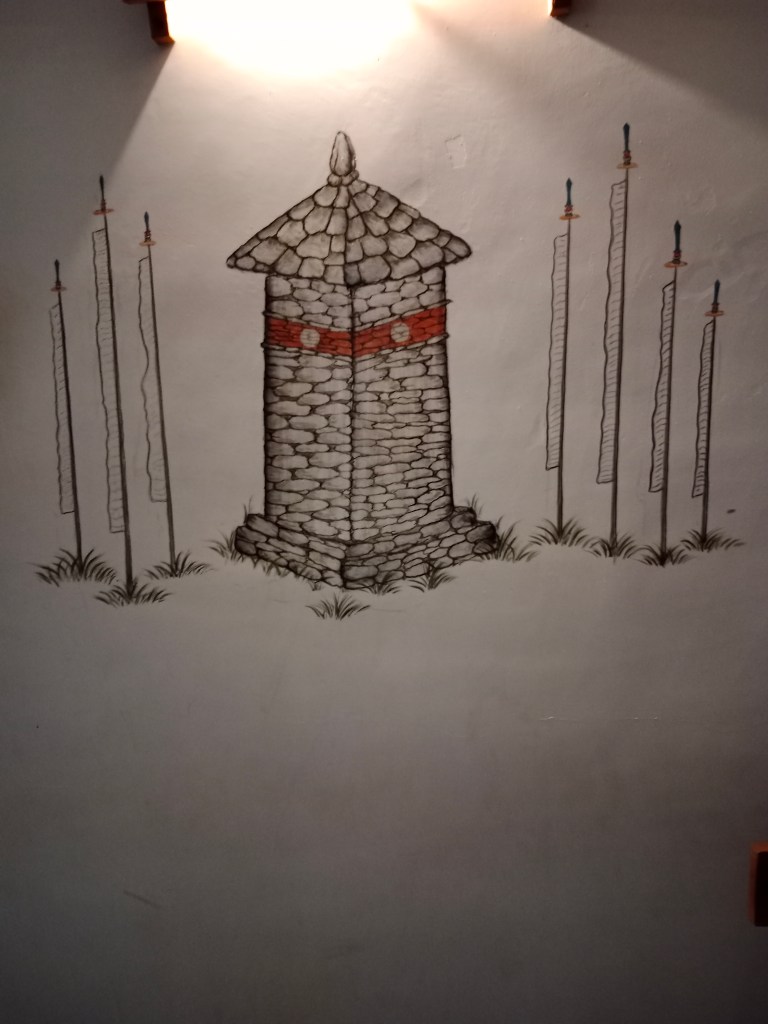
Each chorten has a “Sokshing” which is a square wooden pole carved from juniper trees, has been painted bright red and is installed on an auspicious day to the accompaniment of sacred hymns.
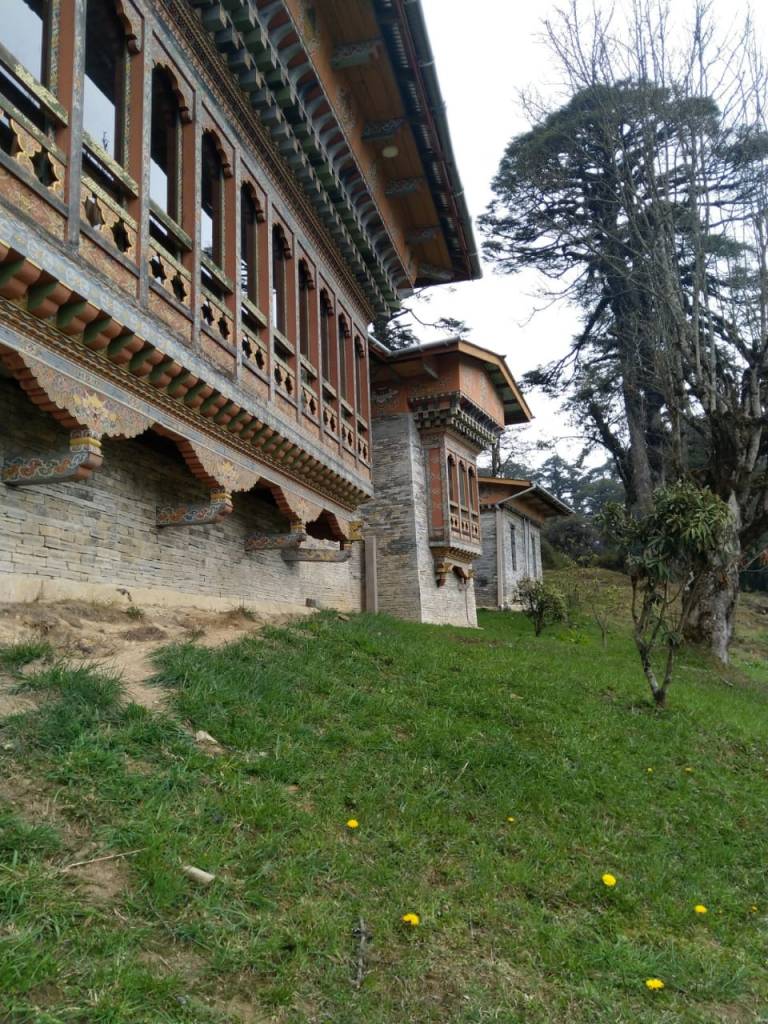
In addition to the Chortens, there is a temple here called the Druk Wangyal Lhakhang.
Druk Wangyal Lhakhang
Built in memory of the fourth king of Bhutan, is an important place of worship for the locals. It was completed in time for the commemoration of hundred years of of monarchy in Bhutan. The walls of this temple are adorned with traditional paintings relating to Bhutanese history. The courtyard of the temple is the venue of the famous Bhutanese festival in December performed by the Bhutan Army.
The Druk Wangyal Lhakhang
The beautifully decorated walls of the Lhakhang
Royal Botanical Park
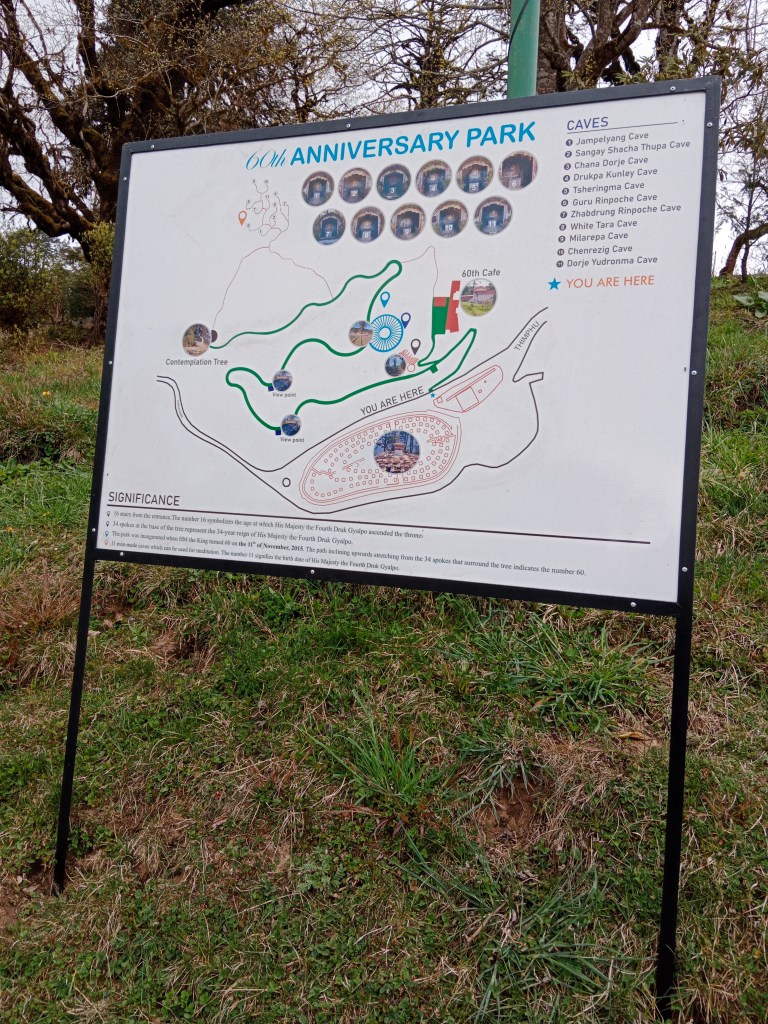
Adjacent to the Chortens is a park that is home to many varieties of Rhododendron. In late February and early March, the Rhododendrons bloom and add colour to the place.
The direction board at the Park
Cafe
There is a cosy café near the Dochula pass and with it’s glass windows provides beautiful views of the Himalayas.
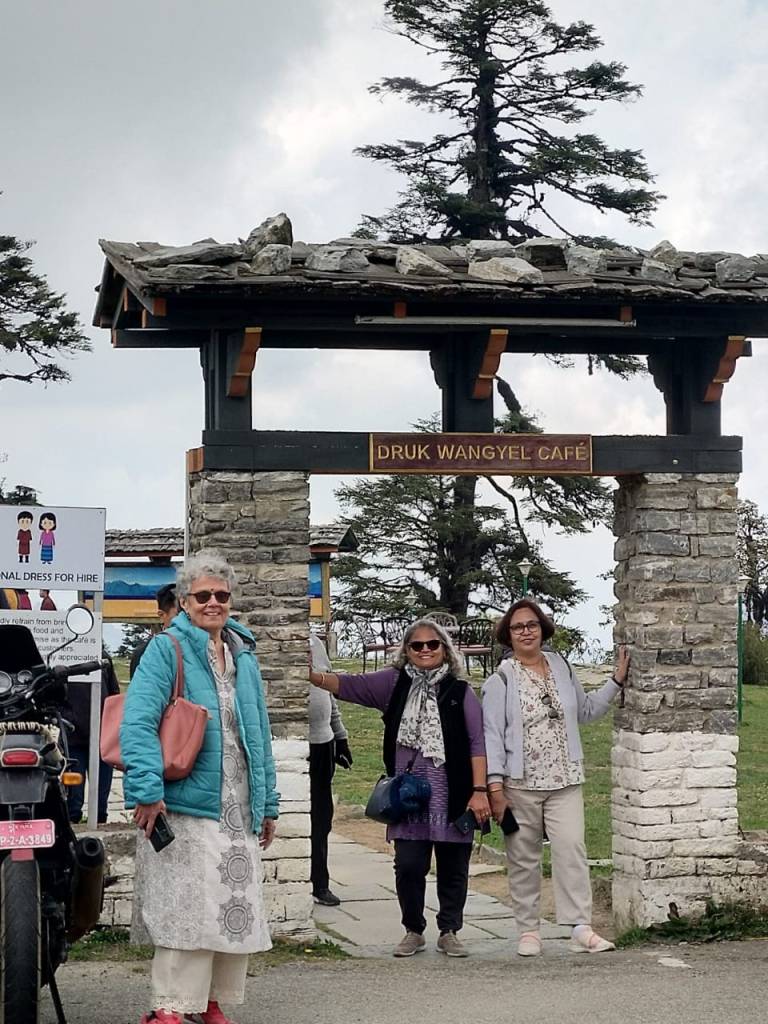
The café entrance
Our group enjoying coffee and hot chocolate at the cafe
Remnants of Rhododendron blooms
We visited Dochula pass two times and the second time it was much more foggy and misty than the first time…
The mist at the pass on our second visit
After the halt at Dochula we proceeded on our way to Punakha. Punakha is yet another interesting place in Bhutan, closely associated with the strange legends of “The Divine Madman”.
See you next week at Punakha. Till then do give your comments and feedback.
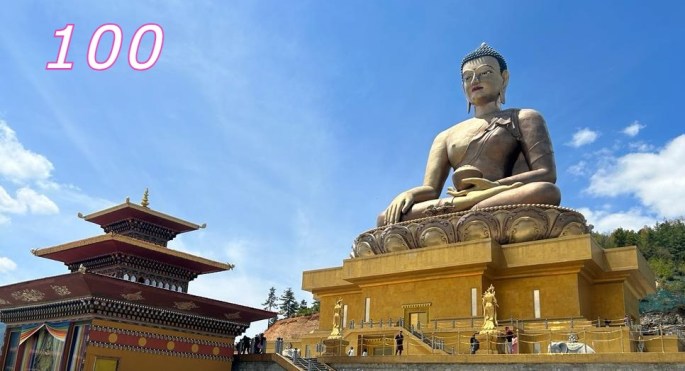
Let me start this blog with a big thankyou to each and every one of you who have accompanied me on this journey to this milestone….my 100th blog…
Celebrating a milestone…..
Starting with Thimpu……
A new day dawned on Thimpu and the visuals from our hotel window were very beautiful….Enjoying a cup of tea sitting by the window, we clicked this picture…
Day dawns on Thimpu
Excited and looking forward to a great day ahead, we had breakfast and met up with our group in the hotel lobby.
Outside our Hotel Osel with typical Bhutanese decor at the entrance
Soon we were on our way to do the sightseeing around Thimpu city.
Our first halt was at Memorial Chorten.
Memorial Chorten
Built in honour of the third king of Bhutan, this Stupa is a prominent landmark in Thimpu with its golden spires and bells. Most Buddhist Stupas contain human remains but this Stupa stands out in that it does not contain any human remains and only has a photo of the third king in ceremonial dress adorning the hall. It had been the wish of the king to build a stupa “like the mind of Buddha” but he passed away before achieving it and so it was built by his mother in his memory in 1974.
As one enters the complex, there are large prayer wheels and a shrine with copper lamps being lit by devotees.
The prayer wheel and the copper lamps at Memorial Chorten complex
As one walks past , the central walkway leads to the main Stupa or Chorten built in Tibetan style. The large white exterior has a golden spire on top and a smaller golden spires on the porches in all directions.
Main Stupa
The intricate decorations and the Buddha statue on the second floor seen from outside
The chorten is decorated with richly carved annexes facing the four directions and contains mandalas, statues and a shrine dedicated to the third king. A staircase from the ground floor leads to two floors each with four shrines. There are multiple statues of wrathful looking protective deities.
Locals come here to offer prayers and everyone has to remove their footwear and caps . Photography is prohibited inside the Stupa.
From Memorial Chorten, we proceeded to another of Thimpu’s landmarks…
Buddha Dordenma
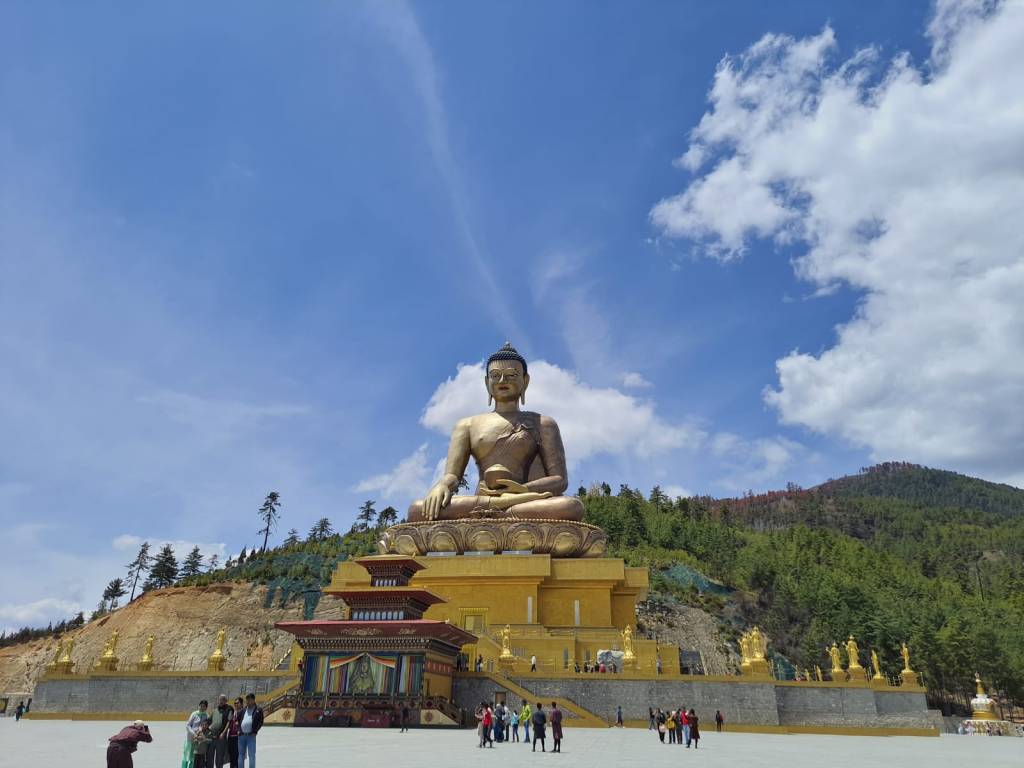
This gigantic statue of Sakhyamuni Buddha on a hill is iconic of Thimpu and can be seen from far away . It is one of the largest sitting Buddha statues in the world at 169 feet height. It was completed in 2015 and took nine years for completion. It is made of bronze and gilded with gold . The statue faces the East and is believed to bring peace and prosperity to the people.
The statue was built with private funding from the Buddhist community in China, Singapore, Thailand and many such countries. It had been prophesied in one of the sacred texts that a statue of Buddha or the Unifier will be built in this place which was the site of the palace of the 13th Desi of Bhutan.
The gigantic statue seen from below the hillock
It was built to commemorate the 60th anniversary of the fourth king of Bhutan.
The decorative gate and the statues in the courtyard of the Buddha Dordenma complex.
A panoramic view of the Complex
As one enters the complex below where the statue is located, there is a huge hall with multiple golden coloured pillars. All along the walls are replicas of the giant Buddha of various sizes and in golden colour. There are 125000 such Buddha statues which are replicas of the giant statue inside glass showcases along the walls .
The walls have beautiful murals of Buddha, Zabdrung Rinpoche and Padmasambhava…the three most revered images in Bhutan. A crystal pillar and various offerings given by devotees is spread before the altar.
The main statue.
One of the many statues and a Stupa in the courtyard
The snow clad Himalayan peaks as seen from the courtyard
Our group at the Buddha Dordenma Complex
Our next destination was the Royal Takin Preserve.
Royal Takin Preserve
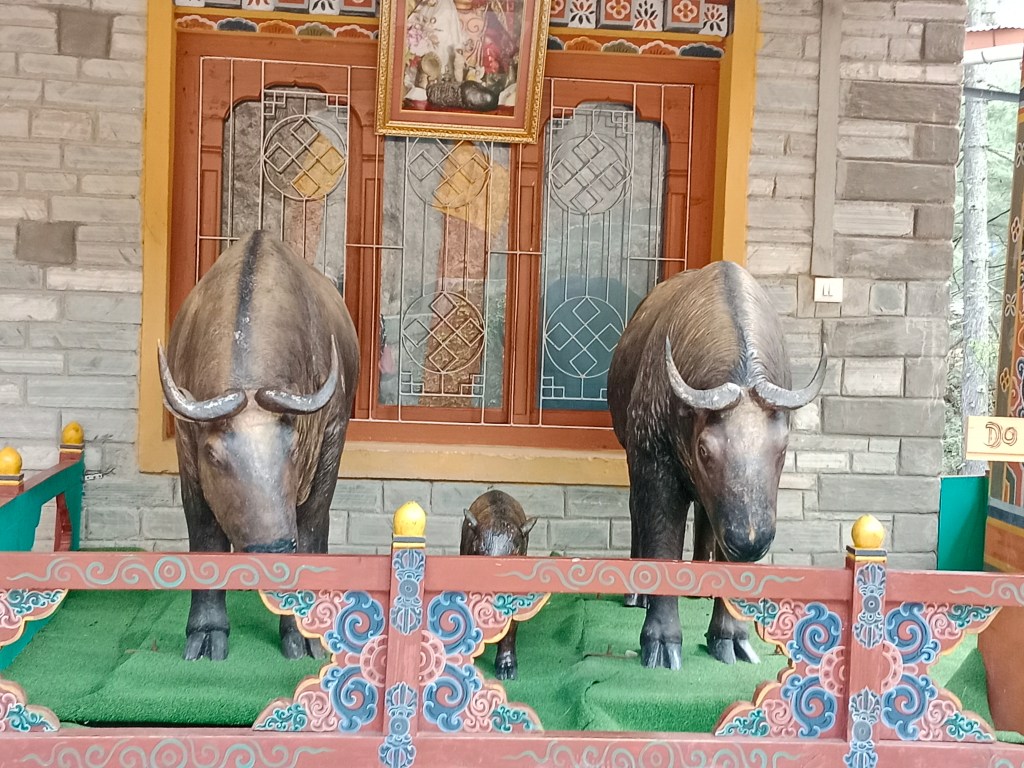
This is a wildlife reserve created to preserve the Takin which is the national animal of Bhutan. Takin is a rare and unique animal and is supposed to be a mosaic of the goat and the antelope.
The reserve is meant for the animals to roam around freely in natural surroundings unlike in the confined areas of a zoo. It is located in a forested area spanning more than 8 acres and has wild boar, sambar, barking deer, musk deer and other animals besides the Takin.
There is an interesting legend on how the Takin was created but it’s correctness is doubtful. A Tibetan monk known popularly as “The Divine Madman”( about whom we will discuss in further episodes) with tantric powers is supposed to have created the Takin by fixing the head of a goat to the body of a cow.
A short hike up a garden path leads to the animal viewing area. Some pictures…
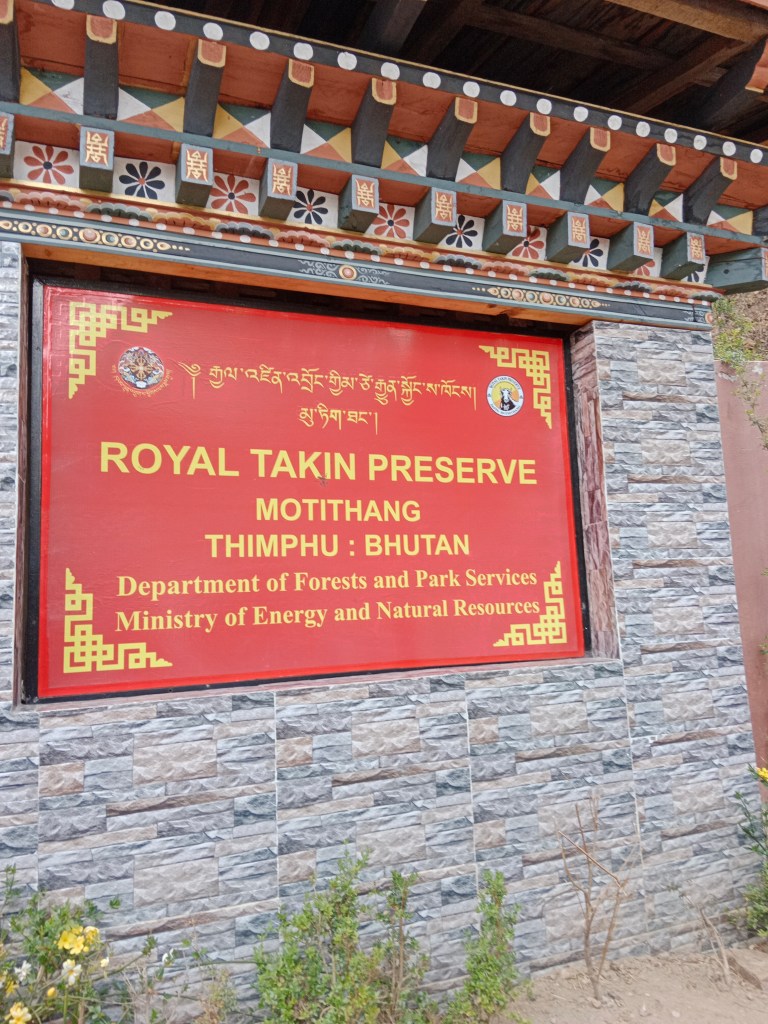
The entrance to the Preservewith models of the Takin
The preserve forest and the trek to the animal viewing area
Animals relax in natural surroundings
The Takin
Bhutan Post Office and Museum
By now we were all famished and so we had lunch at a restaurant at Thimpu and proceeded to the Bhutan Post Office and Museum.
This place functions as a post office and has a museum depicting old stamps and postal articles. A documentary on old postal services is also played out here.
This post office is unique as it allows us to create a stamp with our desired image and use it as a functioning postage stamp for a fee.
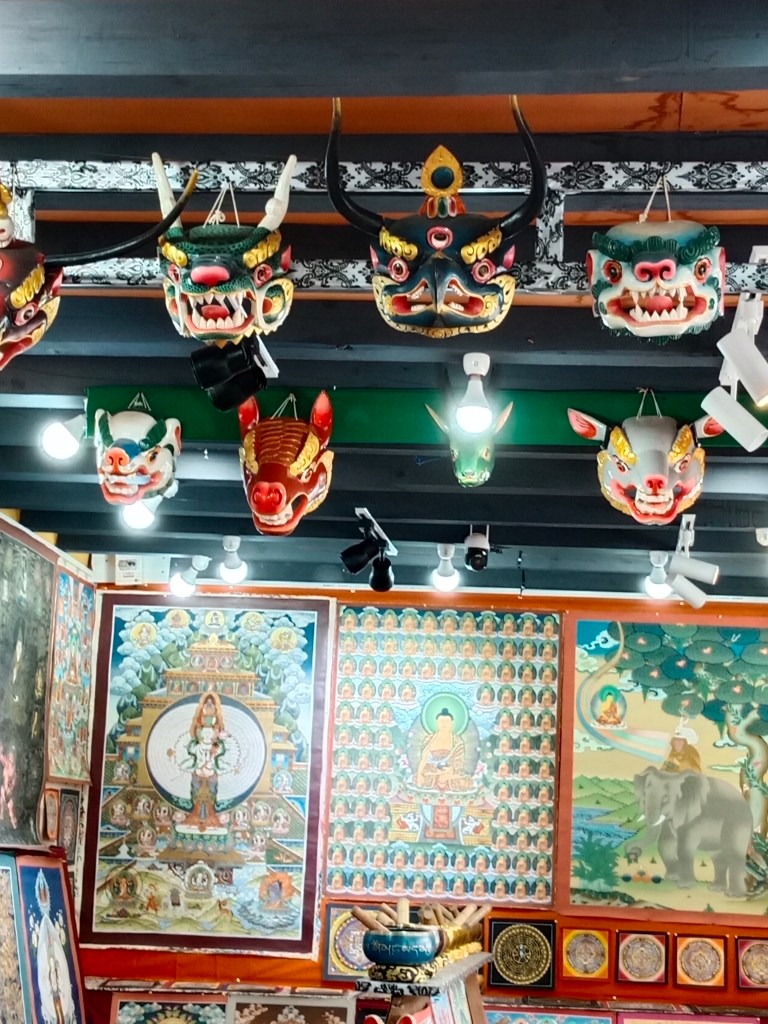
Various gift articles and souvenirs are for sale here as are the famous Bhutanese Thanghkha paintings.
Some pictures…
Souvenirs and masks at the postal museum
Typical Bhutanese Thanghkha Paintings
Changangkha Lhakhang
An ancient temple built in the 12th century, located on a ridge in the city, offers great views of Thimpu city from above.
A short trek up to the ridge brings us to the temple courtyard where there are several prayer wheels. Inside the temple is a statue of Avalokiteswara with 11 heads, 1000 hands and eyes. The eyes are located on the palms of the hand. Avalokiteshwara is a lord of compassion and he/she has 11 heads as he has to think of the welfare of all his disciples and thousand hands to help all the people around….so goes the legend. It was built by a Tibetan monk who came to spread Buddhism in the Himalayas.
This temple is frequented by parents with small children who seek the blessings of the lord for health and happiness of the child. Childless couples also visit the temple to be blessed with a child. Children are brought here for naming by the monk too.
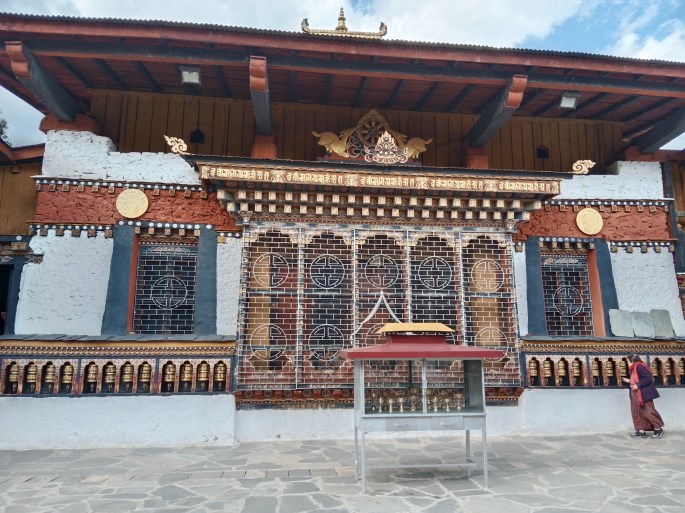
The Changangkha Lhakhang Temple
The flags and views of Thimpu city
Clock tower
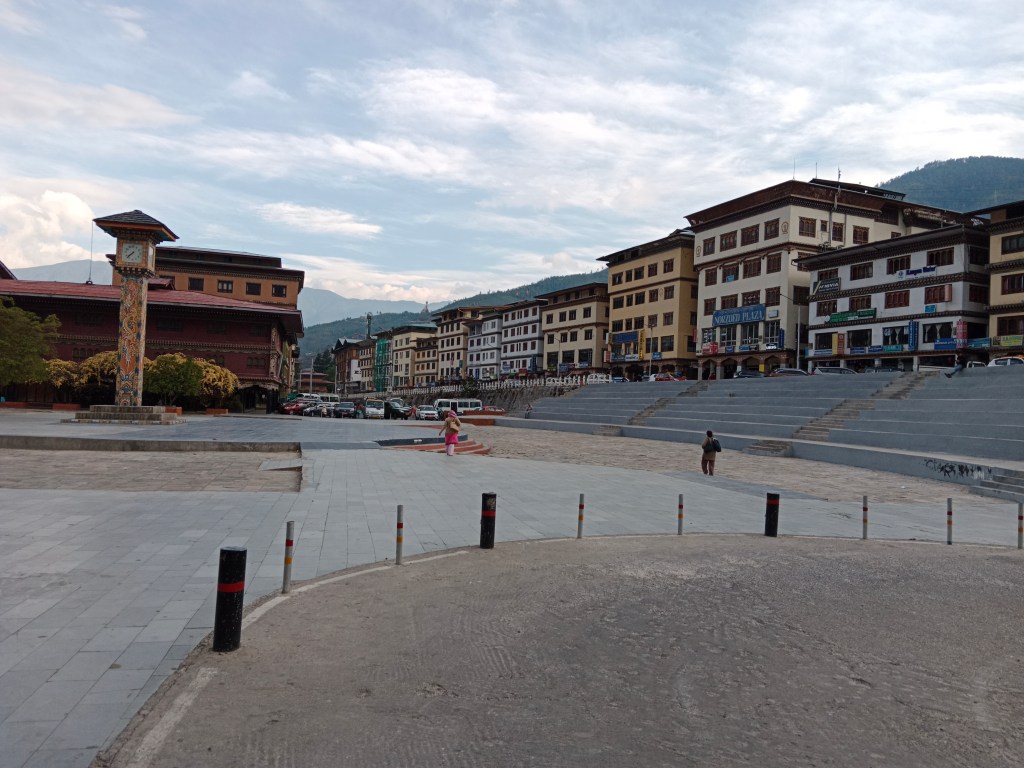
A central square with a clock tower forms the main shopping area in Thimpu. The square is surrounded by buildings with a variety of shops. Flower boughs create a nice ambience here. The sides have seating arrangement like in a stadium as important events are often held in the central square
The central Square and Clock Tower(note how clean it is)
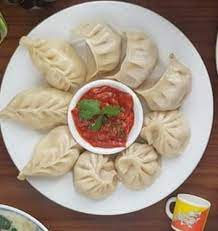
After some shopping here, we had tea and Momos at a restaurant near the central square.
The Flower boughs and the momos
Handmade Paper Factory
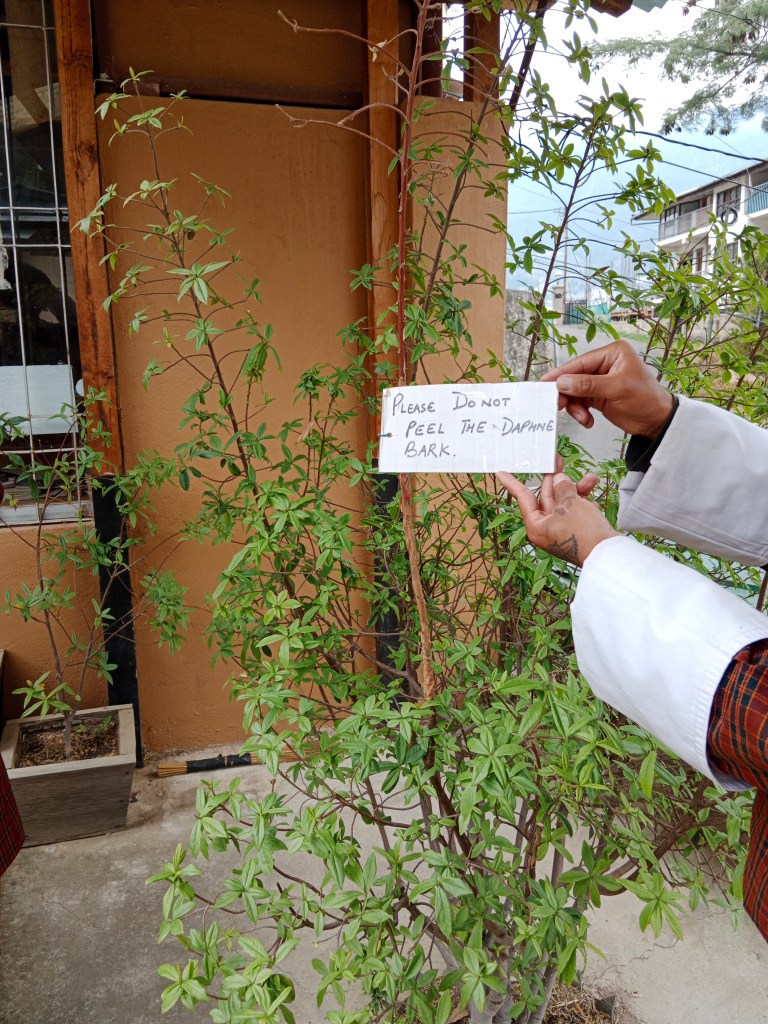
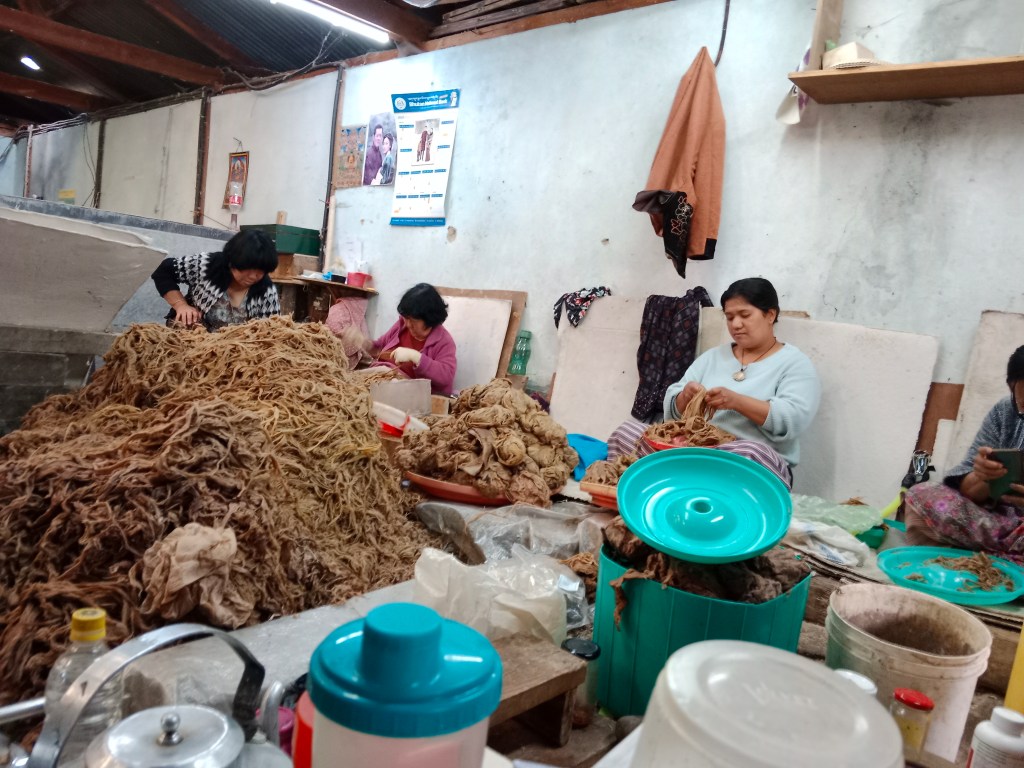
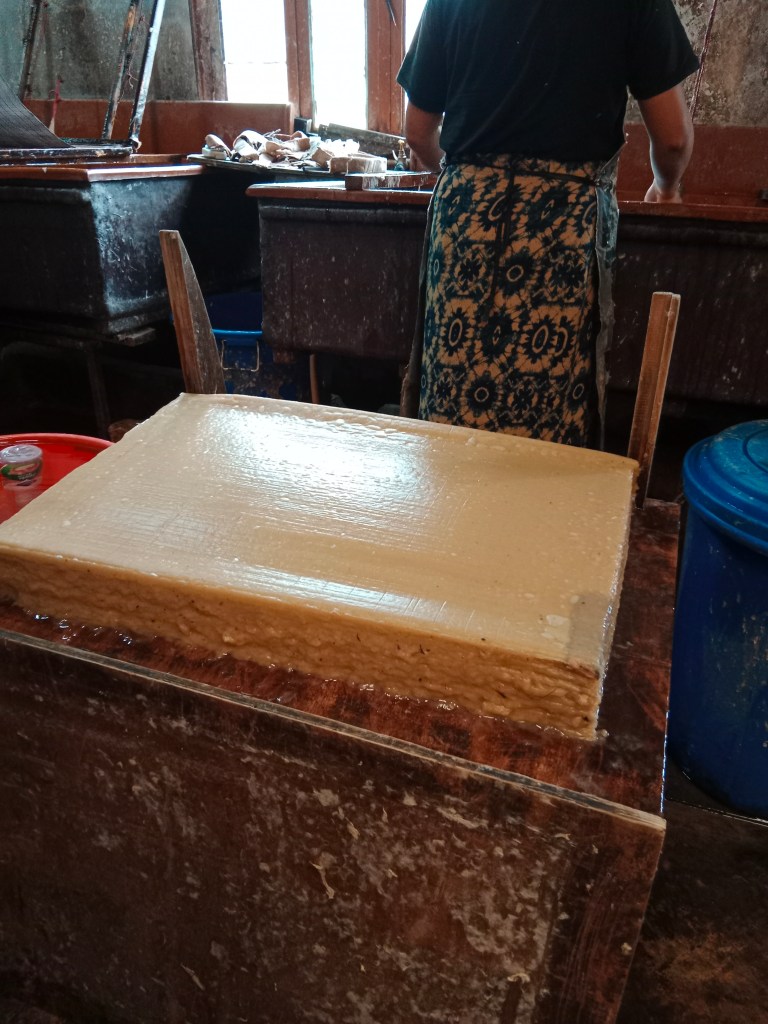
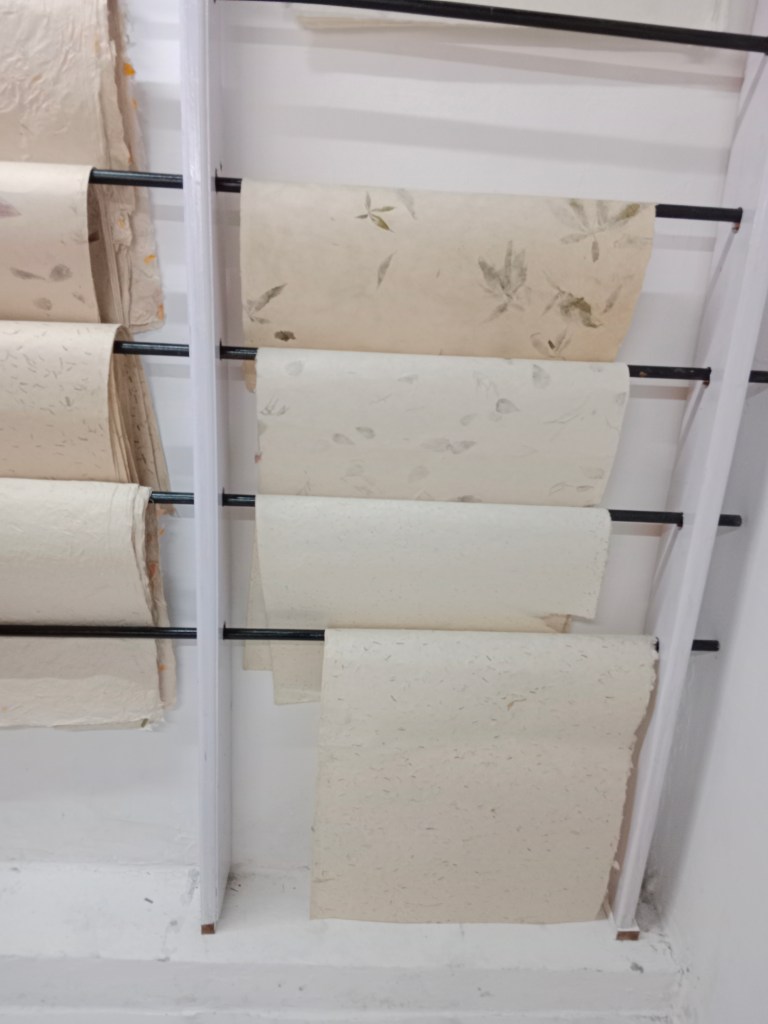
Another interesting place we visited at Thimpu was the handmade paper factory. The process of paper making was demonstrated to us. The bark of the tree is processed and made into a pulp. This is further converted into blocks and paper of required size and thickness is cut out and dried. The paper is of good quality and paintings on this paper are on sale too.
The tree from which paper is made and processing of the bark
Blocks of paper and paper cut into required size
Finished product and a painting on display
Well, that rounds up our visit to Thimpu. Our next destination was Punakha. See you next week at Punakha.
Till then, like, comment, subscribe and give me your feedback…
When we talk about Bhutan, the first picture that comes to our mind is the strong association with Buddhist culture. Structures that have unique architecture and are associated with Buddhist culture are the Dzongs that we see here.
Dzongs
“Dzong” in Bhutanese means a fortress. So all of them are fortresses that serve multiple purposes. The two main functions are Administrative and Religious. Though the dzongs were present in Bhutan since the 12th century, they belonged to different schools of Buddhism established by various Tibetan monks. It was Zhabdrung Rinpoche who used these Dzongs as a unifying force to bring various schools together thus unifying Bhutan.
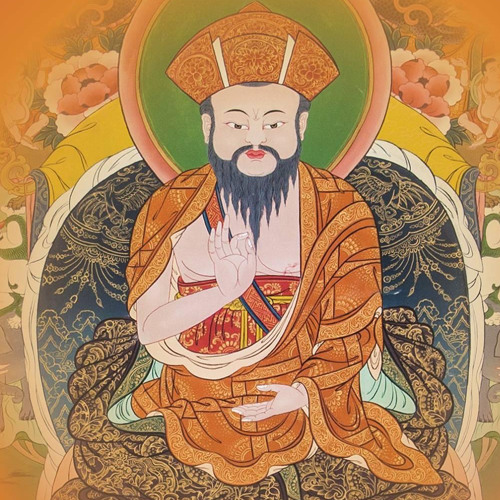
Zhabdrung Rinpoche (Bearded Lama)
Zhabdrung Rinpoche(Popularly called the Unifier of Bhutan) was born Ngawang Namgyal and was a Tibetan monk. Bhutanese consider him as the most important personality in the history of Bhutan. He formed the Dzongs which helped in bringing neighbouring rulers together and this helped in unifying them into a consolidated Bhutan.He introduced the dual system of administration which is followed even today with the Je Kenpo controlling the religious activities and Desi (elected leader) controlling political activities.
A mural painting of Zhabdrung Rinpoche
DzongArchitecture
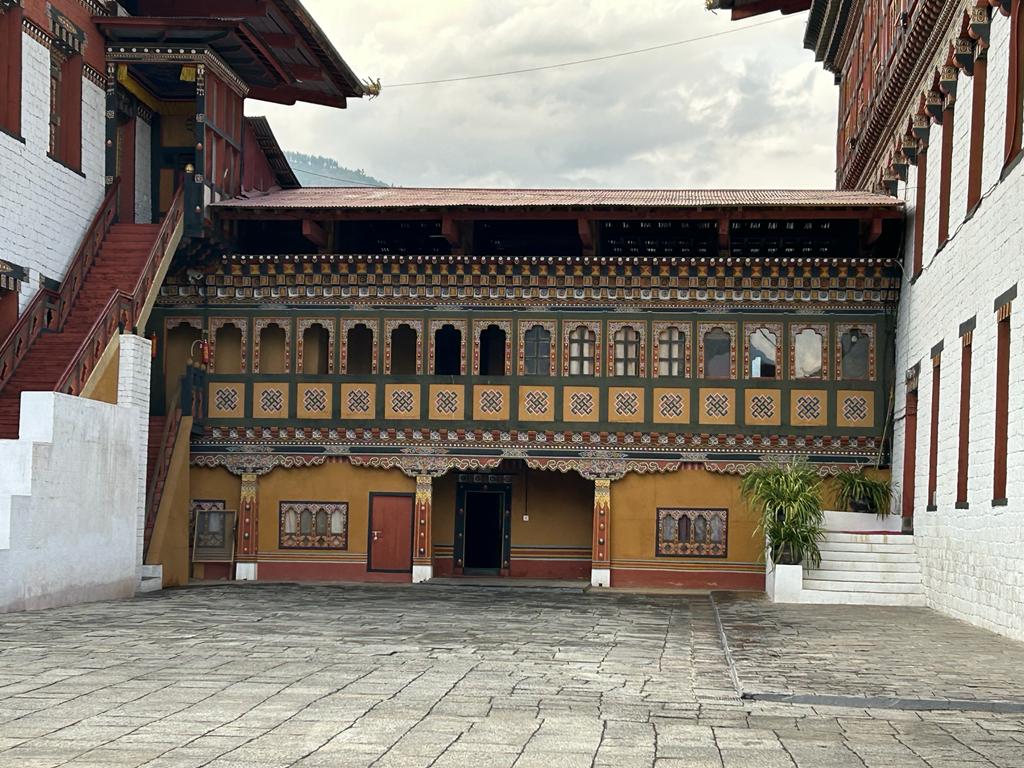
As a general rule, dzongs have rectangular buildings around a stone paved courtyard. At the centre of the courtyard is a prominent tower or UTSE which houses the shrines of guardian deities and Buddhist masters . Most such temples have statues of Gautham Buddha, Avalokiteshwara and Zhabdrung Rinpoche .Administrative offices and monk’s accommodation also form part of the Dzong complex.
They usually have huge exterior walls which are painted white with red ochre stripes near the top of the walls dotted by gold circles. Windows are usually absent in the lower part of the walls.
Flared roofs atop the interior temples which are mostly painted with red and have a gold lining is another unique feature. There are massive doors for entry and exit and are usually made of wood.
Brightly coloured typical Bhutanese motifs decorate the inner temple and courtyard walls. Paintings depicting Bhutanese beliefs and folklore adorn the walls of the Dzongs.
Location
It is believed that the locations were chosen based on the prophecies of ancient saints and auspicious events that took place.
Strategic location of the Dzongs is one of the main factors that led to the unification of the country. Most are located on hilltops or ridges giving a panoramic view that helped prevent attacks from enemies. Many of them are located close to rivers or surrounded by them again giving strategic advantage against the enemies.
Purpose
Dzongs serve as religious, military, administrative and social centres for the respective district and are the venue for the annual religious festival.
A large number of national treasures including the remains of Zhabdrung Rinpoche are inherited and housed in these Dzongs.
Continuous changes in structure and adaptation to modern requirements have made these Dzongs the centre of religious and administrative activities. They have adapted to the change in the government system from monarchy to constitutional democracy and as such occupy a significant status in the country.
Most Dzongs today house the offices of the respective district authority and a number of temples and residences of monks.
My Experiences
We visited two main Dzongs ….one each in Thimpu and Punakha…the summer and winter capitals of Bhutan. We also saw the Dzong in Paro.
Some pictures from these two Dzongs and special experiences there….
Tashichho Dzong (Thimpu Dzong)
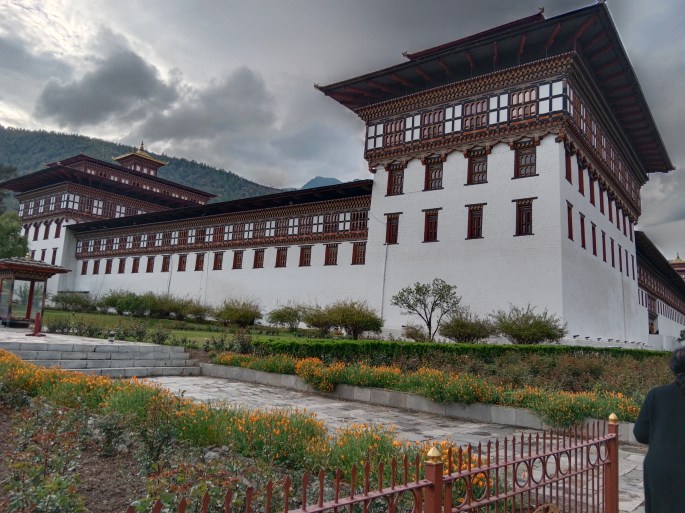
The seat of Bhutan’s government since 1968, this Dzong was built by the third King of Bhutan. A series of fires and an earthquake destroyed the original Dzong which has been in existence since 1216.
The name Tashichho Dzong means “Fortress of the Glorious Religion“. It houses the throne room and offices of the king, the cabinet secretariat, and other ministries besides the thirty odd temples and shrines.
A panoramic view of the Thimpu Dzong
A closeup view of the Thimpu Dzong
The gate leading to the King’s Palace and a flagstaff in the Dzong complex
Ceremonial flag lowering
Every evening, there is a flag lowering ceremony held at Thimpu Dzong. Fortunately we were witness to it. A group of smartly dressed soldiers accompanied by a monk take part in the ritual again emphasising the dual system of governance.
After the flag is lowered , it is carried by the soldiers inside the Dzong.
Watch a short video of this ritual below…
A video of the ceremonial flag lowering at Thimpu Dzong
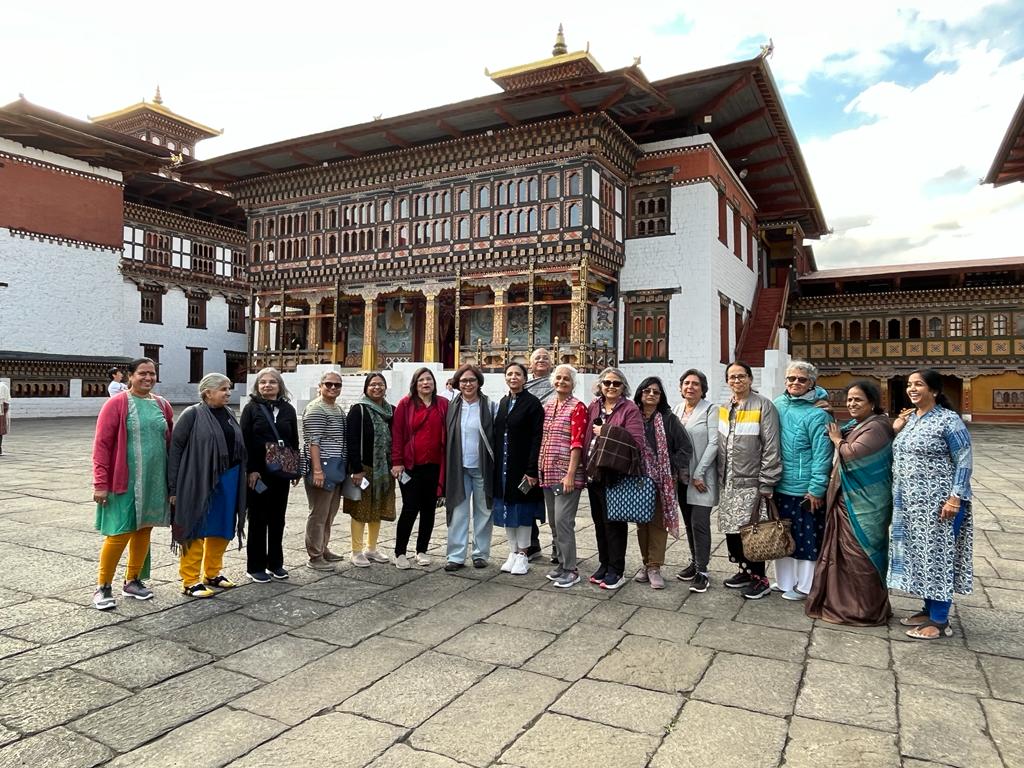
Our group at the spacious central courtyard of the Dzong
The prayer wheels and the central tower
Typical Bhutanese designs adorn the walls
Thimpu Dzong was one of our first destination at Thimpu. After the scenic drive from Phuentsholing, we visited this dzong. This was our first visit to a Dzong.
The other Dzong which we visited was in Punakha.
Punakha Dzong
Known in Bhutanese as “Palace of great happiness or bliss”, this dzong is the second largest dzong in Bhutan and has one of the most majestic interiors. It houses the remains of Zhabdrung Rinpoche.It was the administrative centre of the Bhutan Government till 1955 when the capital was moved to Thimpu, though Punakha still is the winter capital.
This Dzong was the site of coronation of the first King of Bhutan.
It is located between the Po Chu and Mo Chu rivers which join to form the Puna Tsang Chu which ultimately joins the Brahmaputra river. Due to the presence of the two rivers, this dzong is vulnerable to flash flooding.
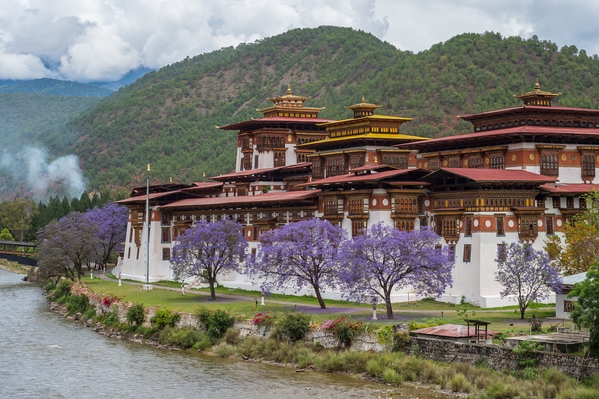
The Punakha Dzong with wooden bridge across the Mo chu river
The beautiful jacaranda trees adding to the beauty of the Punakha Dzong
A wooden covered bridge across the river Mo Chu was built in the 17th century and connects the dzong to the main road.
Crossing the Mo Chu river on the wooden bridge, we were on the side of the Dzong
On the bridge leading to the Dzong ( in the backdrop)
Soon we were in front of a flight of stairs…
A flight of stairs leads to the interior of the Dzong.
You will notice in the picture that towards the top of the stairway there are three divisions in the stairs. The extreme left is for visitors, the extreme right is for monks and the central part for the monarchy.
Once we climbed the stairs we entered a small passage that led to the central courtyard.
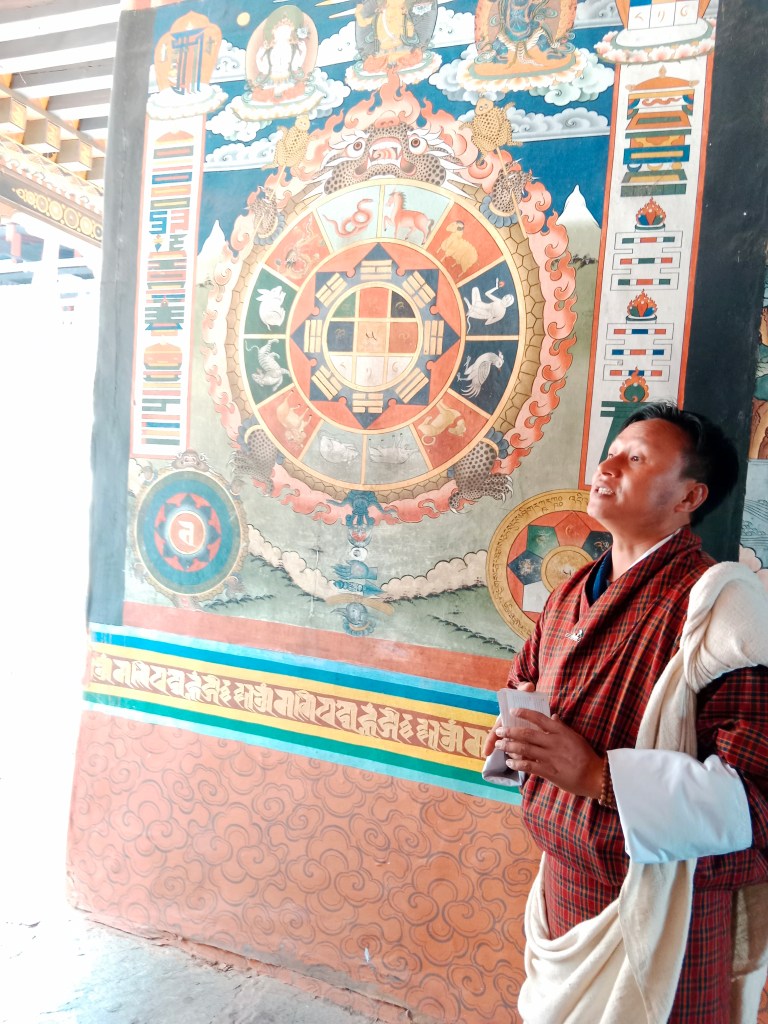
This passage had traditional Bhutanese folklore paintings, the Zodiac signs and the name of Zhabdrung Rinpoche painted on the walls.
The paintings of zodiac signs, folklore and name of Zhabdrung Rinpoche and Sanchay explaining
The huge central courtyard with the sacred banyan tree
Our guide led us from the first courtyard further into another courtyard where there were two very beautifully decorated temples. Tourists can enter only one of these temples.
The inner courtyard with the two decorated temples
The decorations at the temple entrances and a golden gate within the courtyard
Our guide took us around the Dzong and explained the significance of many of the sights.
One peculiar thing we found in all the temples and shrines was that there were seven bowls of water offered to the deities. Traditional Bhutanese legend has it the when Buddha was born, he was no ordinary child and he took seven steps as soon as he was born and lotuses bloomed on those steps. Hence the importance of the number seven and the water bowl offerings
Since temples and shrines do not allow photography, these cannot be shown…
A third Dzong which we saw was the Paro Dzong.
Paro Dzong
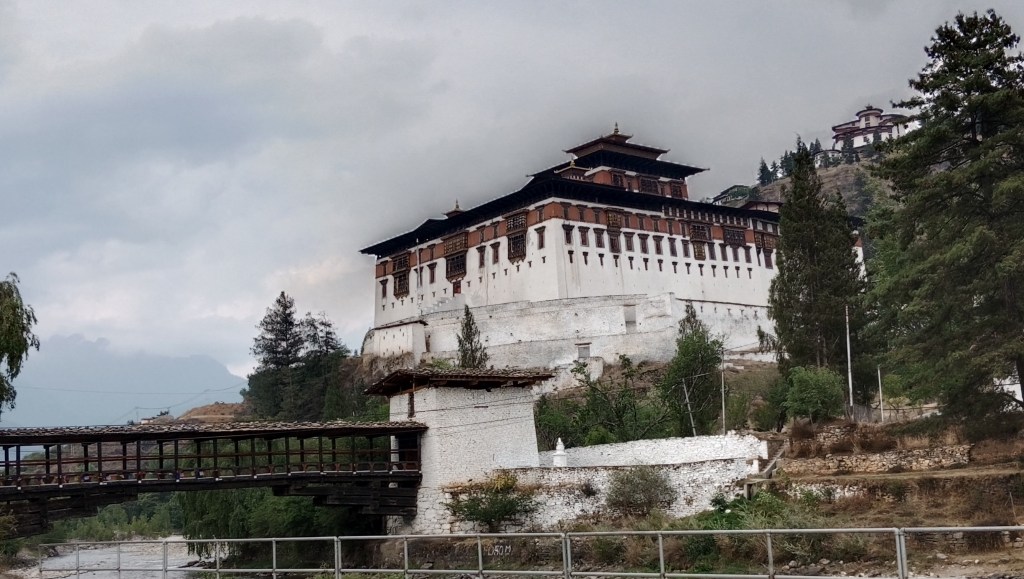
Known locally as Ringpung Dzong meaning “Fortress on a Heap of Jewels” is located on a steep hillside overlooking the Paro Valley .It has an impressive collection of heritage buildings inside and hence got it’s name. It has a complex of courtyards with temples, shrines and towers with intricate Bhutanese carvings. Unlike other dzongs, this one has huge windows with delicate art work and decor.
Its courtyards serve as the venue for Cultural performances too…
A wooden bridge across the Paro Chhu leads to the Dzong.
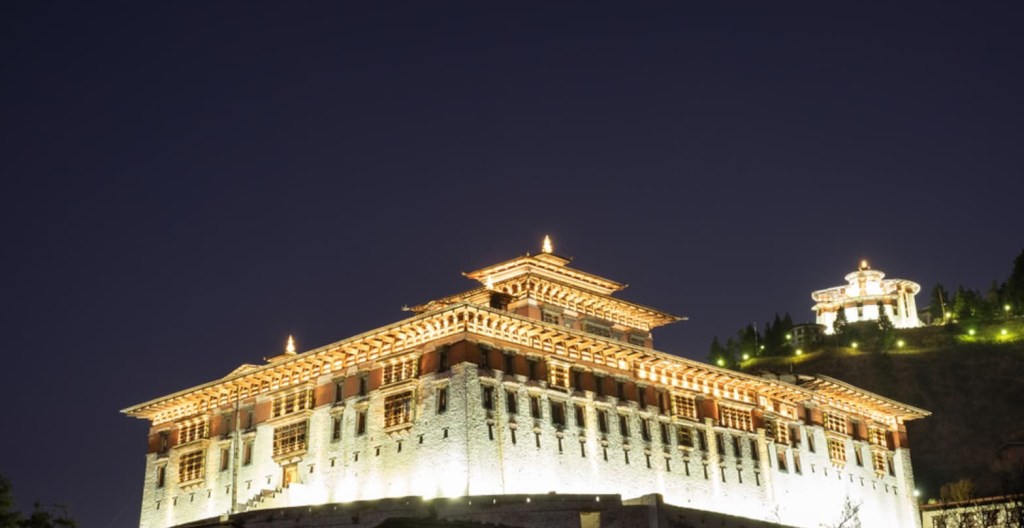
The National Museum of Bhutan sits further up on the hillside. The Dzong and Museum are illuminated at night providing spectacular views.
The Paro Dzong with the wooden bridge across the Paro Chhu.
The illuminated Paro Dzong and the National Museum behind it
Well, this is just a round up of the Dzongs I visited in Bhutan and all I learnt about these fortresses. There is a lot more to these including the history and various changes that have taken place in modern times. That will get too exhaustive and hence, I stop with this brief overview.
Next week we do a city tour of Thimpu. Till then, keep your comments and feedback coming in.
A beautiful morning dawned in Phuentsholing and we were all set to move to Thimpu which was our next destination in Bhutan. We were to continue our drive further in the Duars region of the Himalayas and it had to be beautiful.
After a sumptuous breakfast at our hotel, we set off on this drive on a bright and sunny day. Soon we left Phuentsholing town and its outskirts and were truly in the lap of the lower Himalayas.
Hills on one side and ravines on the other, with rivers at the bottom of the ravines….a very simplistic description of the surroundings . But a few pictures will give you a clearer picture of the scenery…
Leaving Phuentsholing behind…
The winding roads and the Monastery roofs add to the beauty
Stupas of this type line the roadside every now and then
The varied shades of green on the hillside and a waterfall far away
Soon we stopped at a View Point. The views were beautiful and there were the typical coloured flags hung over there. Sanchay, our Bhutanese guide explained the significance of the flags and its importance in Bhutanese culture.
Beautiful view from the view point with a monastery we had passed by on top of another hill
Stupa at the Viewpoint
Our group at the viewpoint and Sanchay explains…
Bhutanese Flags and their significance…
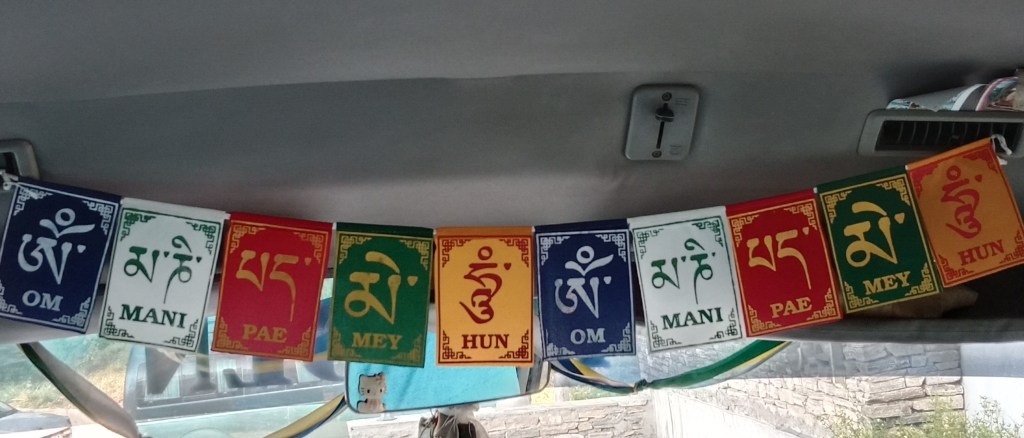
Talking of flags, the bus in which we were travelling had this colourful flag hung in front…so typically Bhutanese…
The flags with the famous Bhutanese chant…..
Coloured flags : Colours of the flags represent the five elements which create and destroy us. The colours are…blue (sky), White (clouds), Red (fire), Green(water) and yellow (earth) .There are prayers written on these flags and are tied by common people to ward off evil and bring good fortune.
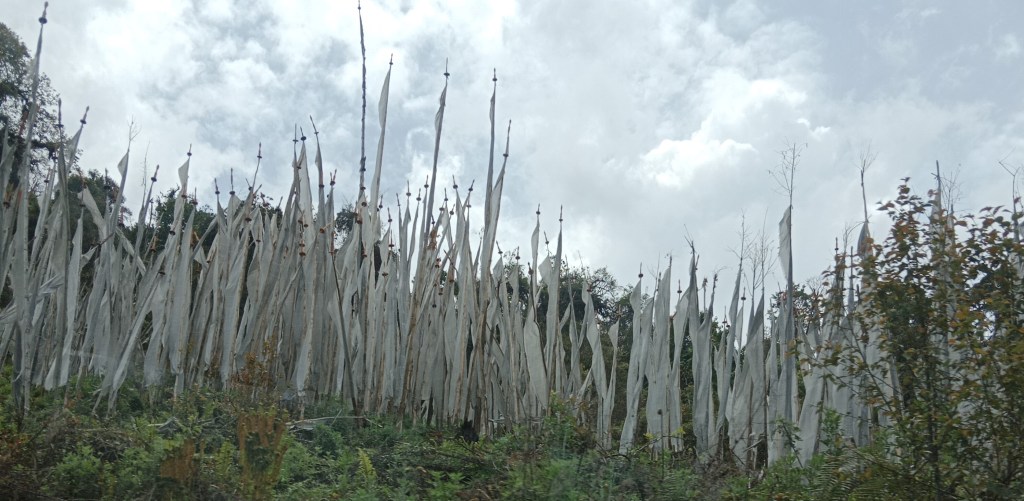
White flags : These are tied by relatives of a dead person in his honour and they too contain prayers which will give salvation to the soul. 108 white flags are generally put up for one person. We found several such groups of flags on the hillside everywhere as we drive along.
Coloured flags and white flags dot the hillsides everywhere
We continued our drive and soon took a wash room halt near a group of shops. Some pictures of local life in Bhutan…
A fruit shop on the way. The white cubes seen hanging is a variety of hard Bhutanese cheese
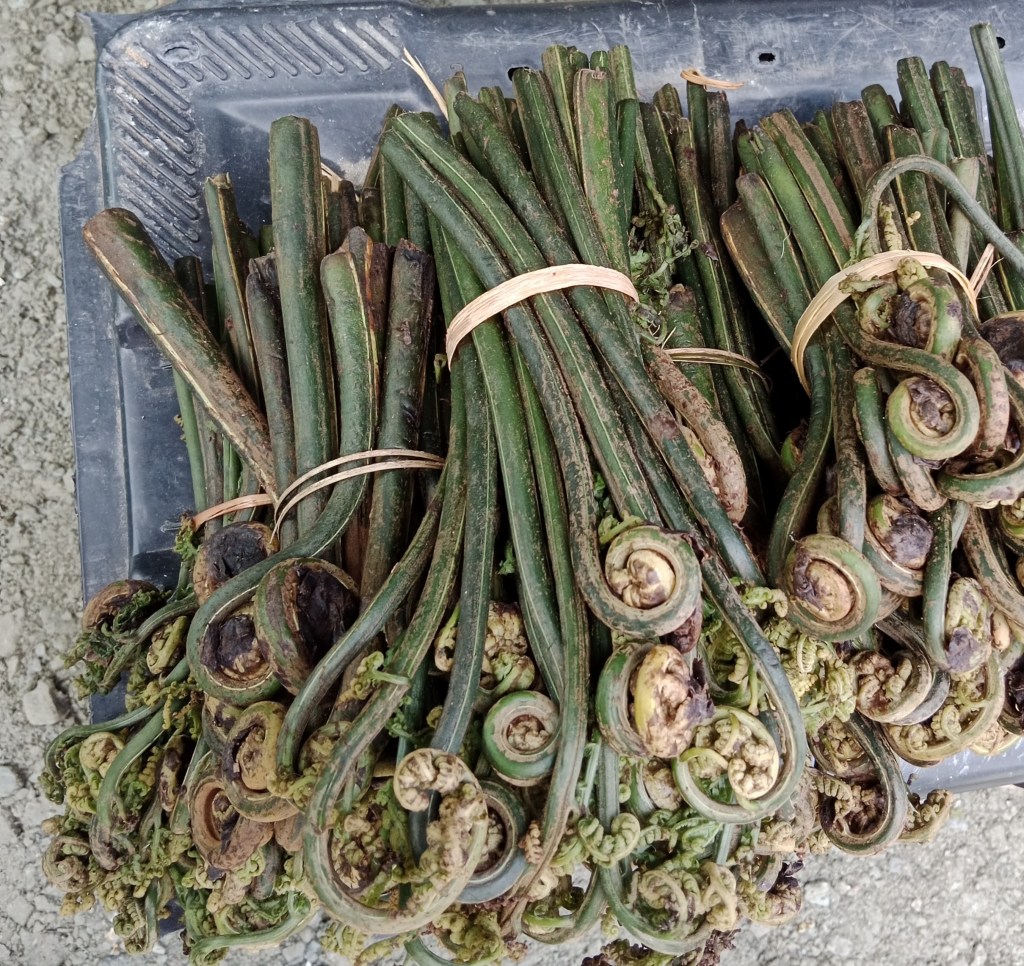
A wayside shack of a shop with a little shopkeeper, local greens and brinjals…
Continuing our drive, we were in for more natural beauty….
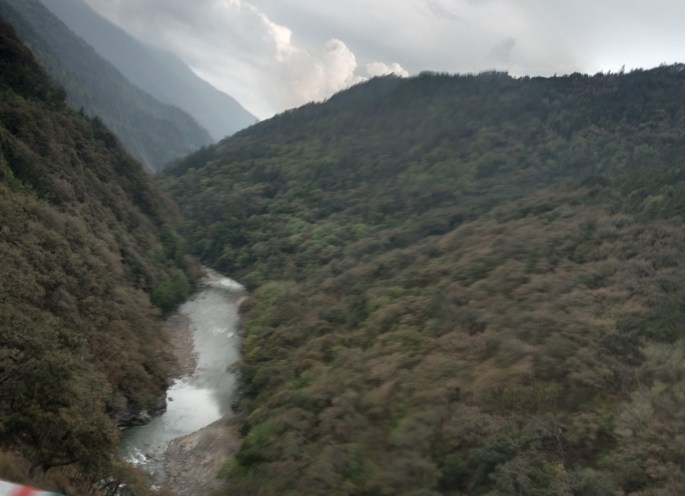
A river flows along the ravine
Every now and then there were places of landslides which are very common in this region.
Evidence of landslides
A small waterfall
Soon it was lunch time and we halted for lunch at the Dam View Restaurant. Some pictures from near the restaurant..
The valley and the dam
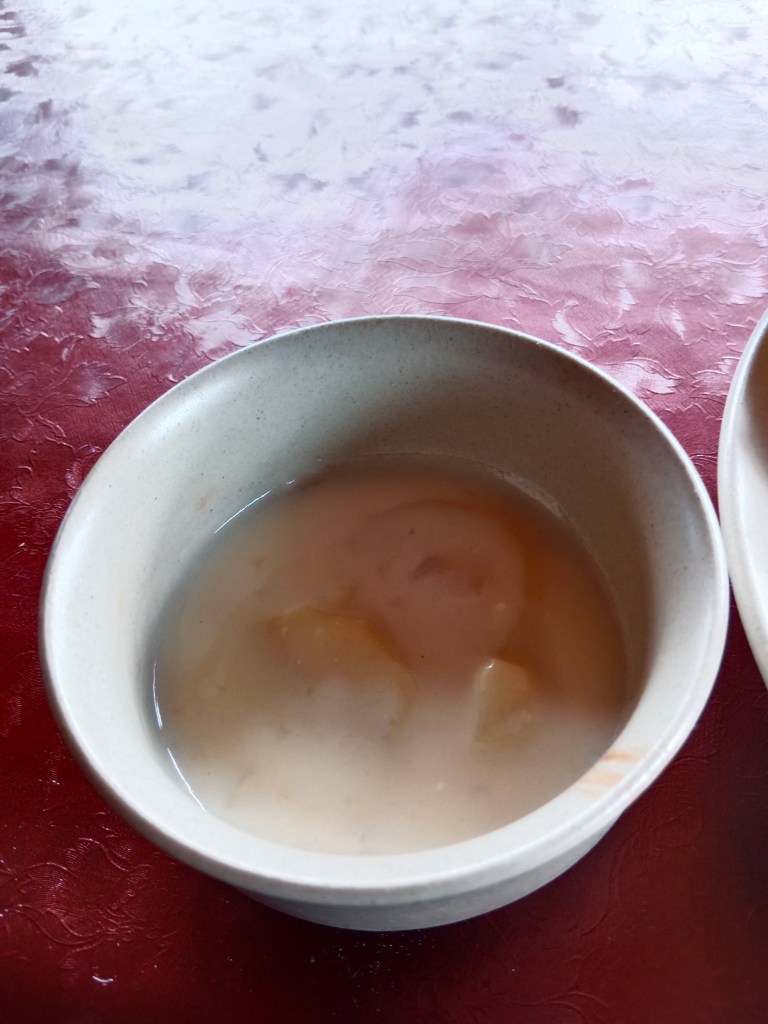
We enjoyed the scenery from the restaurant overlooking the valley and the dam . Our first encounter with KEWA DATCHI also took place here. It is a very popular Bhutanese dish which has a cheesy gravy with potatoes similar to our vegetable stew.
The restaurant and Kewa Datchi ( traditional Bhutanese gravy)
When we are talking about the dam, there is something interesting I learnt about Bhutan. Bhutan produces surplus hydroelectric power and India is one of the countries that imports the power from them. I felt it was commendable for such a small kingdom to do this!!!
At many places during our drives through Bhutan, there were check posts where Sanchay would get down and present all our papers ….probably crossing over to a different district..I assumed !
Continuing our drive to Thimpu, we encountered some rocky areas of the hill slopes with the roads being particularly narrow at places. At places the rocks seemed to have faces chiselled on them…or was it just my imagination running wild ?…you can decide by looking at the pictures below…
Rocky cliffs and chiselled rocky hillslopes
A stream was flowing by peacefully…
A stream flows along
Sanchay then announced that he is going to give us a surprise….a waterfall where we could wet our feet…
The waterfall and some of us near it….the water was ice cold
Enjoy the feel of the icy cold waters in this video
After the icy encounter, for which we thanked Sanchay, we continued the journey to Thimpu and soon, we could see signs of a city approaching…
As we approached Thimpu
As in any other place, gradually the number of buildings along the roadside increased and soon we were at Thimpu . We thought we would drive directly to our hotel but Sanchay had other plans for us. He wanted to take us to Thimpu Dzong , which is a government office and a monastery rolled into one . So we drove straight there and visited the Dzong where we also witnessed the traditional flag lowering ceremony that happens every evening there.
After the visit to the Dzong we drove to our hotel in Thimpu and relaxed for the night.
The Thimpu Dzong which we visited needs elaborate description and will be covered in my next episode on the dzongs of Bhutan. See you next week in the dzongs…a unique place , typical of Bhutan. Till then, do subscribe, comment and give your feedback.
Phuentsholing….that quaint little town in Bhutan is the gateway to this Himalayan Kingdom.
Let me start with a brief overview of my Bhutan trip…
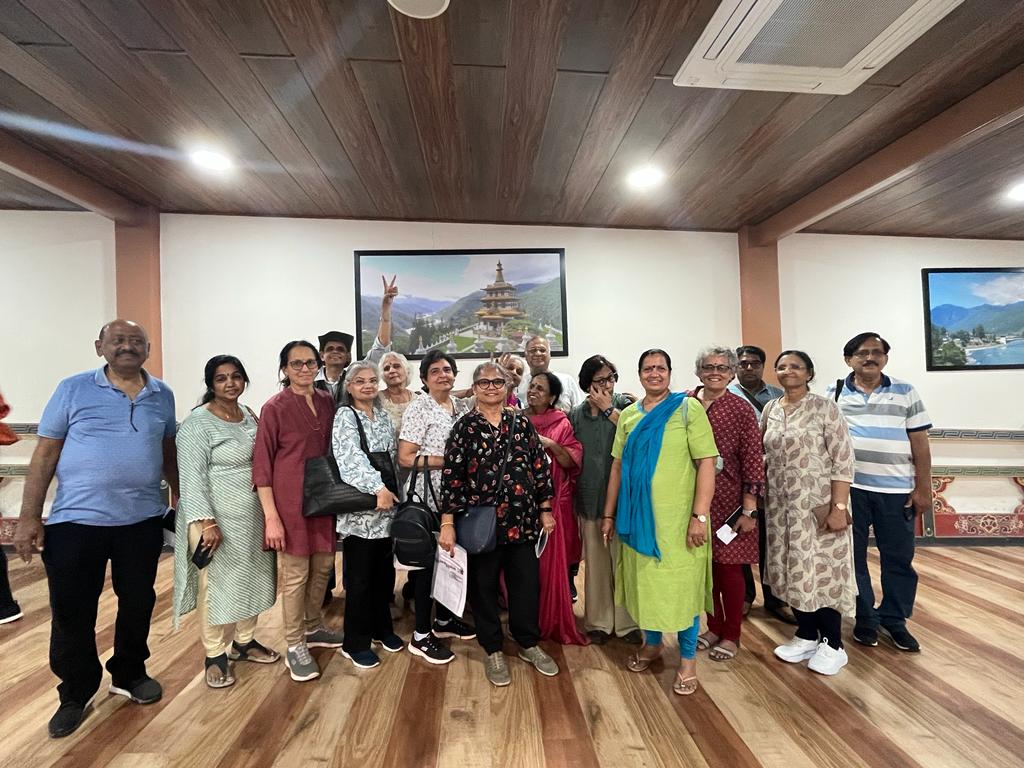
I did this tour of Bhutan with a group of amazing Seenagers ( Senior citizens with a teenager’s heart!) organised by a travel and adventure company from Bangalore called 50 plus Voyagers. We were twenty three of us and apart from a a couple of us,( who knew each other before) were total strangers when we all met up. In a matter of few hours, all of us gelled with each other and anyone would think we had been friends for years….
That friends, is the magic of age…each one of us knew that we were in it for fun and wanted to make the most of what life had to offer in its twilight years….
Accompanying us on this tour was our Teenage guide Vanshika and two Bhutanese guides, Sanchay and Tenzing
Have a look at my co travellers before we embark on this Himalayan journey…
My co travellers on the Bhutan tour…at the immigration office at Phuentsholing
Our Tour Manager Vanshika
Our Bhutanese guides Sanchay and Tenzing
Earlier that day, we arrived Bagdogra by flight from where we were received by our tour manager Vanshika. We started our drive to Bhutan from Bagdogra airport by car. Siliguri is the closest city to Bagdogra and we drove past Siliguri..
A lunch at a hotel in Siliguri helped in quenching our hunger and getting to know each other more…
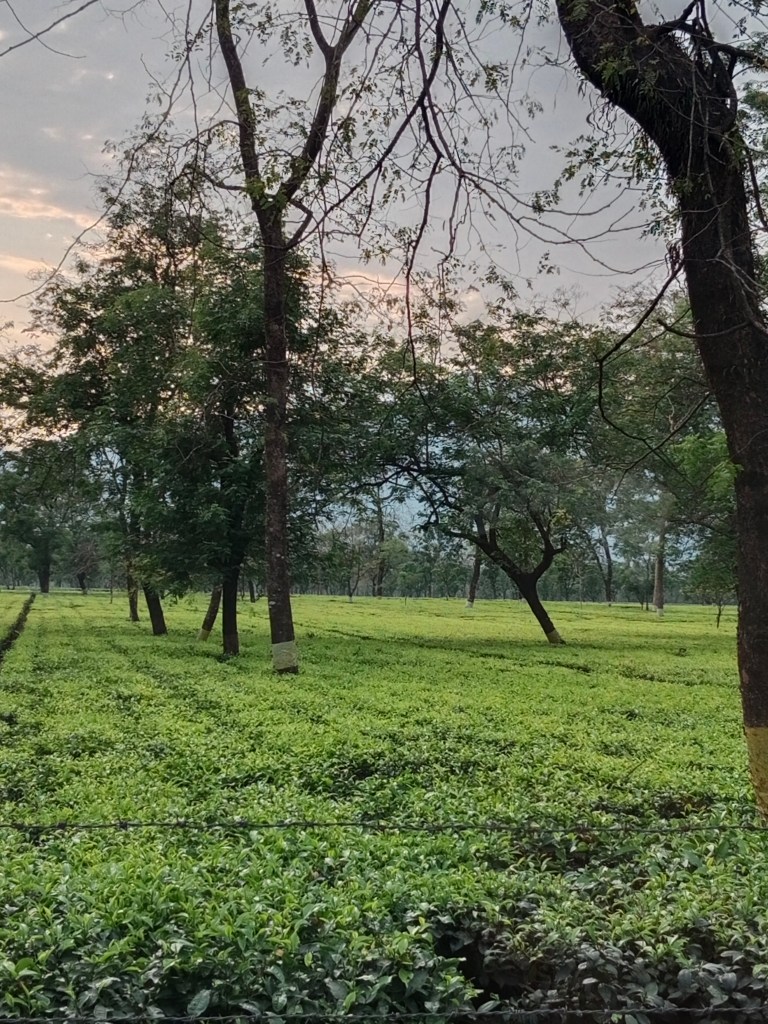
Soon we left the crowded streets of Siliguri and headed to Jalpaiguri where the greenery of the tea estates left us in awe. The peculiarity of these tea estates is that they are on flat ground. Elsewhere, tea estates are located on hill slopes but here it was different….
A little bit on the Duars region of the Himalayas
These are basically plains on the foothills of the eastern Himalayan ranges mainly in North East India and West Bengal.
Duar means door and forms the gateway to Bhutan and NE India. With the backdrop of the Himalayas, this region is a paradise for nature lovers. The Teesta river, several wildlife sanctuaries, tea gardens, several small rivulets and waterfalls add beauty to this region.
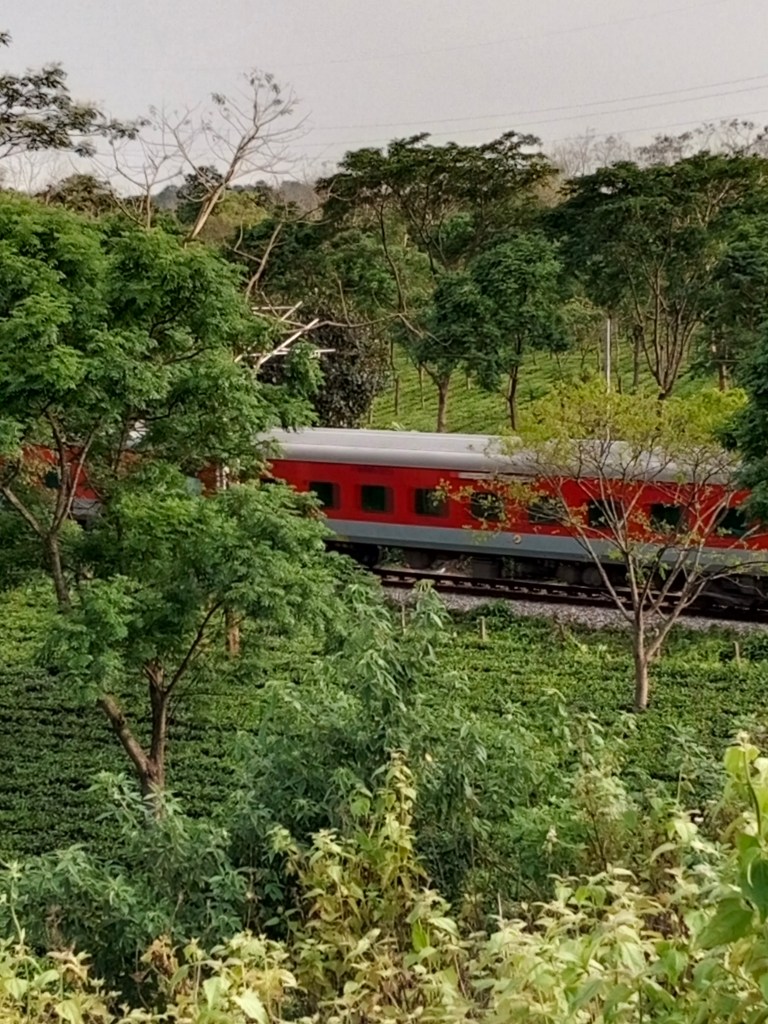
Some pictures from our drive through the tea estates of West Bengal…
The tea gardens
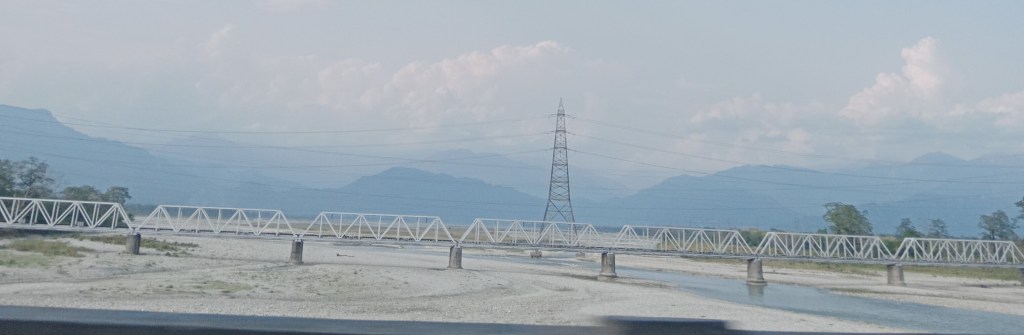
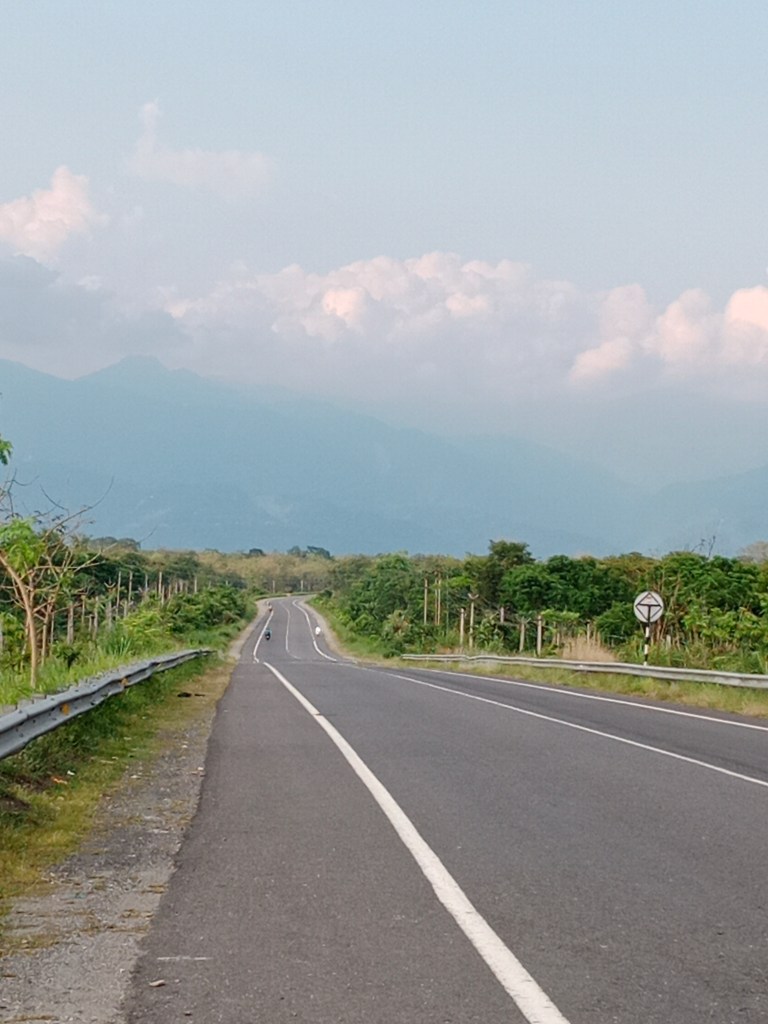
We also crossed some bridges and the long road to Bhutan welcomed us with the views of the mountains ahead…
The rivers and the long road to Bhutan with the mountains ahead….
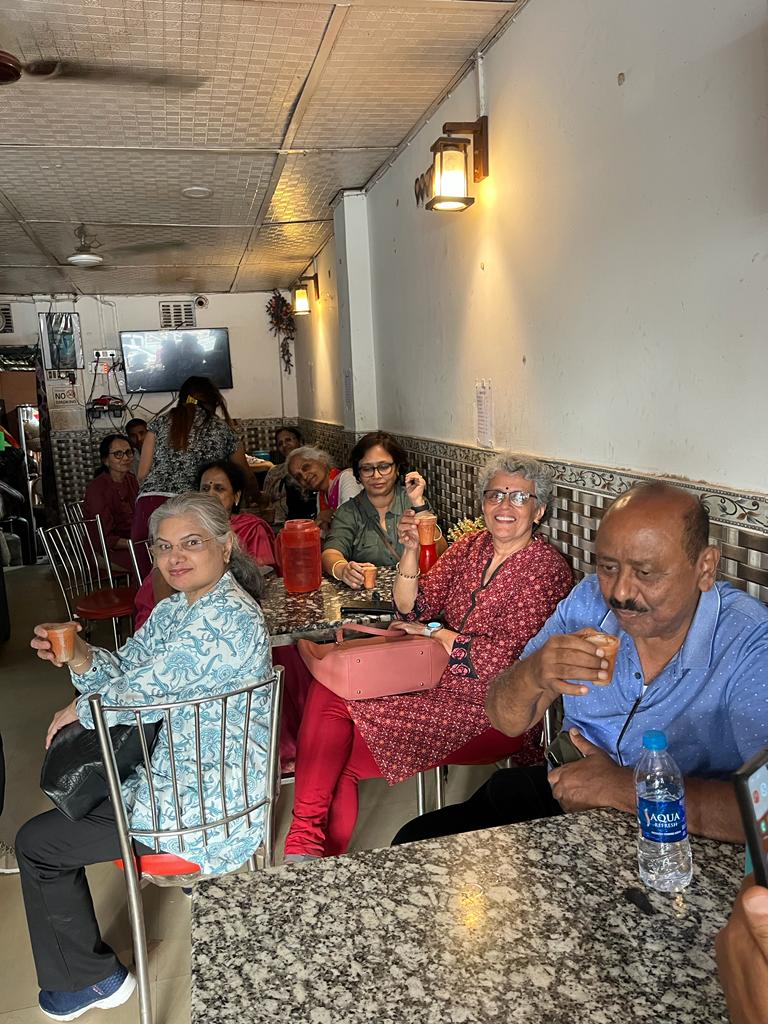
Just as we were enjoying this ride, it was tea time and we enjoyed some saffron tea and biscuits at a tea shop…
Enjoying tea and biscuits…
Continuing the drive, we enjoyed the scenery and the company. After five hours of the drive from Bagdogra, we were close to the Bhutan border and we could see Phuentsholing town at a distance.
Phuentsholing at a distance….on the slopes
The last Indian town was Jaigaon and as we approached Phuentsholing, our guide collected our passports and other documents to get the visa and other permits for travel in Bhutan.
Once we reached the border, there was an ornate gate here to demarcate the border. In addition there is a wall also to one side.
The ornate gate at Phuentsholing and the wall demarcating the Indo-Bhutan border.
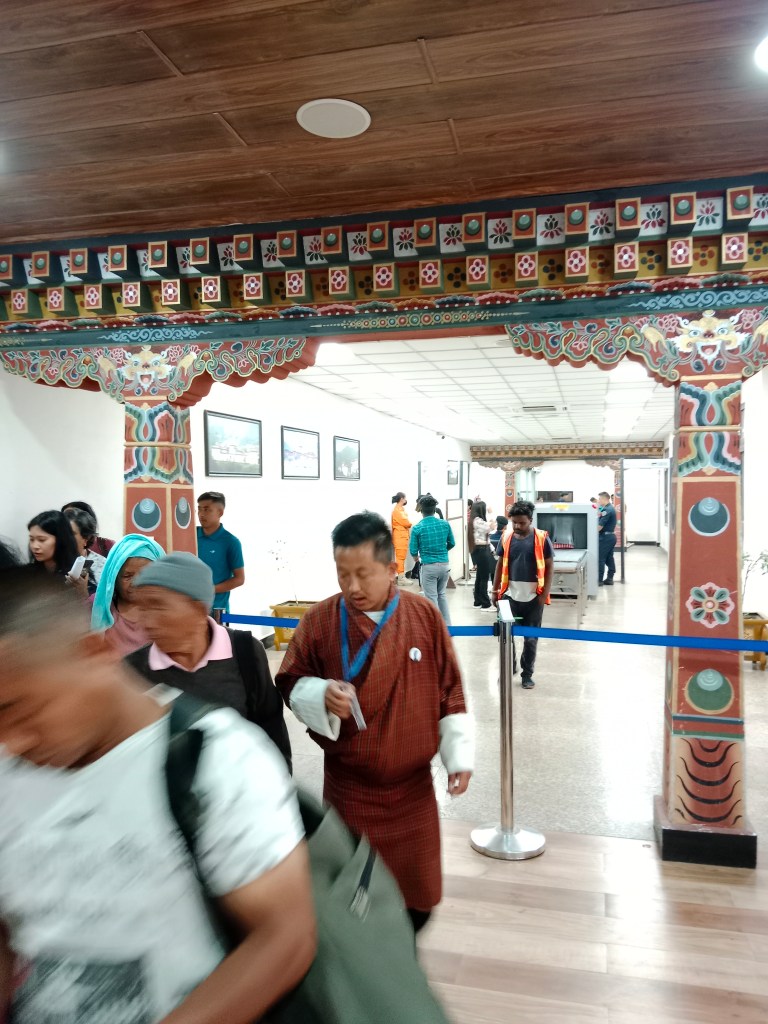
After alighting from our vehicles we walked to the immigration counter at Phuentsholing. Our guide accompanied us and we walked through the typically Bhutanese style immigration office.
?
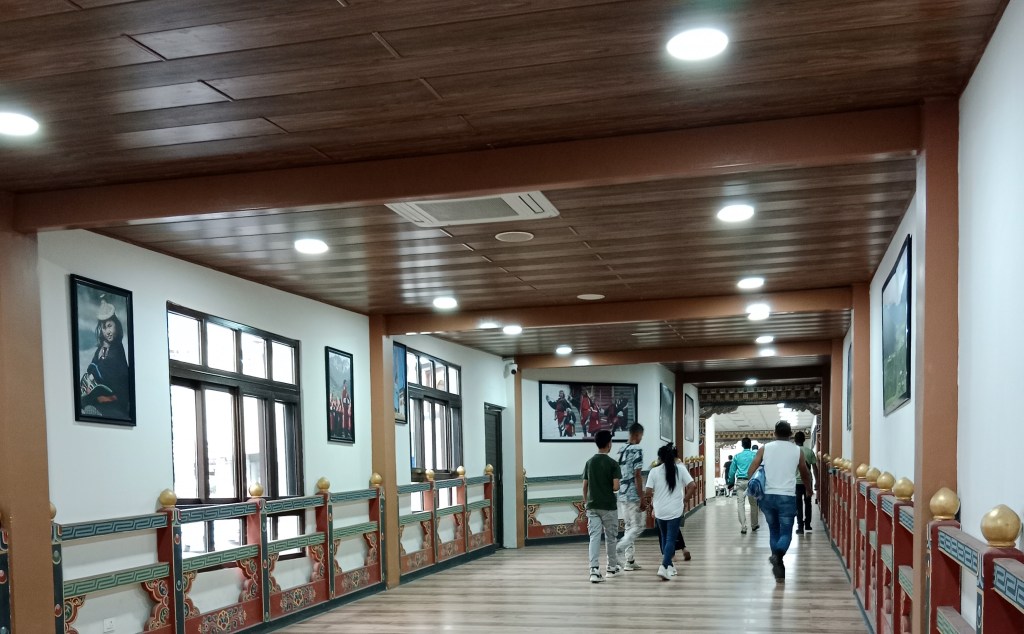
The immigration office with typical Bhutanese decor
We had to wait there for sometime as our papers were getting ready and we used that time for some quick pictures .
Once our papers were through, we walked in to Bhutan and I must tell you, it was such a contrast.
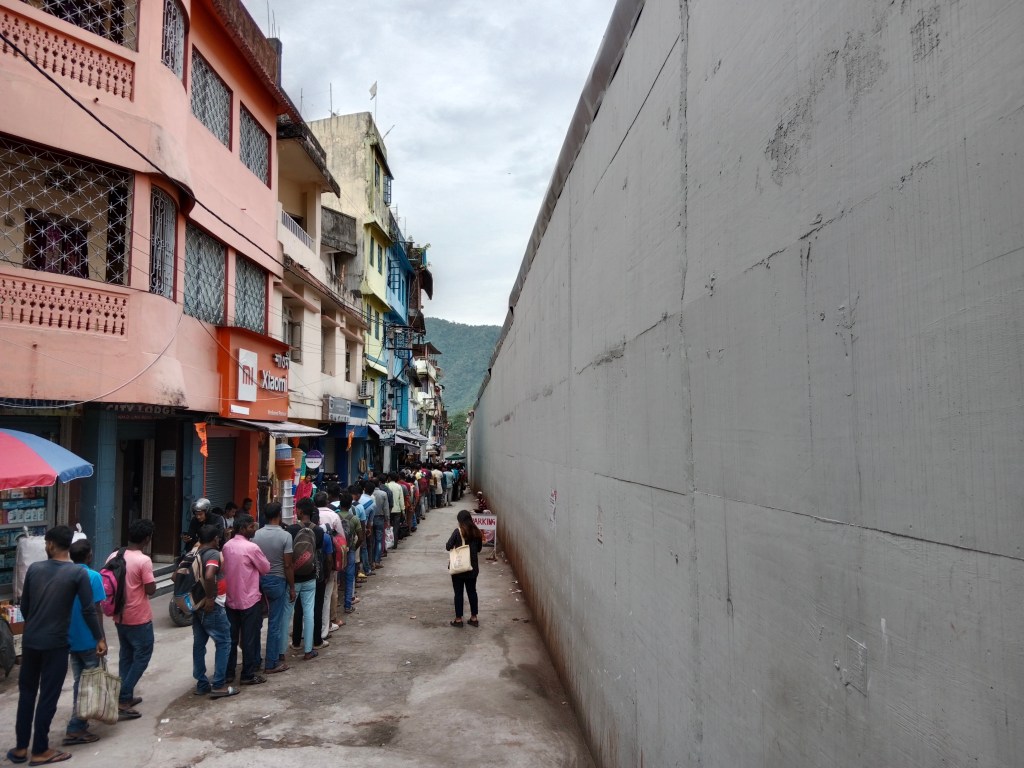
A few feet this side of the ornate gate and the streets were clean, there was no honking, vehicles were stopping to let pedestrians pass and the whole atmosphere was so calm and peaceful. It was simply unbelievable!!!
The Indian side here was particularly crowded and dirty ( though I must add that it does not represent a major part of India) and that added to the contrasting image in our minds.
The clean streets of Phuentsholing and our hotel
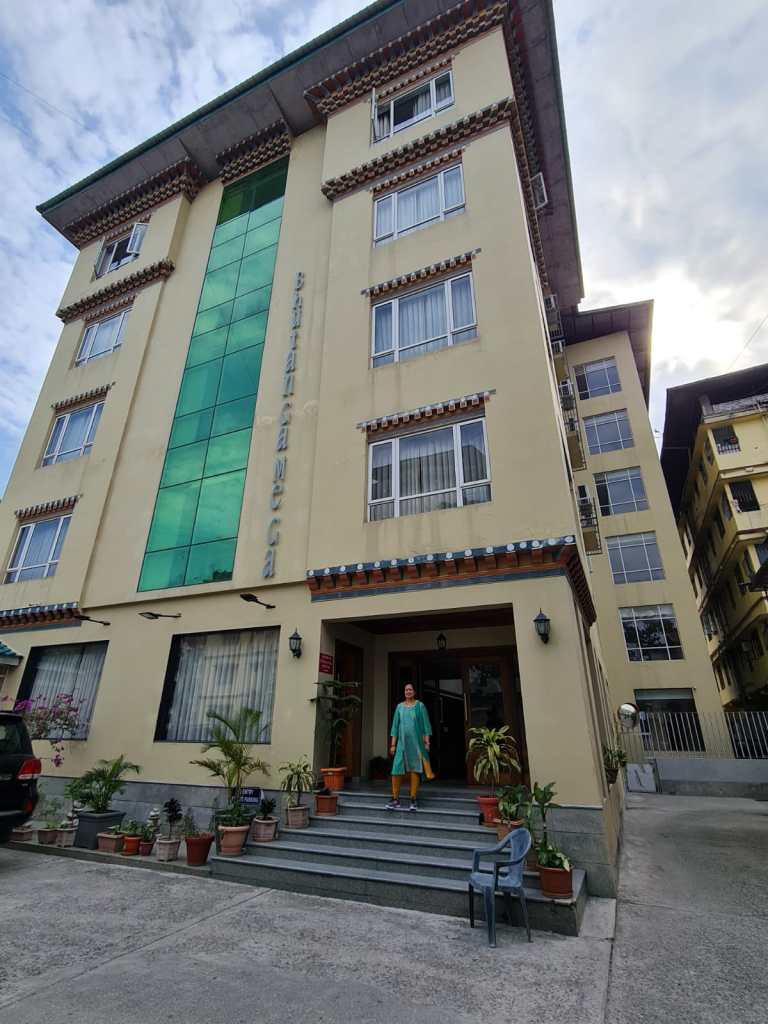
Soon we reached our hotel Bhutan Ga Me Ga ( meaning happiness in Bhutanese). With a nice welcome drink, we all reached our respective rooms after a long drive and relaxed for sometime.
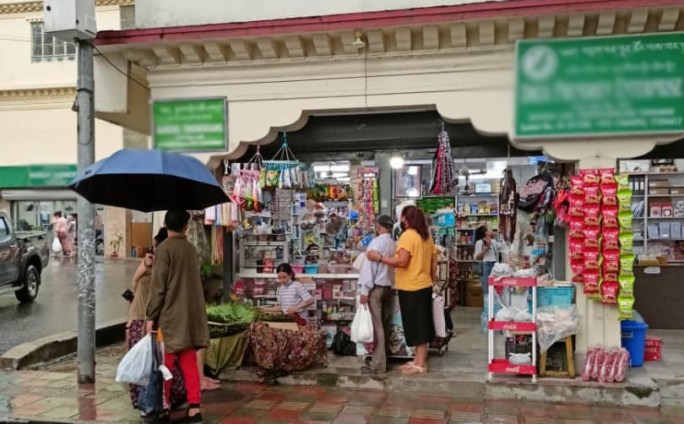
We decided to explore Phuentsholing and here are some pictures from our outing….
A typical shopping area with shops displaying boards in green and white colour
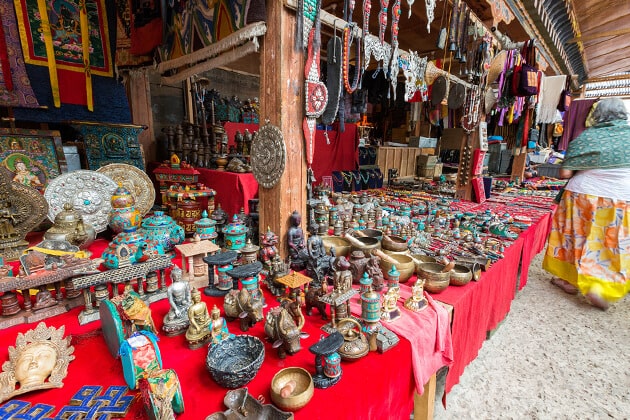
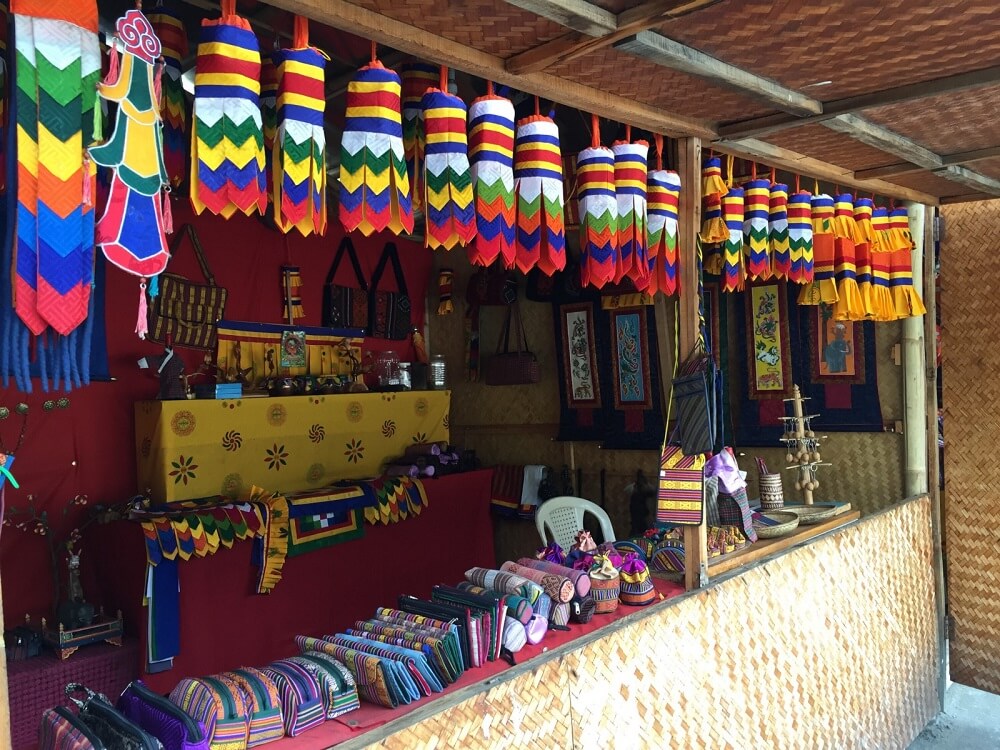
Bhutanese Handicraft shops
There was a monastery close to our hotel that was beautifully lit up at night.
The lit up monastery
Returning to our hotel in time for dinner, we rested for the night looking forward to our drive to Thimpu the next day.
From the next episode, we are going to travel inside Bhutan and it will be good to know some important details of this country to understand the various places we visit and their significance.
Bhutan is located in the Eastern Himalayas between China in the North and India in the South. Its actual name is “Druk Yol “or Land of the Thunder Dragon. It is a constitutional monarchy with the King as the head of state and the prime minister as head of government.Buddhism is the state religion and its political history is intricately connected with its religious history. Religious leaders known as the Chief Abott are given as much importance as the political leaders.
Dzongs are fortresses where there are both political and religious activities taking place. This again points out the importance given to religious activities and leaders. We visited several Dzongs in Bhutan which we shall cover as we go along.Zhabdrung Rinpoche occupies a very important role in Bhutan and his statues are seen in all monasteries and Dzongs
The national language is Dzongkha (meaning language spoken in the fortress)
Getting back to Phuentsholing…..
We stayed at Phuentsholing overnight during our return journey too.
At that time, we visited a Buddhist Temple called Karbandhi Gompa.
Karbandhi Gompa
Located at a height of 400metres , the beautiful garden surrounding this temple offers views of Phuentsholing town and the Indo Bhutan border.
The temple itself has beautiful paintings of Buddha and statues of Buddha , Guru Rinpoche and Zhabdrung Ngawang Namgyal ( Zhabdrung Rinpoche or Unifier of Bhutan)
We attended a typical Buddhist prayer session accompanied with music using local instruments. Unfortunately photography is not allowed at the temple.
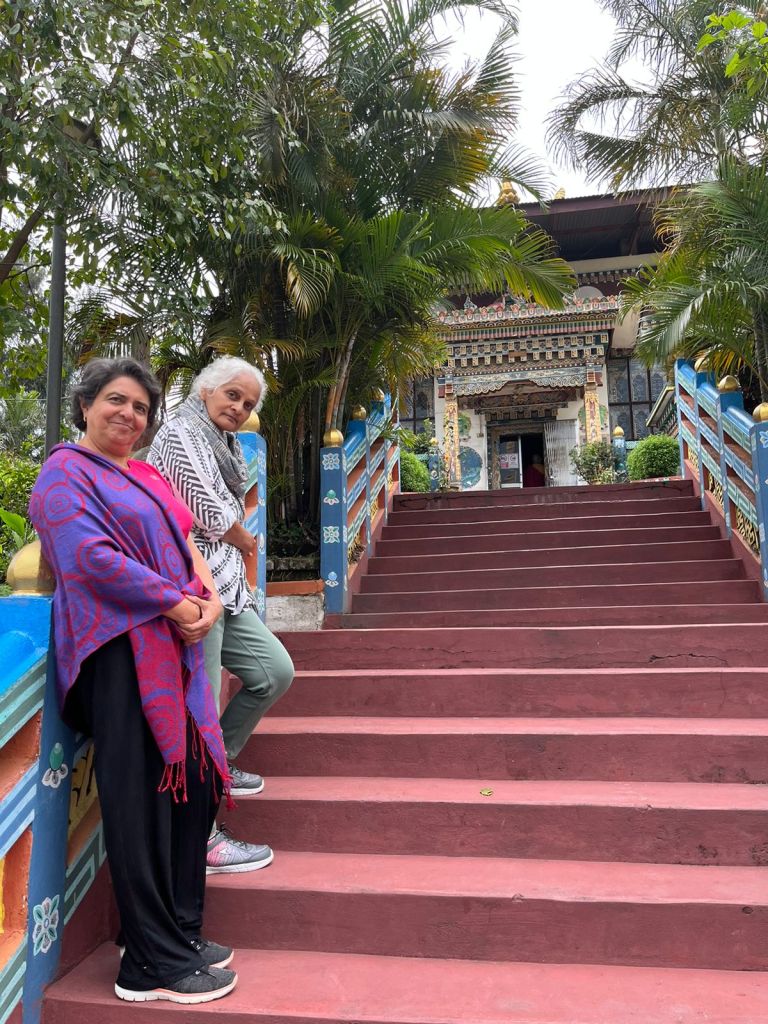
Karbandhi Gompa and the steps leading to the temple
The views of Phuentsholing town and the IndoBhutan border were also great…
Phuentsholing town and the Indo Bhutan border from above
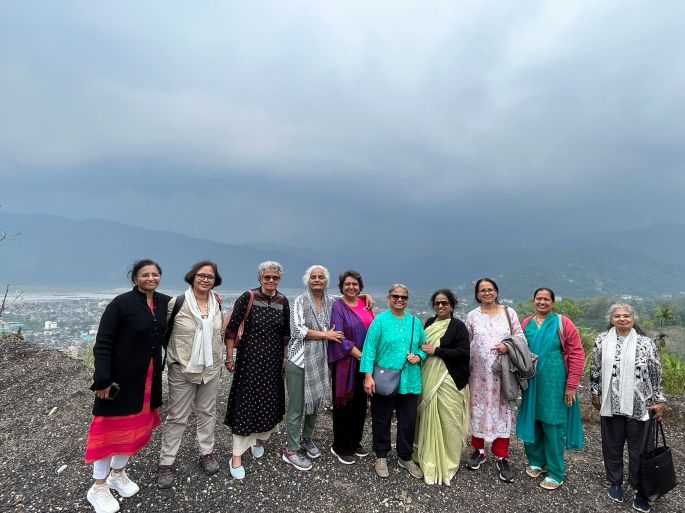
Our group at the Indo Bhutan border viewpoint
We checked into our hotel and got busy as most of us did our last minute shopping for trinkets, handicrafts, clothes and Bhutanese Wine which was good and was available at reasonable rates.
Well, that’s all from Phuentsholing. Next week we do a picturesque road trip to Thimpu. Till then do subscribe, comment and give your feedback…




















































































 Travel-along.in