Uncovering Alexandria’s Hidden Catacombs

Our first destination in Egypt was Alexandria and the last episode covered most of the sites we visited. However, the catacombs or underground tombs in the outskirts of Alexandria is where we are going today. Join me…

An insight into the catacombs of Kom El Shoqafa

These catacombs are essentially underground tombs widely believed to have been used between the 2nd and 4th centuries . It was initially intended as the burial facility for one family but it is still not clear how it went on to house numerous other tombs.

An accidental discovery; these ancient tombs are one of the most important archaeological sites here. A donkey wandering along, accidentally fell into the shaft of these tombs and they were discovered while rescuing the donkey. It stands as an excellent example of a combination of Greek , Roman and Egyptian architecture

Soon after this discovery, archaeologists started excavations and found the spiral staircase going around the shaft. At the bottom was a domed circular room known as rotunda.

The term Kom El Shoqafa in Arabic means “Mounds of Shards”. When discovered , the area was strewn with broken clay pots and containers and hence the name. It is believed that the relatives of the dead who visited the tombs carried food and wine for their kin and after offering it to them, broke the pots there leading to the accumulation of such debris.

Our Visit

Reaching the excavation site, we were quite intrigued by the presence of apartment dwellings adjacent to the site. In fact, the whole area is like a courtyard surrounded by buildings; most of them dilapidated .

The central courtyard around which the tombs are located with dwellings surrounding it.
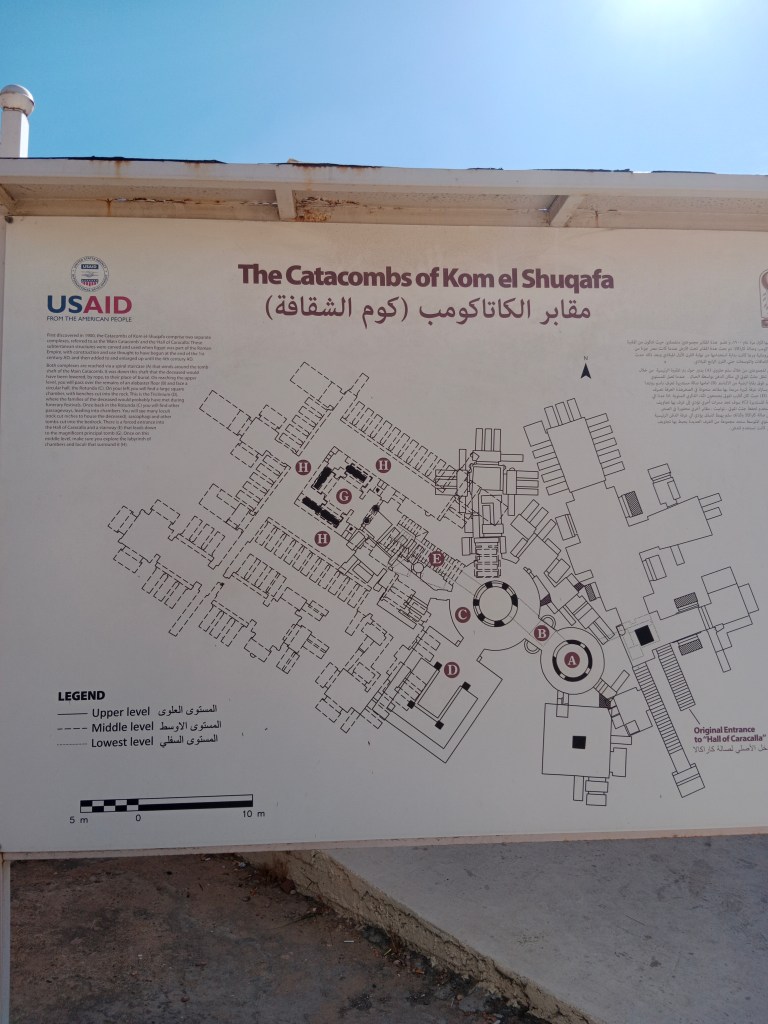
A board outside explains the layout of the tombs

The catacombs consist of three levels cut into solid rock and can be approached via a circular stairway going around the central shaft.

The winding stairway going around the central shaft

Standing at the bottom of the central shaft

There is a domed circular room called the rotunda with several portrait statues having multicultural elements.
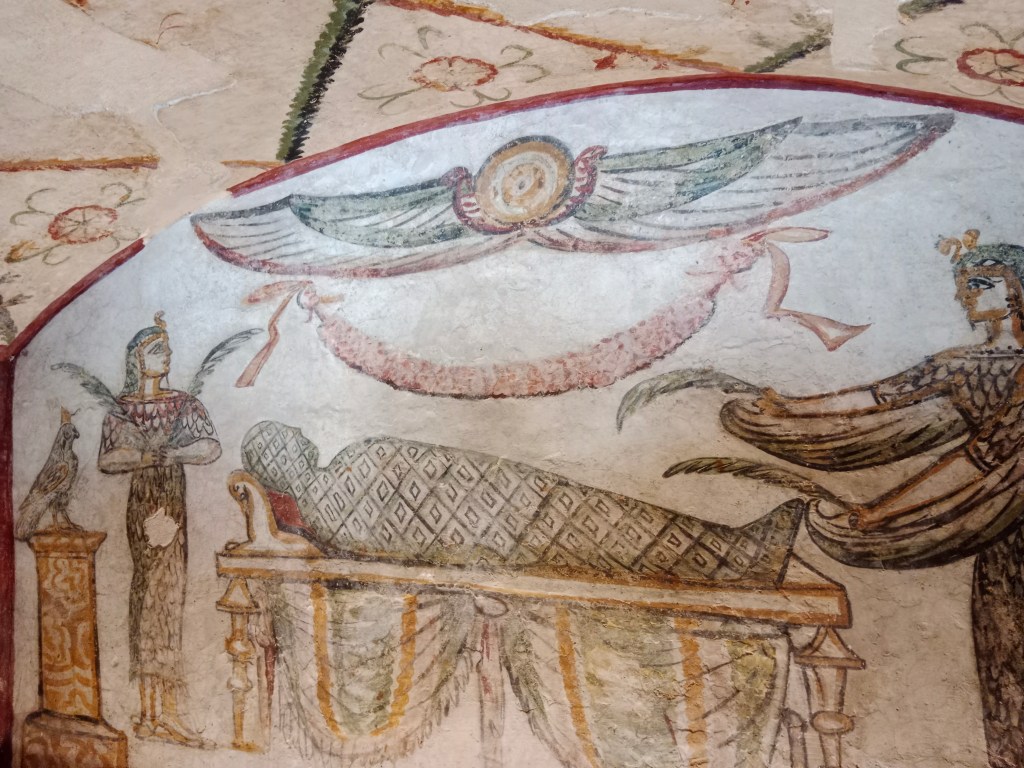
A mummification painting showing multicultural features

The Medusa head on the ceiling appearing to guard the chamber

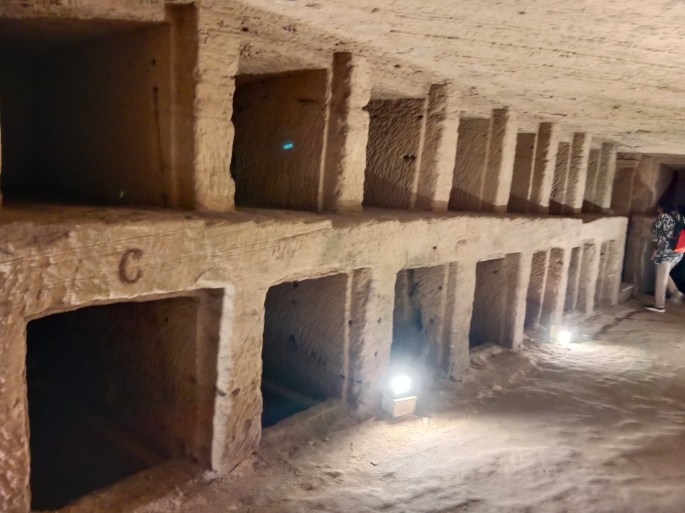
There are multiple burial recesses at various levels.

The hall and the tomb chambers

A hall with multiple pillars with a flight of stairs leads to the principal tomb chamber
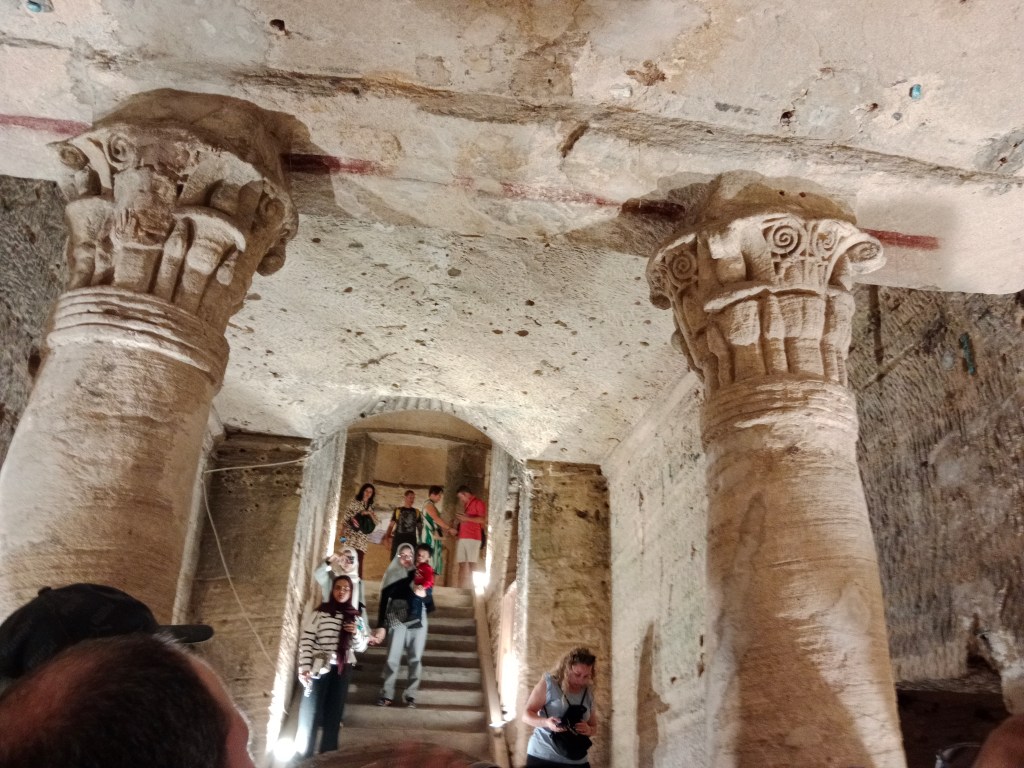
The hall with pillars leading to the stairway towards the principal tomb chamber

The Principal Tomb chamber

There is a temple like facade in front of the principal tomb chamber with the winged sun disc decorating the top .

Two columns flanking the entrance have a snake sculpture showing features of Greek ,Roman and Egyptian architecture and topped by a shield decorated with the Medusa. The imagery is believed to be to ward off grave robbers.

The entrance with the winged sun disc on top and snake and Medussa at the side.

The tomb chamber is decorated with the sculpture of the jackal headed God Anubis (God of mummification) performing a mummification of a body on a lion headed bed. Vulture headed Gods supervise the process. The organs of the body are believed to have been removed from the body and preserved in jars called canopic jars.
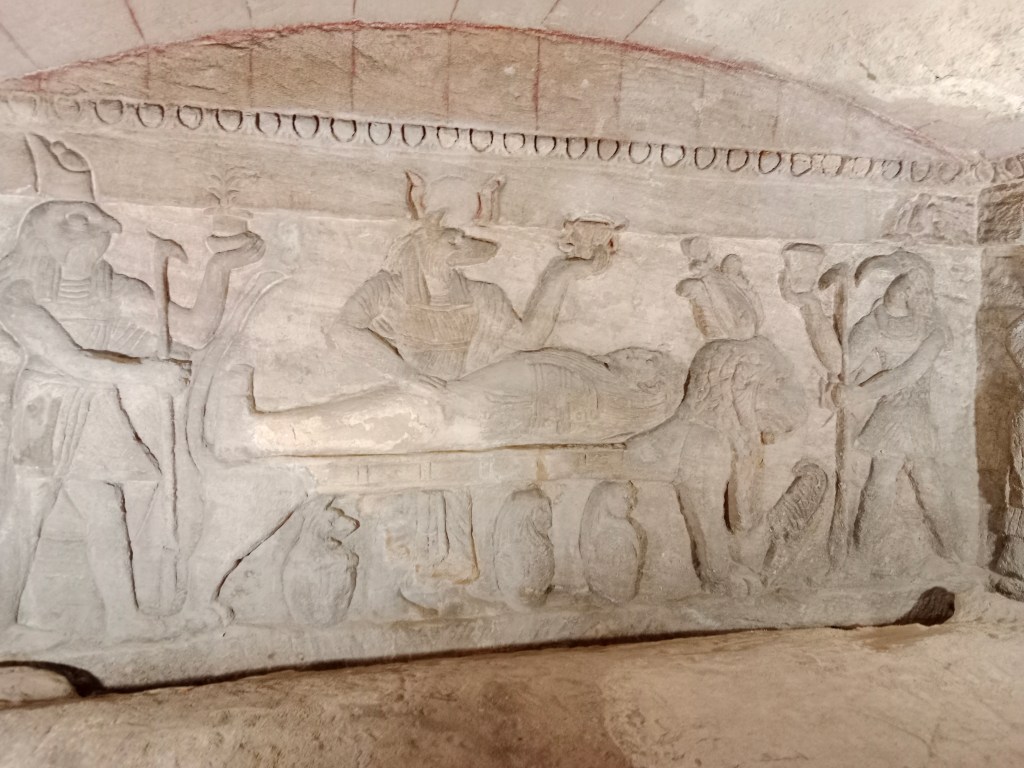
The central panel of the tomb chamber showing the jackal headed Anubis engaged in mummification process. Below the bed are three canopic jars used for organ preservation.

On either side are statues of a man and woman carved into the wall again showing mixed architecture. Greek and Roman characteristics with Egyptian decorations are typical of these statues conveying evidence of a multicultural society.

The statue of the lady on one side showing multicultural features

Along the sides of the chamber are three huge stone coffins with unremovable lids. Bodies are believed to have been inserted here through an outer passage way.

On going further down, there are chambers with multiple burial recesses presumably for the commoners.
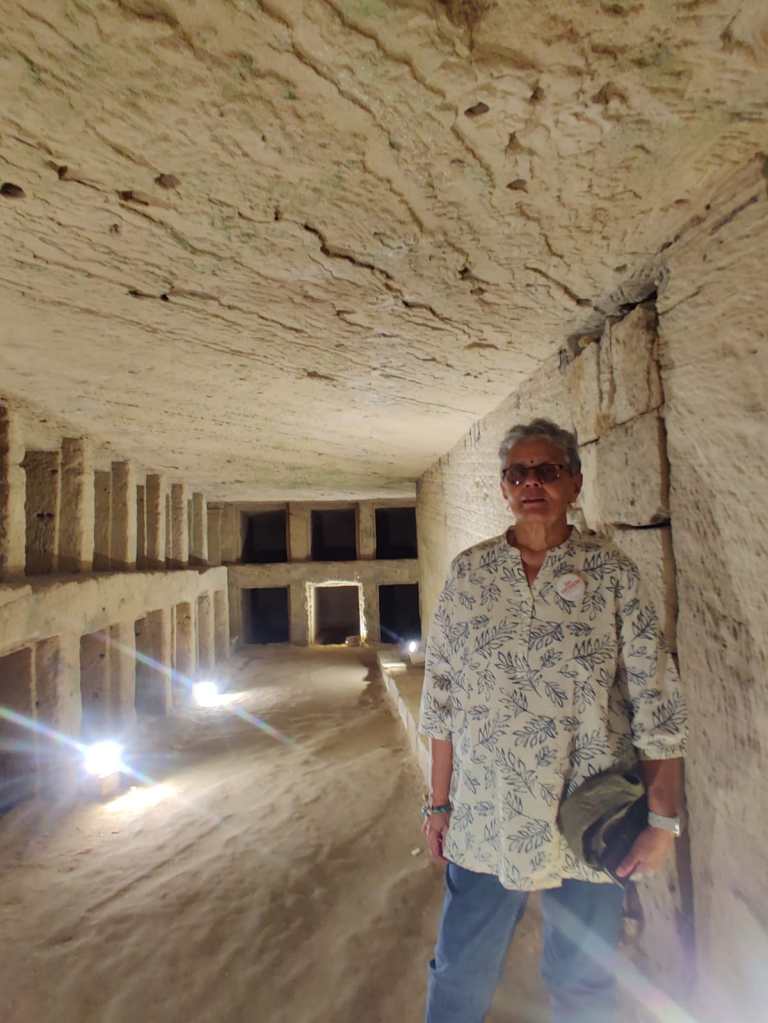
The hall with multiple burial recesses for commoners

I must admit that the place generates an eerie feeling as one goes from one burial chamber to the other. But the as yet preserved paintings and inscriptions are indeed a wonder.

With mixed feelings we exited the tomb chambers but not before a picture…
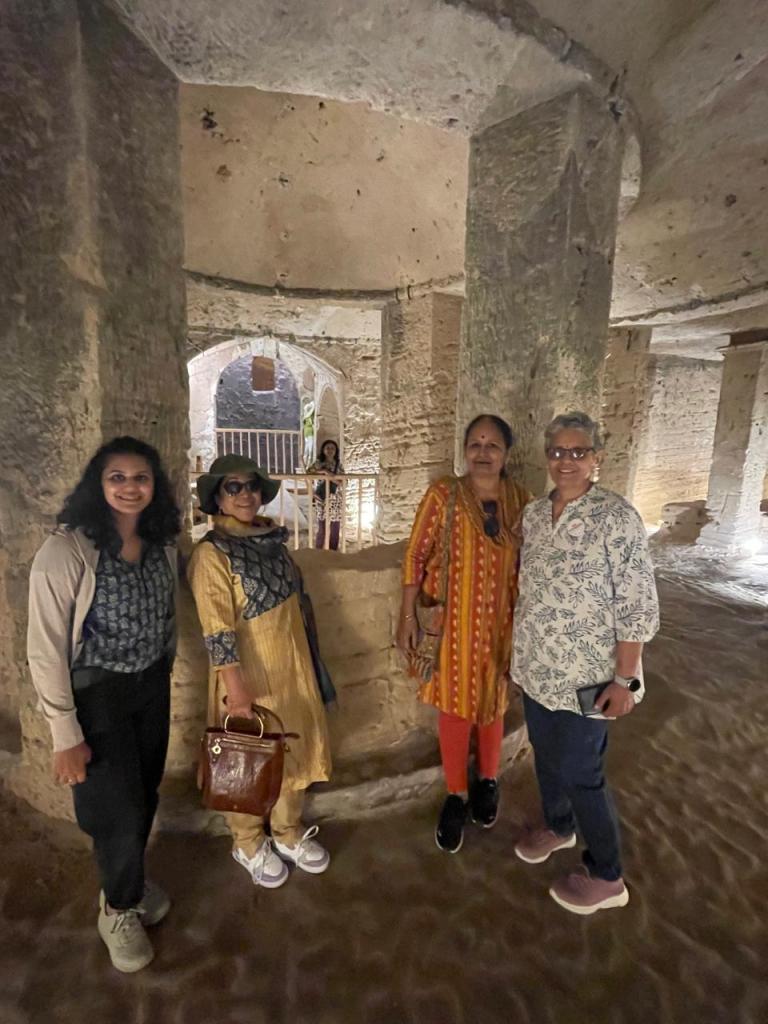
Time for a picture before we exited the tomb complex

We moved on to explore the other sights at Alexandria, which have already been covered in the last episode.

The contents of this episode call for an end on a somber note….so let me leave you with that.

See you at the Pyramids next week…

Till then, do subscribe, comment and give your feedback…

Exploring Alexandria: A Rich Tapestry of History

Our first destination at Egypt was Alexandria, the second largest city of Egypt lying on the Mediterranean coast. The city was founded by Alexander the Great around 330 BC and was the capital under Ptolemy and the other successors of Alexander including the period of Romans till the Muslim conquest of Egypt in 641 AD. It must be mentioned here that the city was also a major center of Christianity.

From the 18th century, it grew to be a major industrial center and shipping hub due to the proximity to the Suez Canal.

Multiple invasions and wars had ensured that most of the ancient city has been destroyed and what we see today is whatever little was left and what has been rebuilt in modern times. Many of the historical and architectural monuments we visit today at Alexandria are the result of excavations and attempts at conservation.

The most important sight is the underground tomb complex dating back to the 2nd and 4th centuries known as the Catacombs which we visited. That requires more detailed description and will be covered in the next episode. In this episode, I will cover the other interesting details of Alexandria.

Our Visit

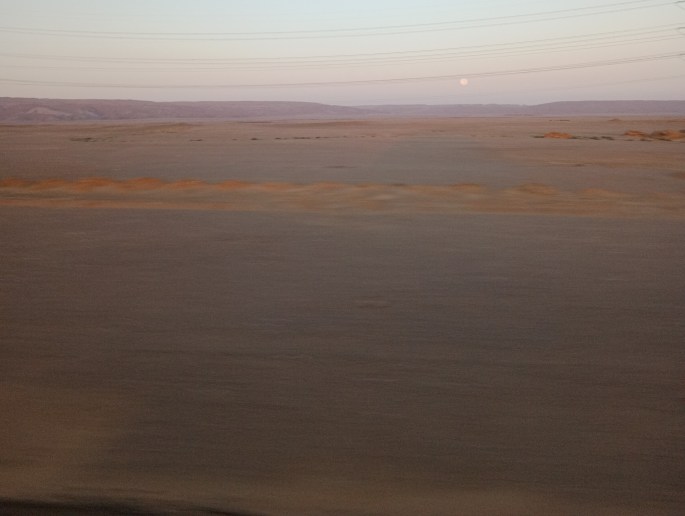
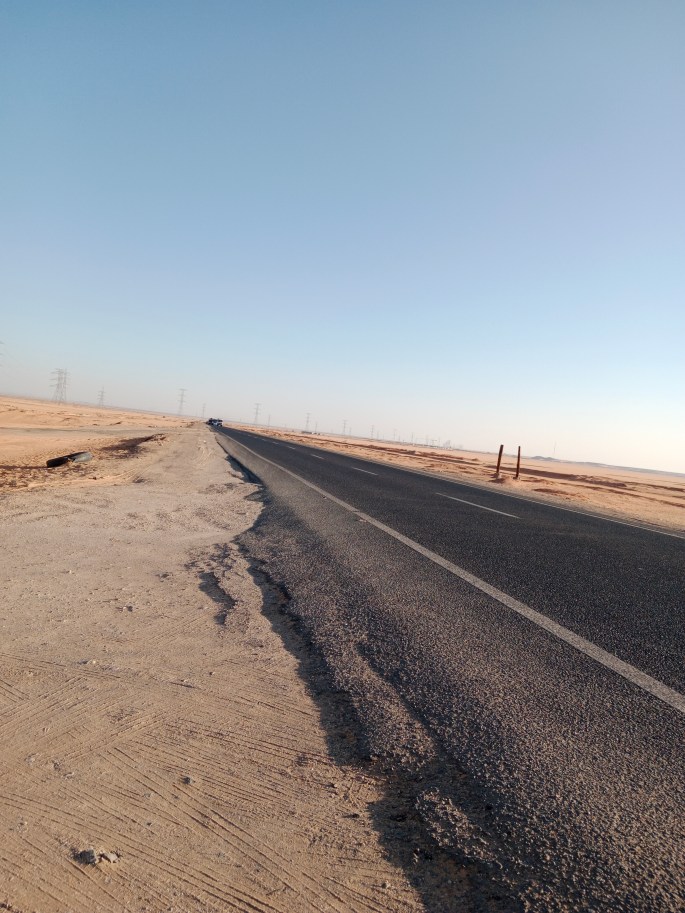
Driving down from Cairo, Alexandria is 220 kms away and it took us around 3 hours to cover the distance. Most of the drive was through open desert land and the landscape looked daunting.

The vast desert….

The road through the desert

Enroute, we had a small refreshment halt ….

The stop enroute….like an oasis!!

We came across small towns all along.

A typical street scene in an Egyptian town

As we reached the outskirts of Alexandria, the streets looked more like that of any modern city.

Approaching Alexandria.

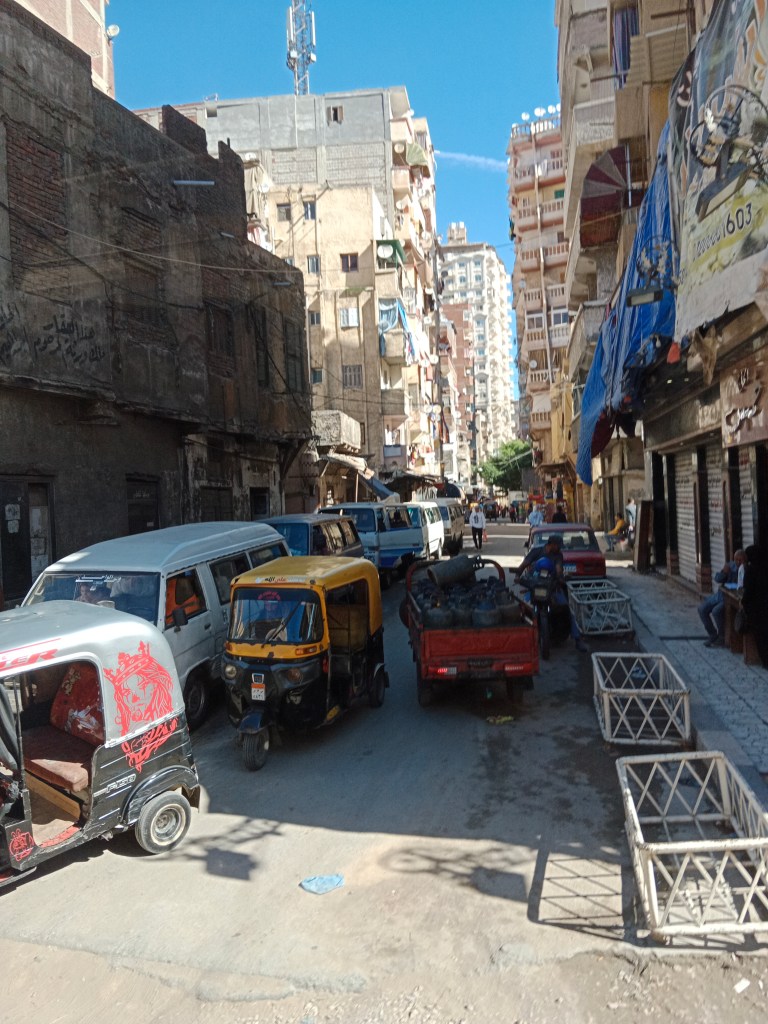
Once we left the main part of the city, the appearance was generally like that of an under developed country with narrow crowded streets, unfinished and unclean exteriors of buildings .

Typical street scenes in Alexandria

Driving through the narrow streets, we reached Pompey’s pillar.

Pompey’s Pillar

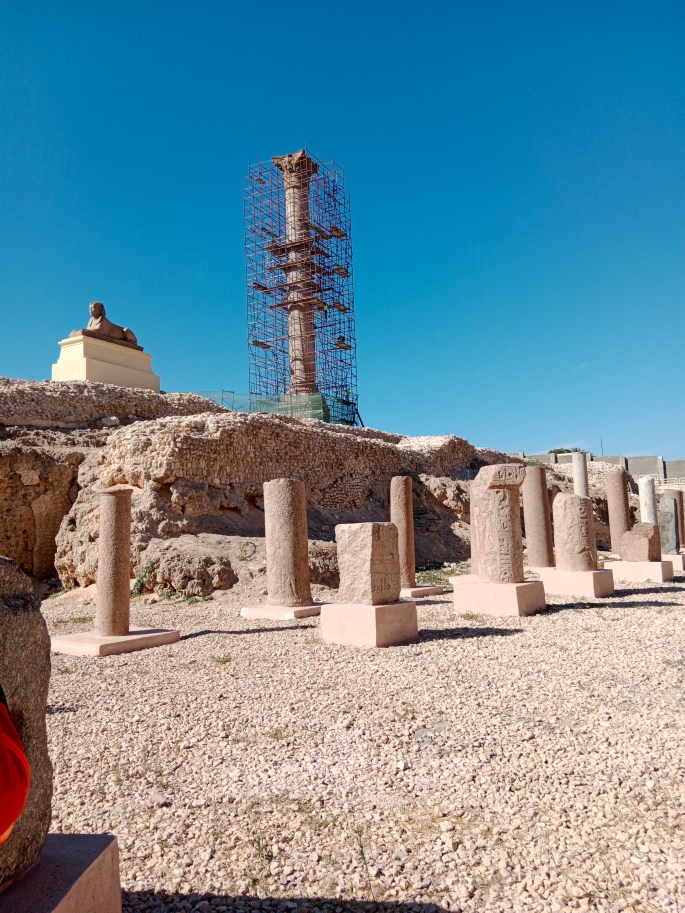
A reminder of the Roman past of this area, it is a triumphal pillar in honor of the Roman emperor Diocletian built between 298 and 302 AD consisting of a monolithic Corinthian column . This column once had the statue of the emperor atop it. There are two sphinxes , one on either side of this column.

This monolithic column is 26 mts tall and held a 7 mts tall statue of the emperor on top and is made of pink granite. There are some Greek inscriptions at the lower part of the column.

The connection of this pillar to the Roman politician Pompey is not yet clear though it was believed in the Middle Ages that the his ashes were in a pot on the column.

The Pompey’s pillar and the Sphinxes (under renovation)

The entire area surrounding this column consists of the ruins of the Serapeum, an ancient Greek temple dedicated to the God Serapis. The God Serapis has a mix of characters of the Egyptian Gods, Osiris and Apes and Greek Gods Zeus and Dionysus.

The temple is believed to have been looted and what remains today are only the ruins….some broken pillars and stones. There are underground tombs too.

The ruins of the Serapeum

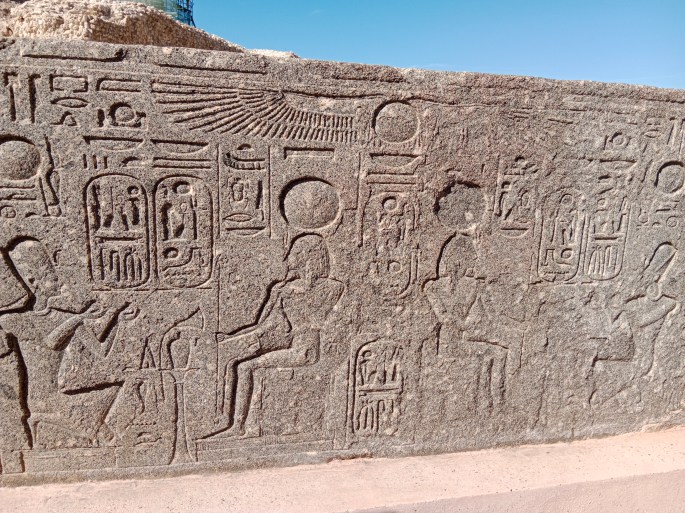
Heiroglyphic inscriptions

After visiting Pompey’s Pillar, we proceeded for lunch at a local restaurant with views of the Mediterranean sea.

Lunch with a Mediterranean view….

Our next halt at Alexandria was at the Library.

Bibliotheca Alexandrina

This is actually a library and cultural center overlooking the Mediterranean Sea at Alexandria. There was an ancient library in Alexandria which was one of the largest in the world. The revived library inaugurated in 2002 contains space for eight million books and a reading area of 20000 sq mts on eleven cascading levels. It also houses a conference center, specialized libraries for the blind, museums, art exhibitions and a manuscript restoration library and a planetarium.

The outer wall is made of grey granite with inscriptions in 120 languages.

The exterior of the main building with inscriptions in 120 languages

Once inside, there is a model describing the unique shape of the building.

The model depicting the unique shape of the building

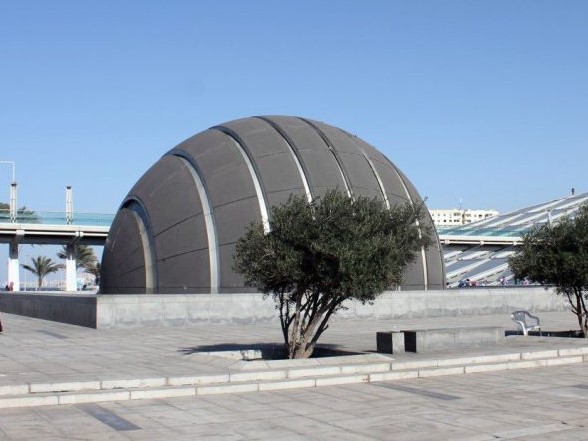
The planetarium at the complex

The main reading room stands below a glass roof shaped like a sundial illuminating the room equally throughout the day.

The spacious reading room

Sharing some pictures of the exhibits in the museums

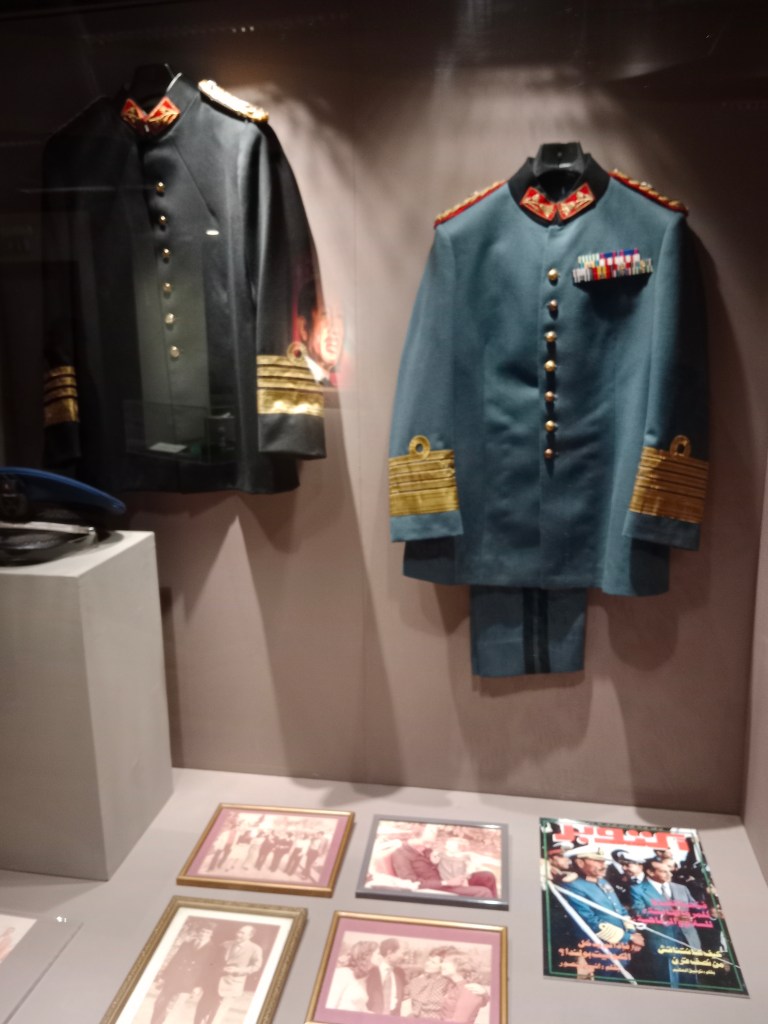
Bust of President Sadat and some of his personal items in the Sadat Museum

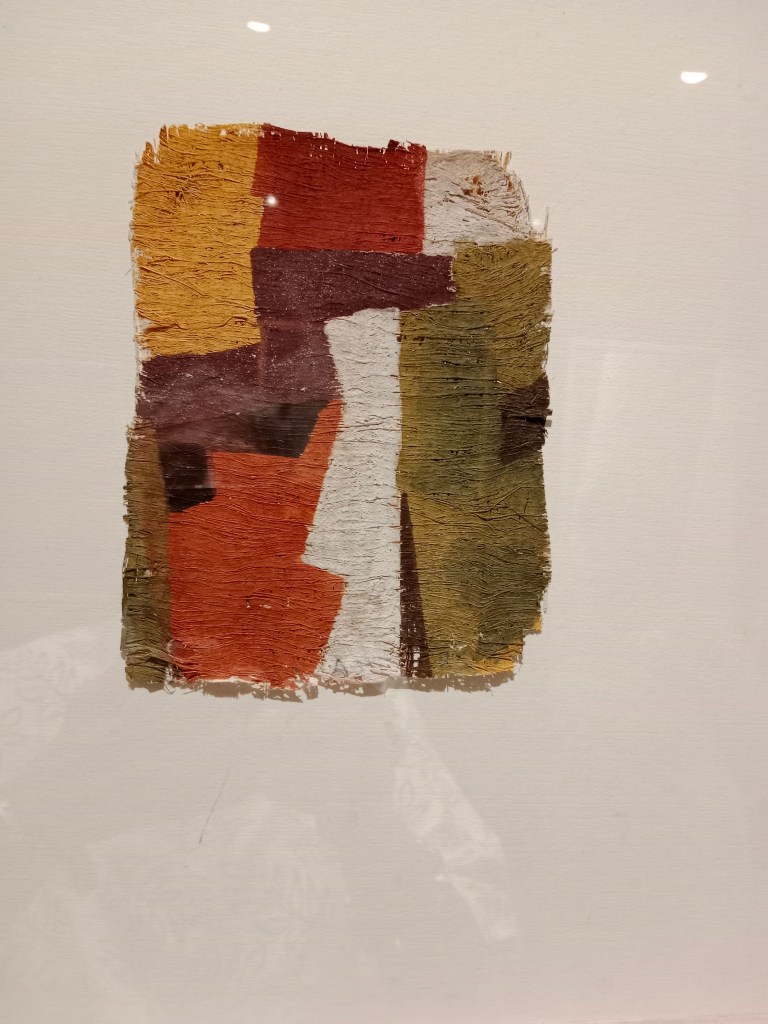
Bedouin jewellery and a papyrus painting

One other unique display was of the covering of the Kaaba (holy shrine) of Mecca.

The covering of the holy shrine in Mecca

Driving from the library towards the Citadel of Alexandria, the views of an Alexandrian evening by the sea were beautiful…

An Alexandrian evening by the Mediterranean

Qaitbay Citadel

The Qaitbay Citadel or the Citadel Of Alexandria is a defensive fortress on the Mediterranean coast. It lies at the site of The Lighthouse of Alexandria which was one of the wonders of the Ancient World.

The lighthouse of Alexandria called the Pharos of Alexandria was built during the reign of Ptolemy II (280-247 BC). It was one of the tallest man made structures of that time .The lighthouse was damaged during multiple earthquakes that rocked the area between the 11th and 14th centuries.

The citadel was built at that site by the Mamluke Sultan Qaitbay in the 15th century as part of his coastal defense against the Turks. It functioned under the Ottomans but gradually fell into neglect. In the 20th century, the Egyptian Antiquities council restored it. An Egyptian Maritime Museum also functions here now.

The Citadel as seen across the bay

The entrance leads to a central courtyard, with the main fort towards the sea.

As one enters

The central courtyard

The main structure is a square building with towers on the four corners giving it the typical look of a fort. There are three levels and windows at different levels for shooting in case of attack.

The Citadel located on the seaward side of the central courtyard

Inside the main building are a series of halls and corridors with distinctive architectural style.

As one goes up the ramp built along the side, one reaches the seaward side offering great views of the Mediterranean sea.

The ladies pose for a picture with the Mediterranean sea behind.

By then, the sun was setting on Alexandria and we had a long drive back to Cairo. So we all got back into the bus and reached Cairo looking forward to another exciting day of the tour…. to the catacombs of Alexandria

See you next week at the catacombs. Till the, do give your comments and feedback.