Hatshepsut: The Powerful Female Pharaoh of Egypt

Fancy a female Pharaoh? Well, this episode is about a powerful female pharaoh who ruled ancient Egypt. First let us get to know more about this lady, and then we shall visit the temple she built for herself.

Pharaoh Hatshepsut was the daughter of Thutmose I and during her teenage years was married to her half brother Thutmose II . After his death, the two year old Thutmose III inherited the throne and she ruled as regent for a son who was not her own.

The lady pharaoh went against the traditional patriarchal systems and cleverly established female kingship. In order to establish herself as the pharaoh, she started depicting herself as a male pharaoh. Like most pharaohs, she recorded her accomplishments and assumed all symbols of pharaonic position including the traditional false beard. Her rule was one of the most prosperous times of the Egyptian civilization. She was the second female pharaoh in Egyptian history but more powerful than her female predecessors.

One of the most prolific builders of ancient Egypt, she constructed several temples and the masterpiece was her mortuary temple that we call the temple of Hatshepsut today. Building Osirian statues of themselves was common to most pharaohs and she was no exception.

Towards the end of the reign of Thutmose III, an attempt to remove her from historical records was made and many of her statues were removed or defaced.

Our trip

From the Valley of Kings, located in the Theban hills, we proceeded to this temple located close by. This is a mortuary temple built by Hatshepsut facing the Karnak temple across the Nile. The specialty of this temple are it’s three terraces at different levels with porticoes lined by columns.

Reaching the Temple

The foreground has statues of Hatshepsut as a sphinx. This was part of her attempts to establish her kingship by portraying herself as powerful.
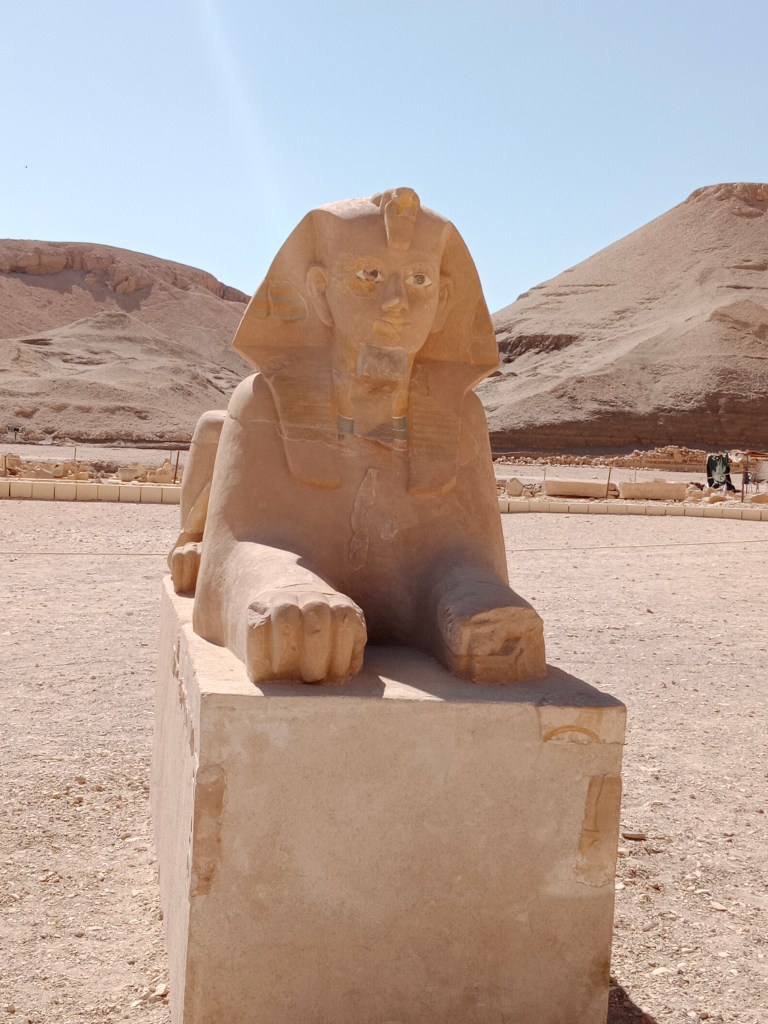
Sphinx of Hatshepsut
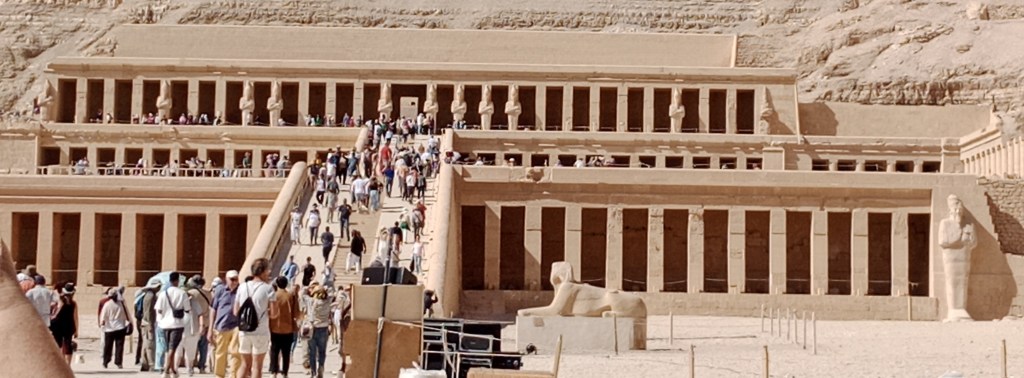
The three levels of terraces with porticoes lined by columns and statues at the ends.

The balustrade along the passage to the main temple has the falcon headed God Horus.

The falcon headed God Horus at the balustrade

The lower terrace has 22 columns and features reliefs on the walls. These reliefs depict the part played by her in putting up obelisks at the Karnak temple, offerings to various Gods and Hatshepsut as a sphinx defeating the enemies .

Reliefs showing offerings to Horus by Hatshepsut

The middle terrace also has porticoes lined by columns and decorated with reliefs mainly relating her to God Amun Ra, thus legitimizing herself as a ruler. A shrine dedicated to the cow headed God Hathor is also located here.

Offerings to the jackal headed God Anubis

The cow headed God Hathor

The upper terrace also has porticoes lined by columns but the highlight are the massive statues of Hatshepsut.
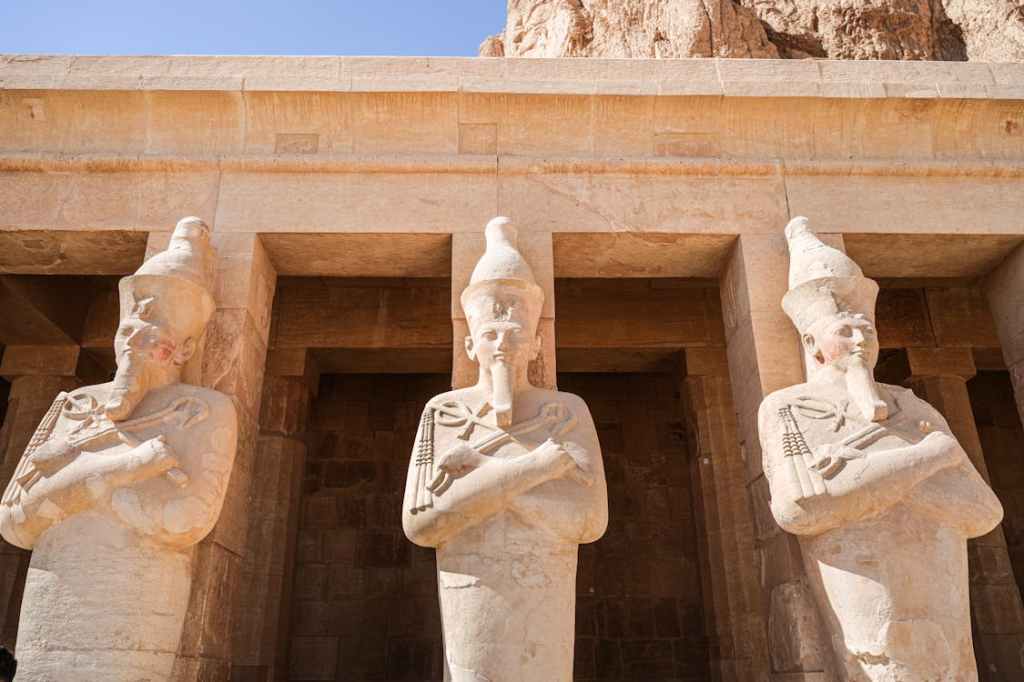
Hatshepsut statues on the upper terrace

Moving down from the terraces, we walked on to the foreground where there are still a lot of ruins and extensive restoration work was going on.

Ruins surrounding the temple

Another monument we visited near the Valley of Kings was the Colossi Of Memnon.

These are two massive stone statues of the Pharaoh Amenhotep III, which stand at the front of the ruined Mortuary Temple of Amenhotep III, the largest temple in the Theban Necropolis. Both statues are quite damaged, with the features above the waist virtually unrecognizable. Earthquake and floods have ensured that with the exception of the Colossi, nothing remains today of Amenhotep’s temple.

Colossi of Memnon with the ruins of Amenhotep’s temple in the backdrop

After the exhausting visit to the Valley of Kings and Hatshepsut’s temple, we were all tired and hungry and so we proceeded to an Indian restaurant in Luxor for lunch.
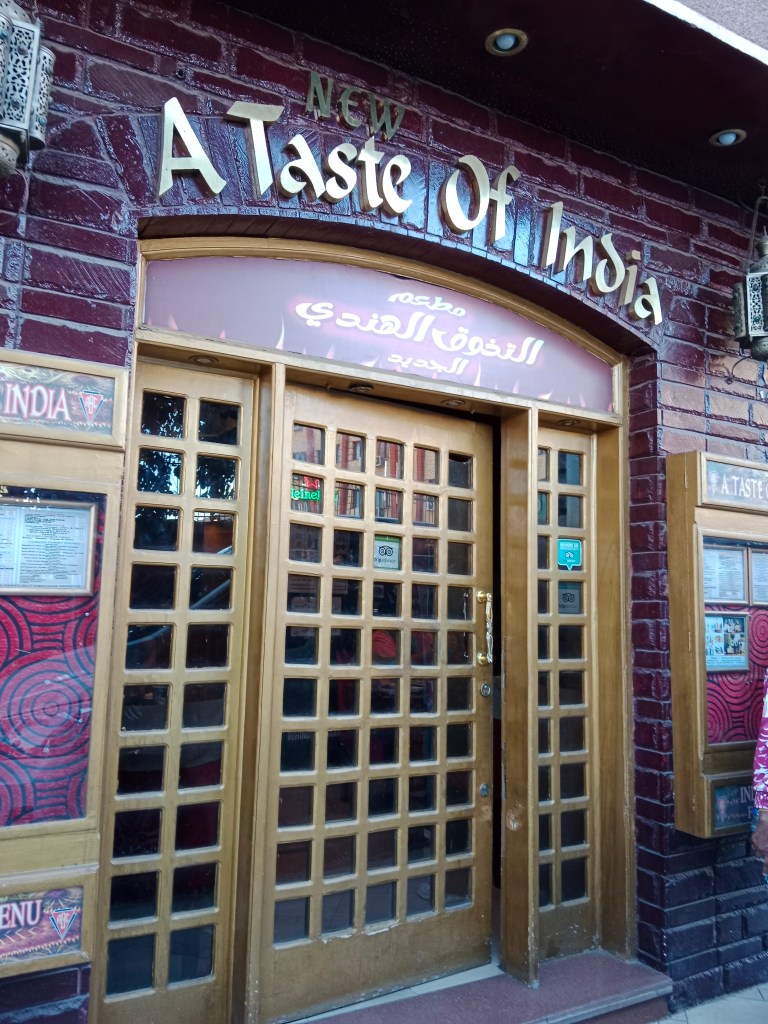
A taste of India at Luxor….

Post lunch we explored Luxor market .

A riot of colors at the Luxor market

Making few quick purchases, we headed to the airport to fly back to Cairo.

Next week, we explore Cairo. Till then, do subscribe, give your comments and feedback.
Uncovering Alexandria’s Hidden Catacombs

Our first destination in Egypt was Alexandria and the last episode covered most of the sites we visited. However, the catacombs or underground tombs in the outskirts of Alexandria is where we are going today. Join me…

An insight into the catacombs of Kom El Shoqafa

These catacombs are essentially underground tombs widely believed to have been used between the 2nd and 4th centuries . It was initially intended as the burial facility for one family but it is still not clear how it went on to house numerous other tombs.

An accidental discovery; these ancient tombs are one of the most important archaeological sites here. A donkey wandering along, accidentally fell into the shaft of these tombs and they were discovered while rescuing the donkey. It stands as an excellent example of a combination of Greek , Roman and Egyptian architecture

Soon after this discovery, archaeologists started excavations and found the spiral staircase going around the shaft. At the bottom was a domed circular room known as rotunda.

The term Kom El Shoqafa in Arabic means “Mounds of Shards”. When discovered , the area was strewn with broken clay pots and containers and hence the name. It is believed that the relatives of the dead who visited the tombs carried food and wine for their kin and after offering it to them, broke the pots there leading to the accumulation of such debris.

Our Visit

Reaching the excavation site, we were quite intrigued by the presence of apartment dwellings adjacent to the site. In fact, the whole area is like a courtyard surrounded by buildings; most of them dilapidated .

The central courtyard around which the tombs are located with dwellings surrounding it.

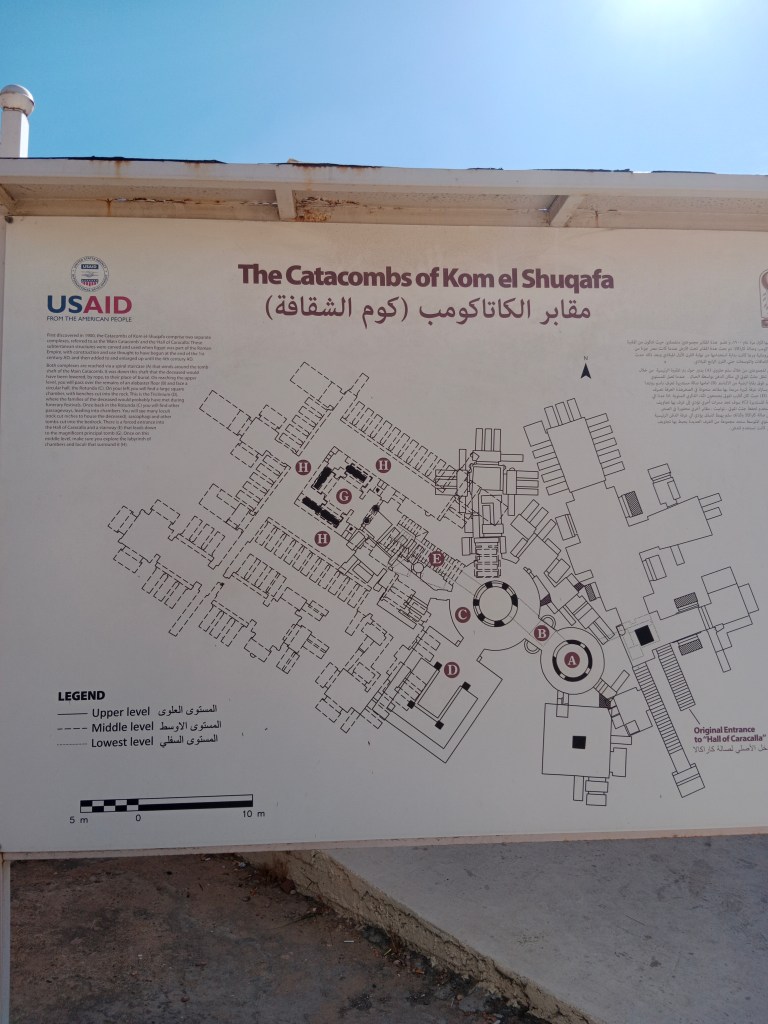
A board outside explains the layout of the tombs

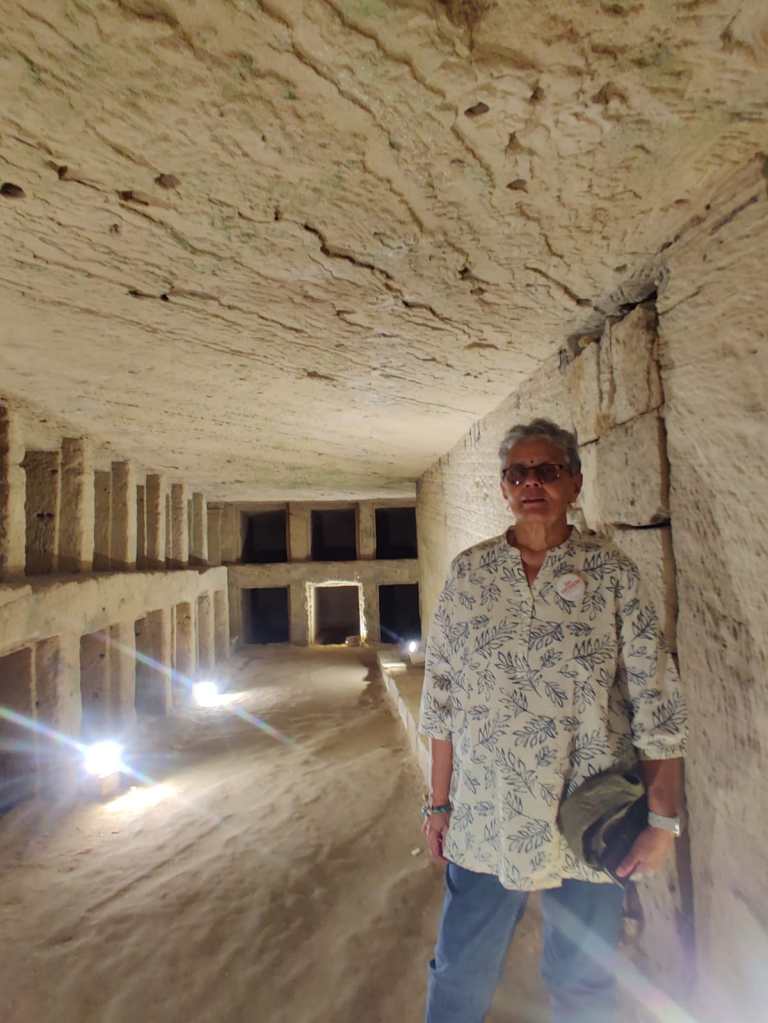
The catacombs consist of three levels cut into solid rock and can be approached via a circular stairway going around the central shaft.

The winding stairway going around the central shaft

Standing at the bottom of the central shaft

There is a domed circular room called the rotunda with several portrait statues having multicultural elements.

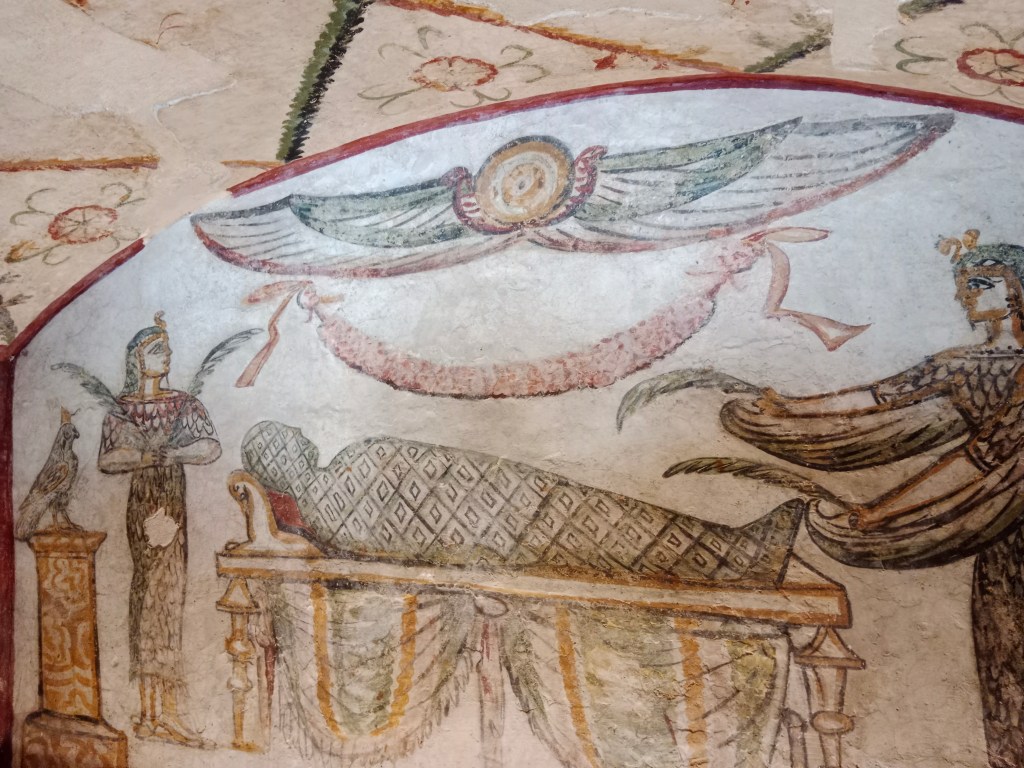
A mummification painting showing multicultural features

The Medusa head on the ceiling appearing to guard the chamber

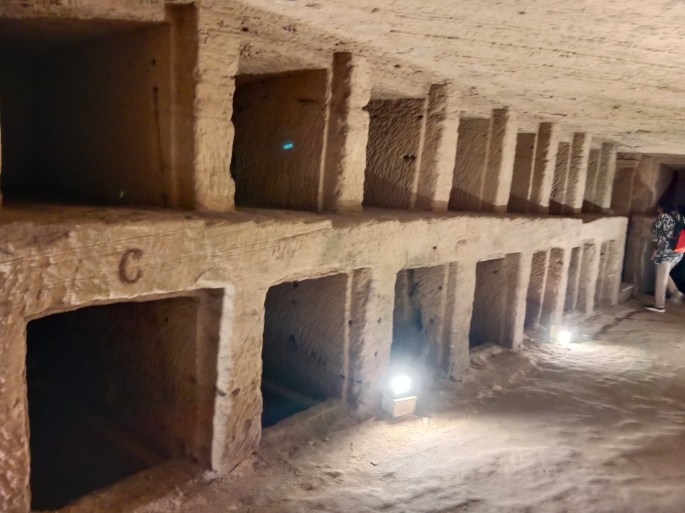
There are multiple burial recesses at various levels.

The hall and the tomb chambers

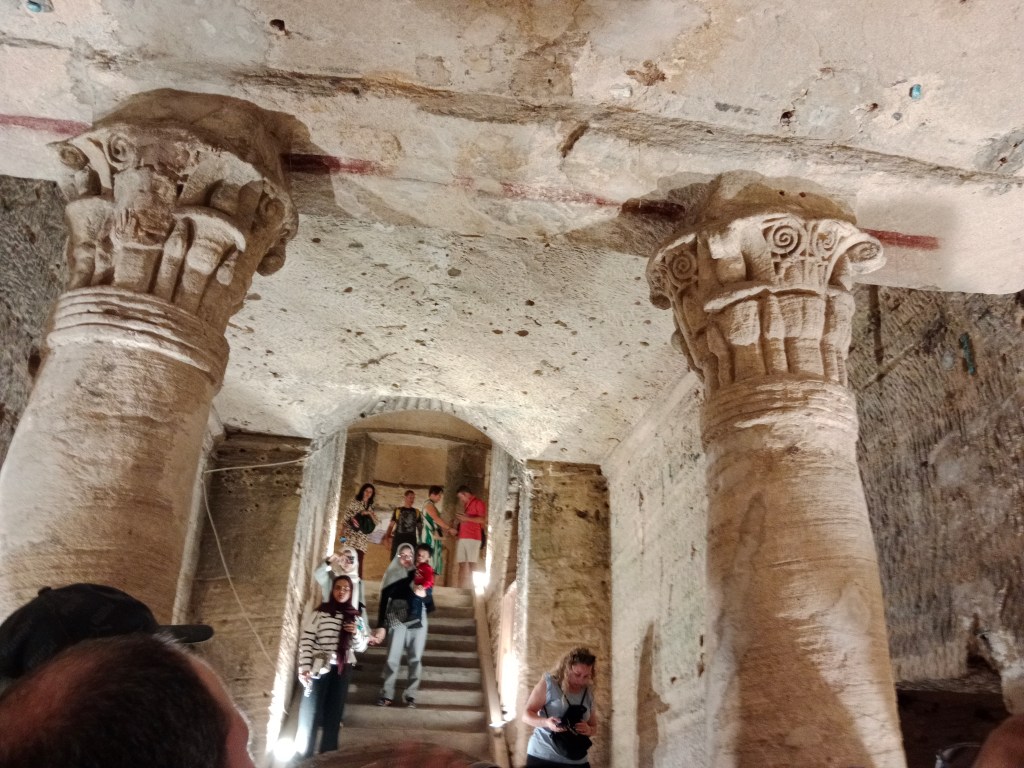
A hall with multiple pillars with a flight of stairs leads to the principal tomb chamber

The hall with pillars leading to the stairway towards the principal tomb chamber

The Principal Tomb chamber

There is a temple like facade in front of the principal tomb chamber with the winged sun disc decorating the top .

Two columns flanking the entrance have a snake sculpture showing features of Greek ,Roman and Egyptian architecture and topped by a shield decorated with the Medusa. The imagery is believed to be to ward off grave robbers.

The entrance with the winged sun disc on top and snake and Medussa at the side.

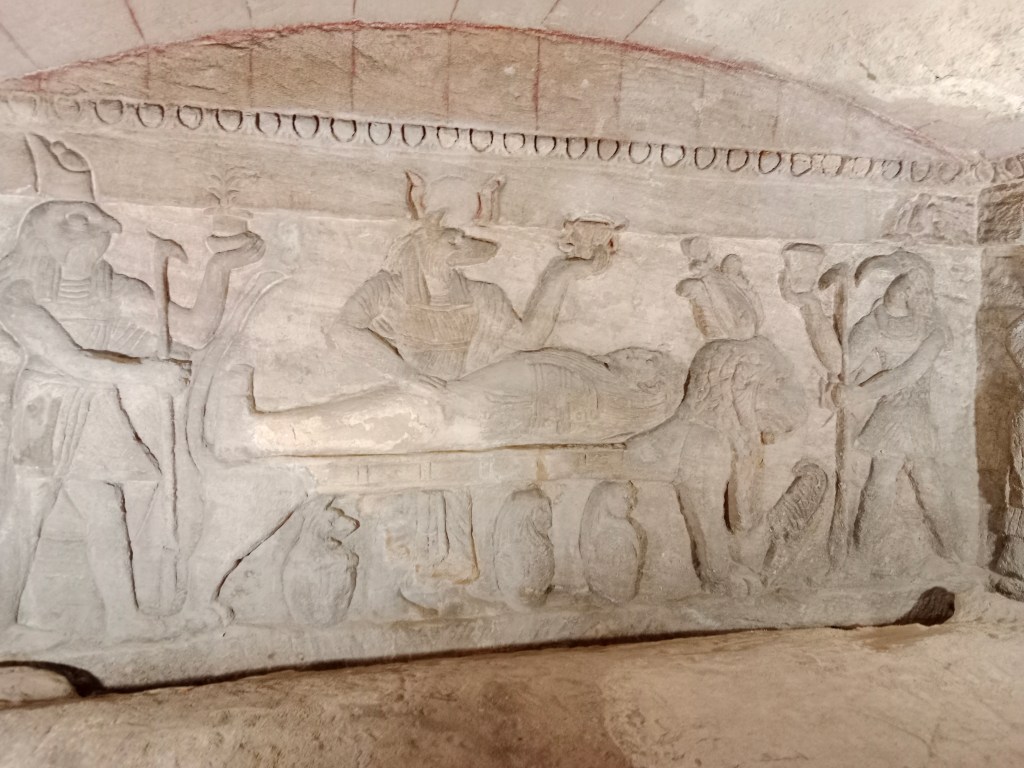
The tomb chamber is decorated with the sculpture of the jackal headed God Anubis (God of mummification) performing a mummification of a body on a lion headed bed. Vulture headed Gods supervise the process. The organs of the body are believed to have been removed from the body and preserved in jars called canopic jars.

The central panel of the tomb chamber showing the jackal headed Anubis engaged in mummification process. Below the bed are three canopic jars used for organ preservation.

On either side are statues of a man and woman carved into the wall again showing mixed architecture. Greek and Roman characteristics with Egyptian decorations are typical of these statues conveying evidence of a multicultural society.

The statue of the lady on one side showing multicultural features

Along the sides of the chamber are three huge stone coffins with unremovable lids. Bodies are believed to have been inserted here through an outer passage way.

On going further down, there are chambers with multiple burial recesses presumably for the commoners.

The hall with multiple burial recesses for commoners

I must admit that the place generates an eerie feeling as one goes from one burial chamber to the other. But the as yet preserved paintings and inscriptions are indeed a wonder.

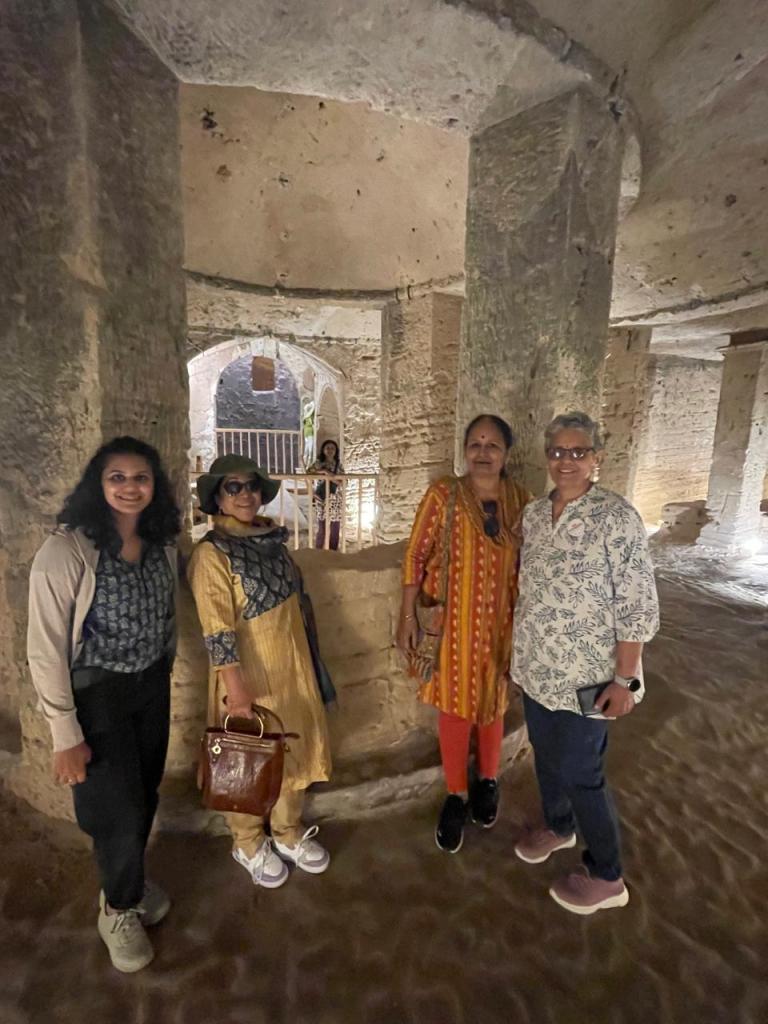
With mixed feelings we exited the tomb chambers but not before a picture…

Time for a picture before we exited the tomb complex

We moved on to explore the other sights at Alexandria, which have already been covered in the last episode.

The contents of this episode call for an end on a somber note….so let me leave you with that.

See you at the Pyramids next week…

Till then, do subscribe, comment and give your feedback…