
Once upon a time, in the 1600s, there was a fort in India with a vault storing some of the most precious diamonds of all time. The Kohinoor and Hope diamonds were among these stored here . Do you know which fort I am talking about? The historic Golconda fort located in Hyderabad.
At that time, India had the only known diamond mine in the world. These mines were located in the Guntur and Krishna districts in present day Telangana. These diamonds were cut and sold in the diamond market city of Golconda which lay inside fortressed walls. It was such a booming centre of diamond trade that the word “Golconda” became synonymous with great wealth and held a legendary aura about itself.
Today, if you visit Golconda, all that remains is the ruined walls of a fortress city , a far cry from the legendary aura that it once held. Ofcourse what remains of the walls and rooms does give the feel of pomp and splendour of the bygone era. Today, Golconda fort finds itself on the tentaive list of UNESCO to become a World Heritage site and is under the control of the Archaeological Survey of India.
Before I take you through the fort itself, a short history will help put things in perspective.
Golconda, a historical perspective
The fort itself was built in mud by the Kakatiya ruler, Prataprudra in the 11th century. It went from him to the Bahmani Kings and then on to the Qutub Shahi dynasty. It was under the Qutub Shahi dynasty that Golconda fort saw its expansion from the original mud walls to huge fortified granite walls and it became their capital. It was a great centre of cotton trade and cotton fabrics were even exported from there apart from the booming diamond trade .This brought great wealth to the Qutub Shahi rulers . This attracted the Moghuls and in 1687 , Aurangzeb led his army to the Golconda fort marking the beginning of Moghul rule in the region. After the fall of the Moghul Empire in 1724 , Golconda came under the Nizams of Hyderabad and subsequently after Indian Independence, integration of Hyderabad state occured.
Golconda Fort
As one drives in to Golconda fort, one passes through narrow crowded streets and suddenly encounters a fortified stone wall with an entrance. This is the Moti Darwaza and this wall is the outer wall of the fort stretching over a distance of 11 kms. We enter through this gate and continue to drive through narrow streets lined with old dilapidated houses and shops. People go about their daily lives in a hurry and I understand that this part of Golconda had the living quarters of the helpers of the rulers at one point of time and it is now home to their descendents. This was all part of the fortified city at one point in time.


The Moti Darwaza and the narrow streets that lie inside…
Continuing to drive along the narrow crowded streets, we reach an open area from where the actual fort can be seen. The inner part of the fort starts from here and this wall extends over a distance of 4 kms . It was within these walls that the royal family resided . After the tickets are purchased at the counter, one has to walk along a paved path with a manicured lawn on one side.
Then we reach an ornate doorway decorated with images of peacocks and lions indicative of the Hindu origins of this fort. The door is solid metal and looks very heavy. This is the BalaHissar gate.

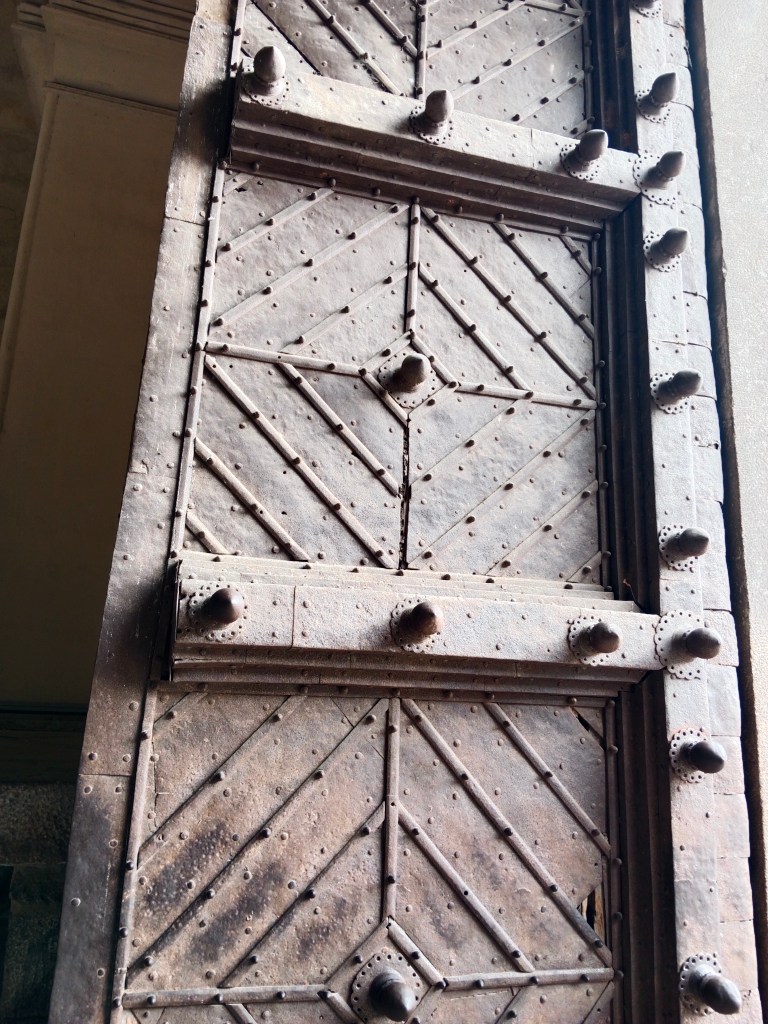
The ornate doorway and the huge metal door at BalaHisar gate.
After you cross the gate and walk ahead , almost the first thing you encounter is the Fateh Darwaza. This gate or darwaza has a cannon mounted on its wall and if one stands beneath the dome and claps one’s hand, the sound is supposed to reach the top. This is supposed to be a safety measure to warn the inhabitants of impending danger. The dome has geometric cuts along the walls which provide this acoustic effect which is one of the specialities of this fort.
Apart from this, there are a couple of places in the palaces of the fort where this unique acoustic system has been put to use.

Fateh Dawaza ……Note the geometric cuts on the ceiling giving the acoustic effect
Crossing this door and walking along a paved passage, one gets a view of major parts of the fort…..an overview of the place…

The first views of the entire fort…
The paved pathway and at places a wooden one guides one through the ruins of the fort.
To the left of the pathway is an ornate building with multiple arches called tha Aslah Khana. This was the place where arms and ammunition were stored.

Aslah Khana
Continuing further, we reach the area where the offices of the kingdom were located. This also has elaborate arches with a storage loft above to store documents.
Walking along further, we come across the barracks where the foot soldiers lived. Now, this is strategically located at the outermost part of the fort

Barracks
Soon we reach the palace area with the lawns in the centre and the palace on one side called the Rani Mahal .There is a courtyard with a stage on the opposite side where Taramati and Bhagmati , the court dancers used to dance and the royal family enjoyed it. The centre court also has a ruined fountain. The makeup room of the queen lies adjacent to this.
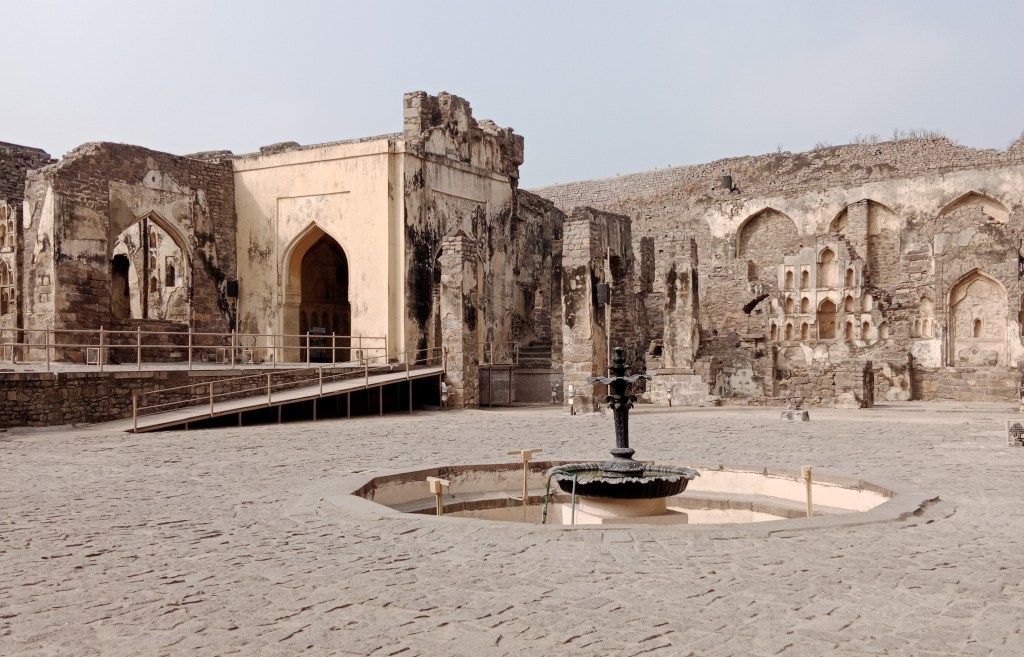
Rani Mahal with the open courtyard

The Queen’s bath and makeup rooms
At many places, one can see the dilapidated and broken pipelines used in those days. The water to Golconda was transported by canals from Banjara hills and pumped using wheels.
There are two mosques within the fort. The first one is the Taramati mosque used by the commoners and the other one is the Ibrahim mosque located at the top and used by the royalty.


The Taramati mosque (left) and Mosque of Ibrahim
Nagina Bagh
This is a landscaped garden which was once the diamond trading centre.

Nagina Bagh
A climb of more than 350 steps takes one to the top of the fort where the Durbar Hall is located. As we climb up, we come across Ramdas Prison where Bhakt Ramdas was imprisoned. He had used money from the kingdom to build a temple for Rama and that led to his imprisonment.
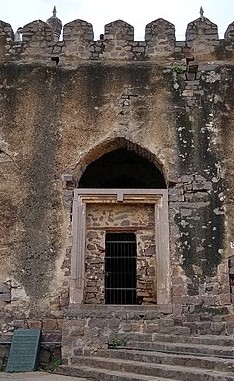
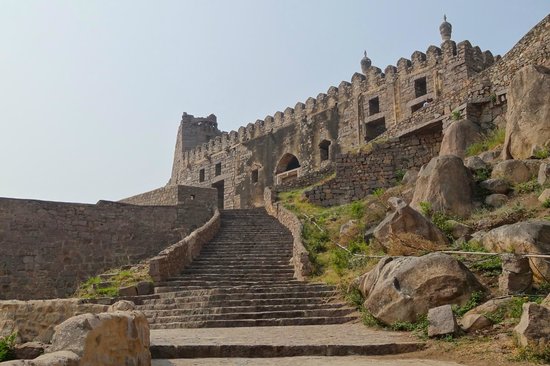
Bhakt Ramdas jail and the steps to the Durbar hall
Climbing up , we first come across the Jagdamba Temple which is more than 500 years old. Legend has it that Prataprudran , the Kaktiya ruler built this temple here and the fort was built from there downwards later on. Even today, worship takes place at this temple.

Jagdamba Temple
Baradari or Darbar Hall
This was where public audiences were held and there are two buildings Diwan I Aam and Diwan I Khas around an elevated central courtyard.

Baradari and steep steps leading to it
From the central courtyard which is the highest point of the fort, one can get a beautiful panoramic view of Hyderabad city. The famous Qutub Shahi tombs where the Qutub Shahi dynasty was laid to rest can also be seen from here. There is a secret underground tunnel from here that leads to the tombs and Charminar. In case of enemy attack, the royalty could escape to charminar and in case of death, the body would be secretly laid to rest at the tombs. Meticulous planning and execution to meet all exingencies indeed!!
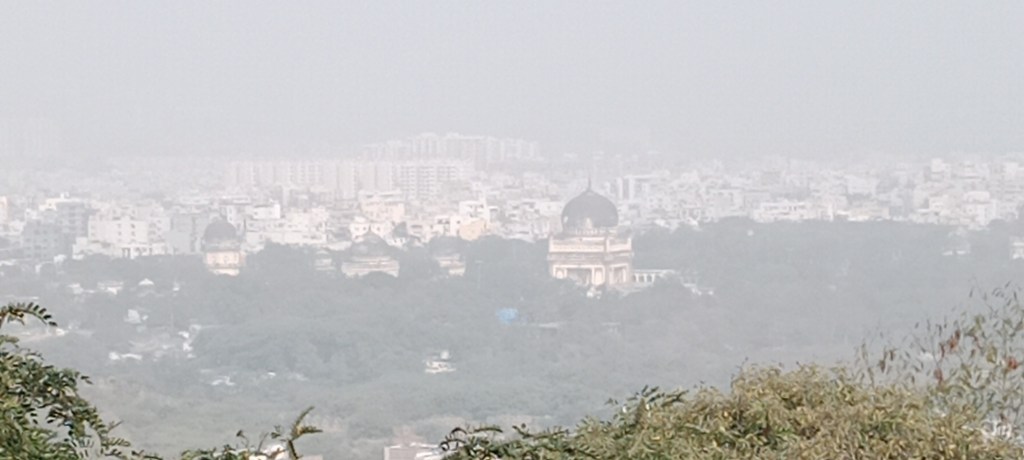
Bird’s eye view of Hyderabad and the domes of the Qutub Shahi tombs
A short rest in the darbar hall and a difficult descent down followed. The beautiful views of the fort as one descended compensated for the difficult trek. Some views…
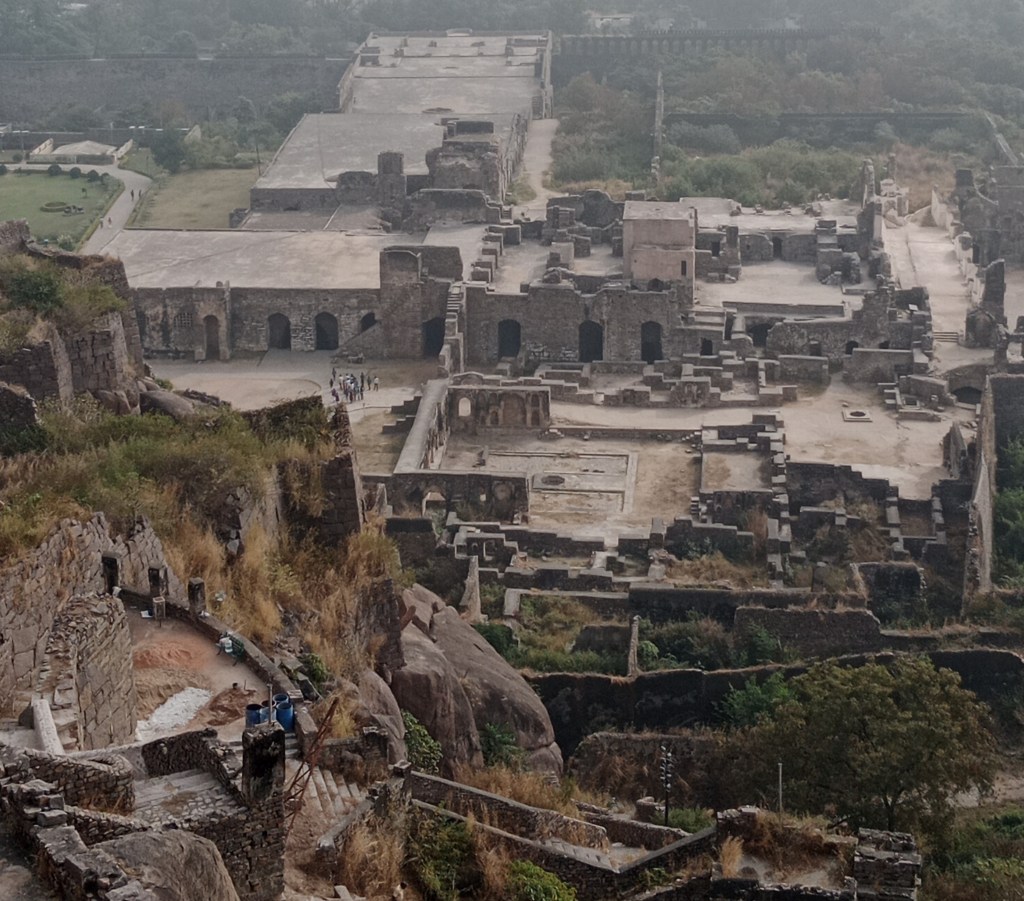

Panoramic views of Golconda Fort
Tired after the climb and descent, I was happy to meet my driver and board the cool comfort of the car .
This marks the end of the episode on the diamond fort but there’s more coming from Hyderabad. So do continue to comment and feedback till I reach you next…
 Travel-along.in