Starting the Meghalaya series with one of it’s unique attributes….the living root bridges.
Meghalaya’s Living Root Bridges are a natural wonder and have found a name in the tentative list of UNESCO world heritage sites . Meghalaya is a land of dense forests and the local Khasi tribes use living roots of trees to build natural bridges across rivers. It is in fact a kind of tree shaping where the delicate roots of the rubber fig tree (Ficus Elastica) are guided to form a bridge over a framework of bamboo.
One of the less highlighted features of these living root bridges are that they become stronger and more resistant with use unlike concrete bridges and are claimed to have a life of a few hundred years. As long as the tree grows strong and healthy, the roots forming the bridge also grow and thicken and hence the bridge becomes stronger with age.
These bridges are found extensively in the Khasi and Jaintia hills of Meghalaya.Most of these bridges are found on the steep slopes of the subtropical forests that cover these hills. Other Northeastern states like Nagaland are also home to these unique natural bridges.
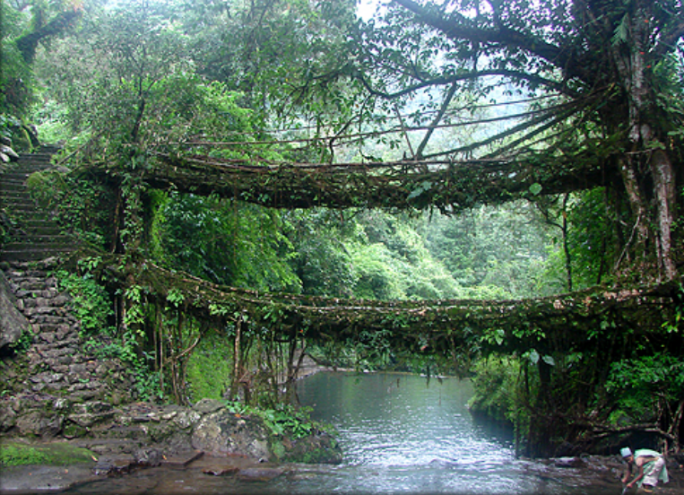
These bridges typically rise 50 to 100 feet above ground level and the longest one is claimed to be 175 feet long. Most of these bridges have only one level but there are unique double decker ones where they are at two levels .
How these bridges are made:
Some of these are made manually just by guiding the roots without the use of a scaffolding. Such bridges are smaller and continuous manipulation of roots is done making it a continuous process.
Using wood or bamboo scaffolding
A scaffolding of wood or bamboo is prepared and the roots are guided along this framework by wrapping the roots over the scaffolding. In these cases, the scaffolding may require replacement over time as they are made of perishable material. The roots grow along as long as the parent tree is alive.
Using Areca Palm Trunks
Here the delicate aerial roots of the Ficus Elastica tree are placed into the hollowed out branches of a type of palm tree. This provides the essential nutrition and protection and serves as a root guidance system. A bamboo framework supports the entire structure. Over time, as the aerial roots grow and become stronger, the palm support is not required. Stones, mud, timber planks and leaves are added gradually and this plugs the gaps. Over a few years (15 to 30), these bridges do not need the bamboo framework and can support weight by itself.
Using conventional structures
Sometimes these roots are guided along already existing steel wire suspension bridges. Here the time required for the roots to develop is immaterial as the framework is already present.
Care of these bridges
These bridges need to be constantly checked and cared for. The roots are trimmed and manipulated as per the requirement.
Visiting these living wonders
A visit to most of these bridges involves moderate amount of trekking. There are stone steps laid out but ultimately it is in the middle of dense forest and has its own challenges.
Importance of these bridges
The local villagers and farmers use it for transporting materials.
They are crucial for biodiversity as they promote growth of moss which provides habitat for squirrels, birds and pollinating insects.
They provide crossing opportunities for the wildlife in the forest.
Last but not the least, the whole exercise is a collaborative process and everyone is involved in the creation and maintenance adding to the sense of oneness , cooperation and involvement.
Our Visit
We visited two such bridges ; the first one was the Riwai root bridge at Nohwet village and the other was the double decker bridge at Nongriat near Cherapunji. A look at the pictures that follow will give you a better idea .
Riwai Living Root Bridge
Located a few kilometers from Mowlynnong, ( the cleanest village in Asia) ; a visit here required a short trek along a path with stone steps . It lies across the Thyllong river ( river of Gods) in a fairly densely forested area and is about 30 feet long. The trees that form this bridge were planted in 1840.

The stone paved passage leading to the bridge
A memorial plaque near the bridge highlights its features and also the importance attached to these natural bridges.
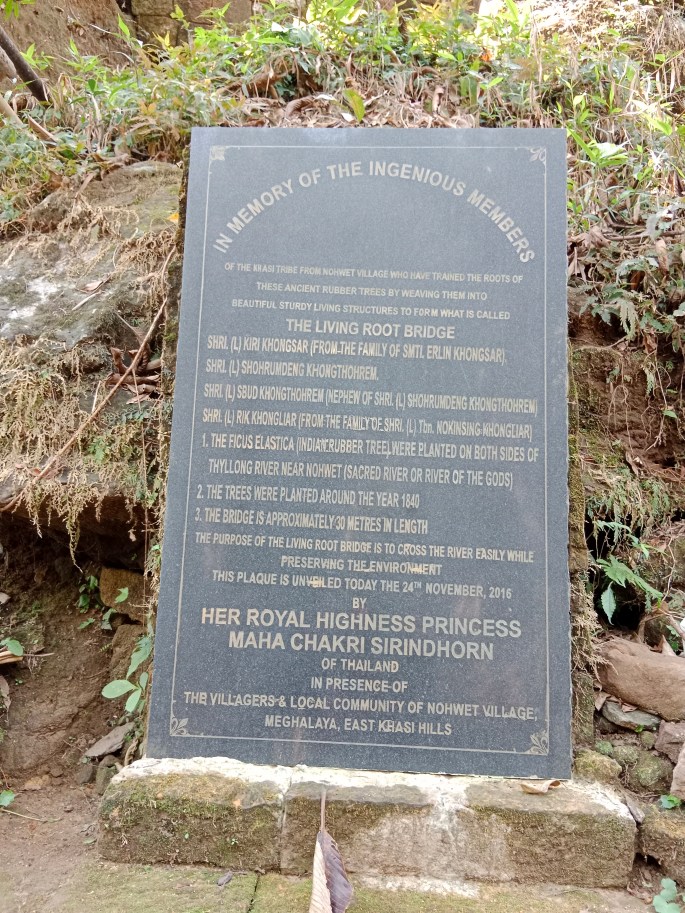
The memorial plaque
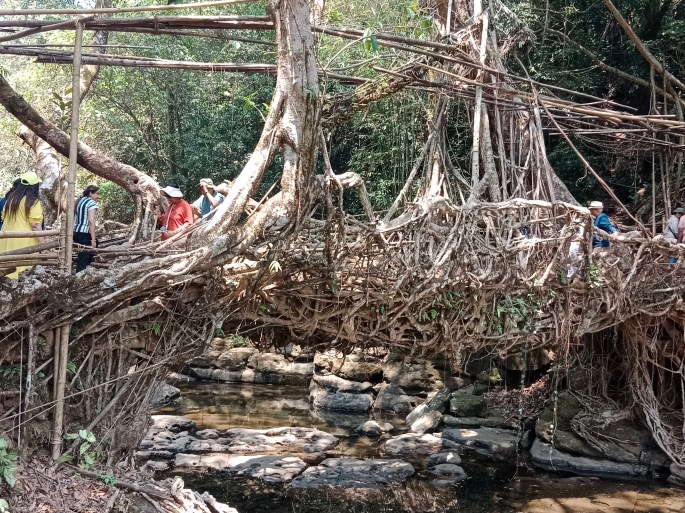

Long shot and closeup of the root bridge

Crossing the root bridge
Once you cross the bridge and proceed a few steps down, one reaches the Thyllong river where the rocks provide an access and a photo opportunity with the bridge in the back ground.

The Thyllong river with the rocky bed

Our group with the bridge in the background
The Double Decker Root Bridge
Located at Nongriat near Cherapunji, a trek to this is moderately challenging. It involves trekking down 3500 steps one way to reach the double decker bridge. The path is also paved but is fairly steep and many places. After reaching down, the trek up the 3500 steps can be really challenging and some of the trekkers had to use a doli towards the end. The whole trek lasted for almost eight hours.
Some pictures…


The Double decker bridge with some of our trekkers on it
A video showing one of the trekkers crossing the bridge

One of the trekkers cools her heels in the river below
I hope you have got a fair idea of the root bridges of Meghalaya. See you next week with more such natural wonders from the land of clouds.
Till then, do subscribe, give your comments and feedback.
 Travel-along.in