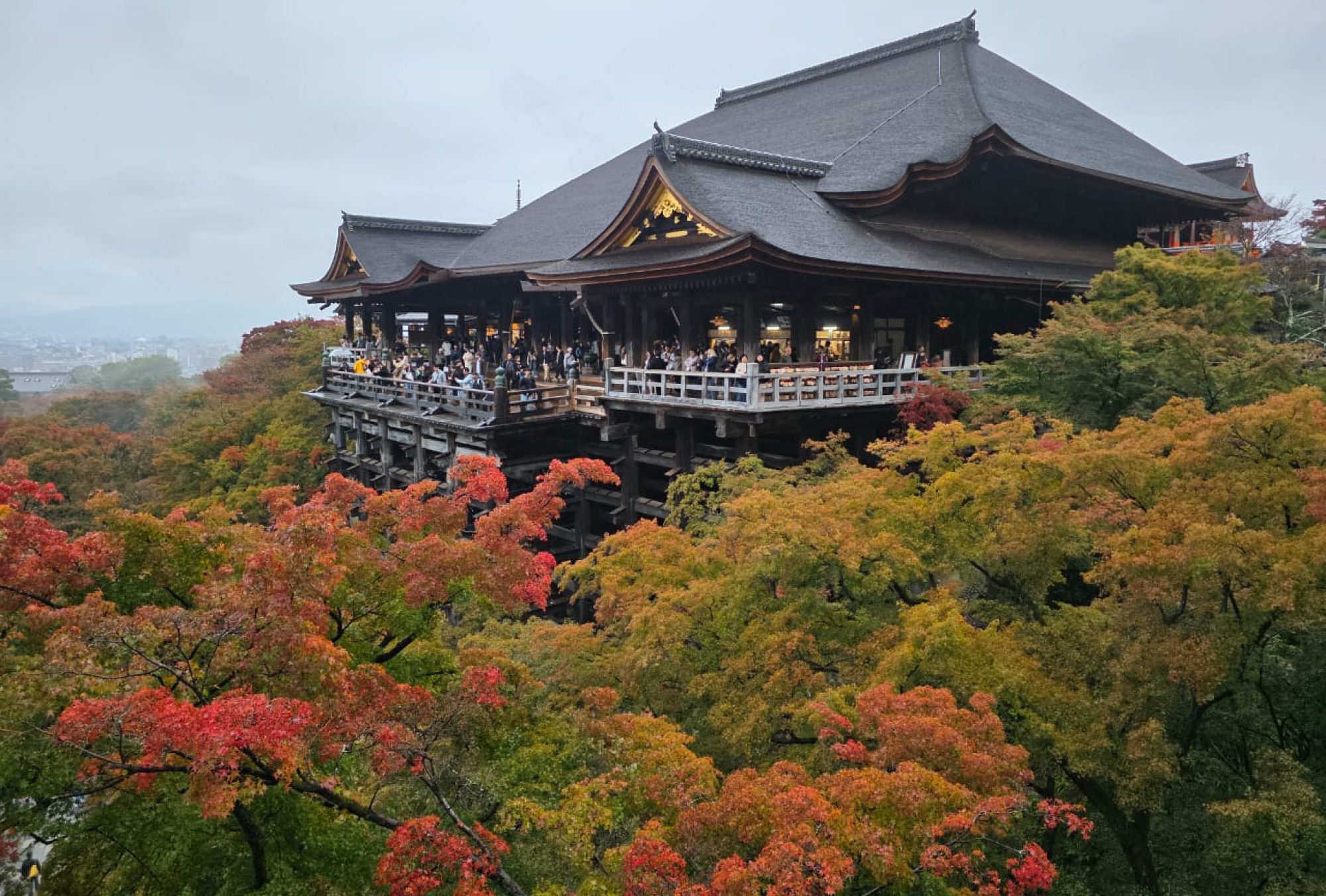

The Karnak temple complex is Egypt’s largest single gathering of temple ruins. It looks more like an open air museum filled with massive pylons, columns , statues , obelisks and a sacred lake. It is so vast that it has often been called a historical document in stone!
One of the peculiarities of the temple is that it was built over 1500 years ; added by generation after generation of pharaohs resulting in a collection of temples, sanctuaries, pylons and other structures. Stretching from the Middle kingdom to the Ptolemaic period and over thirty pharaohs contributing to its building ; it lacks a systematic plan ; but the expanse and complexity of this temple is not seen elsewhere. The ruins are still impressive though nothing remains of the houses, palaces and gardens that surrounded the temple in ancient times. It was also modified by later cultures for their own religious purposes such as Coptic churches . Even today, it is considered to be the largest temple complex ever built.
The history of the Karnak temple is largely the history of the city of Thebes and it’s changing role in Egyptian culture. Karnak and other areas of ancient Thebes including Luxor, the Valley of King and Valley of Queens are designated UNESCO World Heritage sites. We will be visiting all of these in subsequent episodes.
The original name of the temple was Ipet-Isut meaning the “Most Select of Places” while the modern name Karnak comes from the village nearby called el-Karnak meaning “fortified village”.
The complex is a vast open site and has four temples but only the one dedicated to Amun Ra, the Sun God is open to the public and hence is very often interpreted as the temple of the Sun God.
Our Trip
We visited the Karnak temple after the cruise had docked at Luxor.
Just as we entered the complex there was a model of the temple which actually gave us an idea of the vastness of the temple we were going to explore.
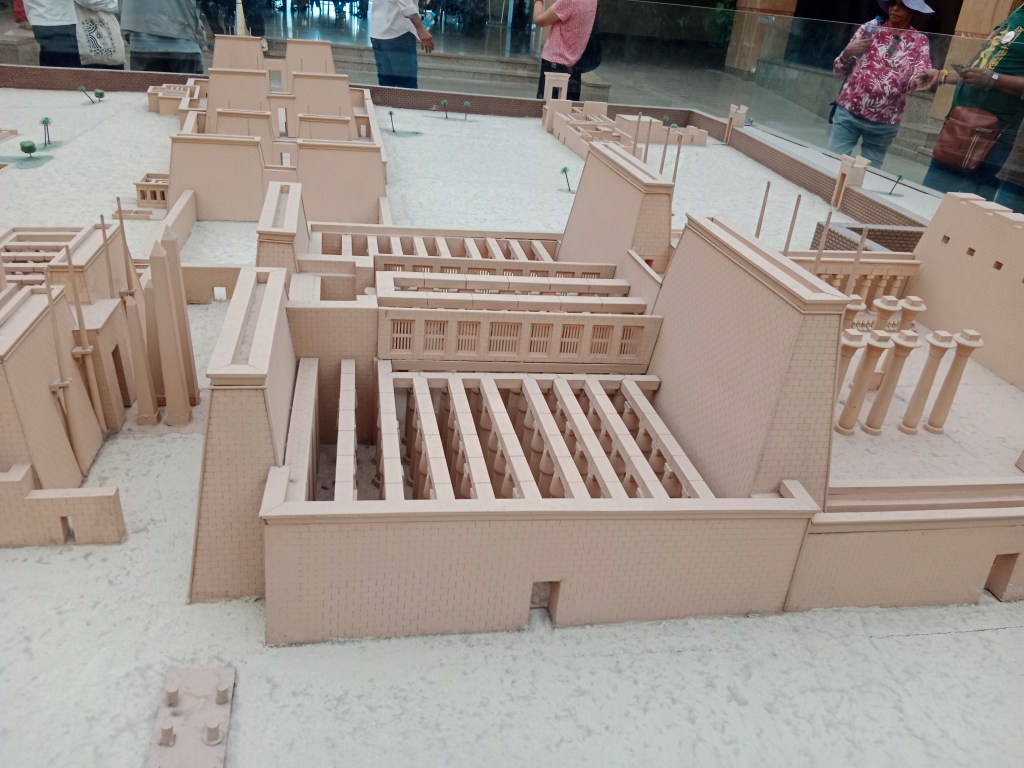
A model of the temple. The location of hall of pillars and the obelisks are clearly seen
The avenue of rams
The first thing that greets us as we approach the main temple is the avenue of rams with obelisks in front . This is a wide passage lined on either side with statues of rams .
On close observation, each of the statues has the body of a lion in sitting position with the head of a ram . A statue of the king is held between the legs of the lion as if protecting the king. Some of these statues are partly damaged but most of them are intact. This avenue leads us to the first pylon marking the entrance .
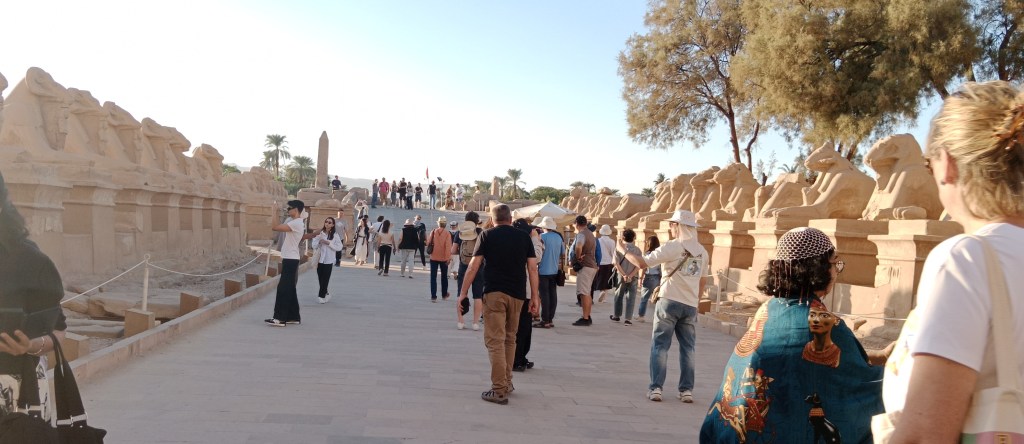
The avenue of rams leading to the main temple
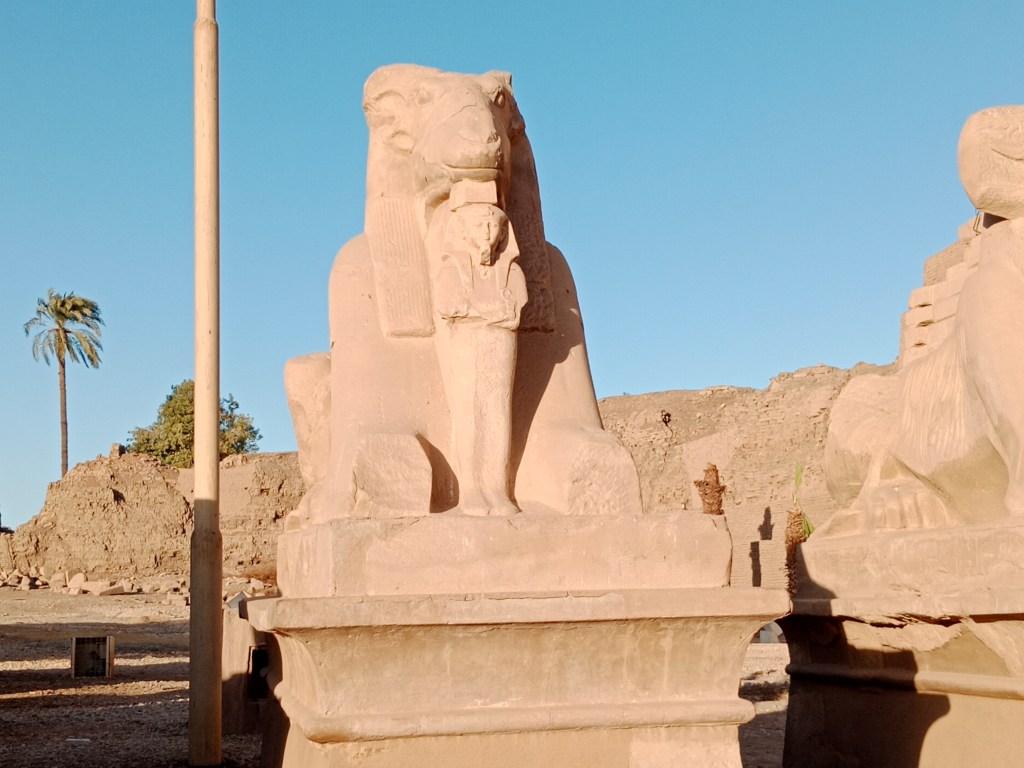
The king’s statue being protected by the ram
The pylons and the halls
There are 10 pylons in the temple separated by halls and courts forming professional gateways, some along the main axis and some at right angles. The reliefs on these pylons reflect the king who built them. The first pylons to be built were the ones inside starting near the sanctuary. The others were added on the outer side of the older one. The first pylon that we see , is in fact the last to be built .
The first set of pylons is incomplete and lacks any kind of decoration or reliefs. It has openings where they used to erect flags. This was the last one to be built and hence the lack of finish….
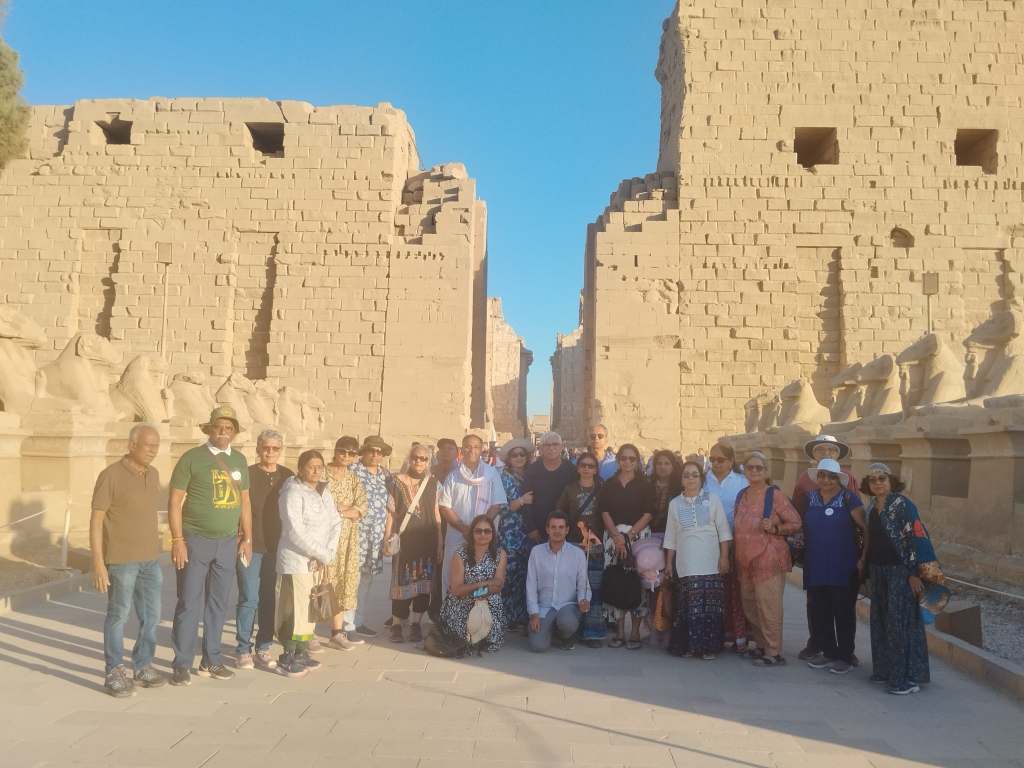
Our group in front of the temple with the first set of pylons behind us, the avenue of rams on either side and some parts of the serial pylons seen along the passage behind.
Crossing the threshold and the first set of pylons we reached the open courtyard where there are three shrines; the biggest one of Amun-Ra, and the others are one for his wife Mut and one for his son Khonsu. The walls of these shrines have reliefs of offerings to these Gods.
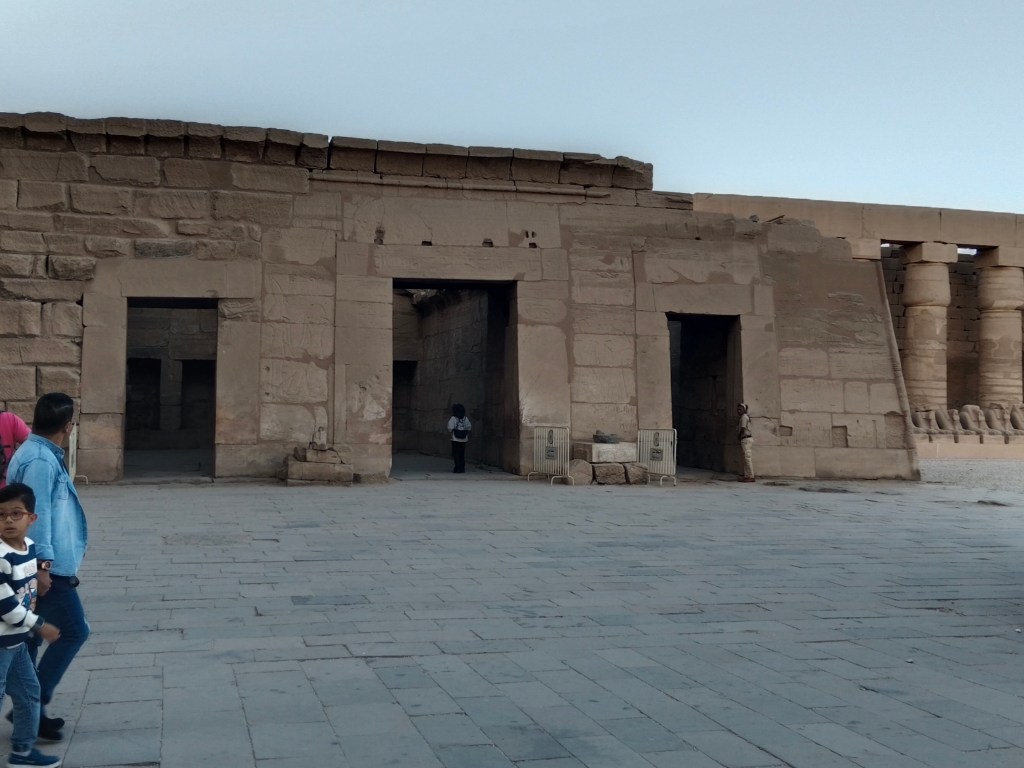
The shrines of Amun-Ra, his wife and son.
Apart from this, the courtyard has partially destroyed columns and a single well preserved column. The columns look as if they have been shaven off but they were destroyed in an earthquake. Ruins of various smaller shrines were also scattered all over the courtyard.

Partially destroyed columns and a single surviving column seen in the midst of ruins.
As we approach the second pylon, there are two massive statues of Ramesses II on either side with a statue of his favorite queen Nefertari between his legs.

The colossal statue of Ramesses II with wife Nefertari ( ruins seen in the backdrop)
Once we crossed the second pylon, we entered the fascinating Great Hypostyle Hall. The pylon itself has colorful reliefs unlike the first incomplete pylon.

The colorful reliefs on the second pylon
The Great Hypostyle Hall (hall of pillars)
This great hall has 134 massive columns with architraves on top weighing 70 tons each. 12 of these columns are 70 ft high while the remaining are 40 ft tall. As we walked around the hall, the sheer vastness and size of these columns left us in awe. The columns have extensive relief and paintings, some still retaining color after centuries!!
This was in fact an unbelievable piece of Egyptian architecture. Have a look at the pictures below.
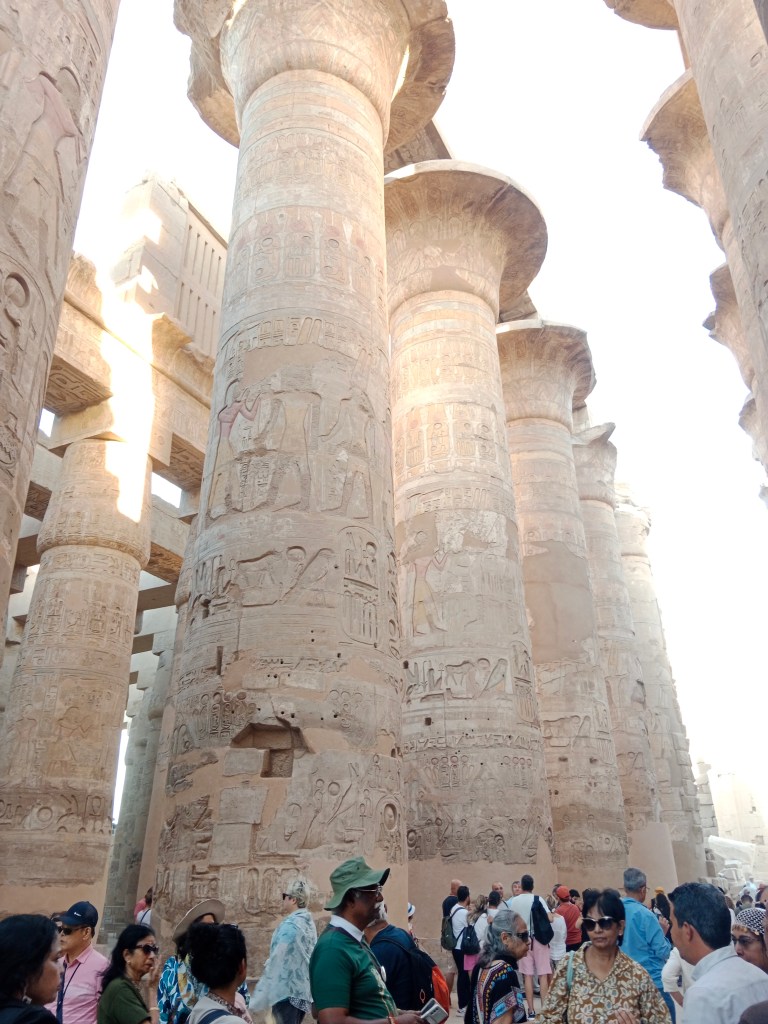
The Great Hypostyle Hall with colossal columns

Note the reliefs on the columns


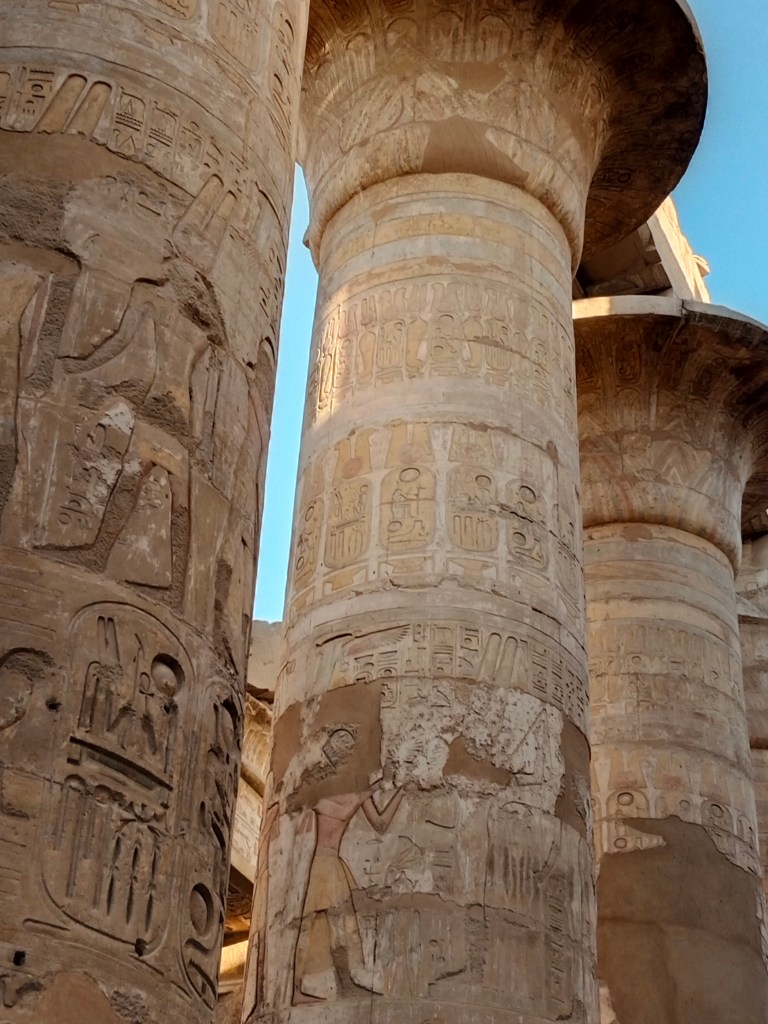
Note the reliefs with preserved colors
The fourth pylon marks the entrance to the sanctuary of Amun and the courtyard in front had three pairs of obelisks built by the kings Thutmoses I,II and III. Many of the obelisks are in ruins, some have toppled down and some are broken at multiple places.

Courtyard with obelisks

The most well preserved obelisk. (note the detailed hieroglyphics)
Another interesting feature here is the statue of Pharaoh Thutmoses III with inscriptions of all the countries he conquered.

Statue of Pharaoh Thutmoses III (partially in ruins)

Hieroglyphics related to the countries conquered by Thutmoses III.
The entrance to the sanctuary lies immediately behind this. The Sun God’s shrine was so built that light focused upon it during the winter solstice.

The entrance to the sanctuary of Amun Ra

The altar where the sacred barque (boat) of Amun Ra was once kept
The Sacred Lake
As we exited the sanctuary and walked towards the side, we came across the sacred lake. The lake is filled by the water table and was used by priests to purify themselves before various sacred rituals. It was also used for navigation of the sacred barque.

The sacred lake
This brought us to the end of the tour of the Karnak temple. I am sure you must be overawed at the sheer vastness of this temple complex and the size of it’s pylons. A wonder in art indeed!!!
Our next destination was Luxor temple and we proceeded there.
See you next week at Luxor Temple.
Till then, do subscribe, like and comment.








 Travel-along.in