The Fox Glacier

Zig Ziglar……the American author says…Difficult roads lead to beautiful destinations…This saying can be interpreted metaphorically to our life events. But here it’s not metaphorical….it’s physical….

After a difficult but scenic drive from Queenstown along the Haast Pass ( about which was my last blog),we were at the beautiful small town of Fox Glacier….. justifying what Zig Ziglar said!!

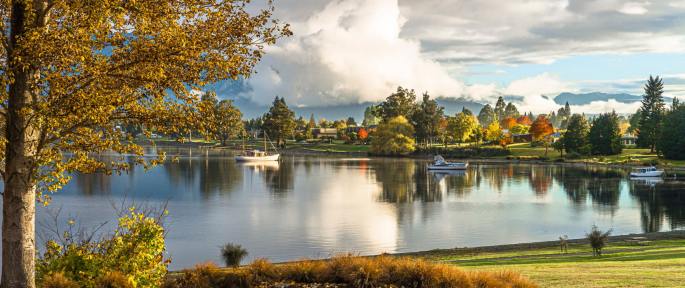
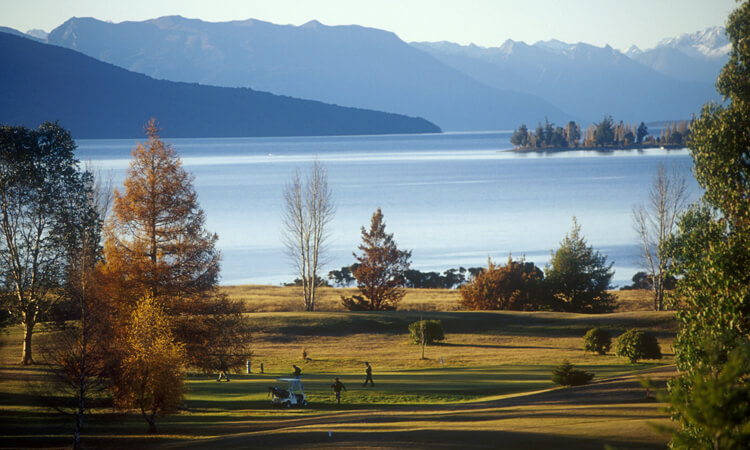
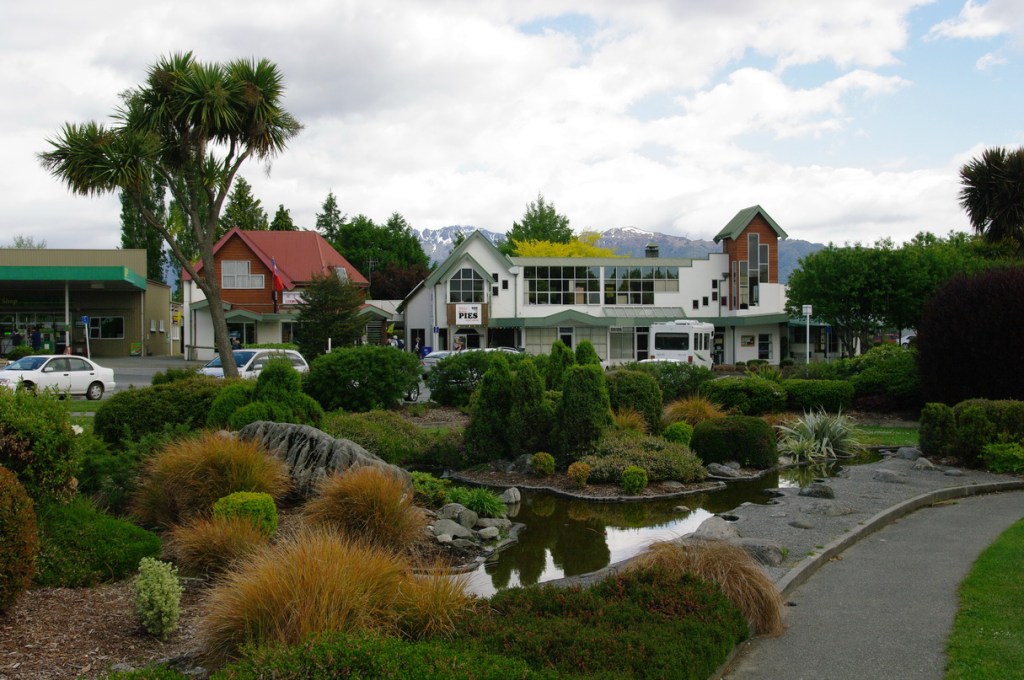
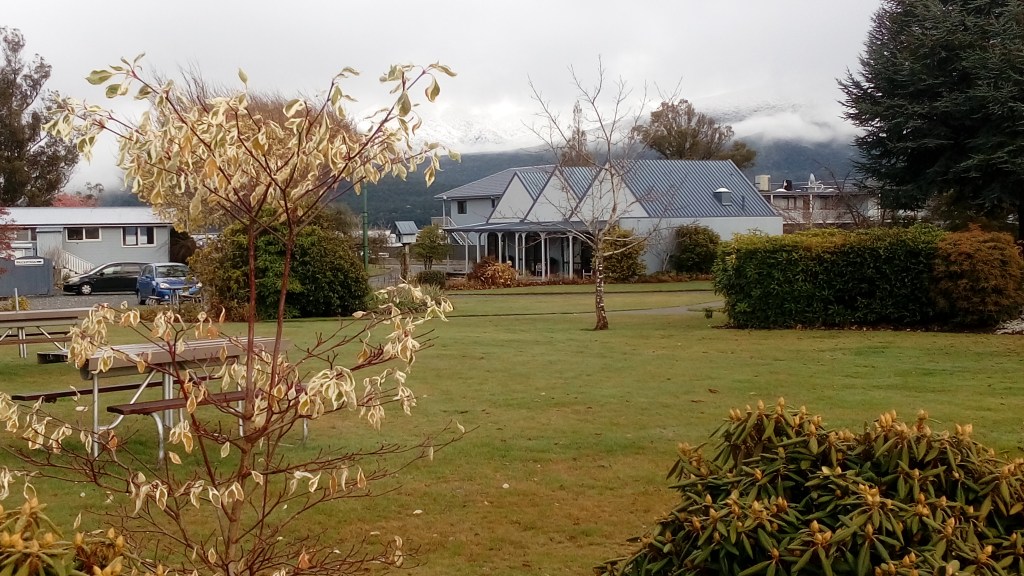
The Fox Glacier Town

Called Weheka in Maori, this town is actually a tiny village on the west coast of south island in New Zealand. It was renamed Fox Glacier after a visit by the then Premier of NZ, William Fox . State highway 6 (Haast Pass road) passes through this village as it leads to another glacier; the Franz Josef Glacier.

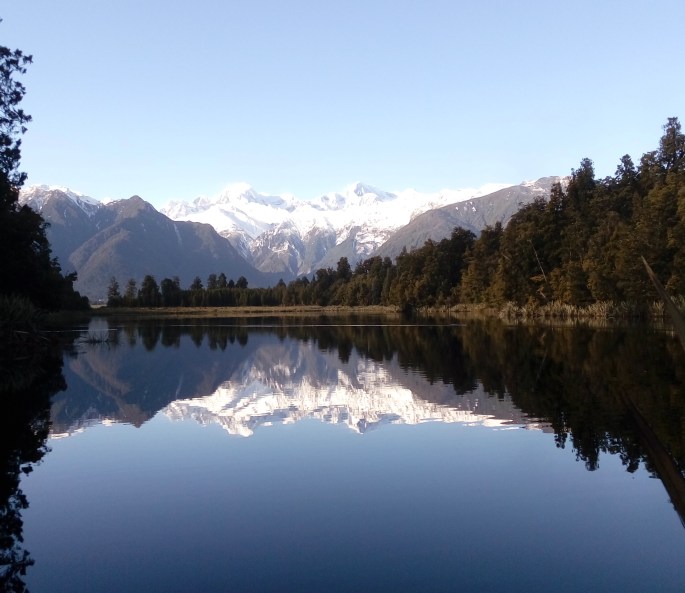
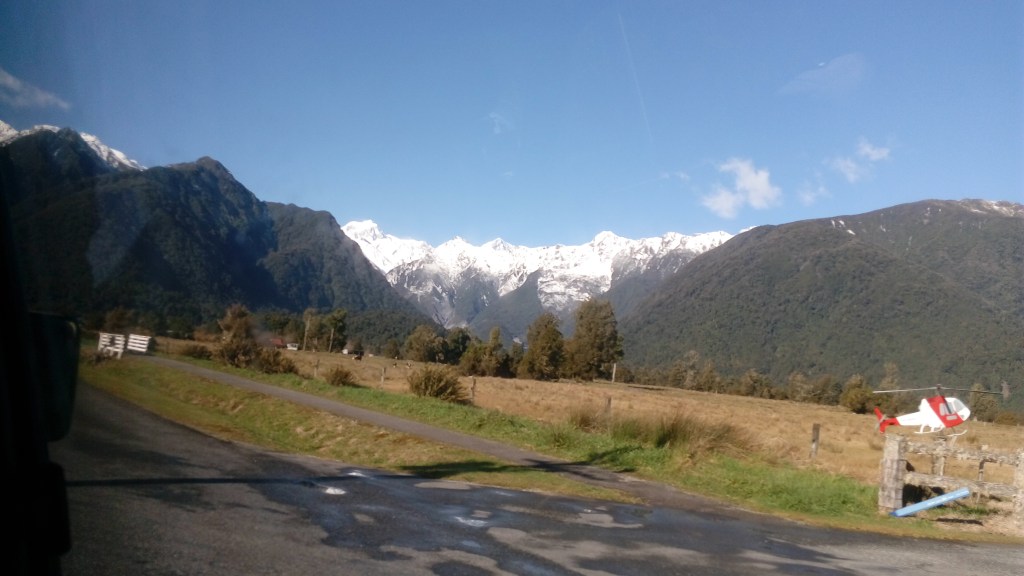
The village serves two important tourist destinations. The Fox Glacier itself and Lake Matheson. The town is famous for the glacier hikes and helicopter rides.

We stayed at the beautiful Bella Vista Hotel. The views from the hotel were awesome.

Fox Glacier Town

The Bella Vista Hotel

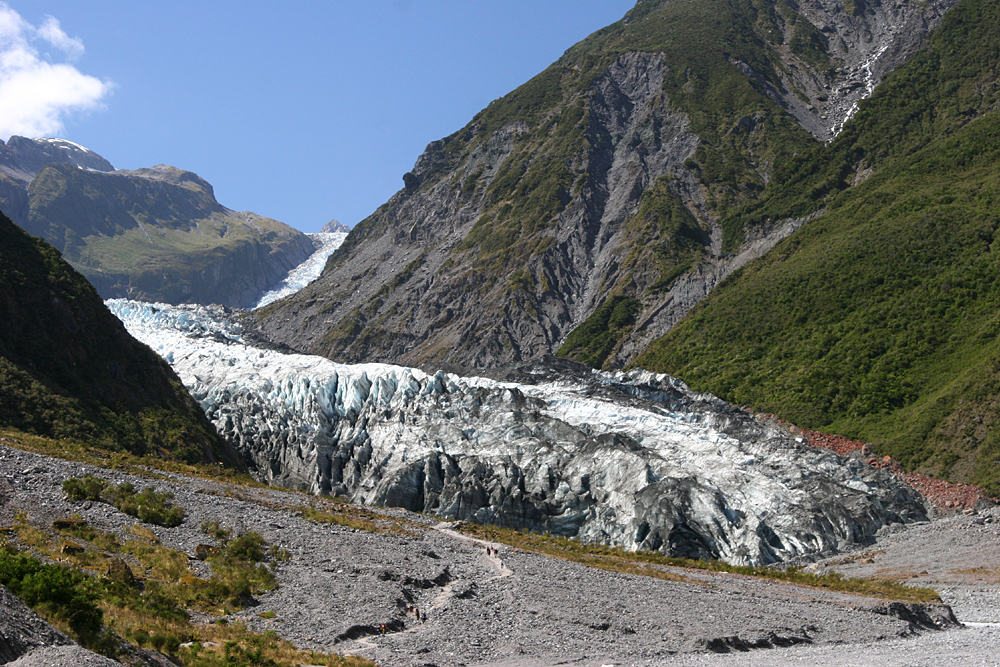
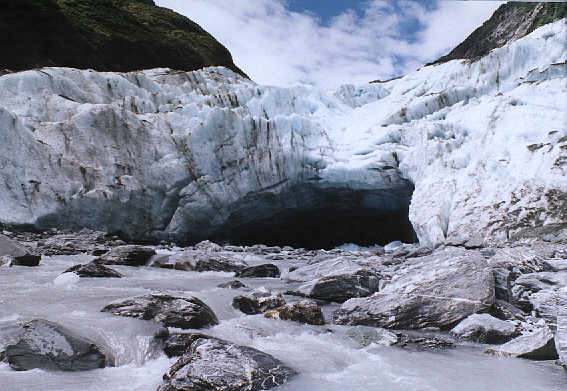
The Fox Glacier

The specialty of this glacier is its close proximity to the Tasman Sea. No where else in the world are there glaciers so close to the coastline and that makes Franz Josef and Fox glaciers truly unique.

The glacier is 13km long and is located in the Tai Poutini National Park. It is one of the most accessible glaciers in the world with its terminal phase as low as 300 meters above sea level about 6 km from fox glacier town.

Fed by four alpine glaciers, Fox Glacier descends from a height of 2600m above sea level in the Southern Alps into the temperate rain forests just 300 m above sea level. The outflow from the glacier forms the Fox River. During the ice age, the ice retreated and left behind many moraines. Lake Matheson( which we visit next) is one such lake.

Fox Glacier

Fox River originating from the glacier

Primarily there are two modes of visiting the glacier…by hiking or by helicopter. Helicopter rides can be booked from the counters in the town and they take you to the top of the glacier. Bad weather is a constant threat to these trips and one must have sufficient time at hand to deal with such delays.

Helicopter rides to the glacier are very popular

There are about 30 different walking tracks around the Franz Josef and Fox glacier areas. Hiking guides are available and one can hike as per one’s capacity from simple walks along the glacier edge to rugged and strenuous hikes up the glacier.

Some of the popular tracks are: Southside Walkway and Fox glacier Valley Walk

Southside walk is a 6 km walking/cycling track that follows the south bank of the Fox River through a rain forest. A 40 minute walk takes one to a view point of the glacier. Cycling is not allowed beyond this point.

Views from South side walk…Fox Glacier

Valley Walk

This is shorter and around 2.6 km

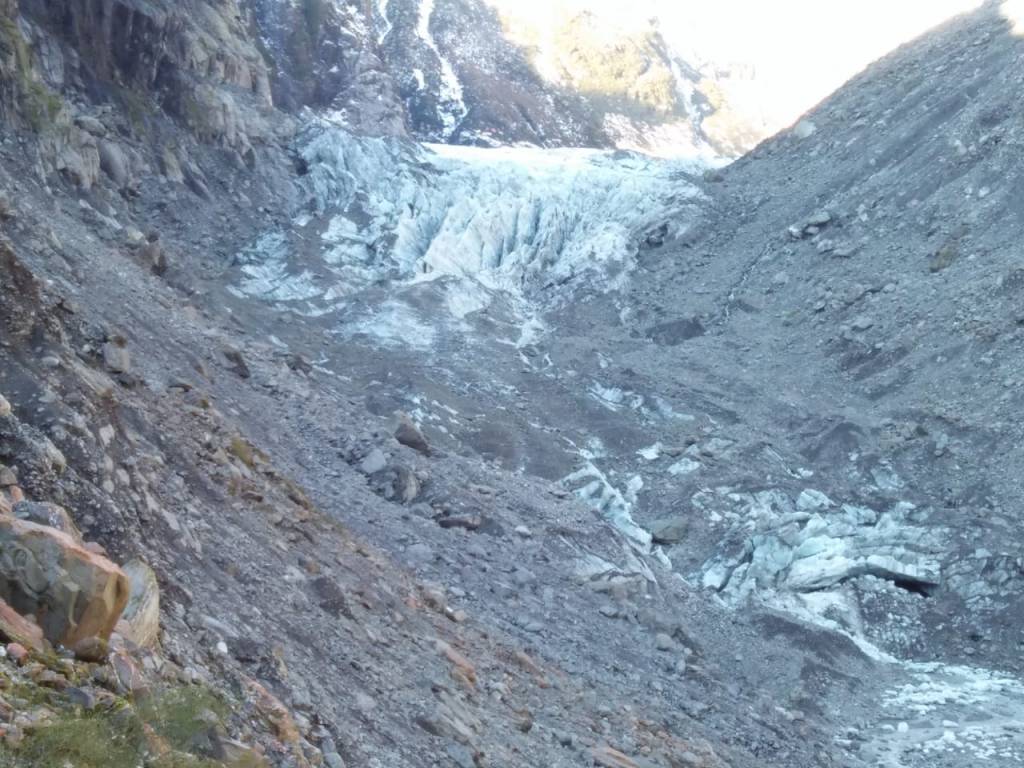
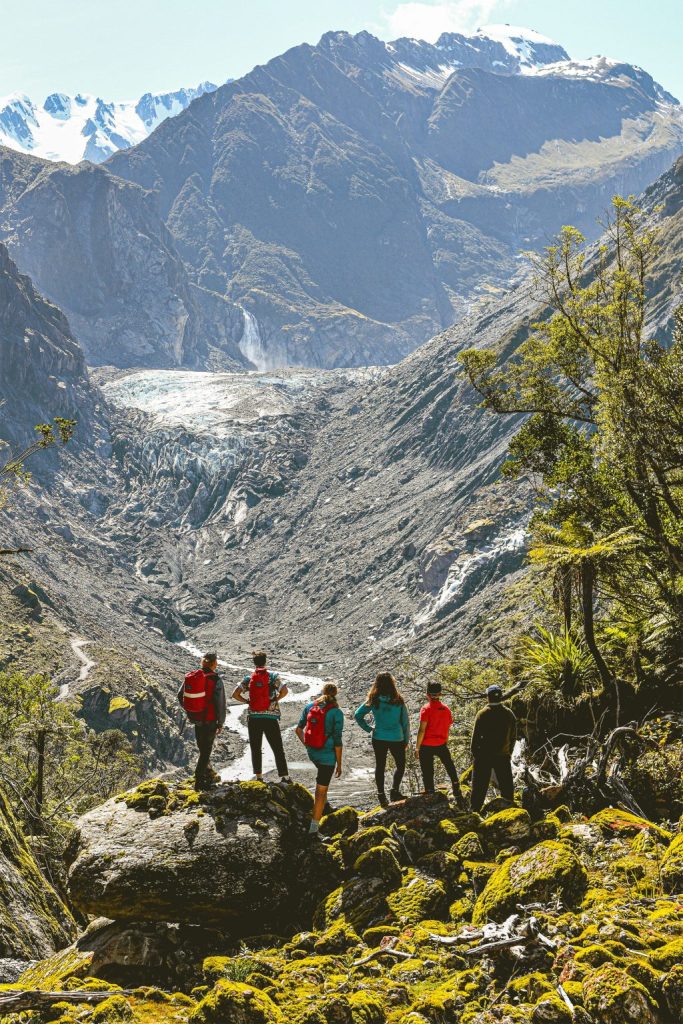
We did this walk and could access the terminal portion of the glacier from around 200mts away . The initial part of the track is not very steep. The slope is gradual and one can follow a stream which we had to jump across several times. Gradually the steepness of the track changed and the final part was a rather steep climb . But we were rewarded with these views at the end….

Terminal portion of the glacier

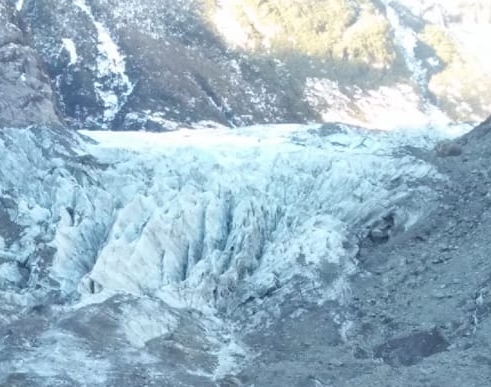
A close up of the terminal part of the glacier

Another view of the glacier from a distance

Apart from this trek on to the glacier, is an easy wheelchair friendly walk called the Minnehaha Walk from near the town following a stream through the rain forests with the bonus of seeing glowworms at night. This is a loop walk of around 1.2 km and can be easily done in around 30 mins along a rain forest.

Minnehaha walk through rainforest

We did this trip to the Fox Glacier in 2018. I understand that there have been considerable changes here after that. The road to the iconic Fox glacier was closed in 2019 . A severe storm in February 2019 caused a massive landslide . Flooding following heavy rains in March 2019, caused further damage to the road . Tons of rock and gravel came crashing down to the Fox valley and destroyed the causeway and the car park areas. This landslide was New Zealand’s largest active landslide and is called the Alpine Gardens landslide.

After this, the reestablishment of road access was considered impractical and the road was indefinitely closed.

Helicopter rides to the glacier, and scenic flights to Franz Josef are still happening. The economic impact of this closure on the township is huge but the other activities for which it is a hub still continue. One such great place to visit from Fox Glacier township is none other than Lake Matheson…the iconic lake of New Zealand.

Next week we visit this Lake and I promise you some breathtaking views. Till then, its bye from Fox Glacier…

Do give me your valuable comments and subscribe below..

Haast Pass

When it comes to scenic road trips, few can compare with the beauty and diversity of the drive from Queenstown to Fox Glacier. This drive takes you past some beautiful glacial lakes, along the banks of glacial rivers, across some rapids, on the passes of the Southern Alps, along the coast of the Tasman Sea and finally reaches glacier land. Can you ask for more variety?

The Haast Pass is the unofficial name of the road from Wanaka along the Haast river to Haast town. It is also called State Highway 6 . This Pass road is around 140 km long and is located in the Southern Alps in the South Island. A mountain pass at an elevation of more than 1800 ft above sea level, is said to be one of the most scenic alpine routes in New Zealand. Located in Mount Aspiring National Park, it a must do journey; but is also a test for the vehicle and the driver alike. It has many curves and bends and many one-lane bridges and is dotted with slip hazard warning signs! There are no settlements on this road. This is claimed to be the route that the Maori followed in their search of green stone or jade which they called pounamu.

The real Haast Pass is located halfway along this route.

The journey offers a variable landscape of rainforests, wetlands, lakes, rivers and rapids. This road snakes its way to innumerable adventures that lie in wait to be discovered. During winter this road is prone to snowfall and it is best travelled on outside the winter months. Very heavy rainfall also results in road closures here and it is required to keep track of this before travelling.

Our Trip

We were essentially travelling from Queenstown to Fox Glacier. Since we wanted to combine this road trip with some sightseeing on this scenic road we booked on a Great Sights bus.

As we left Queenstown, we had some great views of Lake Wakatipu from another side. Some pictures to enjoy…

Lake Wakatipu

After leaving Queenstown, our first halt was at Wanaka.

Wanaka

A popular ski and summer resort town in South island set on the border of a lake by the same name, is picturesque! It is the gateway to the Mount Aspiring National Park which is a wilderness with glaciers, alpine lakes and forests.

Some pictures…

Some views of Lake Wanaka

The Beautiful town of Wanaka in Fall colours

Further down the road was another beautiful lake…Lake Hawea.

Lake Hawea

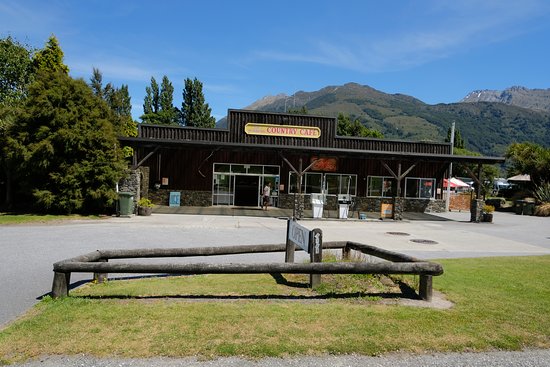
Lake Wanaka came into view once again and the road followed the side of Lake Wanaka. Then came the small town of Makarora. Named after the river Makarora, there is a famous cafe where we had a small break.

Makarora Cafe

Driving further on the highway, we crossed the Makarora river.

Makarora River

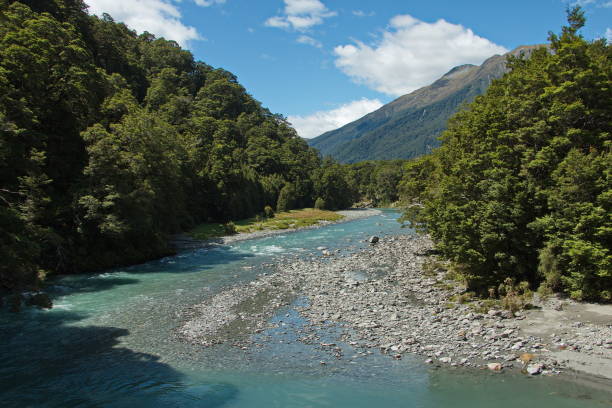
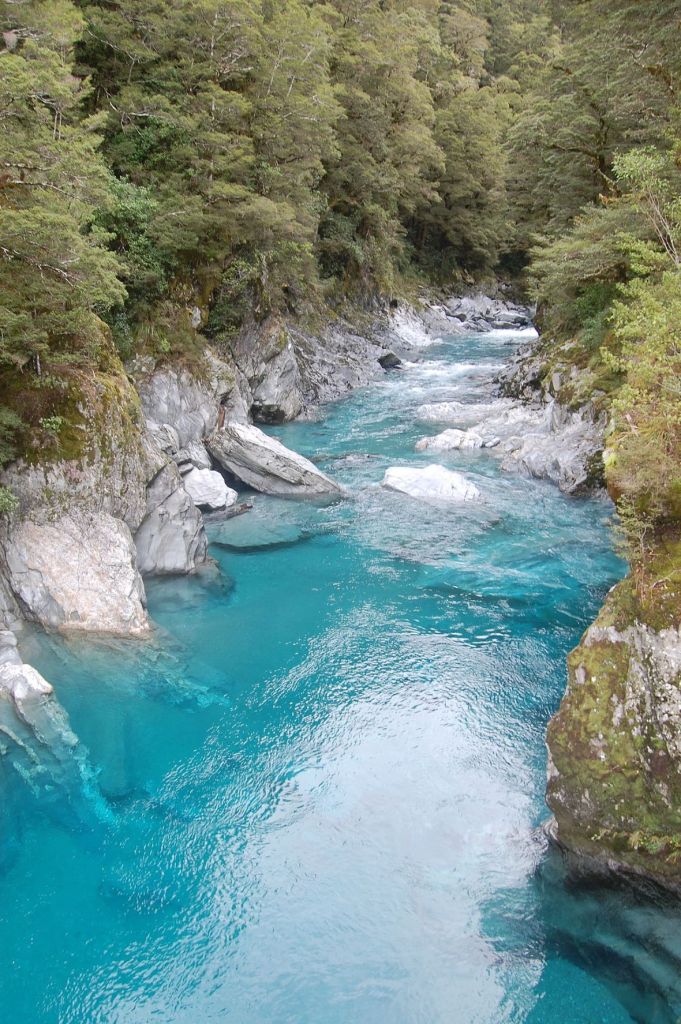
This river starts at Mount Aspiring National park and flows into Lake Wanaka after passing Makarora town. It meets the Blue river to form the famous Blue Pools which is about 30 minutes walk from the highway. We did not do this trek but it is an awesome place where there are hanging bridges to view the blue pools. The river attracts recreational activities like fishing, kayaking and jetboating.

These rivers have a peculiar blue color as they are fed by glaciers and there is minimal pollution.

The Blue Pools

There is a famous campsite called Cameron Flat further down the road. Many campers use this site to park and explore the Makarora river, Blue pools and surrounding areas.

Cameron Flat Campsite

As the drive continued further we were alongside the Makarora river for a considerable amount of time. Then came another beautiful glacial river….the Haast River.

Haast River

Further on the highway we crossed the actual Haast Pass.

This is a mountain pass in the Southern Alps used by the Maoris in the pre European times.

Haast Pass

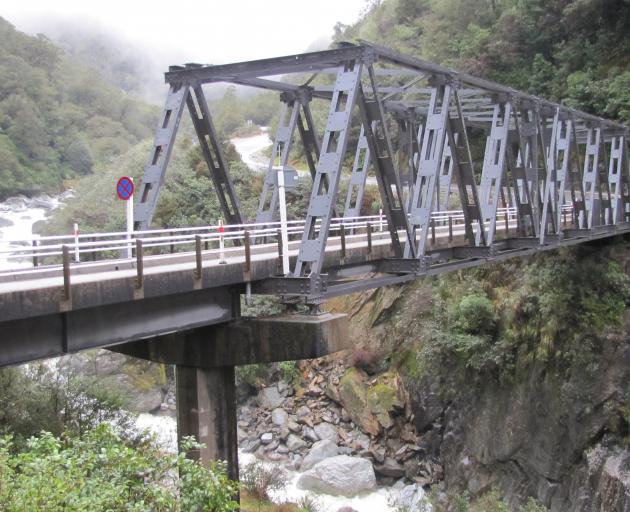
We also crossed The Gates Of Haast. These are a series of rapids on the Haast River and can be seen from the bridge as one passes it.

The Gates Of Haast

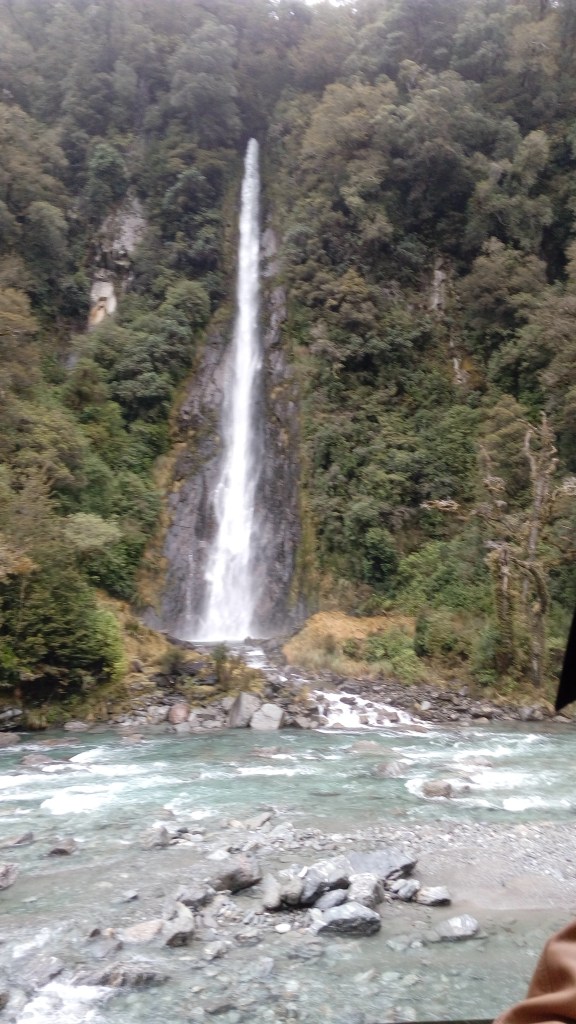
As we drove along, we came to Thundercreek Falls; one of New Zealand’s highest falls.

Thundercreek falls

As we passed Haast town, the coastline became visible and it was a sudden change from the forests and rivers to the open sea.

Ship Creek

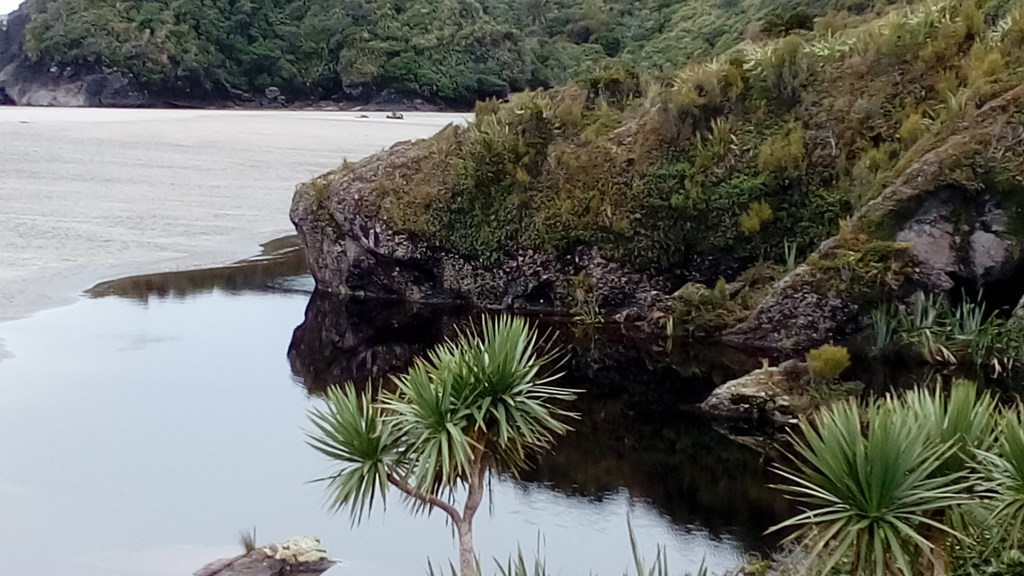
The beach at ship creek has logs of driftwood all over the sand. Besides there is a boardwalk on which one can walk along and see the beautiful reflections on the still waters. There is a small watchtower here from which the reflections look more impressive.

Driftwood at shipcreek

Reflections at ship creek

Ship creek beach

The rainforest and its reflections at ship creek

Knight’s Point is a lookout point that provides spectacular views of the ocean. The rock formations seen in the ocean at this view point are unique.

Knight’s Point lookout

Salmon farm

Salmon farms dot the coastline of South Island . Salmon farms rear different varieties of salmon .Most of them have a cafe and we stopped at one such farm for lunch.

Cafe at the salmon farm

Salmon rearing ponds

From here on the landscape gradually changed and the valleys were replaced by glacier land…..reaching Fox Glacier.

In true Kiwi hospitality style, the bus driver dropped us off at the Hotel and arranged for Murray a local driver for our next day’s programs. After some settling down, we explored Fox Glacier town and had dinner at a local cafe and returned to the warmth of the room.

Next day, we visited Lake Matheson and Fox glacier. Next week I will take you to the glacier. Till then, keep reading, commenting and do not forget to subscribe below

Milford Sound

Described by Rudyard Kipling as one of the Wonders of the World, Milford Sound is home to some of the finest landscapes in New Zealand’s South Island. Known in Maori as Piopiotahi…meaning one piopio…a small bird like a thrush which is now extinct, it is indeed an awesome place! With a magical combination of mountain peaks, dark waters and superb forest clad cliffs,the scenery is intoxicating….to say the least.

Fjords and sounds…an introduction

A fjord ( pronounced as fiord) is a long narrow inlet with steep sides or cliffs created by a glacier. There are many fjords on the coasts of Alaska, Antarctica, British Columbia,Scandinavian countries,UK and of course New Zealand. Norway probably has most of its coastline as fjords. A true fjord is formed when a glacier separation creates a U shaped valley which gets subsequently flooded by the ocean

A sound is a smaller body of water typically connected to larger sea or ocean. Sounds are often formed by seas flooding a river valley….a typical example being the Marlborough sounds of New Zealand.

Fjordland National Park

Milford Sound is located deep within the Fjordland National park which occupies the south west corner of South Island. The largest of the National parks in New Zealand, it is a World Heritage Site. The retreat of the glaciers after the ice age left U shaped valleys with sheer cliffs on either side. There are around 15 fjords here; some of them reaching 40 km inland. Some of the more famous sounds here are Milford Sound, Doubtful Sound and Dusky Sound. Several lakes lie within its boundaries…the more famous among them being Lake Te Anau.

Our Trip

We had heavy rains at Te Anau on the previous night and when we reached the Real journeys office, there was some uncertainty about conducting the tour due to risky conditions at the Homer tunnel. Fortunately for us; we soon embarked on the trip in a beautiful glass topped bus.

The drive took around two hours and had some amazing scenery all along.

Our first halt was at The Mirror Lakes.

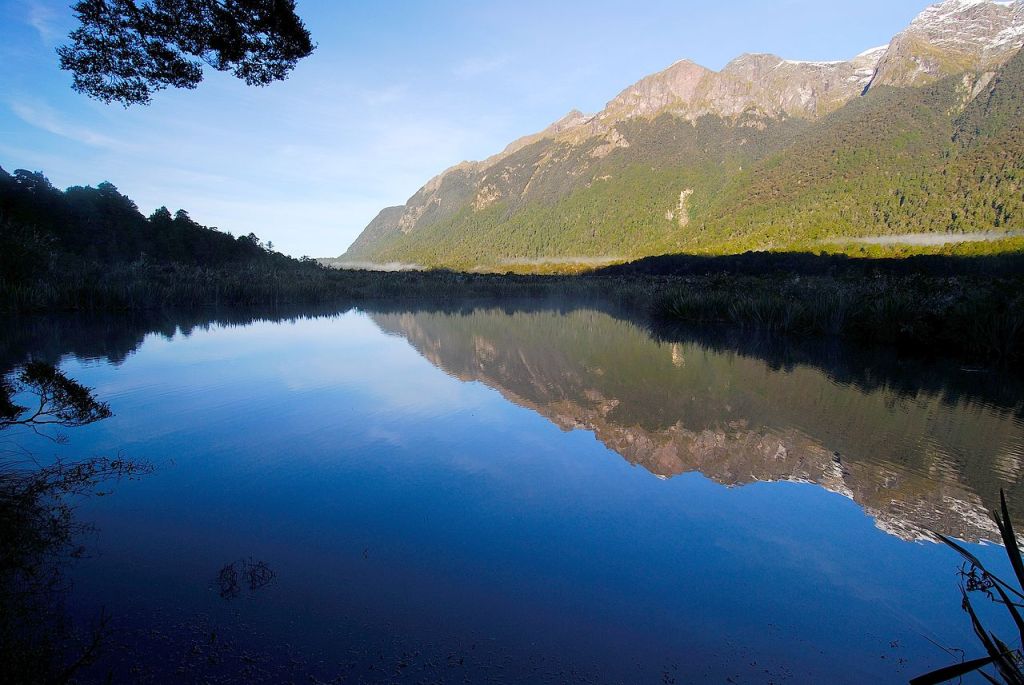
About 56 km north of Te Anau and halfway to Milford Sound we had a short photo halt at Mirror Lakes. The calm waters of this group of small lakes, reflect the Earl mountains and provides great photo opportunities. A short walk along a wooden boardwalk leads one to the viewing point.

The Mirror Lake

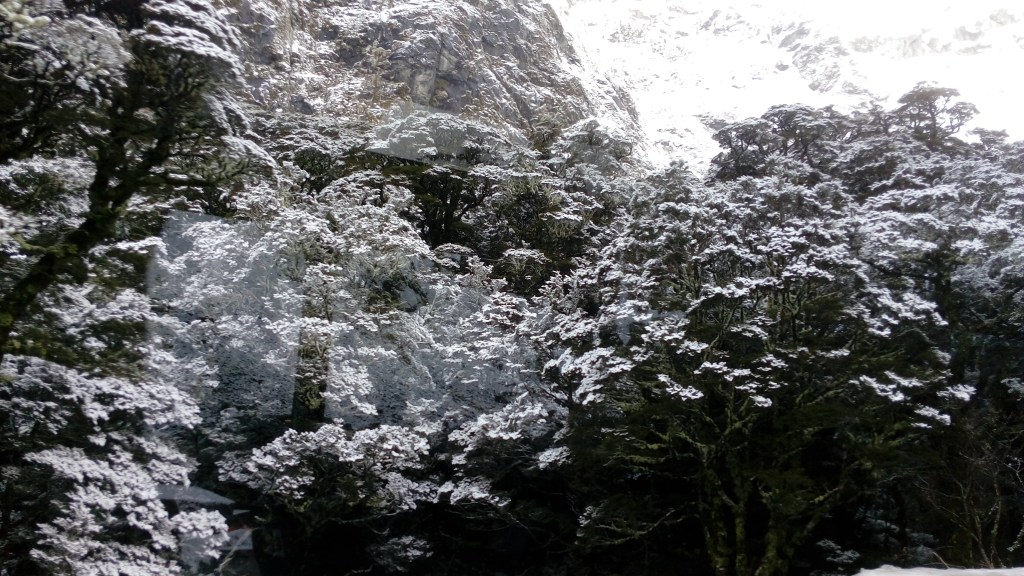
From there we continued the drive and reached the Eglinton Valley. Here the scenery changed dramatically to steep snow covered cliffs. The Eglinton valley was the shooting location for some parts of the famous movie Lord Of The Rings.

Some pictures from Eglinton Valley..

The Eglinton Valley

Just to get the real feel of driving along to Milford, have a look at the video below

A short video of the drive to Milford Sound

There are many hiking tracks at various locations on this road which can be attempted if time permits. Since we did a day trip from Te Anau, we could not explore these. Many of these locations are beautiful and serene and provide nice short trip opportunities.

Our next destination was the Homer Tunnel. This tunnel is like a life line to Milford Sound as it was only after the completion of this tunnel that road trips to Milford sound was possible. It took 20 years to build due to the difficult terrain and climatic conditions here. The tunnel is 1.2 km long and vehicular traffic is very carefully and strictly monitored here. It is a high avalanche prone area in winter and hence poses severe challenges to the drivers.

Approaching Homer tunnel

Homer Tunnel

The Hundred Falls

True to its name, this place has hundreds of small waterfalls gushing down the rocks. We had rain the previous night and perhaps that added to the number and size of these falls.

The Hundred Falls

After we reached Milford Sound, we waited at the wharf to board the Cruise that was to take us on the Sound. The Milford Mariner was our cruise boat.

The Milford Mariner

Once the cruise started, we were treated to some amazing scenery. I would have loved to remain outside on the deck but it was too cold for comfort and had to rush into the cabin for warmth.

The Beauty of Milford ….from the top deck of the boat

View from lower deck

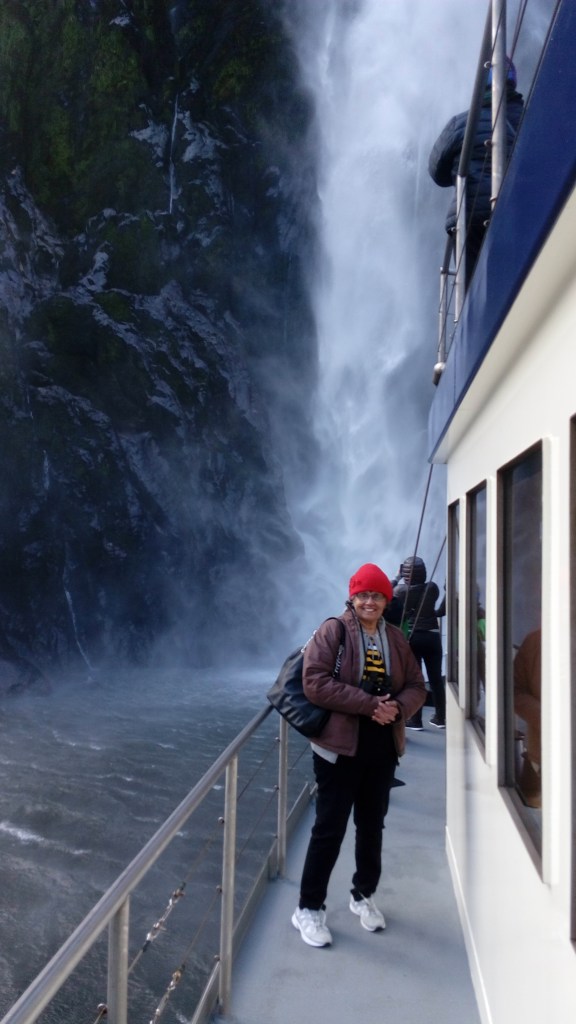
As we cruised the Sound ,we came across innumerable waterfalls, adding to the charm. Some pictures…

Some of the waterfalls that dot the cliffs of Milford

Very often seals are found basking in the sun on the rocks….we saw some of them….here they are…

Seals basking on the rocks

According to our guide, seeing Dolphins is not such a common thing….but we did see them…adding to the feel good factor…

Dolphins at Milford sound

Enjoying the scenic beauty of Milford Sound, we returned to the wharf and to the bus to be driven back to Te Anau.

Leaving Te Anau was never going to be easy. This was one place that has given me some really cherished memories. Next day we returned to Queenstown to embark on another journey along the Haast Pass to Fox Glacier. So next week, we will be enjoying the drive along the Haast Pass in the Southern Alps.

Hope you enjoyed the tour of Milford Sound. Do give me your feedback and do subscribe below.

The Glowworm Caves

New Zealand is home to this natural wonder. The glowworms are widespread in New Zealand generally in cave systems. The most popular of the cave systems to view glowworms are at Waitomo, Te Anau and Waipu.

A short introduction on the glowworms

The New Zealand variety of glow worm is actually the larva of an insect which looks like a mosquito. The scientific name is Arachnocampa luminosa. The larva produces a blue green bioluminescence. The Maori name is “Titiwai “meaning projected over water. They live in dark, cool , damp and humid environments like caves, sheltered banks and native bushes.

This is not to be confused with fireflies which also are bioluminescent but belong to the beetle species.

The insect eggs are deposited on cave walls. On hatching, the larvae immediately begin to glow. They grow from the initial size around 4 mm upto 40 mm. over several months. They move around the cave wall and finally attach themselves to a site and start producing a silk nest. The larva produces long silk threads which have sticky droplets on them to capture prey.

The bioluminescence is a result of an enzyme luciferase acting on a molecule called luciferin. Though the enzyme has similarities with that found in fireflies and other bio luminescent systems, the composition of luciferin is totally different in this species. The purpose of this glow has been attributed to attracting prey and also potential mates.

The adult stage

The larva and the silk threads

Bioluminescence

Our Trip

We decided to do the glow worm tour at Te Anau. Real Jouneys is the tour company which organizes these tours from Te Anau.

The glow worm caves lie in the mountains across the Lake Te Anau .The caves are around 12000 years old and are still being carved out by the force of the water that flows through them. The result is a twisted network of limestone passages, whirlpools and an underground waterfall.

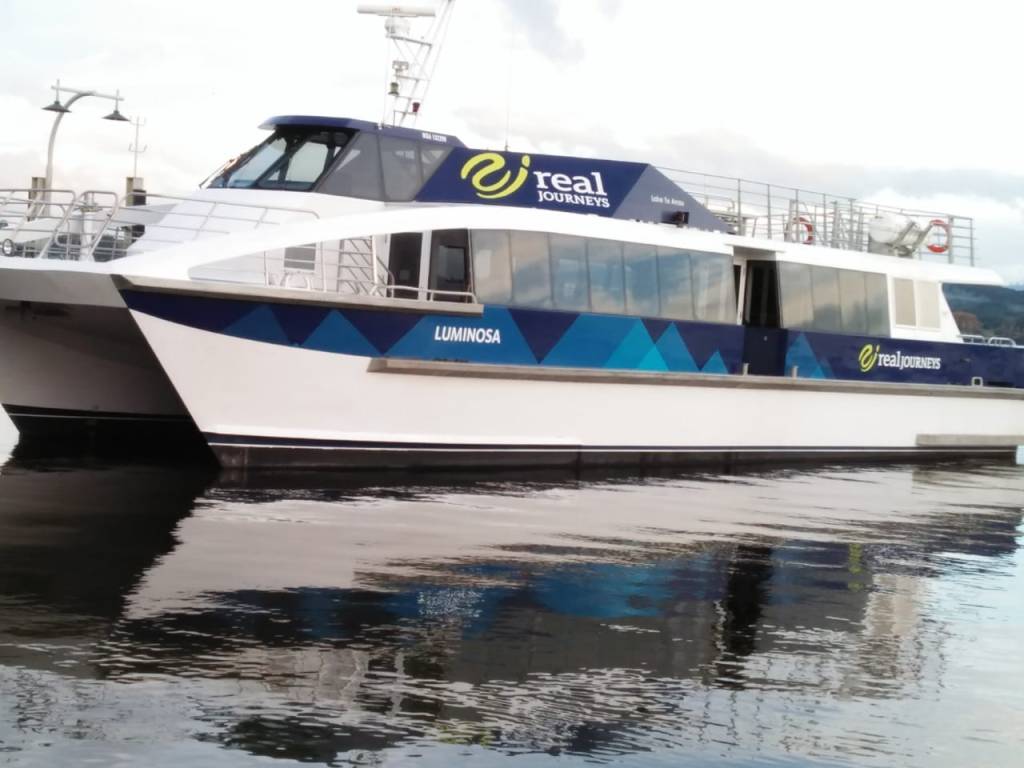
Tourists have to take a catamaran to the other side of the lake. These caves are situated close to the water level and the trips are called off if there is flooding in the caves. The trip was cancelled on the previous day due to heavy rain and flooding of the caves.

We were lucky to get a rain free day to do the trip. The catamaran ride lasted about 40 minutes.

Once we reached the other side, we were guided by helpers to get across the slippery rocks on the edge of the lake. The whole area has a very marshy , damp , slippery appearance with dense vegetation .Then we were guided to the Cavern House. The Cavern house has tourist facilities like a small cafe , toilets etc and has a small hall where the guides explained about the bioluminescence and the larvae . There are educational exhibits here too…

The mountains where the caves are situated

The catamaran luminosa that takes you across Lake Te Anau

The Cavern House

Photography is strictly prohibited in these caves.

After the educational session, we were divided into small groups with a guide for each group. We followed the guide along some narrow passages among caves. At many places, limestone formations are seen inside the caves. One has to bend and turn and manouvre oneself to prevent injuries from jutting rock formations. As we went further inside, it got darker. The guide had a headlight on her forehead. At places, there are steps made manually too. At places there are small lights too.

As we walked along the caves, there were silk threads visible at places. But the larvae could not be seen. Finally we reached a small area with flowing water and we boarded a very shallow boat. The boat is so shallow that you cannot sit upright. This is also to prevent injuries to the head as the boat goes through the narrow channels.

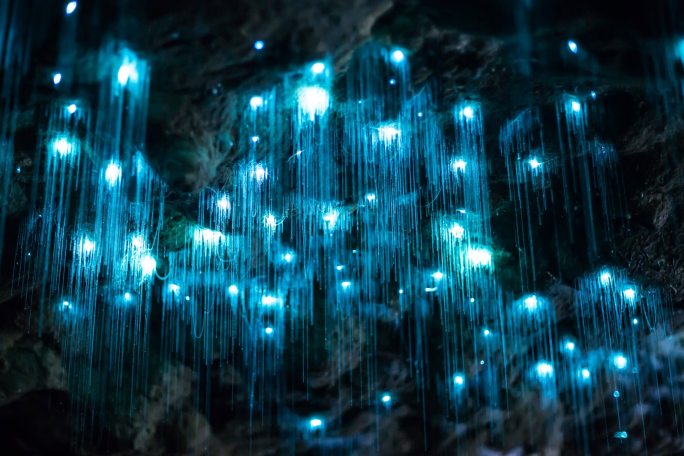
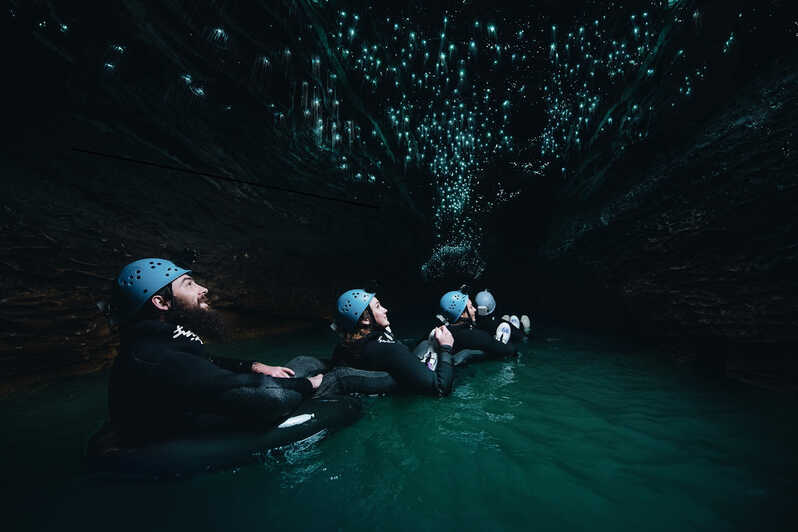
Once the boat was on its way, we started seeing the beautiful blue green light all along the walls of the caves. At places, it was very bright and at places it was dull. I assume it depends on the density of larvae at that site. It was indeed a great experience. It looks like a sky lit up with stars!!

Some pictures…

Walking to Cavern House with the guide

The underground waterfall

Walking tracks inside the caves

At places one has to bend to avoid injury

The shallow boat ride and the glow worms on the walls

The star like glow of the larvae

After this wonderful experience we were treated to some hot coffee and took the cruise back to downtown Te Anau.

Our trip to Milford Sound was scheduled for the next day . See you next week at Milford Sound….another beautiful location.

Till then, good bye

Do comment and subscribe below

Te Anau

After pulse raising Queenstown, our next destination , Te Anau was a total contrast. A quiet, peaceful ,small town. We took a bus to Te Anau and were the only passengers on the bus. The driver directly dropped us off at our hotel at Te Anau.

The hotel had a beautiful ambience and was very cosy and homely.

The Beautiful Asure Amber Court Hotel where we stayed.

First let me tell you about this cute little town….Te Anau.

Te Anau in Maori language means Place of the swirling waters

Nestled on the edges of the picturesque Lake Te Anau is this pristine , quiet town of Te Anau. Lake Te Anau is the largest lake in the South Island and second largest in New Zealand. The Mt Luxmore and Murchison mountains form an awe inspiring backdrop to this beautiful lake.

The town on the edges of Lake Te Anau

Beautiful Lake Te Anau

Lake Te Anau from various angles

Te Anau is the gateway to Fjorland National Park. Though Fjorland can be reached from Queenstown also , Te Anau is closer and the drive less tiresome. Te Anau came into the lime light only after the opening up of the Homer tunnel on the 120 km alpine road to Milford Sound . It has since become a hub for those visiting Fjorland. It is also the hub for those doing tramping at the Kepler and Routeburn tracks which is a loop adventure activity along the tussock covered alpine vistas.

We decided to do a day trip to Milford Sound( Fjorland) from Te Anau. Since we were at Te Anau during the fall season, the fall colours added to the beauty of this place. Some pictures…

A typical street in Te Anau

A typical house in Te Anau

Some pictures from downtown Te Anau

A shop with the model of a takahe….an endemic bird of New Zealand

The Takahe…

It is a variety of swamp hen indigenous to New Zealand. It was extensively hunted by Maori and was considered extinct. But was rediscovered in the late 1900s in the Murchison mountains close to Te Anau. It is now considered a threatened species.

There are many activities one can undertake at and from Te Anau. Some such activities:

Day tour of Milford Sound:

A two hour ride on Milford highway passing the Homer Tunnel and a cruise on the famous Milford Sound…the detail episode on this trip coming up soon!!

Fjorland from air:

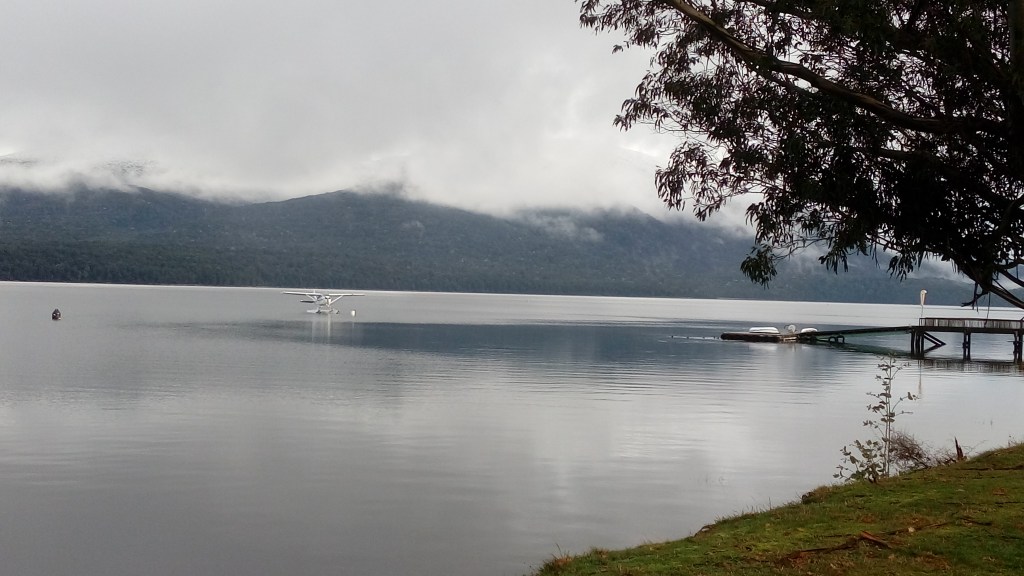
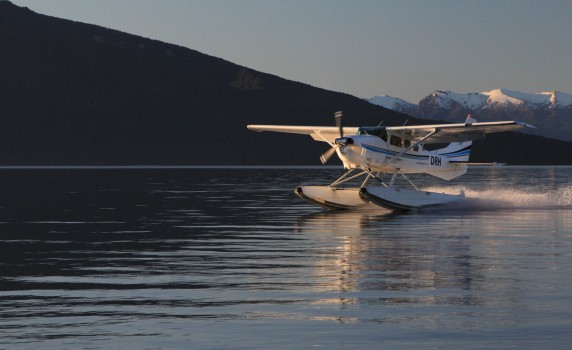
A helicopter or float plane ride over the fjords and sounds of Fjorland National Park.

The Float plane used for Fjorland from air

Lake 2 Lake cycle trails

Cycling and biking trails along the banks of lake Te Anau and Lake Manapouri

Lake Cruise on TeAnau and Manapouri lakes

A cruise along the lakes takes one through some exquisitely beautiful scenery

The Glow worm Caves

Across the Lake Te Anau lies a glow worm grotto which can be explored. We did this and I will be doing an episode on these caves soon

The Great Walks

The Kepler, Milford and Routeburn tracks offer a magnificent way to explore the unique eco system of Fjorland

Apart from these activities, Te Anau is a nice destination for a quiet break in the midst of a hectic sightseeing schedule too.

Digressing a little from Te Anau, I have mentioned a lot about the scenic beauty of New Zealand. It is time I told you about the beauty of it’s people….

I had mentioned that Kiwis are great hosts and that tourists are treated with warmth and affection in New Zealand…some instances

Athithi Devo Bhava!!!

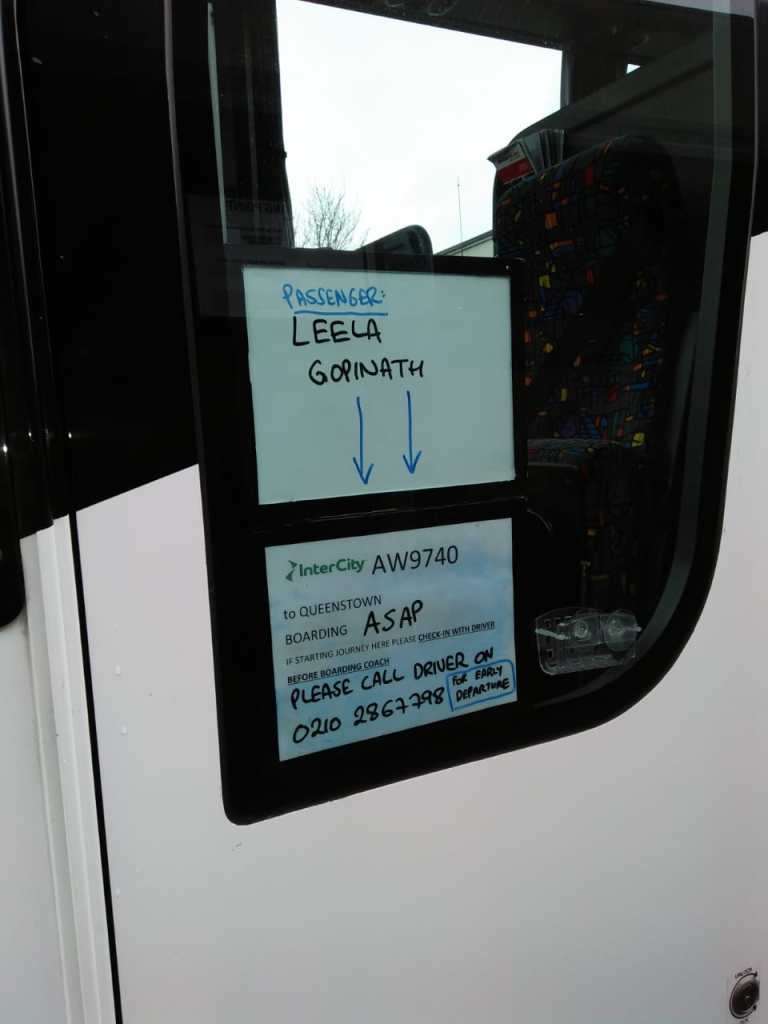
I must tell you about a very interesting anecdote from Te Anau. Apart from the sheer surprise, it really points out the sincerity with which the Kiwis treat their tourists. We were strolling around Te Anau town one afternoon as our connecting bus was scheduled only in the evening. Suddenly I saw a bus parked on the street with my name written on it. I just could not believe my eyes!!. There was a contact number asking me to contact the person to schedule an early departure.

Imagine seeing your name on a bus in the middle of a small town somewhere in New Zealand!!!….I had to pinch myself to be sure I was not dreaming!!

When I called him, the driver said that he is free and since we are the only passengers in the bus, he will take us as per our convenience. Mind you, this is a government intercity bus booked online from India! To fulfill their commitment to the tourist, they were not only running the bus but adjusting to our requirements. This is really Athithi Devo Bhava(our guests are like God)….a famous Indian proverb! There were at least two instances where we were the only passengers in a luxury bus and the driver dropping us directly at our hotel.

Athithi Devo Bhava….Kiwi style!!!

The Intercity bus

When this driver dropped us at Queenstown, he called up a cab and put us in the cab to our hotel. All this without any request from our side.

At another place called Rotorua, which I will cover later, the receptionist at the hotel waved down a bus and helped us carry our luggage to the bus. Mind you, its a regular local bus. And the driver of this bus digressed from his regular route and took the adjacent street so that he could drop us at the correct bus station….with no complaints from our co passengers!

Many a time, local passengers ahead of us in queue would let us board a bus first .

When we expressed our surprise and appreciation of this kind of hospitality,the reply was

“You are our guests and it is our responsibility to get you safe to your destination”

This motto is followed by everyone…it is almost like a rule…that tourists should be assisted at all places.

I really wonder how this approach has been ingrained in all the people there. Definitely something worth emulating!

Well, this episode has shown you the beauty of the land and its people!

Next I will meet you at the Te Anau Glow worm grotto….with those beauties that spread light even in darkness….

Meanwhile do subscribe below

QUEENSTOWN

Starting my New Zealand series with Queenstown….the adventure sports capital of the world. Staggering natural beauty and heart pumping thrills await you at this great destination.

A short Overview on New Zealand

New Zealand … an island nation consists principally of two main islands, The North Island and The South Island.

New Zealand is an awesome country, extremely beautiful and is a storehouse of tourist attractions. Fjords, Sounds, Geothermal phenomenon, unique wild life etc combine to make it a tourist’s dream destination.

The Maoris were the original inhabitants of this land. Even today, they keep up their traditions and put up cultural shows for the tourists.

The people are extremely friendly and treat tourists very specially. Preference is given to tourists at all places. This has to be seen to be believed. I will narrate our experiences as I write along.

Drive anywhere in New Zealand and your eyes will spot some white balls moving around the lush green meadows. These are sheep and they are an integral part of New Zealand’s economy.

Bio safety regulations at New Zealand airports are very strict. Being an island nation, they have unique flora and fauna and are very careful in retaining them as it is. No vegetable or fruit matter is allowed into New Zealand. The idea being that scattered seeds from fruits and vegetables brought from elsewhere may grow in NZ and over take their local produce. This shows how strict they are in such matters. So much so, baggages are sniffed by sniffer dogs much like drug detection.

They are also very strict in the road safety protocols they follow. Any repair or maintenance work on the road, there are warning signs from almost a kilometer away and the police oversee the entire process. It might seem very strange to us but I felt it was very good. Just shows the value attached to human lives!!!

Our Trip

Our Air New Zealand flight from Melbourne to Queenstown was indeed a dramatic one. Queenstown being a centre of adventure tourism , I was prepared for that….but….I did not know that our adventure tourism activities would start from the flight itself!!!!

Landing in Queenstown, we were thrown into some real bad weather and the flight kept circling Queenstown. The captain announced that the earlier flight had been hit by lightning and so we were diverted to Christchurch. After landing in Christchurch, we were told that depending on the weather situation in Queenstown, we would either refuel and fly or offload at Christchurch and head to Queenstown by road. Luckily for us, the weather cleared up. Soon the flight was refueled and we flew back to Queenstown.

The landing in Queenstown is spectacular. You fly in between the snow capped Southern Alps (much alike the views of our own Gulmarg ) with the beautiful Lake Wakatipu and the trees in fall colours.

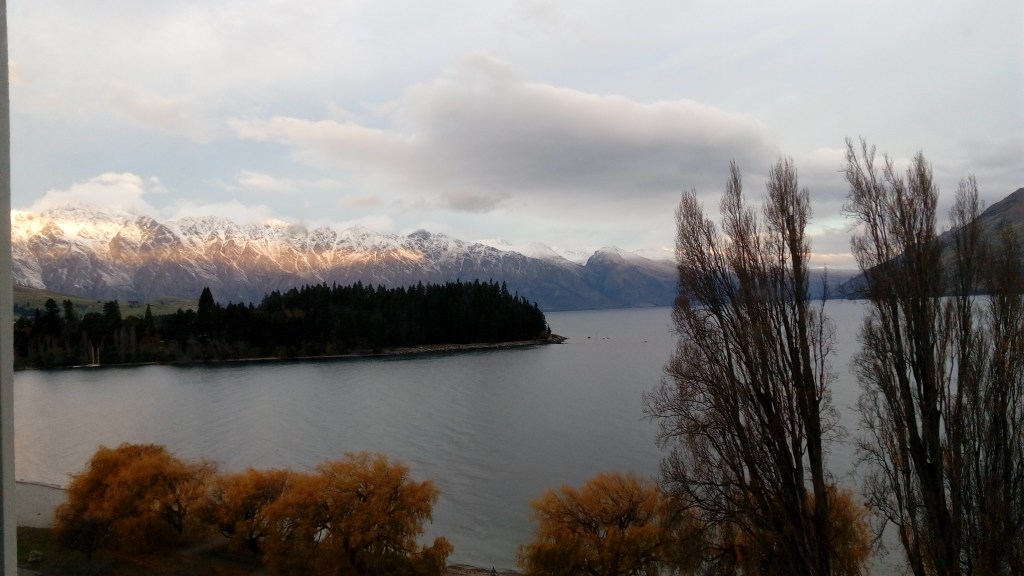
After landing we drove to the hotel as we were already late. The Rydges Hotel was beautiful with views overlooking the Lake Wakatipu. The lake with the trees along the shores reminded me a lot about Dal Lake in our very own Kashmir. After a long and tumultuous flight, we crashed for the day.

The next day was a bright and sunny day much to our respite.

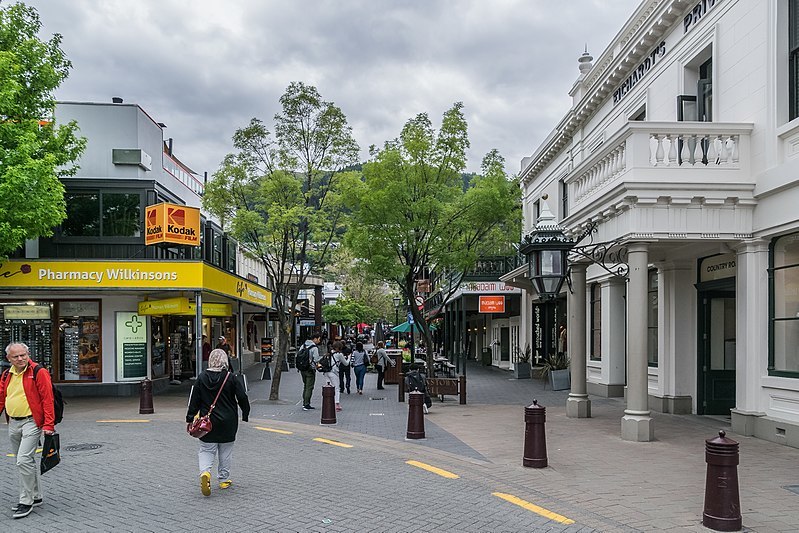
Queenstown is a beautiful city lying on the shores of Lake Wakatipu against the backdrop of the Southern Alps. It is highly tourist centric and the quaint streets are lined with bars, pubs, restaurants, gift shops and tour companies. Some pictures….

Beautiful Queenstown

A typical Queenstown street

Lake Wakatipu

Lake Wakatipu, an inland lake in the South Island is renown for its scenic beauty. Queenstown is located on its northern border. The beauty of this lake is essentially the essence of Queenstown. It drains into the Kawarau River which is the venue of many of the adventure sport activities held here. Bordered by The Remarkables mountains,it is also an important winter sports destination. A vintage ship TSS Earnslaw regularly plies on this lake enabling tourists to enjoy the beauty of the lake and mix it with some history too! A large wine producing area also thrives along its edges.

Lake Wakatipu

Sunset over Wakatipu

Lake Wakatipu on a less cloudy day

The Vintage ship on Lake Wakatipu

Being an adventure tourism destination, lot of tour companies promoting adventure tourism are seen dotting the quaint streets of this great resort town.

Why is Queenstown known as the adventure sport capital of the world?

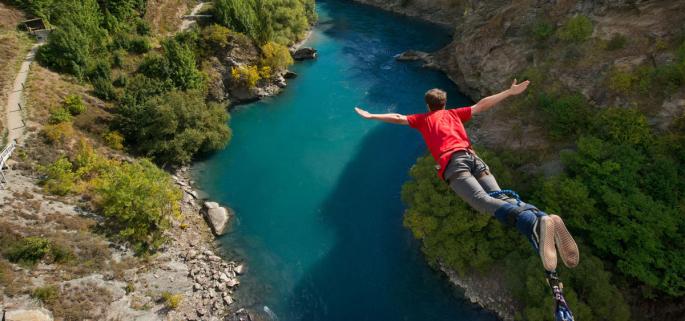
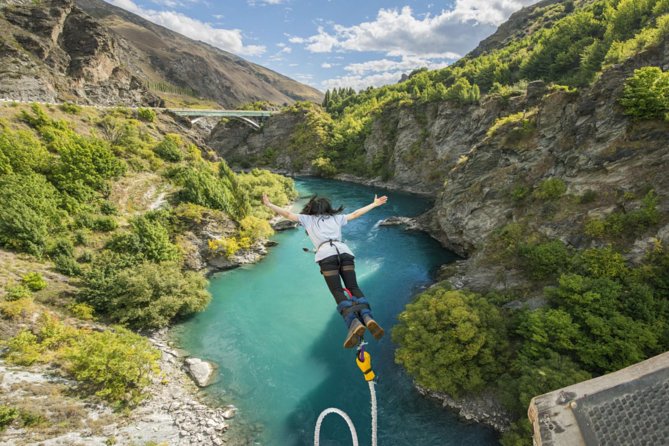
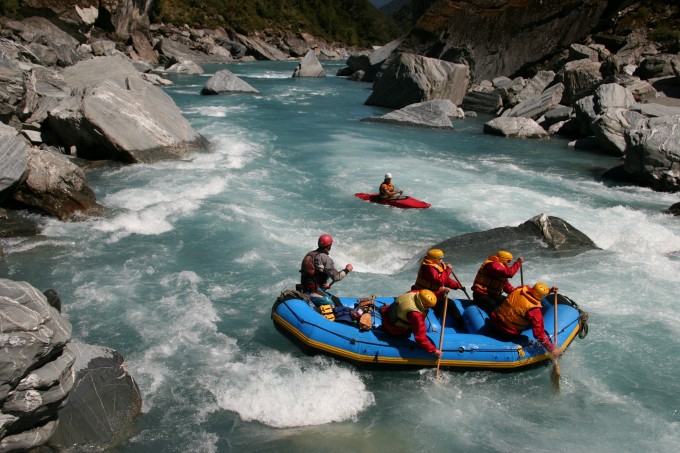
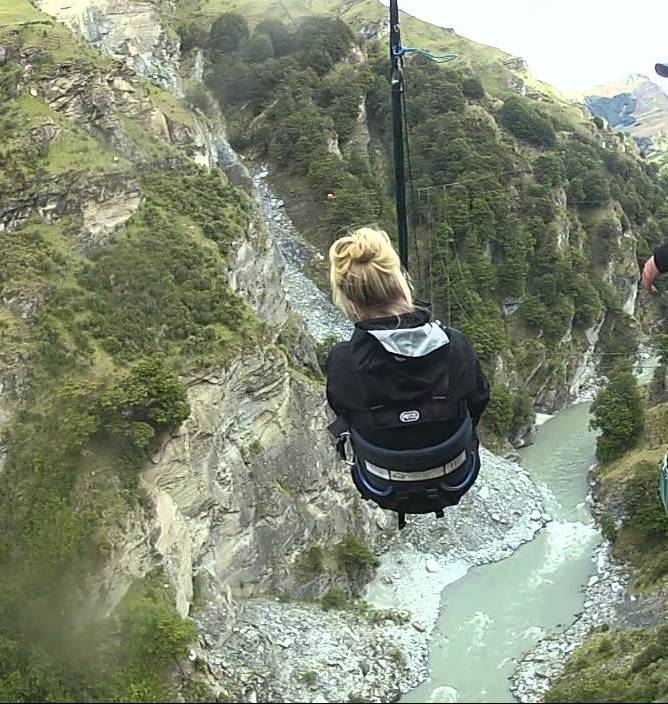
Well, it is the birthplace of commercial bungy, has the highest cliff jump, the world’s steepest zip line, the world’s biggest human catapult and has one of the largest giant swings in the world. Tandem skydiving and paragliding started here. Whitewater rafting and jet boat rides on the Kawarau river started commercially here.

We visited the A J Hackett Bungy centre. They are the pioneers in commercial bungy jumping. Here they have short video shows on bungy jumping. One can register here and then they take you to Kawarau Gorge where the actual jump takes place. We visited the Kawarau gorge which is about 20 minutes bus ride from Queenstown.

Some pictures…

The Kawarau Gorge

Bungy centre entrance

The bungy jumping platform

A jumper takes off from the platform

A live bungy jump….(click on the video)

We saw some of the tourists indulge in these great jumps and other adventure sport activities. Some pictures….

Ziplining

Jet Boat Riding

White water rafting

Canyon swing

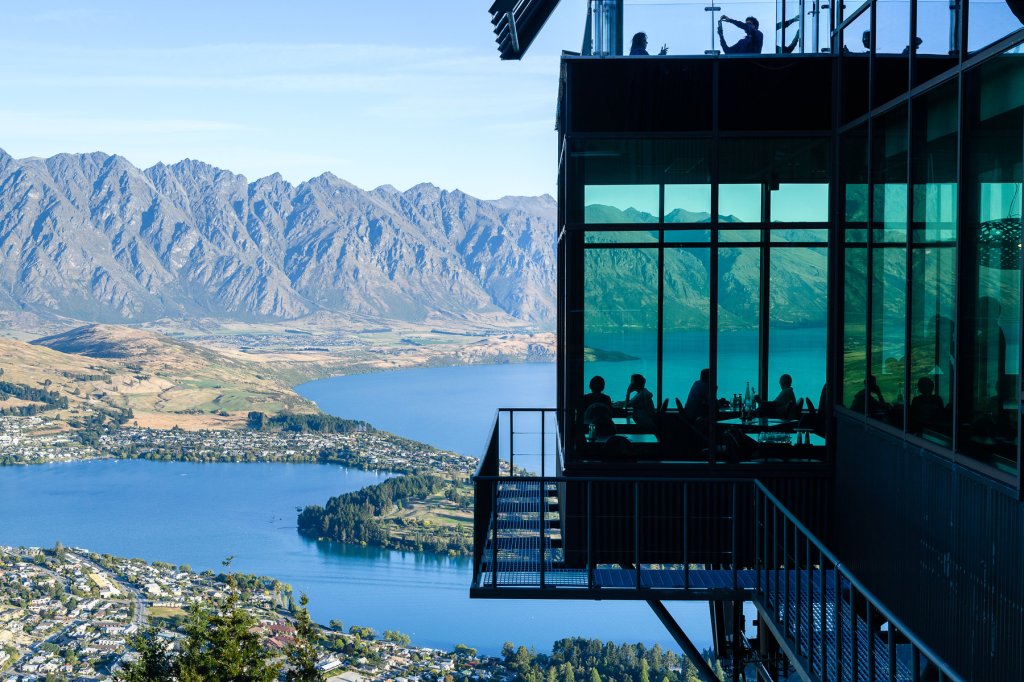
Skyline Queenstown is the gondola that takes one to Bob’s Peak on top of the Ben Lomond mountain. It gives great views of Queenstown and Lake Wakatipu as it takes one up the peak. There is a restaurant on the peak from where there are beautiful views.Some pictures…

The Skyline Queenstown

The restaurant at Bob’s Peak

Apart from Queenstown being a resort town in itself, it is also the starting point for many of the beautiful sightseeing locations in South island. Fjorland National Park and its main attraction…The Milford Sound can be reached from Queenstown. The beautiful small town of Te Anau which is famous for its Glowworm caves is also easily accessible from here.

Since the drive from Queenstown to Milford Sound may be too long, we decided to halt at Te Anau and do the Sound from there. Our next destination was a total contrast from the live and bubbly Queenstown. Te Anau is a small peaceful, quiet resort town…a sleepy town infact. But we were awe struck by its natural beauty. See you next week at beautiful Te Anau…

Till then, do give me your feedback and subscribe below..

The Great Barrier Reef

The great barrier reef is one of the richest and most complex natural ecosystems in the world located on the northeast coast of Australia. Made up of more than 3000 reefs and home to thousands of marine life, it provides some of the most spectacular marine scenery. It is one of the few living structures visible from space as a complex string along Australia’s coast.

The Great Barrier Reef varies in depth with vast shallow inshore areas, deeper at mid-shelf and outer reefs and deepest further out into the ocean.This variation in depth as one goes further out into the ocean adds to the diversity of the species inhabiting these reefs.Apart from this, many of the cays act as breeding grounds for colonies of sea birds and the green turtle.

It holds great scientific interest as it is home to the Dugong(sea cow) and the large green turtle which are threatened species.

Corals:

A coral is an invertebrate colonial organism…meaning many individuals live and grow while connected to each other.

Threats:

Climate change is the greatest threat to the Great Barrier Reef. A combination of rising water temperatures, pollution, severe cyclones and crown- of -thorns starfish outbreaks are the main dangers to the reef itself and the iconic animals that depend on it.

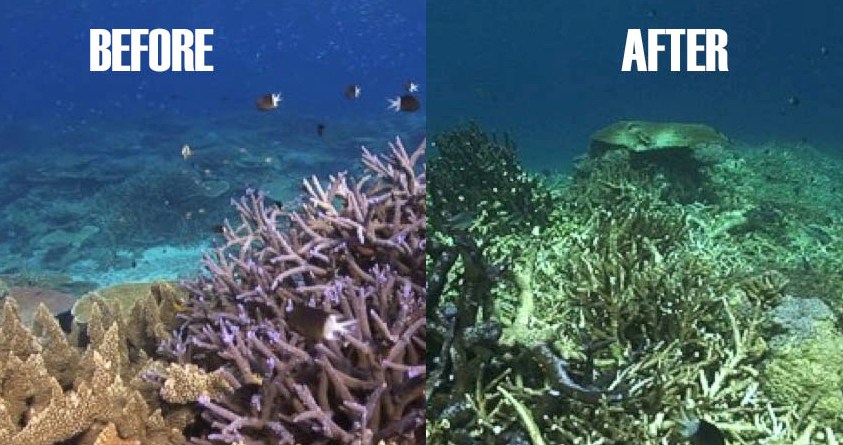
Temperature: Rising temperatures cause heat stress to the corals which expel the microalgae that live inside ; exposing their white skeletons. This is called Coral bleaching. This is a reversible change if temperatures reduce.

Ocean Acidification:

Rising levels of atmospheric carbon dioxide dissolves in the ocean waters leading to their acidification. Acidic pH is detrimental to coral survival.

Cyclones:

Climate change has triggered increase in frequency and severity of cyclones which damage the reef.

Habitat Changes:

Rising water temperatures trigger migration of marine species to cooler areas. This causes competition in these areas threatening the entire ecosystem.

Crown-of Thorns Star fish:

These are spiky marine creatures that occur naturally in reefs. They feed on coral. When they appear in large numbers, they devastate the reef.

Pre and post bleaching images of a coral (these are images from the web and posted solely for demonstrating the changes in corals)

Our Trip

We visited the reef from Cairns; which is considered The Gateway to the Great Barrier Reef. Its tropical climate and its access to the reef makes it a popular tourist destination.

Cairns Esplanade , lined with bars and restaurants has a swimming lagoon.

The Cairns Esplanade Lagoon

Cairns is a fun city and offers tourists various options including casinos.There are plenty of establishments offering trips to the reef. We booked of Reef tour with Sunlover Cruises.

A casino at Cairns

Next morning we packed our swimwear and a change of clothes and headed to the wharf to board the cruise to the reef. The cruise ride was pretty rough and the staff distributed kits for seasickness. Lot of people on the cruise were seasick on our way up to the reef.

The Cruise to the Reef

During the ride to the reef, the instructors on board gave demonstrations on snorkeling and scuba diving. They explained the use of the gear, the flippers, the snorkel etc. Needless to say, the potential scuba divers were given more detailed and practical instructions than the snorkelers. The people who were sea sick were attended to by the cruise staff.

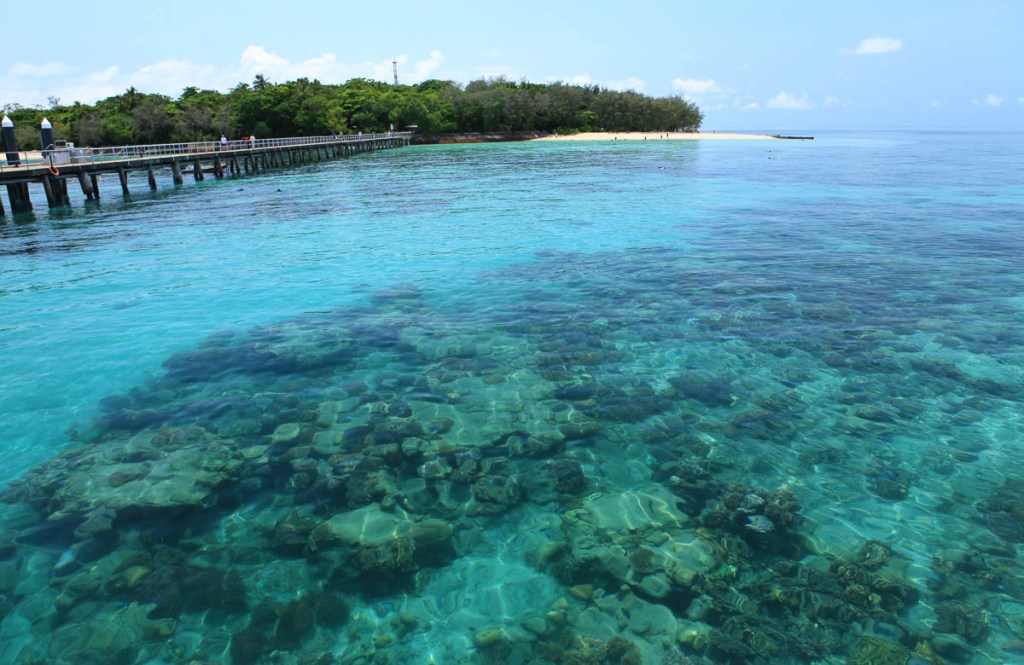
As we rode further away from the shore, gradually patches of reef were visible. The area where there is a reef looks more greenish compared to the surrounding ocean.

Approaching the reef…note the greenish colour

As you reach closer to the reef, few corals can be seen through the clear waters…

Few corals seen as one gets closer to the reef

After a choppy ride for about an hour and a half we arrived at Moore reef pontoon. This pontoon is a platform built at sea from where the tourists can undertake snorkeling, scuba diving and such other reef viewing activities.

The Moore Reef Pontoon

We left the cruise boat and boarded the pontoon. The pontoon has all facilities and we were told that we can leave our belongings at the pontoon.

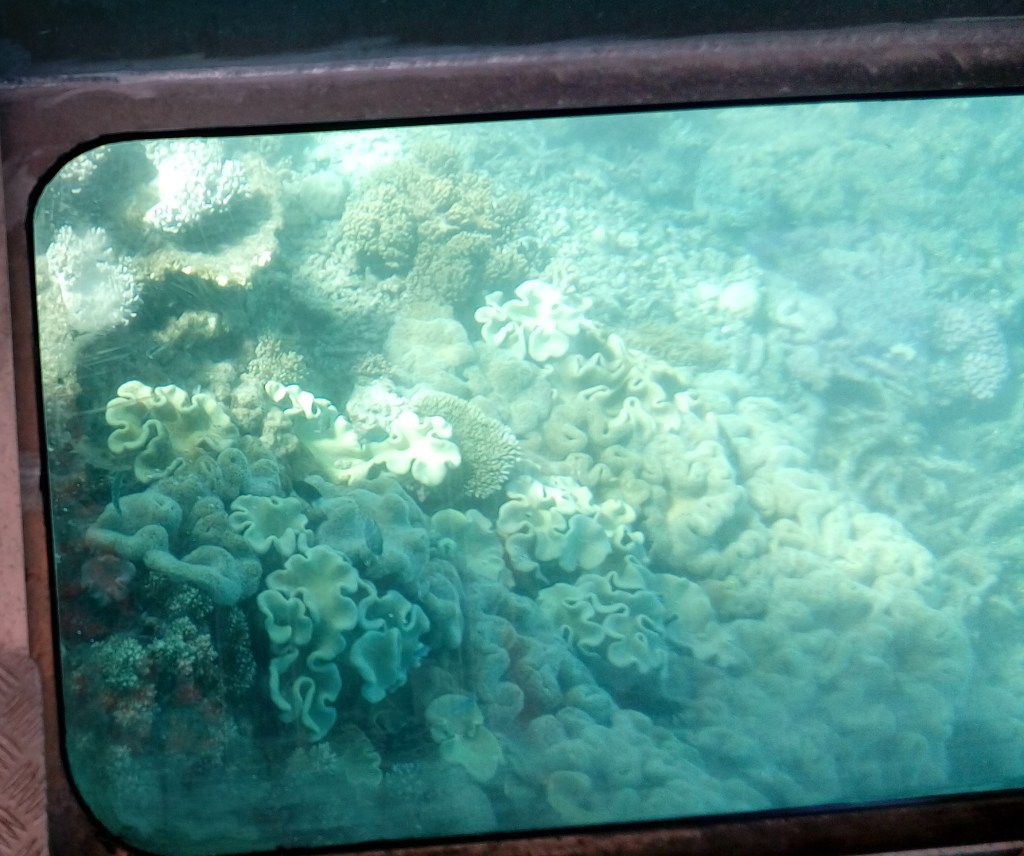
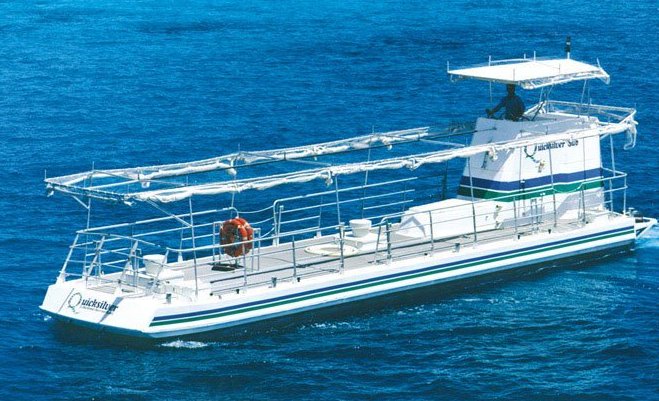
From there, we boarded the glass bottom boat for coral viewing which was ready and waiting for us. The guide took us along some of the reefs which we could see through the glass bottom of the boat.

The interior of the glass bottom boat.

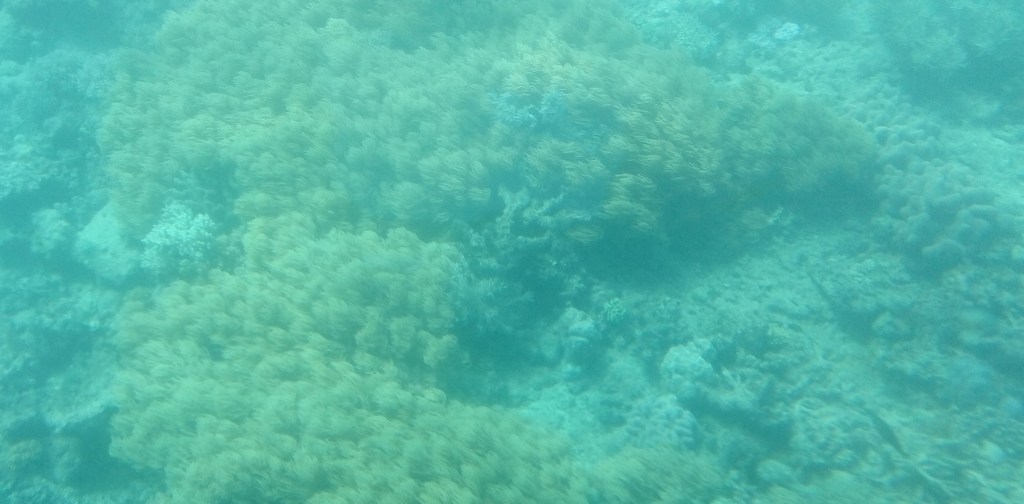
Corals seen from the glass bottom boat.

After the ride on the glass bottom boat we were taken on a semi submersible vessel for more coral viewing.

This vessel is partly submerged in water and the passengers go down via the stairway to the seats which are alongside the sides of the boat. Corals can be viewed through the windows.

The Semi sub

Inside the semi sub

Views of corals from the side windows of the semi sub

After the semi sub experience, we decided to try our hands at snorkeling.

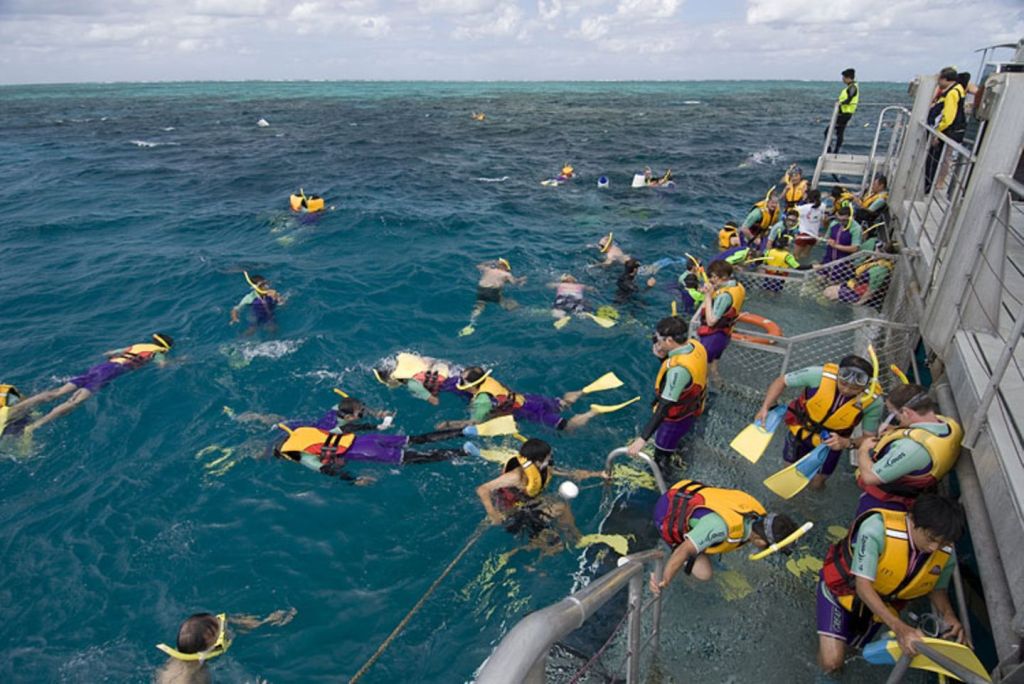
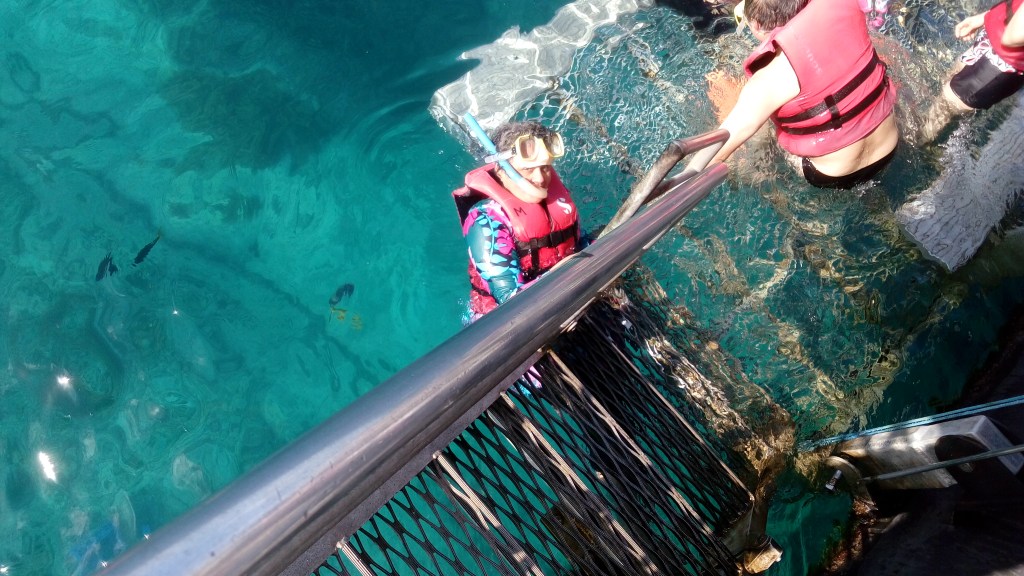
After putting on our swimwear and collecting our snorkel, goggles and flippers, we headed to the stairs on the side of the pontoon. Guided by the staff on the pontoon and the life guards, we joined some of our co passengers who were already snorkeling .

The first time you look under the ocean, is a moment of ecstasy! The sheer expanse of the waters and the fish around you is just amazing. Suddenly you find yourself surrounded by plenty of multicolored small fishes and of course the ocean floor has lots of coral too. I must confess that I had difficulty snorkeling with water entering my snorkel tube in spite of all the precautions taken as per the guide’s advice. Of course there were people who were very adept at it and went on at it for a long time.

The views from our snorkeling expedition are not photographed as it requires special underwater cameras. I am unable to share the real life views due to this. It is difficult to take even these pictures from the snorkeling platform for obvious reasons.

The corals look more colorful in real life than seen in these pictures.These pictures are taken through glass windows which I suspect are tinted and that is why there is a uniform bluish green color overriding the color of the corals

I must mention here that there are lifeguards overlooking the snorkelers very carefully and any sign of distress is addressed immediately.

No one is allowed to touch or hinder the fish in any way. They are very strict about it and we were clearly told that any attempt at touching the fish will entail a fine.

The launching pad for the snorkeling session..

Trying my hand at snorkeling!

After spending some time among the beautiful fish, we returned to the safety of the pontoon , changed up and headed for lunch. An elaborate lunch was spread out on the pontoon and we helped ourselves to it.

Post lunch we visited the underwater observatory on the pontoon. This is similar to the semi sub. Here we can watch the fish that swim along the sides of the pontoon from inside the safety of the pontoon. There was a feeding session for the fish . This is done specifically to attract more fish to the sides of the pontoon for the benefit of the tourists.

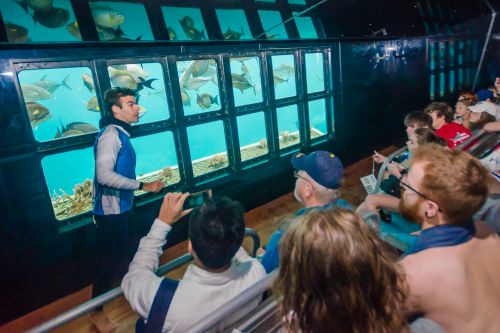
There was an interaction with a marine biologist too after the feeding session. He explained many details about the corals and the fish that live among the reefs.

Views from the underwater observatory

The interaction with the Marine Biologist

After all these activities we left the pontoon and boarded the cruise back to Cairns.

It was indeed a wonderful experience…again a once in a lifetime experience!

If I claim to have shown you all that I experienced; I would be being unfair. The sheer challenges prevent me from getting you better pictures.

After all, there are some experiences in life which cannot be explained or shared ….one has to experience it oneself..

This is one such experience….

After a short two day stay at Trinity Beach, we headed to New Zealand….a real beauty…

Next week, I start my series on New Zealand….see you there…

Meanwhile do comment and subscribe

The Penguin Parade

One of our most memorable trips…the visit to Philip Island to see the little blue penguins.

We started the day with a visit to Moonlit Sanctuary.

Moonlit Sanctuary:

A Wildlife Conservation Park located in Mornington Peninsula , about an hour’s drive from Melbourne; it aims to display native Australian fauna . It has many animal enclosures, as well as many native Australian trees and plants. It also engages in conservation breeding of endangered species.

Here we fed the Kangaroos and wallabies, posed with the koalas and saw some exotic birds, reptiles and dingoes. There are keeper presentations throughout the day when one can learn more about these species.

I had a small encounter here with a kangaroo which got upset with me when the feed was over and started lashing out for more feed. Sure enough , one of the keepers came to my rescue….much to my relief!!!

The angry Kangaroo!!!

A parakeet

The Tasmanian Devil

The Noisy Kookaburra

A Koala

After lunch, we set out to our next destination ; Churchill Island; the site of the first European garden in Victoria state. It contains a working farm, cottages dating from the 1860s and a homestead, all fully restored and open to the public. It is connected by a bridge to Philip island.

The Boonwurrong people who were the traditional people of this area, inhabited this island much before the Europeans arrived.

There is a farm and vegetable garden here where one can explore the heritage farming activities . There are sheep shearing shows conducted which we attended. Any one interested could try their hand at milking the cows!There were plenty of geese and other poultry here…all part of the farm. Surrounding the farmland, there are historic gardens that complete the heritage feel of the place.

Some pictures..

The heritage farm cottages

Animal enclosure

The open gardens overlooking the sea

Sheep shearing

From here we proceeded to The Nobbies

This is essentially a collection of rocks known as Seal Rocks and is home to the largest colony of fur seals .These cobblestone rocks jut out into the sea and form a perfect habitat for fur seal breeding . There is a boardwalk here from where one can look out for the seals.

These seals and are distinguishable by their brown hair. There had been a decline in their numbers due to hunting but conservation activities put in place by the park authorities has seen an improvement in their numbers.

The Nobbies

The Fur Seals

The Koala conservation centre was our next point of visit.

Here one can come face to face with Koalas in their natural habitat. There are treetop boardwalks along which you can walk looking out for Koalas chewing at their favourite food…. the eucalyptus leaves or just lazing away on one of the branches. Interactive sessions on koalas are also available here. As one walks along the boardwalks, one can witness other native Australian animals too.

The little guy loves eucalyptus leaves!

And last but not the least…….the parade of the little blue penguins. …reaching there around sunset time.

The Penguin Parade..

Philip Island is home to the largest little penguin colony in the world. These cute seabirds set out to the ocean in search of food during the day time. At sunset, they return to their burrows and that’s what we call the Penguin Parade.

The Penguin Parade visitor area consists of gallery like steps built on the shore. Visitors have to maintain total silence . Mobile phones and cameras are prohibited in this area. No photography is allowed. Hence the pictures I am putting up for you are from those available online. Only in pictures can one get a visual impact of what I describe.

After we assembled and settled down quietly under the supervision of a keeper, we all waited with anticipation. Suddenly we noticed two heads in the water and they swam ashore. Predatory birds were flying overhead and that deterred the little ones and they all swam back into the sea. After a few rounds of this back and forth , one little thing gathered up the courage and came out of the water and started waddling up to its nest. Sure enough, the rest followed and soon we had hundreds of them waddling along. What an amazing sight that was!!!….its a once in a life time moment actually.

We have heard about Safety in Numbers….these little birds are very aware of it. They always try to stay together in a group supposedly to give the impression that it is big creature to the predatory birds flying above them.

After most of them were ashore, we could walk along the boardwalks again in total silence. The burrows of these penguins are below the boardwalks and the little babies were waiting anxiously for their parents return. Cackling away, those cute beauties were adorable indeed!!

I know it would have been ideal to post a video of the parading penguins. Unfortunately regulations do not allow photographing there . For those of you who would like to see it, there are videos available on you tube…..the next best thing!

The Visual treat for you….take a look…

The Viewing Gallery

An adult and baby penguins

.

The boardwalk to view the penguin burrows

Signage as one leaves the penguin colony

Well, this was really one of my awesome tripsI hope I have been able to communicate this awesome experience to you. But as they say….nothing can come as close as experiencing it oneself. So do make it to Philip Island …its really worth it!!!

With this we bid goodbye to Melbourne . Next destination is Cairns….so next week we are diving at The Great Barrier Reef….don’t miss it!!!

Before that, don’t miss to subscribe below…

THE GREAT OCEAN ROAD

The Great Ocean Road…an overview

The Great Ocean Road is one of the top ten drives in the world and the 12 Apostles are one of the most visited attractions in Australia. It is a listed National Historic site of Australia.There’s so much to see on this amazing coastal drive which stretches 243 kilometres along the coast from Torquay to Allansford.

This road hugs the shores of the Southern Ocean with beaches and limestone cliffs on one side and green countryside on the other. Port Campbell National Park which houses the 12 Apostles lies on this road . The coast from Torquay to Cape Otway is called the surf coast and further on it is called the shipwreck coast.The limestone cliffs here were responsible for many of the early ship wrecks.

The Great Ocean Road was built in memory of Australians who lost their lives in the first World War.

Our Trip

We had a day trip on Great Ocean Road booked from India via Viator

Picked up by Bunyip travels, our local tour operator, we were soon out of Melbourne and at the Memorial Arch on the Great Ocean Road.

Memorial Arch was built as a tribute to honour the three thousand servicemen that built and worked on the road from 1919 to 1932.

The Arch is at one of the original toll points where people paid to use the road .The toll point was taken down once the building costs were paid off and the archway was then built mostly from wood.

The Memorial Arch On Great Ocean Road

After a short photo halt, we drove down to the town of Anglesea where we were treated to some packed breakfast.

The drive on The Great Ocean Road is an experience in itself. The winding road with greenery and palatial mansions of the rich and famous keeps one glued to the window on one side. On the other side, the ocean plays hide and seek with you. A great view of the ocean suddenly blinded by cliffs for a short distance and then again another perspective of the ocean. This is perhaps how you can describe this drive. But the ocean views are awesome to say the least. Occasional rocky sentinels stand out from the ocean with the waves constantly brushing them. Some of these sentinels have obviously worn out due to the constant caresses from the ocean waves. Many of these were connected to the coast long ago and have been gradually severed away by the lashing waves.

Cape Otway lighthouse was our next photo halt. Here , a short walk off the road leads you to a light house and a small cafe.

The Cape Otway Lighthouse

The Cape Otway lighthouse is the oldest surviving lighthouse in Australia.It is decommissioned now. It is a great whale watching destination from ashore as whales swim close to the shores in winter. There is a telegraph station here too.

Further down the Great Ocean road from Otway, the coast is called the Shipwreck coast. Rightly so….at least eight ships have wrecked on this coast. A sinister record indeed!!!

The Great Otway National Park

Located 162 kms from Melbourne this National Park lies in the Otway Ranges. It contains diverse range of landscapes and vegetation types.This park is designated an important bird area due to the variety of birds sighted here primarily due to its diverse vegetation . We had a small halt here and did a small forest walk. Some pictures….

The Otway Rainforest

The Bass Strait

The Bass Strait separates mainland Australia from the island of Tasmania.

There were many lookout points on the Great Ocean Road from where there are amazing views of the Bass Strait. One such picture…

The Bass Strait from one of the look outs on Great Ocean Road.

After a lunch break at one of the towns, we proceeded to Port Campbell National Park

The Port Campbell National Park features multiple limestone cliffs,rock stacks, gorges and arches.The 12 Apostles, The Loch Ard Gorge and the Gibson steps are the more popular attractions . These have all resulted from the salt laden air and harsh weather conditions peculiar to this region

The 12 Apostles

Rising out of the Southern Ocean, just off The Great Ocean Road are these magnificent limestone cliffs called The 12 Apostles. These were connected to the mainland once upon a time. Nature has played its music with these pillars. Winds and waves have battered them over the years into caves, arches and eventually into 150 ft high columns around 10 to 20 million years ago.At present there are only 8 such pillars seen.

These limestone cliffs look remarkable against the bluish ocean backdrop. They vary in colour and appearance depending on the time of the day. There are special sunset tours organised to the Apostles as the sun set views are claimed to be exquisite.There is a long wooden walkway towards the ocean and one can get views of these cliffs from different angles.

Our tour day was a cloudy one and so the pictures do not reflect the varied colours seen on sunny days.Some pictures…

The Apostles

The Loch Ard Gorge

3.5 km further west of the Apostles, is Loch Ard gorge.

The picturesque gorge is home to two yellow colored cliff faces with a bay in between. The water from the ocean enters the bay and can be reached at the beach.Though it looks like something out of a storybook, Loch Ard has a history dating back to 1878. A ship named Loch Ard was wrecked here killing all except two passengers, Pierce and Carmichael.

Stairs allow visitors to access the beach.

This gorge has provided a backdrop for many movies….and is still considered a popular destination for film shoots.

The Loch Ard Gorge

Gibson Steps

Situated close to the Apostles and the Loch Ard Gorge, one can access the beach using this stairway which has 86 steps.

As a popular stop-off on the Great Ocean Road, the Gibson Steps are easy to reach. The easiest way is to park in the designated car park that leads directly onto the viewing platform and the steps below. The views here are stunning, and after a view from the top on the roadside, one can use the steps to access the beach below.

Originally, it is thought the steps were cut out by the Kirrae Whurrong people, a local tribe who called the area home.

Hugh Gibson built the Glenample Homestead nearby and regularly used the carved steps to access the beach below. During this time, it was constantly used by fishermen and other seafaring workers to get to the beach and the water. Gibson is most famous for his role in the Loch Ard shipwreck. The two survivors, Tom Pearce and Eva Carmichael, were nursed and regained their strength at his homestead.

Gibson Steps

After spending some time on the beach and clicking some pictures, we returned to the bus to be driven back to Melbourne.

With another exciting trip to Philip Island to see the little blue penguins scheduled next day, we rested for the night …..

See you next week among those cute blue penguins….till then good bye

Do subscribe below..

MELBOURNE

A Multicultural city, Melbourne with its European feel finds itself very often in the the list of most livable cities. Read along and you will know why….

An Overview:

Melbourne is the capital of the Australian state of Victoria. It is the second most populous city in Australia. The original inhabitants of this place were the Kulin people.

The discovery of gold in Victoria in mid-1851 resulted in the gold rush and ,Melbourne the colony’s major port; experienced rapid growth. International migrants from both Europe and China soon arrived . However the poor working conditions of the miners and lack of facilities lead to the Eureka Rebellion, a mass movement of the people .With the wealth brought in from the gold rush and the subsequent need for public buildings, a program of grand civic construction soon began. When Australia became a commonwealth, Melbourne was its capital till 1927 when Canberra was made the capital. The post world war II years also saw Melbourne grow rapidly ,boosted by post war immigration to Australia.

The city is intricately connected with the Yarra River, which flows all along the city. You will never find a dearth of things to do in this city. You can explore the wonderful galleries, stroll through its green gardens, cruise on the Yarra river or hop on to a heritage tram to discover the magic here.Another of Melbourne’s claim to fame lies in its sports activities.

Highlights of Melbourne:
Eureka Skydeck

This is an observation deck on top of the Eureka Tower, a residential skyscraper. At a height of 975 ft, and 91 storeys above the ground and a basement , it was the world’s tallest residential complex when it was built. Subsequently it has been overtaken by others around the world. Its design represents the Eureka Rebellion against the gold rush ;with the building’s gold crown representing the gold rush and a red stripe representing the bloodshed during the revolt.

The observation deck occupies the entire 88th floor of the Eureka Tower.The Skydeck features twenty viewfinders that help visitors to pinpoint numerous significant landmarks around all parts of Melbourne, along with several free binoculars. 

Eureka Tower and Skydeck

Views of Melbourne city from the Skydeck

The Sealife Aquarium

Located on the banks of the Yarra River, its main feature is an ‘oceanarium in the round’ …. a huge tank with sharks and more than 2000 species of marine life swimming around .

The exhibits are in four levels and a self guided tour takes one around this wonderland.

The exhibits that attracted us were the Penguins…gentoo and king penguins. We got to see the penguins being fed and weighed.

The King Penguins

Baby Penguins swimming around and excited children chasing them outside

City Circle Tram Tour

One great way to sight see Melbourne is to take the City Circle Tram . It is free and with a commentary, this hop on hop off service passes many historic buildings and major attractions.

The City Circle Tram

Docklands

Known as Melbourne’s newest waterfront entertainment area, it is filled with cafes, restaurants and parks . Melbourne Star, the giant observation wheel is located here.

The Melbourne Star observation wheel

Yarra River and Trail

You will find the Yarra river crisscrossing your path in this city. A cruise on the river offers great views of the city. The River front near the Central Business District is beautifully done up with benches to relax by the riverside. A host of restaurants pubs and other utilities line the waterfront making it an interesting place to unwind.

Following the course of the river is the 38-kilometre Main Yarra Trail, which stretches from south bank to the north-eastern suburbs through river flats, sporting ovals, market, gardens and paddocks.

Yarra Riverfront

Federation Square:Federation Square is the city’s public square which opened in 2002. Melbourne’s central city grid was originally designed without a central public square, long seen as a missing element. The proposal to have a central square started in 1960.

The design of the building which is a mix of open and closed areas, stands in contrast to the Victorian architecture around. This area offers both outdoor and indoor entertainment options with performances held all year round. Plenty of cafes and restaurants dot the area making it a great outdoor escape for the locals.

Several museums and galleries dedicated to the original inhabitants are located here.

The Federation Square

Melbourne Cricket Ground:
Known locally as” The G”, it is the largest stadium in the Southern Hemisphere.

The MCG’s most famous moment in history was as the main stadium for the 1956 Olympic Games, hosting the opening and closing ceremonies, track and field events, and the finals in field hockey and soccer.

The MCG was the venue for the opening and closing ceremonies of the 2006 Commonwealth games and the Cricket world cup in 1992 and 2015.

With a history dating back to 1853, the MCG is the largest and oldest sports venue in Australia. Daily tours take people back in history at the National Sports Museum and the Australian Gallery of Sport and Olympic Museum located close to the MCG.


Melbourne Cricket Ground

The MCG and National Sports Museum

Beaches

Brighton Beach is one of the more famous of the beaches in Melbourne, lying along the Port Philip bay. An iconic picture of Melbourne is the brightly colored huts or “bathing boxes”on Brighton beach. These date back to the Victorian era when sunbathers used them to change in private. These boxes are made of wood and are heritage protected. They are still in use. Many of them are leased out and the owners use them to store their beach requirements . They add color to the beach alright! The beaches in this area are calm and provide great opportunities for swimmers.

Brighton Beach with the colored bathing boxes

Shopping:

Crisscrossing the maze of lanes and window shopping is another activity that is interesting. The area around Flinders and Collins streets are particularly great shopping places. You will find everything from opulent shopping arcades for window shopping to the more affordable smaller shops here. When you are tired of walking, hop onto a tram and get dropped a couple of streets away. There is no dearth of such lanes and reaching the correct street can be quiet a challenge….

Shopping arcades

Albert Park

Staying at a hotel in Albert park, the lake and walking trails at Albert Park were walking distance from our hotel. We spent a lot of our free time lazing on the benches in Albert Park by the lake enjoying the sights of the locals running, walking, dog walking or picnicking there.

Albert Park is part of the cultural landscape in the traditional country of the Bunurong People. They were the original inhabitants of this area. Located 4 km from the Central Business District . Albert Park is home to a plethora of events, from fun runs to cycling events, pet-friendly meetups and the iconic Australian Grand Prix.

Some Pictures :

Albert Park

Fawkner Park:

Another beautiful park close to Albert park, this park is a favourite haunt of the locals. With walking tracks and benches under the shade of trees, it is a green oasis in the metropolis.

Some pictures:

I hope you have got a feel of this great city. From Melbourne,we did some great trips. One of them was to The Great Ocean Road…a beautiful road skirting the ocean…

See you at this great destination next week…

Meanwhile, do subscribe below