Sikkim; beauty nestled in the Himalayas

This was essentially our first trip to NorthEast India. A trip to Kalimpong, Gangtok and Darjeeling. Our first halt was Kalimpong, a tiny hillstation in West Bengal. After taking a flight from Chennai, we landed at Bagdogra airport one noon. We were picked up by our tour operator and driven down to Kalimpong.

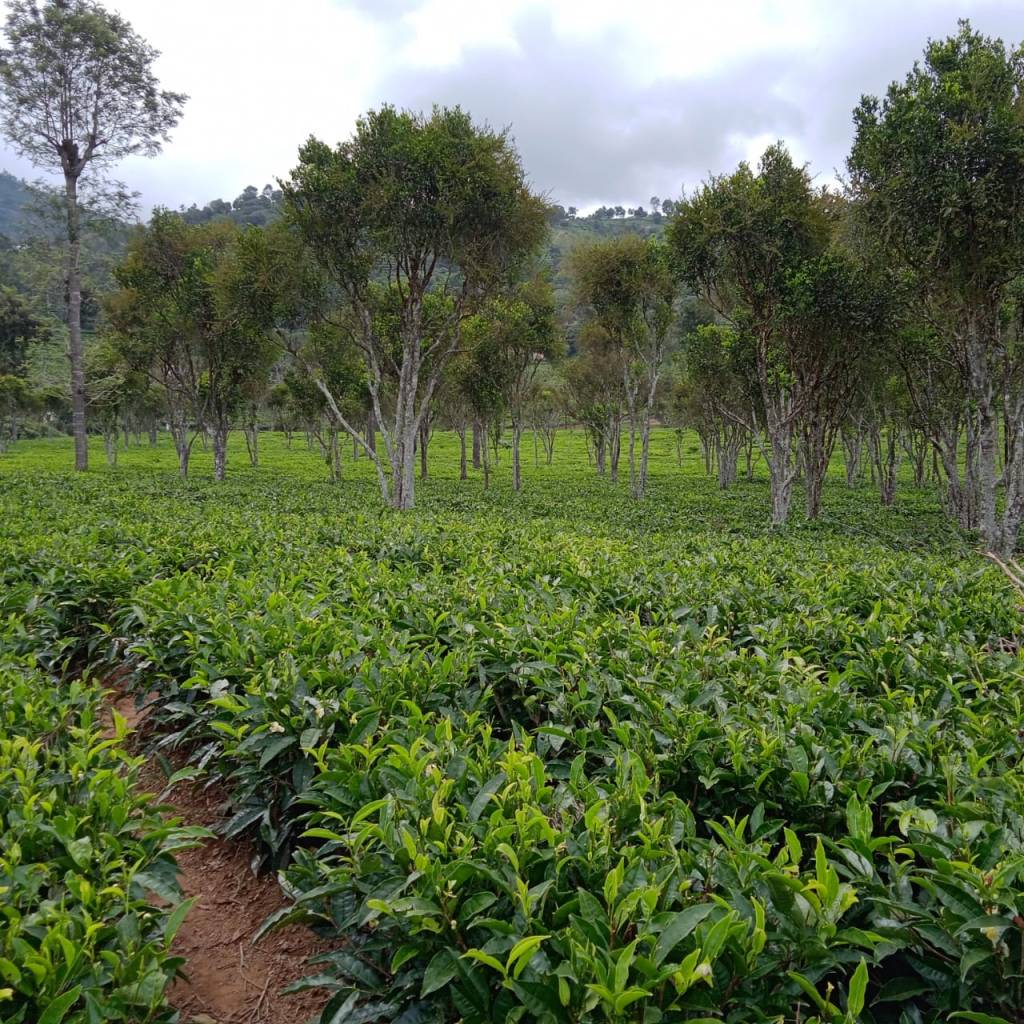
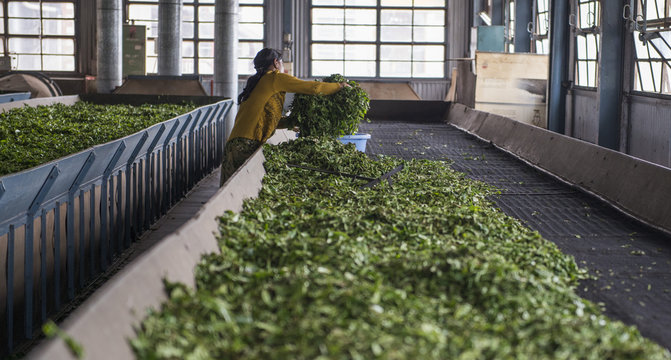
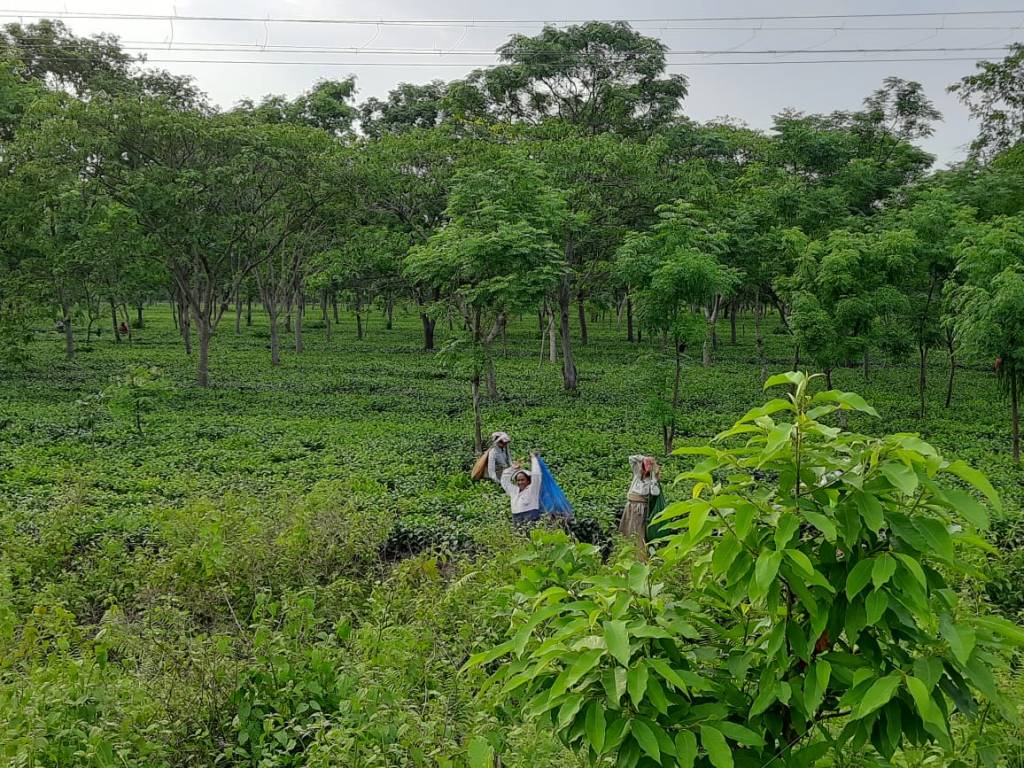
Just after leaving Bagdogra airport, we passed through the town of Siliguri and then on , we were on to some beautiful scenery. The drive was through tea gardens for the major part. The peculiar thing here is the presence of tea gardens on flat land. Down south, all our tea gardens are on hill slopes; not so here.

Tea Gardens

Gradually we were climbing up and we could feel the chillness set in as the altitude increased. Finally, we reached our hotel in Kalimpong by evening and rested for the evening.

Kalimpong

Kalimpong is a tiny hillstation at the foot of the Himalayas in West Bengal with salubrious climate. It is famous for it’s Buddhist monasteries , Tibetan handicrafts and local flowers. It offers great views of the Himalayas and the Teesta Rangit valley of Sikkim.

We woke up to a beautiful sunrise over the Himalayas .

Sunrise over the Himalayas

After breakfast we were picked up on a sightseeing trip of Kalimpong.

Our first halt was at Durpin hill which has the famous Tibetan monastery Zang dok Palri monastery. It is one of the largest and oldest monasteries in Kalimpong and houses beautiful paintings and scriptures.It has nine stupas or chortens in the courtyard.

The Monastery and the nine stupas

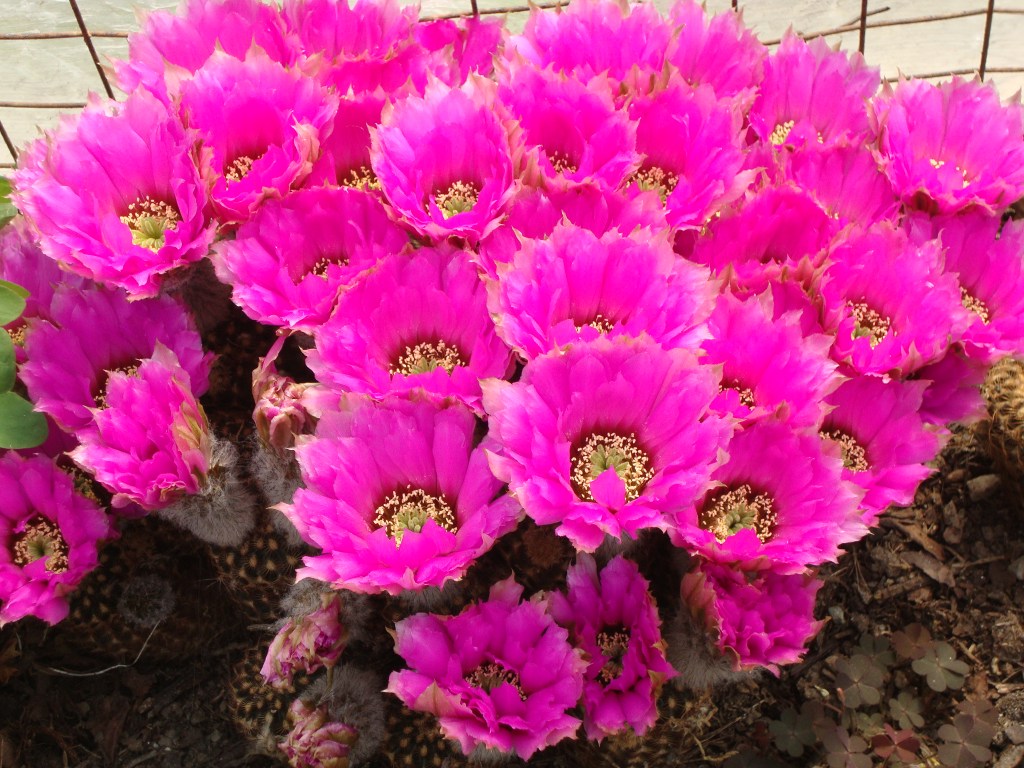
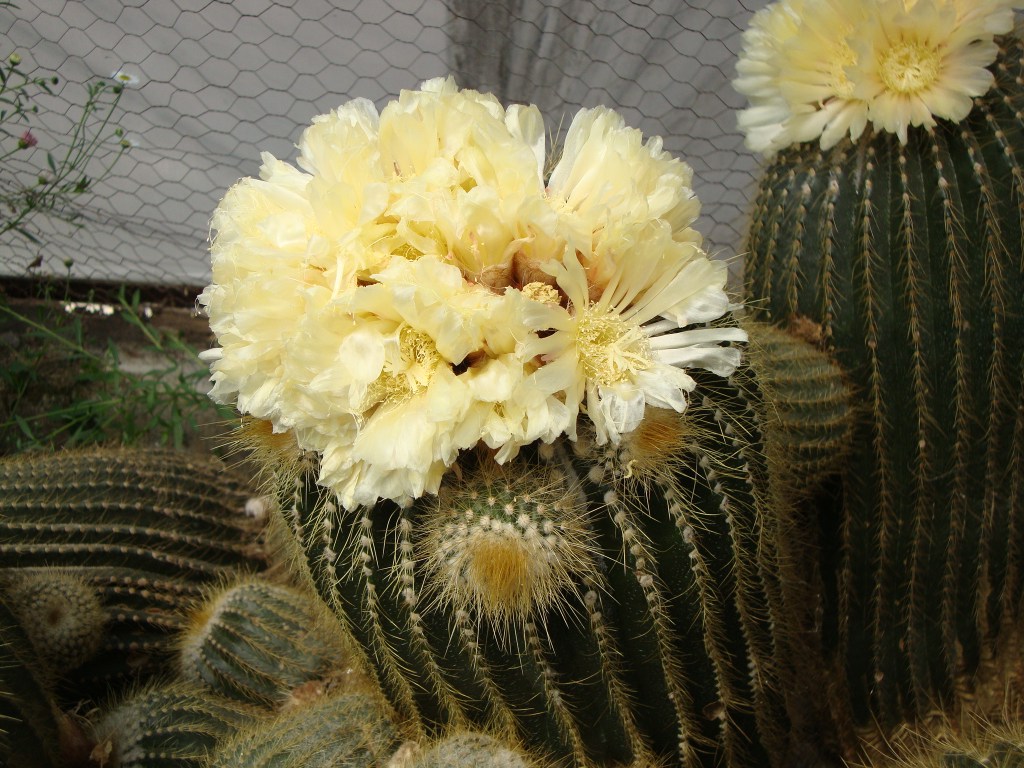
From there we visited one of the beautiful flower nurseries of Kalimpong. The cactus varieties and their unique flowers were truly enchanting. Some pictures…

Beautiful Cactus flowers

Sikkim

After lunch, we drove down from Kalimpong to Gangtok (capital of Sikkim), a distance of little more than 70 kms. Though the distance is less, the road follows a hilly terrain and it was evening by the time we reached Gangtok.

Sikkim is one of the smallest states in India but houses 84 glaciers making it the state with maximum glaciers.

The views enroute were really beautiful , particularly the Teesta river.

The hilly terrain

The Teesta River

Gangtok

This city in the eastern Himalayas ; capital of Sikkim is a prominent Buddhist pilgrim centre. Sikkim was a monarchy when India became independent but subsequently merged with India in 1975. Gangtok was on the trade route with Tibet and flourished through the Nathula and Jelepla passes. However, these passes were sealed after the SinoIndian hostilities leading to the decline of it’s importance. Subsequently the Nathula pass was opened for limited trade in 2006.

The city lies on the lower Himalayan ranges at a height of 1650 mts on a hill side and as such is prone to landslides. Roads are on steep inclines and houses built along the sides making it inevitable to have steep steps for reaching the buildings. It also lies on an earthquake prone zone surrounded by dense forest cover which acts as an impediment to growth of the city.

Gangtok, the city on a hillside

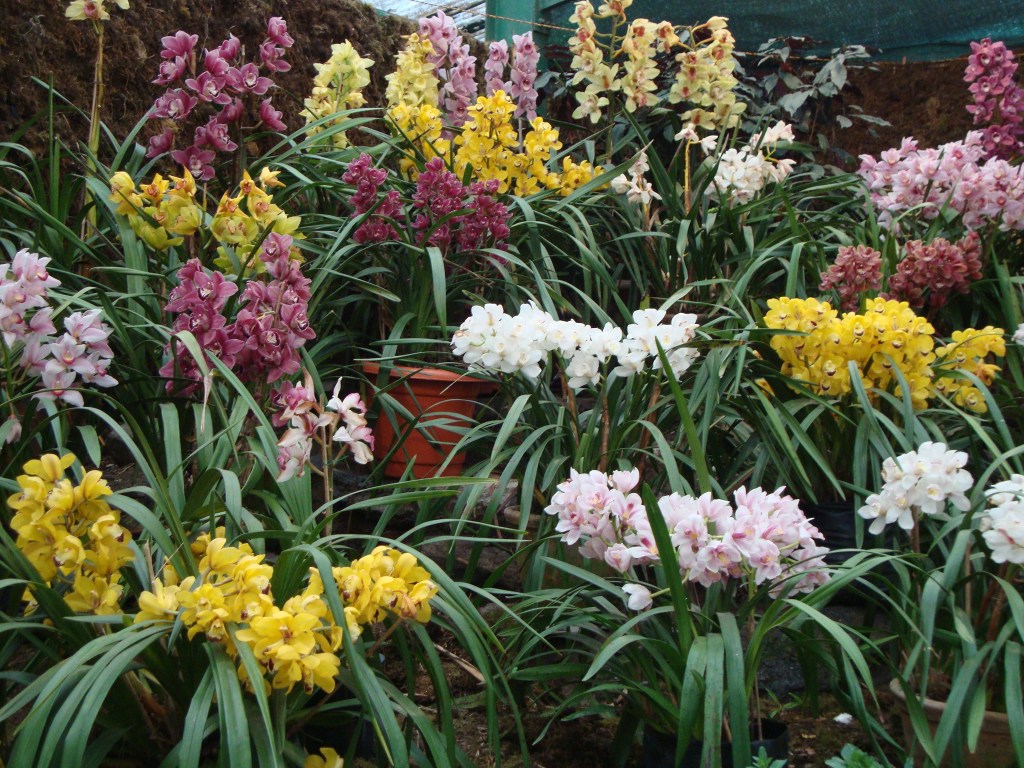
The upper parts of the city have alpine vegetation which gradually changes to temperate as one comes down in altitude. Bamboo is found in plenty. Sikkim is famous for it’s orchid varieties too.

The most happening place in Gangtok is the MG road and Lal Bazar. It is a pedestrian promenade with no vehicular traffic and dotted with shops on either side.

Lal Bazar , the main shopping promenade

We visited Gangtok in April and that was the time of the flower show there. Orchids dominated the show. Some pictures..

A variety of Orchids

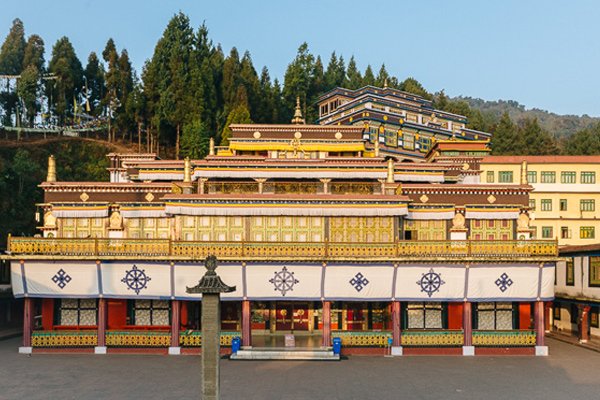
Rumtek Monastery

This is the largest Monastery in Sikkim and is the seat of the Karmapa who fled from Tibet to Sikkim. Also called Dharma Chakra Centre, it has typical Tibetan architecture and houses many monks who perform various ritual practices.

The interiors are colourful and have several relics. Some pictures..

Rumtek Monastery

The colourful interiors of the monastery

Tashi Viewpoint

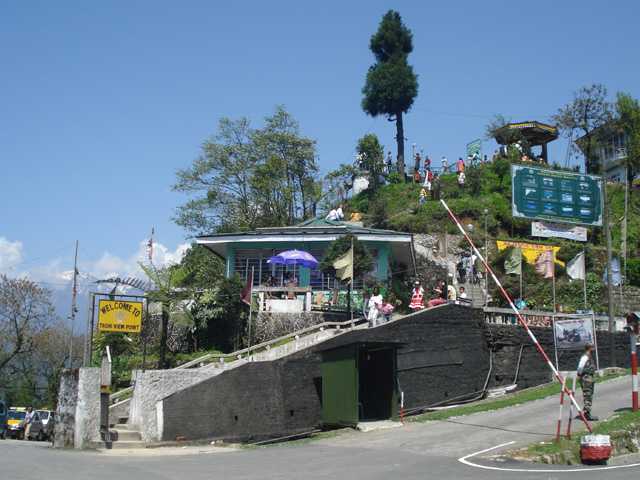
Our next halt was at Tashi View Point. This charming place is a perfect place to witness the brilliant surroundings like mountains, valleys and Gangtok itself.

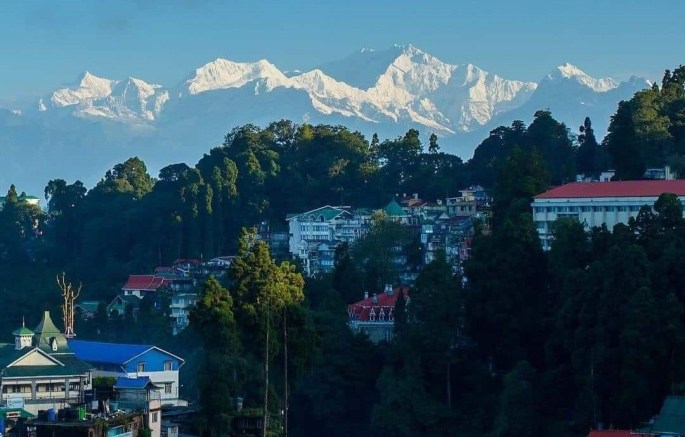
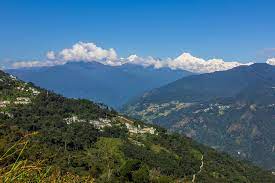
Great views of Mt. Kanchenjunga can be enjoyed from here. It is ideal to come here for sunrise as the different hues of colour reflect on the peak. Some pictures…

Mt. Kanchenjunga from Tashi

Tashi View point

The next day was the highlight of our tour to Sikkim. The visit to the Tsomgo Lake

Tsomgo Lake

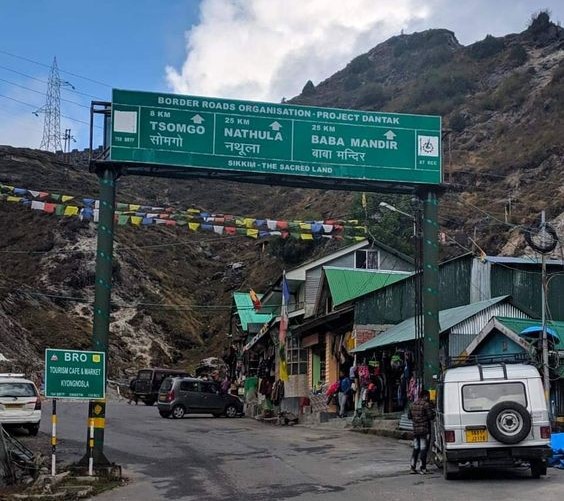
40 Kms from Gangtok on the Gangtok – Nathula highway is this beautiful glacial lake which is also called Changu Lake. The road to Nathula pass literally surrounds some parts of the lake. Since the border with China is just 5 kms away, this area is under army surveillance and we find lot of army personnel here. Due to this, visitors to Tsomgo Lake require to take prior permission by submitting identity proof. This is checked at entry and marked again while leaving.

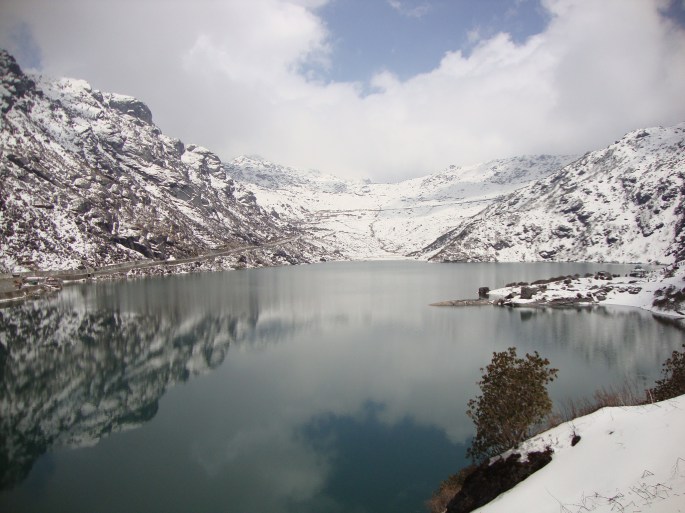
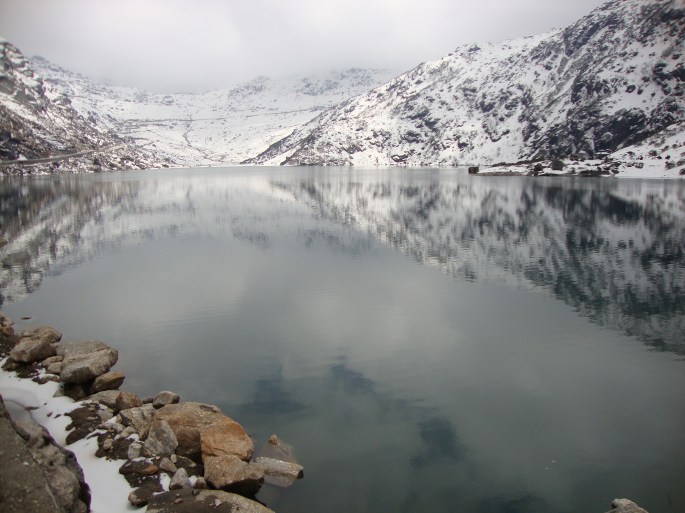
Located at an elevation of 3700 mts, the lake remains completely frozen in winter. The lake is surrounded by snow clad mountains which melts in summer to form the source of the lake. By May when the winter ends and the ice melts, there are beautiful Rhododendron flowers along the edge of the lake. We were a little too early for that!!

Rhododendrons

The Tsomgo lake is host to a number of migratory birds prominent among which are the Brahminy ducks. The migratory birds use the lake as a stopover on their way to the Indian plains from as far as Siberia during the winter months.

Tsomgo is believed to be sacred by Buddhists and Hindus and is shrouded in myths, beliefs and faith. Local legend has it that in ancient times, the Buddhist saints used to predict the future by observing the changing colour of the lake; a dark, gloomy tint told of difficult times and unrest in the region.

The Jhakris or faith healers of Sikkim attribute healing qualities to the water of this lake. Yak rides are an added attraction here.

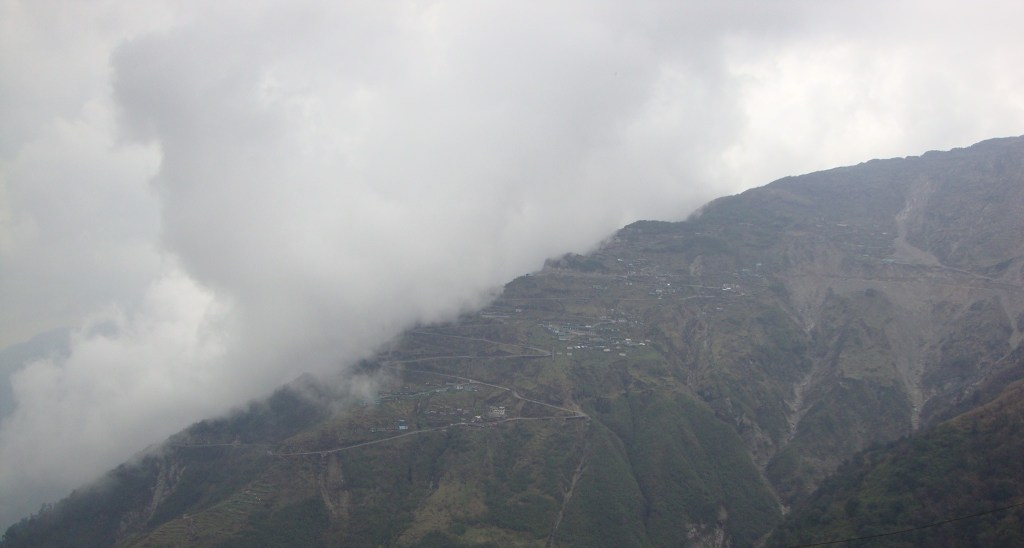
The trip to Tsongmo was a rather jerky one, I must admit. Due to the extremely hilly terrain, the roads are winding up hill slopes and it is uneven and many places there were blocks due to rocks and boulders falling on the road. The road climbs 7500 ft within a span of 35 kms making it one of the steepest inclined roads.The drivers here are experts, and they literally take you on the edge of a ledge with a ravine below. All in all, it was a risky ride. That is probably the reason, that the vehicles move in a convoy .

Our convoy to Tsomgo

The winding roads…

There were waterfalls along the way…

A waterfall on the way

But at the end of it, the views were awesome!!!

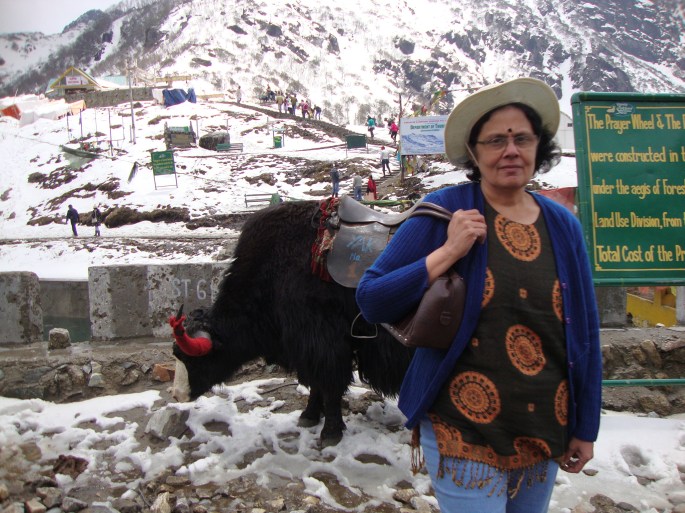
A signboard explaining the sanctity of the lake

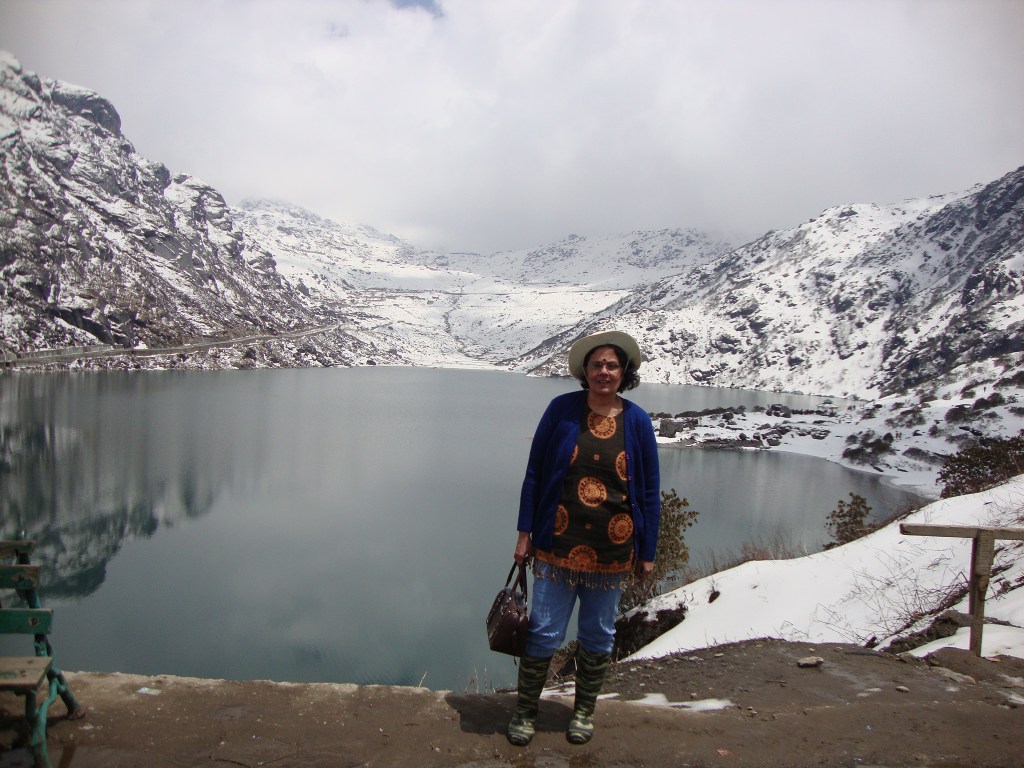
Tsomgo lake and the reflection of the Himalayas…

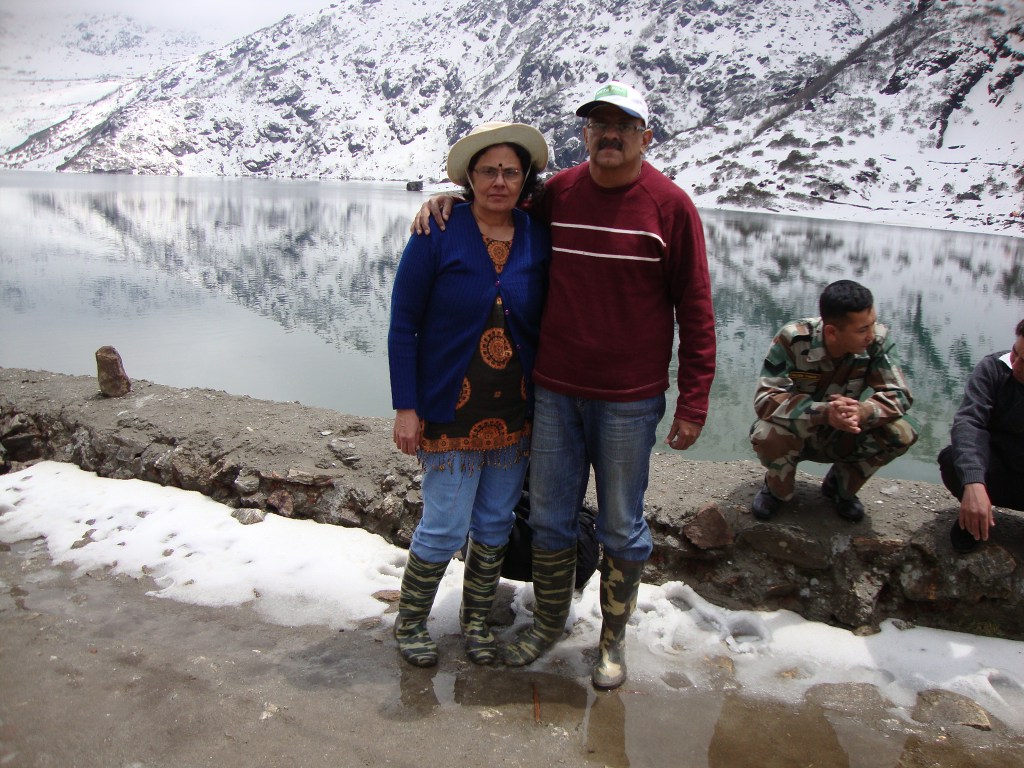
On the banks of the lake with some army personnel in the backdrop

The Yak is ready for a ride….

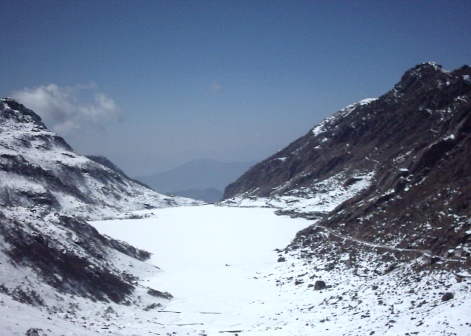
File photo of the same lake fully frozen in winter

There is a small cafetaria close to the lake where we had a quick bite and started our journey to Nathula Pass. There was lot of uncertainity about this part of the trip as bad weather was predicted but we managed it.

Nathula Pass

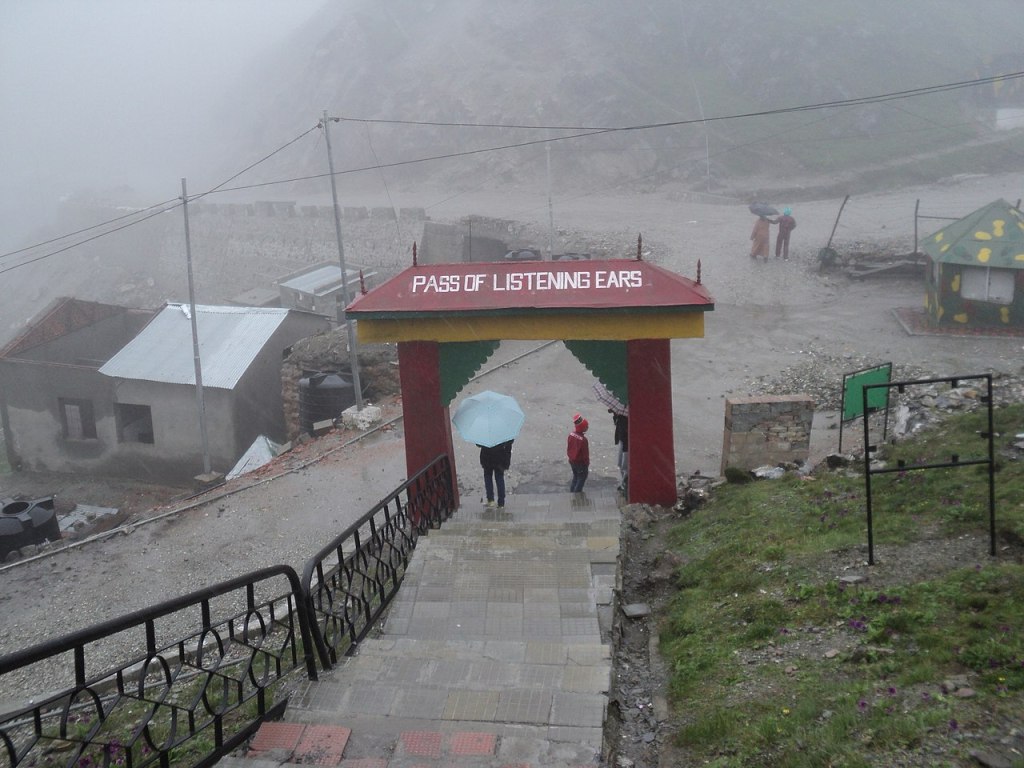
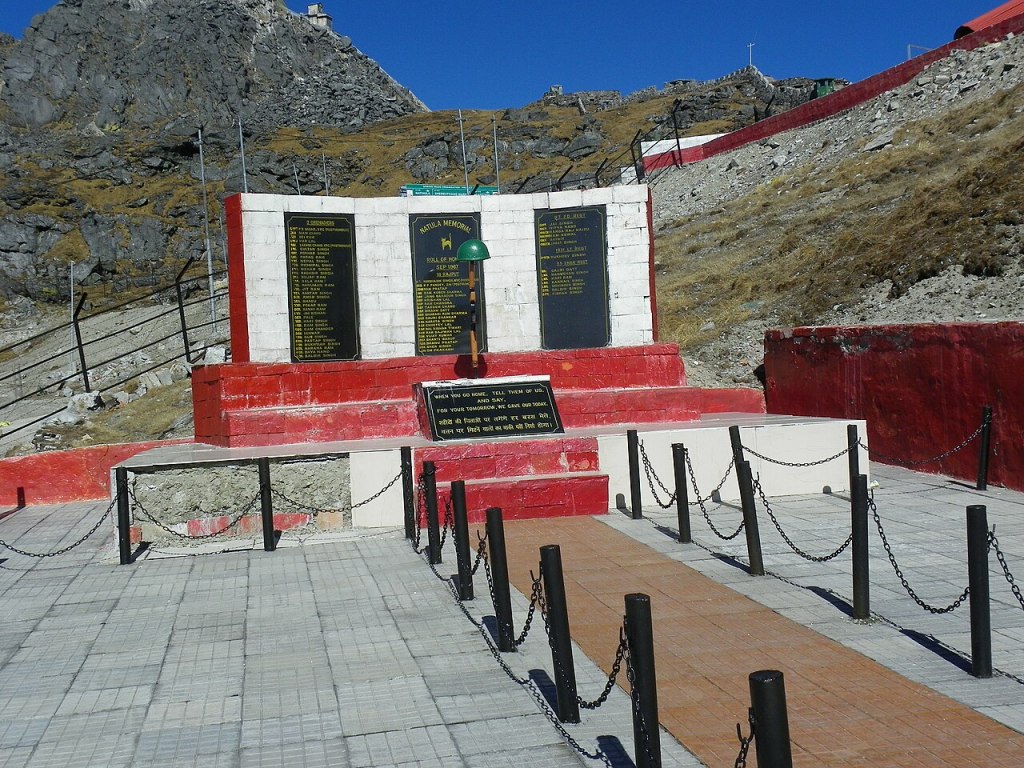
This pass at 14,150 ft connects Gangtok to Tibet and is located in the Himalayan ranges.It was once a trade route but was sealed in 1962 after the India-China war. Squirmishes along the area between the two sides was common. It was reopened in 2006 for trade and as it offered an alternative route for the Kailash Mansarovar Yatra. However, due to bad weather, trade is restricted to only few months in a year. Needless to say, variations in Indo China relations affects tourist accessibility here.

Some pictures..

Map showing location of Nathula and the road leading there

Nathula Pass

Memorial at Nathula

We just managed to look around and the weather dramatically worsened. We were all asked to leave immediately and we did so. Back in the safety of our vehicles, we waited in the long queue of leaving vehicles. Enroute we encountered some delay due to land slips which were being cleared by the BRO (Border Roads Organisation).

With beautiful memories of an alpine lake, we retired for the night with dreams of an exciting ride to Darjeeling the next day.

See you at Darjeeling next week. Till then, do subscribe, comment and give your feedback.

Kodagu; Beyond Koffee

Tasting Coorg coffee, let us continue our journey through Kodagu visiting some of it’s highlights. The Nagarhole Tiger reserve is perhaps it’s main highlight and let us start from there. Come along….

Nagarhole National Park

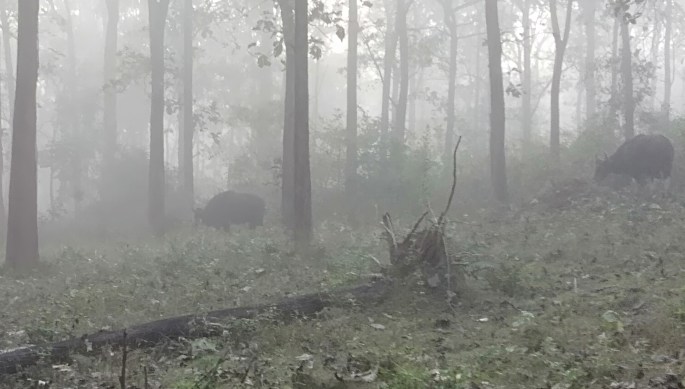
The Nagarhole National Park and Tiger Reserve is part of the Nilgiri Biosphere Reserve and lies along the Brahmagiri hills in Coorg. Sandalwood and teak trees abound in this park which is home to the Bengal Tiger, gaur, Chital, Sambar and elephants and a variety of birds. The Nagarhole River winds through jungle landscapes of this park giving it the name Nagarhole meaning serpent river and joins the Kabini River near Bandipur. This park is contiguous with Wayanad and Bandipur sanctuaries.

A jungle safari through this park can give one an opportunity to see it’s inhabitants. Some pictures….

A misty morning at Nagarhole

On a brighter day…

Elephant walk….

Langur time….

Enroute Nagarhole is a famous waterfall called Iruppu falls.

Iruppu Falls

Located on the highway to Nagarhole, this waterfall is also called Lakshman Tirtha falls. A trek from the falls takes one through the forest to Brahmagiri peak. The Lakshman Tirtha river starts from here and there is a famous Shiva temple on it’s banks.

Iruppu Falls

Moving away from Nagarhole , let us visit some important sights near Madikeri

Abbey Falls

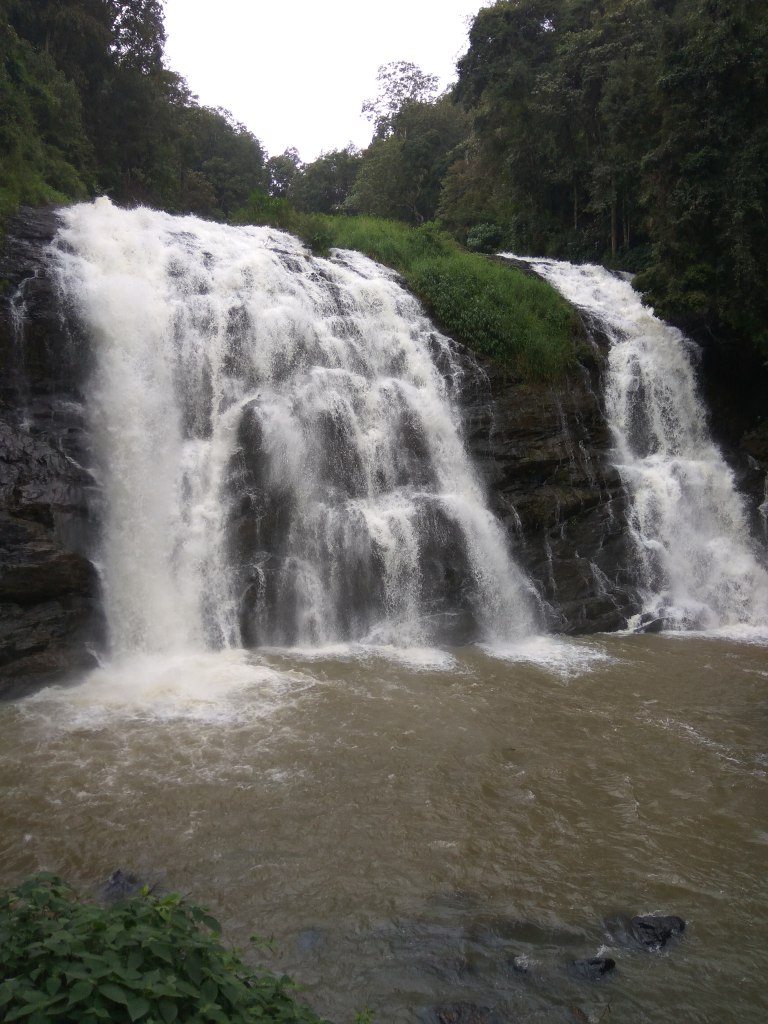
One of the most picturesque sights in Coorg is the Abbey falls where the Kaveri river cascades on a rockface in between coffee plantations. It is located about 8 kms from Madikeri and one has to climb down a flight of stairs to reach this waterfall.

Abbey Falls

The steps leading to the falls

Nisargadhama

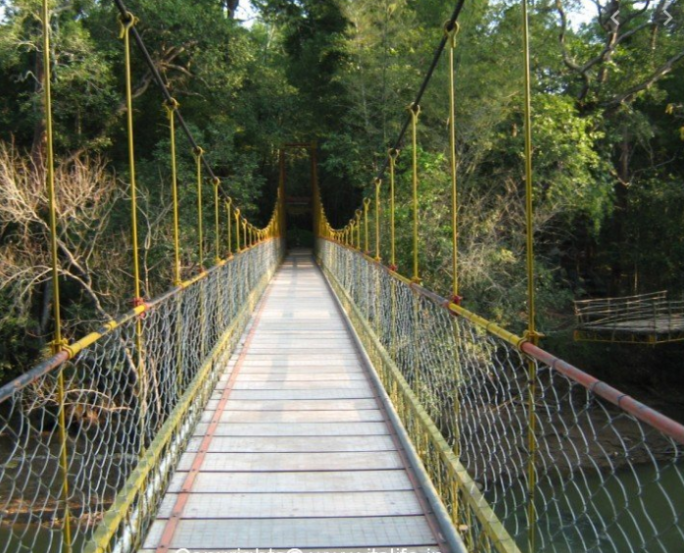
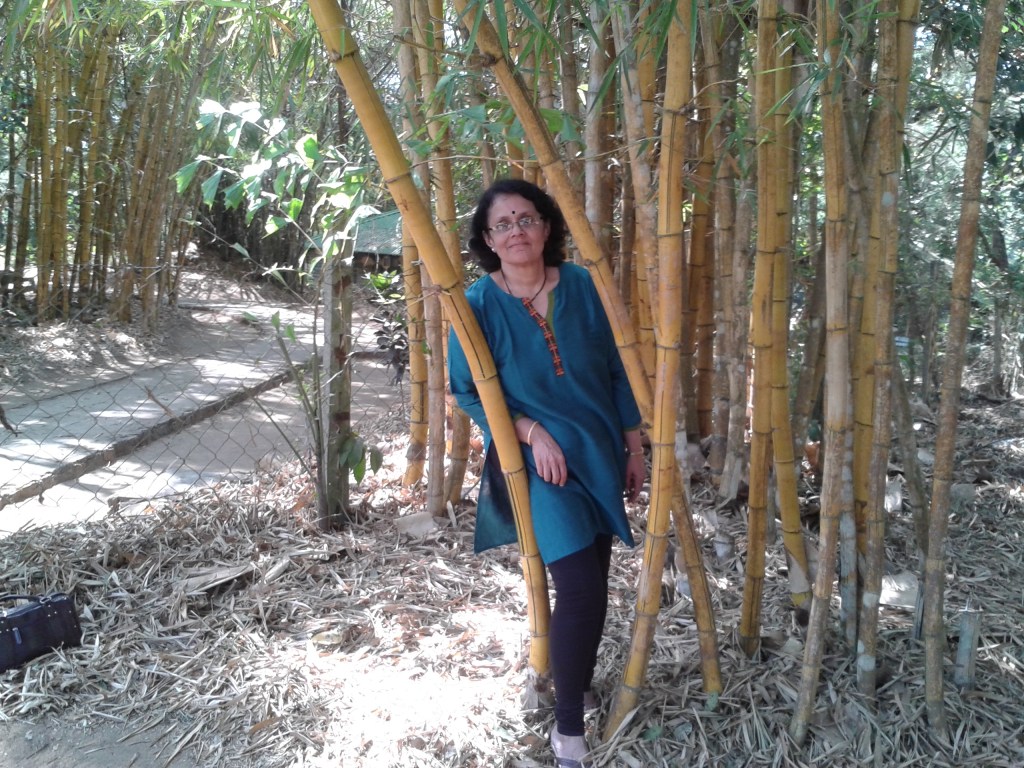
Located about 30 kms from Madikeri and close to Kushalnagar is this bamboo forest and deer park on the banks of the Kaveri. Boating facilities are available here. A hanging bridge over the river is another attraction. Some images..

Kaveri at Nisargadhama

Hanging Bridge

The bamboo forest and deer park

Harangi Dam

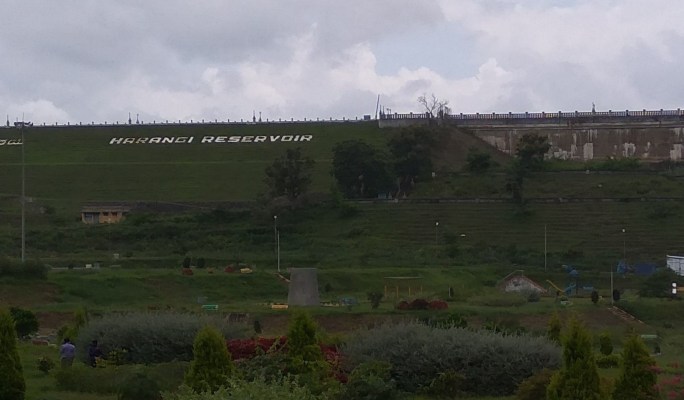
A dam built on the Harangi river, a tributary of the Kaveri also lies close to Kushalnagar town. The dam and the gardens offer a nice picnic spot . A small hydro electric project and an elephant camp also functions here.

The dam and reservoir

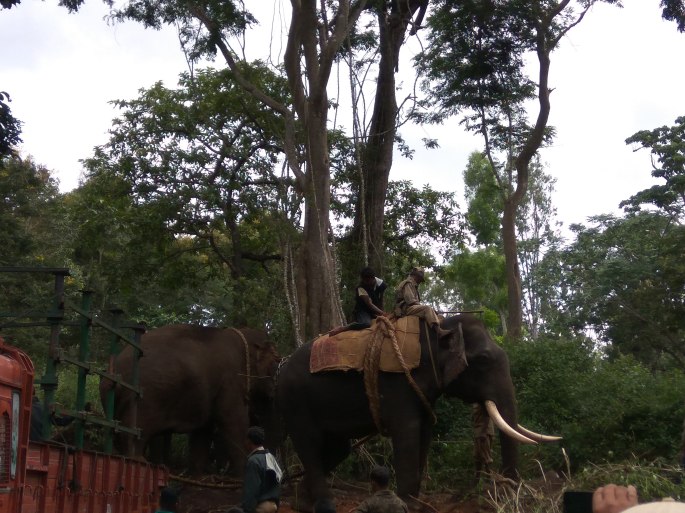
The elephant camp

The Namdroling Monastery

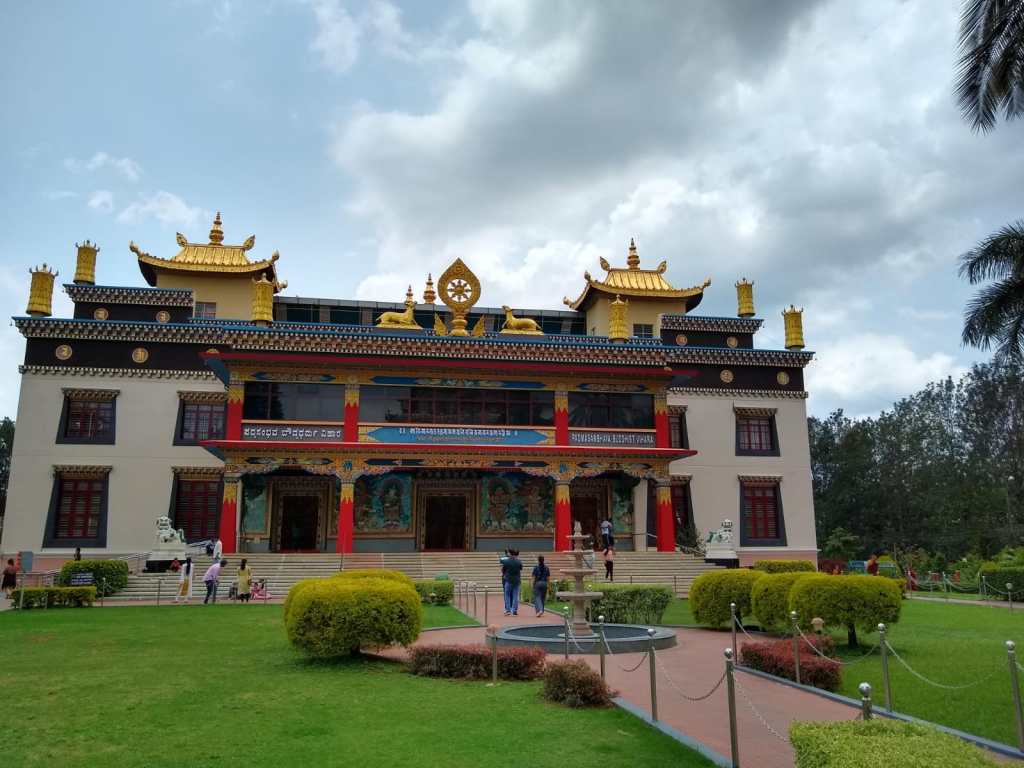
Kushalnagar is a Buddhist hub and there are many Buddhist institutions in the area. The more popular one is called the Golden Temple or Namdroling Monastery.

The Namdroling Monastery

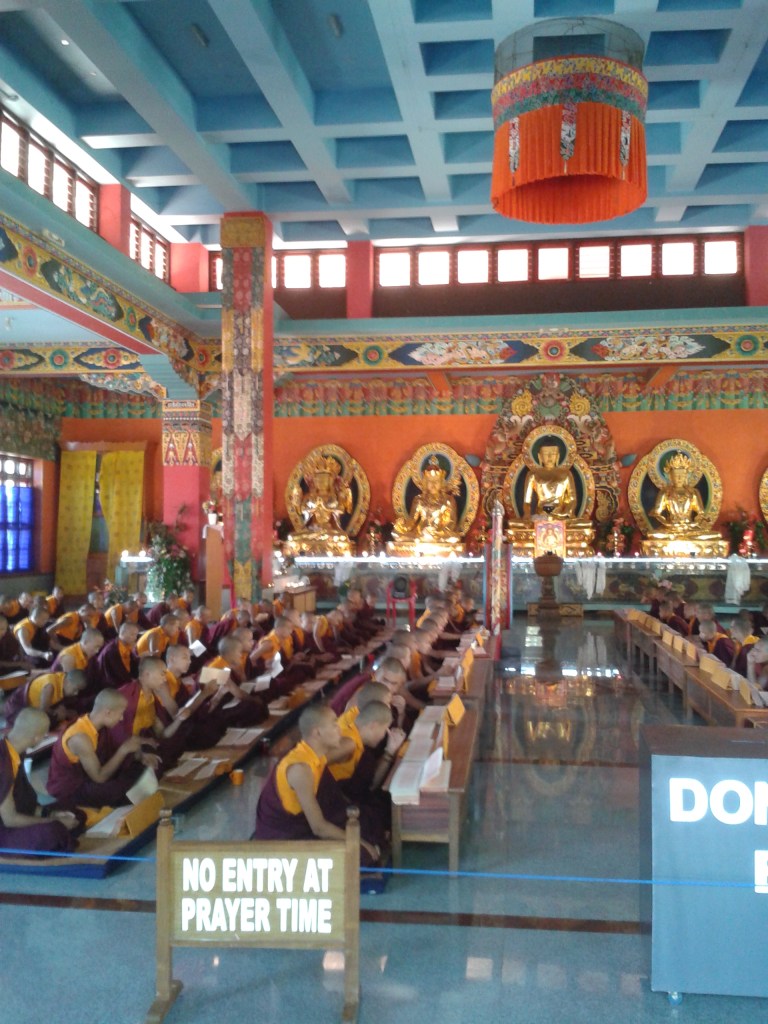
More pictures from inside the monastery…

Inside Namdroling monastery

Dubare Elephant camp

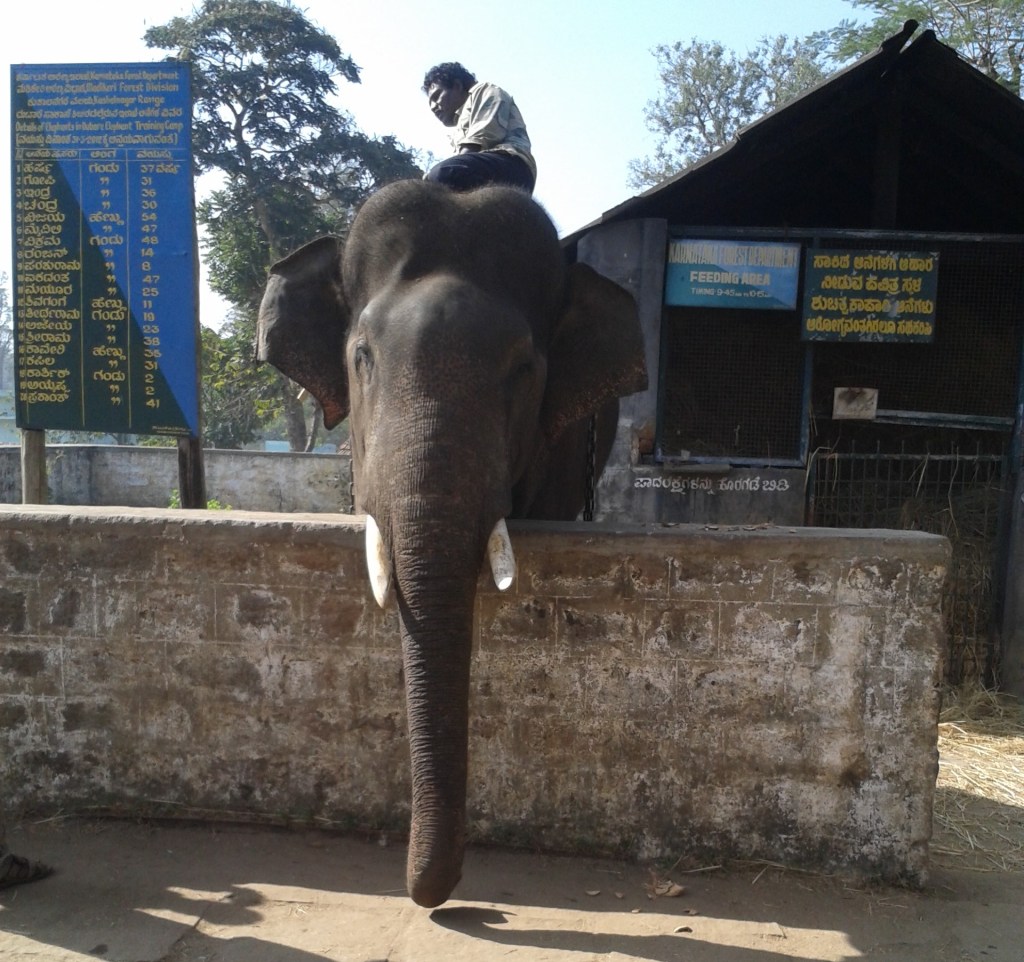
Visitor interaction with elephants is facilitated in this camp located on the banks of the Kaveri river. Bathing and feeding them with sugarcane and jaggery are popular activities offered here. Elephant rides into the forest and information on elephant biology by trained naturalists are added attractions here.

Feeding area at Dubare

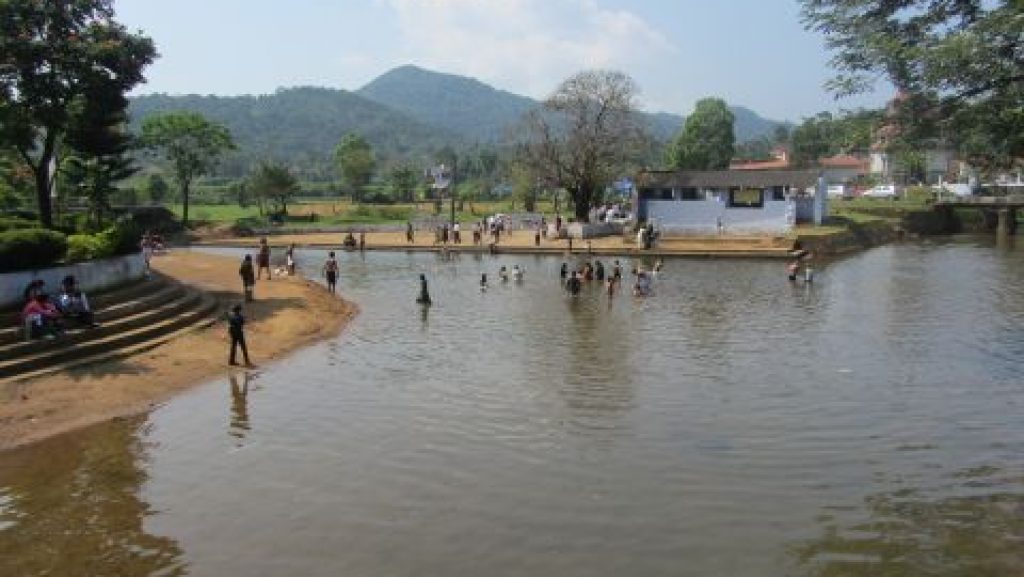
Bathing elephants in the Kaveri at Dubare

Talakaveri

Talakaveri is considered the origin of the river Kaveri and hence a sacred place for the Hindus. There is a tank here which is fed by a spring that is considered to be the source of the river. A temple dedicated to Kaveramma who is worshipped by the Kodavas is located here.

Forests surround Talakaveri

The tank and temple at Talakaveri

Bhagamandala

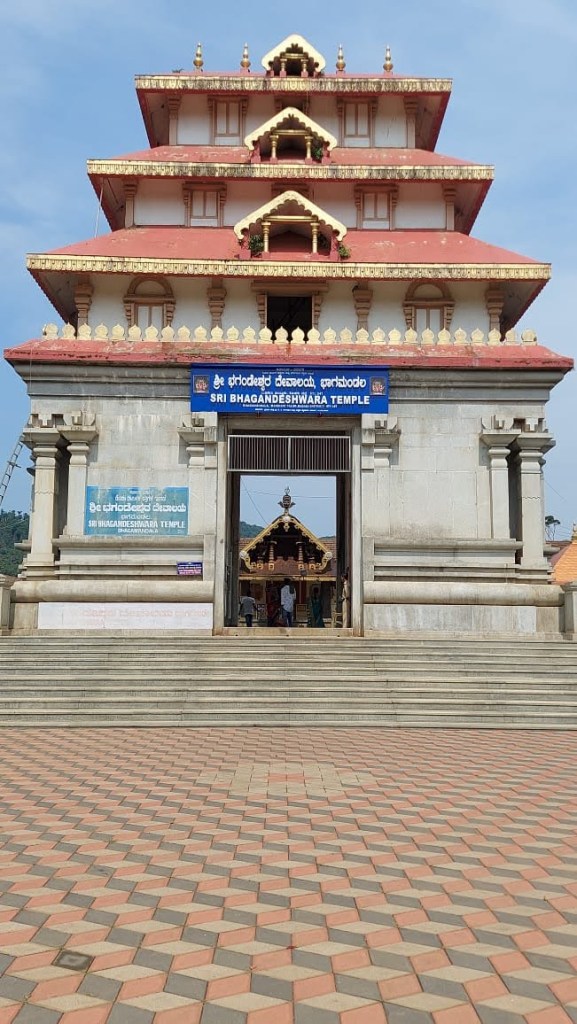
This is a place of confluence of three rivers and is a sacred place. The Kaveri joins two smaller rivers here; the Kannike and Sujyothi. A Shiva temple next to the confluence also attracts pilgrims. Many devout perform rituals for their departed ancestors here before proceeding to worship at Talakaveri.

The confluence of the three rivers at Bhagamandala

Shiva temple at Bhagamandala

It must be obvious by now that there is no dearth of interesting sights near Kodagu. I have tried to cover most of them. Hope you have enjoyed your visit to Kodagu.

Next week we move away from Karnataka to Sikkim . Till then, do comment and give your feedback.

Kodagu, the coffee cup of India

Who would not fancy a hot cup of freshly brewed coffee?

Whether you like it black , with milk or with cream ; a cup of coffee makes every morning special.

Well, today let us visit Kodagu/Coorg , nicknamed the coffee cup of India.

Kodagu lies on the eastern slopes of the Western ghats and enjoys salubrious climate almost all round the year. Kodagu is actually the name of the district and when we talk loosely about going to Coorg what we mean is go to Madikeri and the surrounding areas.

A brief on Coorg and the local inhabitants before we indulge in more coffee talk….

The original inhabitants of Kodagu were the Kodavas who were a warrior community. The British annexed Coorg and deposed the local Kodava rulers. They did help improve the infrastructure, introduced scientific initiatives in coffee farming and contibuted to the overall development but there was a lot of exploitation of the resources and man power from here. It subsequently became part of Mysore state ( now Karnataka).

The Kodavas, the original inhabitants have largely retained their cultural identity and this can be seen in their attire and customs. The sari, the traditional dress of Indian women is worn in a different style here. The men wear a knee lenth black wrap around coat called Kupya, a silk sash around the waist and typical head gear. A dagger tucked into the sash completes the attire.

The traditional attire of the Kodavas

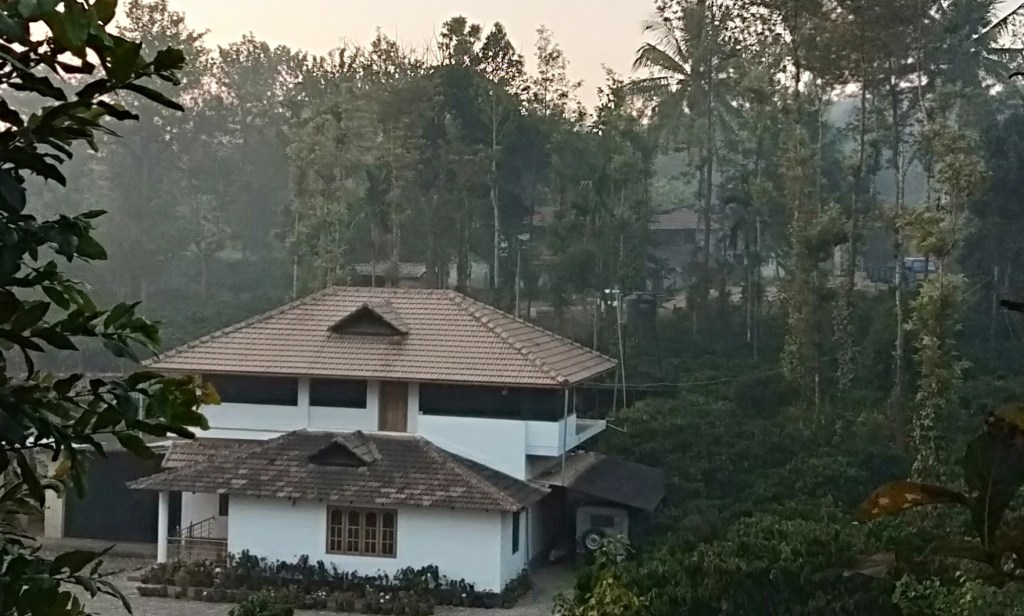
Since most Coorgi households are coffee planters, the house is inside or adjacent to a coffee estate and the harvesting and processing of coffee beans is an integral part of their lives.

A kodava house in a coffee estate

Kodavas are fond of non vegetarian food and meat ; particularly pork (pandi curry) and alcohol are served at weddings and even religious ceremonies and pujas. Traditional Coorgi food is Kadambottu or steamed rice balls served with spicy meat gravies.

Traditional Coorgi food

Coffee Talk…

Coffee was first introduced in India in the 17 th century by a saint Baba Budan who smuggled a few coffee beans during his Mecca trip and planted them at Chikmagalur in Karnataka. Both Chikmagalur and Kodagu produce most of Indian coffee today. Let us talk about Kodagu coffee…

Largely an agricultural district, Kodagu is the largest producer of coffee and pepper in India today . Cardamom, rubber, and oranges are the other important produce.

As one drives in Coorg, coffee plantations on either side of the road welcome you. Misty mornings in a breathtaking landscape of lush green hills ; Kodagu has climatic conditions ideal for coffee cultivation and that explains the vast coffee estates here. Mainly two varieties of coffee are cultivated here, Robusta and Arabica.

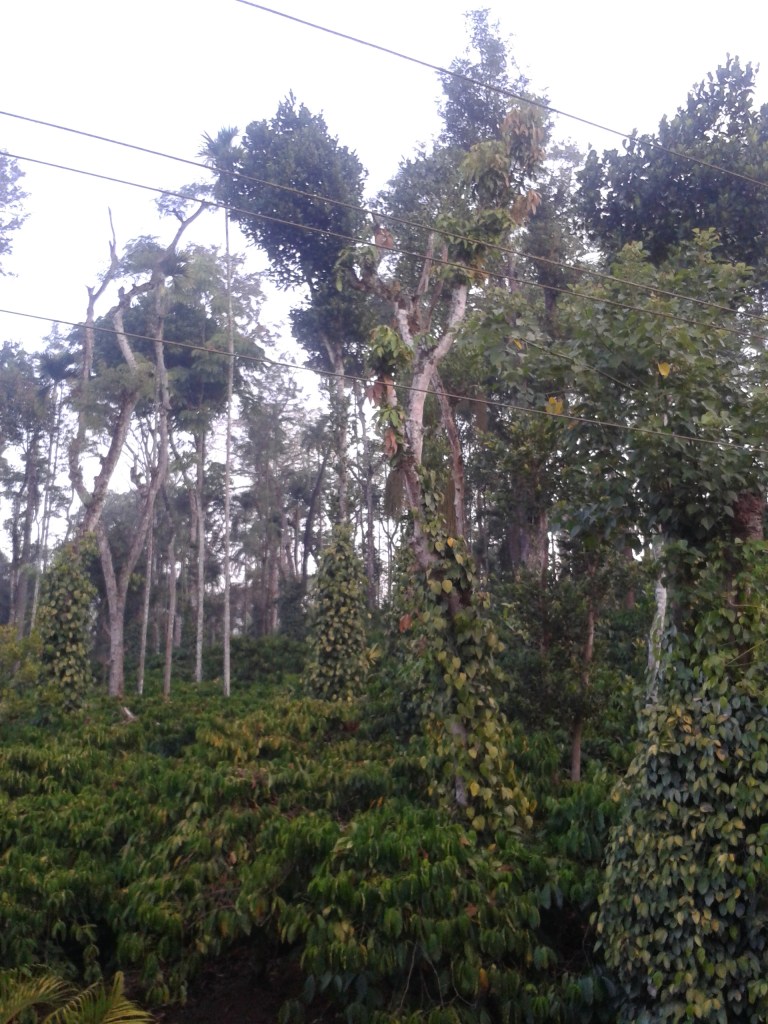
The coffee estates

Coffee shrubs and pepper vines

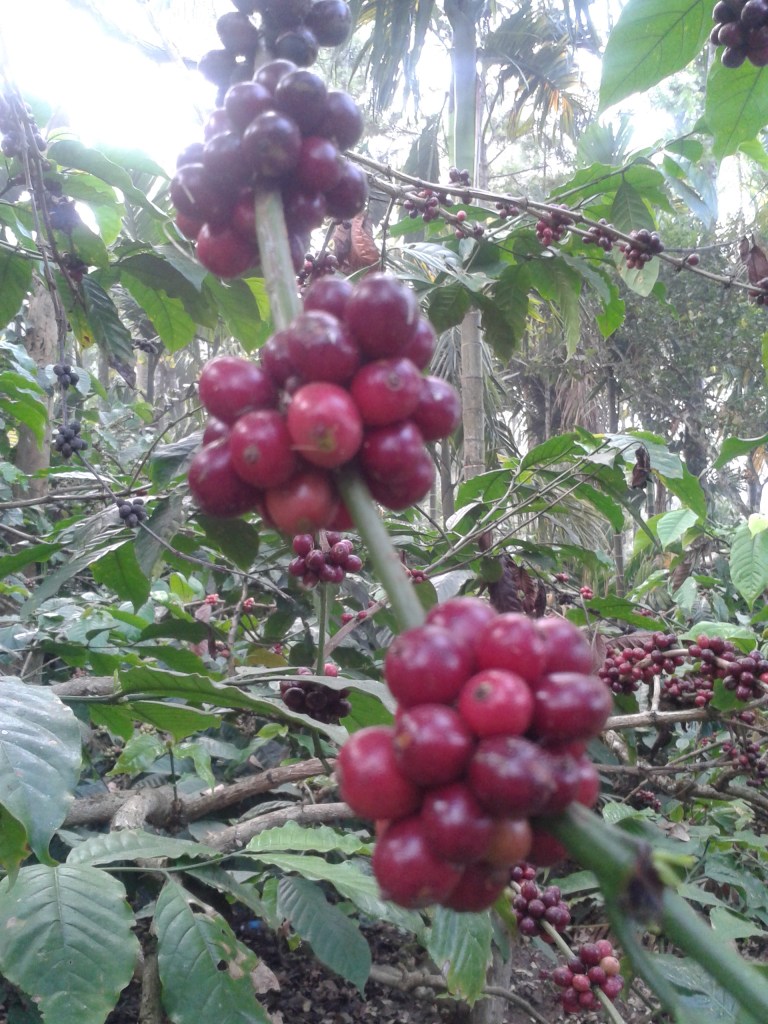
Coffee and Pepper ready to harvest

Spice shops line the road at every few metres…

Most of the homestays and hotels in Kodagu arrange for a plantation visit. That can be a different experience for the urban bred.

A coffee estate walk

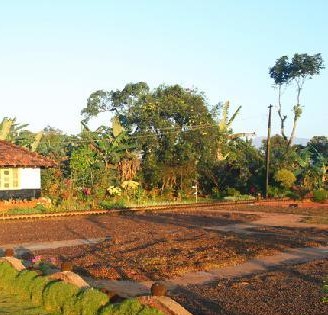
Coffee berries are handpicked as they have to be at the right stage; neither too ripe nor raw. These berries are then dried out in the sun for a couple of weeks. Then the seeds of the berries are separated by removing the skin and dried pulp.

Drying of Coffee berries and extracted beans

The seeds are then stored after grading. Before use, the seeds are roasted and powdered to get you the filter coffee powder available in the market.

Many of these stages are automated by the large coffee cultivators while the smaller farmers use traditional methods. Fermenting the coffee bean and roasting are the two stages which can alter the aroma and flavour of your next cup. So these are carefully monitored.

Cuppers….

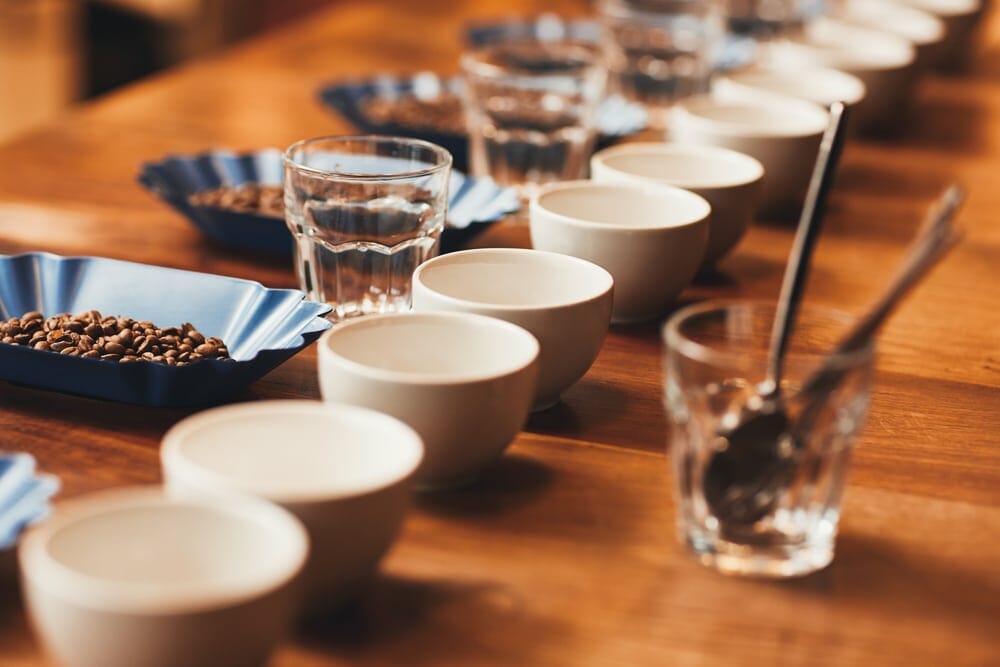
Coffee tasters also called cuppers play a role in determining the taste and flavour of your next cup. The cupper assesses the quality of beans, then “noses” the brew for the aroma. The actual step of tasting begins with the cupper slurping a spoonful of coffee spraying it all over his tastebuds before spitting it out. Difficult to accept , but expert cuppers taste hundreds of coffee varieties a day and still tell the subtle differences!! After all this, I really wonder if the cupper can enjoy his actual cuppa like you and me??

A cupper’s work table

To brew the coffee we buy from the market, in traditional south Indian style, we use a coffee filter. The coffee powder is placed in the filter and hot water is passed through it to extract the flavour. The decoction is then had diluted as black coffee or added to boiled milk to get a cup of freshly brewed filter coffee . Automatic coffee brewing machines are now available of course!

Instant coffee powders are made industrially using various steps.

A traditional coffee filter used at home and an automated filter

And that explains the journey of the coffee bean from birth till it comes to you in a cup as coffee…

Well, I hope you enjoyed the journey of the coffee bean just as you do your morning cuppa!!!

Delving more deep into Kodagu, next week we visit some of the interesting sights around Madikeri. Till then, enjoy your coffee… but don’t forget to give your comments and feedback…

Sakrebyle , Elephant rendezvous

Elephants; the gentle giants , are dear to all of us ; more so to children. So when we saw our granddaughter’s excitement on seeing elephants on the screen, we decided to give her a hands on encounter with these lovable beings. That’s what led us to Sakrabyle, the elephant camp near Shimoga in Karnataka.

A 310 km drive from Bangalore and we were at Shimoga.

The drive to Shimoga

The best time to visit the camp is early morning before the crowds and the heat and so we halted overnight at Shimoga.

A preview of the elephant camp and facilities available before I get into our experiences…

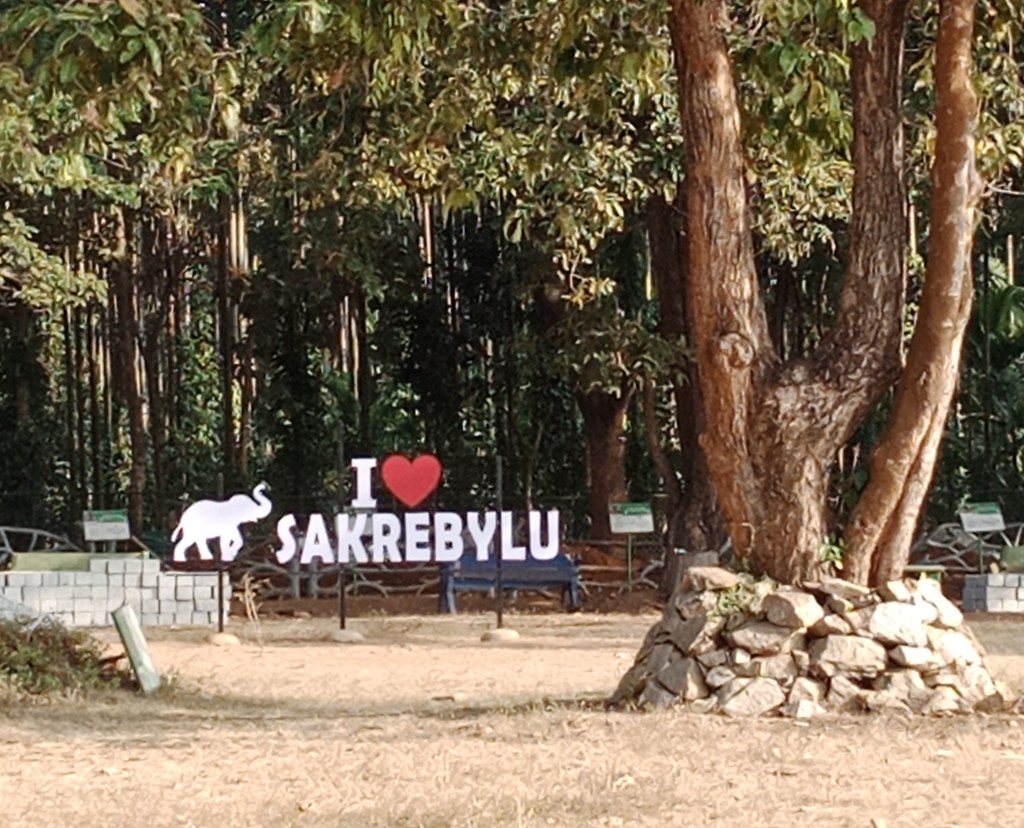
Sakrebyle Elephant Camp

Maintained by the Karnataka Forest department, this camp is a forest camp for captive elephants brought here for training and rehabilitation from many places. Elephants that may have had illnesses , nutritional issues, behavioural issues like rogue elephants or those that were orphaned or abandoned are housed here in the forest camp. A dedicated team of specially trained mahouts train and rehabilitate these gentle giants.

The Forest Camp

They live inside the forest camp opposite the area where tourists interact with them. This forest area also has accomodation for tourists run by Jungle lodges and resorts. The accomodation in the Jungle lodges is very good and safari facilities are there. (Unfortunately, we could not get accomodation at this jungle lodge which would have been ideal). If you book with Jungle lodges, they take care of everything and also they bring you to the interaction area in a buggy saving you the trouble of getting the tickets etc.

The Jungle Lodge and tourists being brought to the interaction area

Every morning, the elephants are brought from the forest to the interaction area.

The elephants coming out of the forest camp

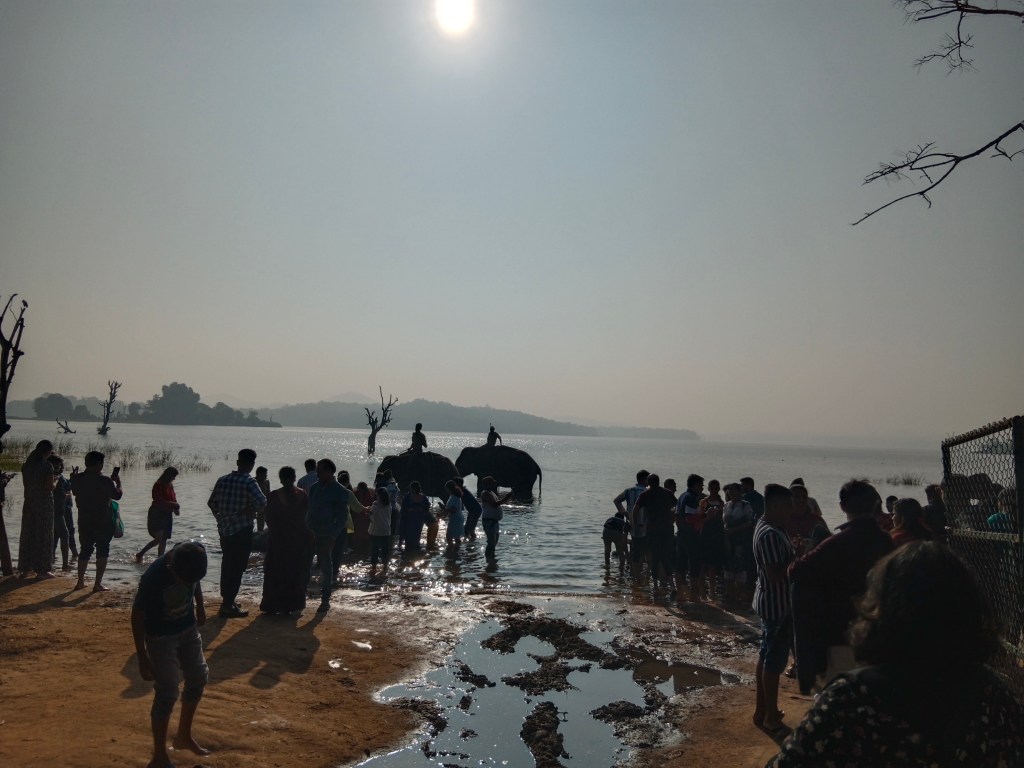
The interacion area is a large open ground with multiple activities. This area lies on the banks of the Tunga river where the giants have their bath. The most popular activity here is an opportunity to bathe the elephants under the supervision of the mahout.

Our trip

Driving down from Shimoga early morning, we reached the camp well on time to join the front of the long queue for tickets.

The counter and the long queue

As we were waiting at the ticket counter, the elephants were being brought in for their daily rituals under supervision of mahouts.

The entrance for the elephants and one of the elephants walking in

A short walk lead us to an open area overlooking the Tunga river

The open interaction area

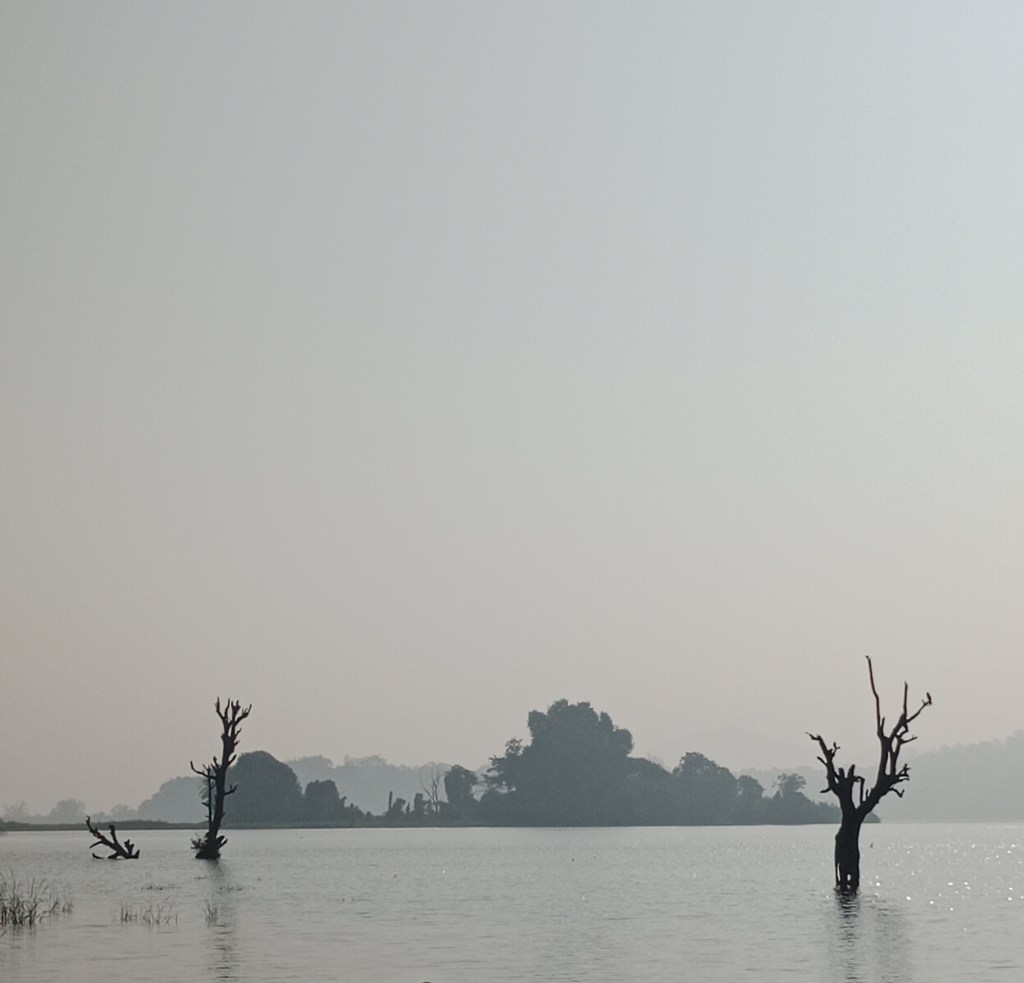
The beautiful Tunga river

The elephant family walks to the Tunga

Ready for a bath in the Tunga river

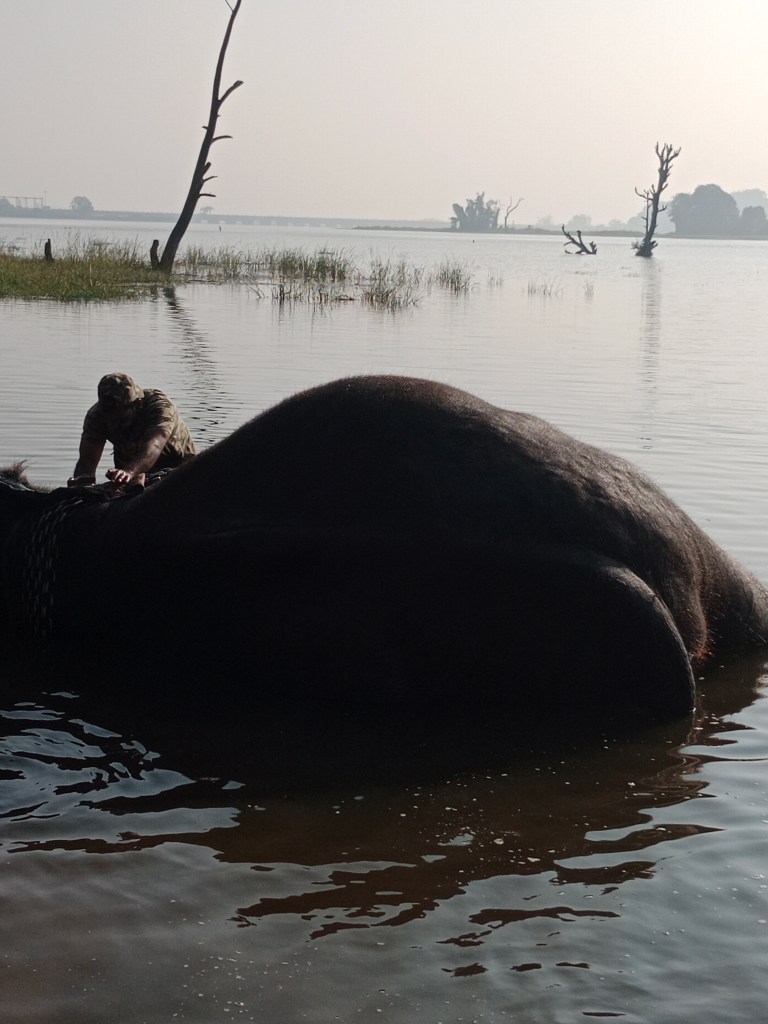
The mahout starts the bathing process…

And we joined in….

After helping with the bathing ritual, we stood around and watched as more elephants came and went through their daily routines

Visitors watch the elephants ….

After the bath, the elephants are fed at an enclosure and visitors can also participate in the feeding of the elephants. Since we were to leave to our next destination, we did not wait for that. Elephant rides are also available from there.

Returning to our hotel in Shimoga we proceeded to Kollur for our annual pilgrimage there and then on to a fun destination near Koteshwar. The little one was all excited about her encounter with the giants and her stories continued for a few days.

Let me stop here for now .

Next week we are at coffee land. Till then, do keep your comments and feedback coming….

Jog Falls

The Sharavati river in Karnataka plunges down a vertical cliff to form the famous Jog Falls or Gersoppa Falls . A beautiful waterfall specially in the monsoons, this SHOULD be in your bucket list!!

Come on…let me take you there virtually….

The Jog Falls ( just after the monsoons)

Legend of Sharavati

The Sharavati River originates at a place called Ambutheertha in Karnataka. Legend has it that Lord Ram shot at the ground with his arrow (Ambu) to quench his wife Sita’s thirst. Out poured the water (Theertha) from the earth. Since this event marked the beginning of the river , it got it’s name Sharavati where “Shara “means arrow.

The Sharavati River near Honavar where it joins the Arabian Sea

At Jog, the water drops 253 mt ; making it the third highest waterfall in India after the Nonkhalikai (Meghalaya) and Dudhsagar falls.

The fall comes down a deep chasm in four parts called Raja, Rani, Roarer and Rocket falls. This waterfall changes itself seasonally depending on the rainfall. Its true might is displayed during or just after the monsoons. The presence of the Linganamakki dam also affects the volume of water in the falls.

The falls during the dry season with much reduced waterflow

There is a viewpoint located right across the falls from where we can actually watch the falls and there is a series of steps to go down to the bottom of the falls.

The viewpoint

Enjoy the video of the falls in monsoon

The other interesting activities that can be combined with Jog falls:

Sharavati Wildlife sanctuary ,Dabbe Falls and Linganamakki Dam visits.

Sharavati Wildlife sanctuary

The Sharavati river basin is rich in biodiversity and also has the Sharavati Wildlife sanctuary.

The Sharavati Wildlife sanctuary in the Western ghats is covered with evergreen forests and grassy hilltops. It harbours rich wildlife like bison, deer, boar, jackals,leopards and the malabar giant squirrel. A visit to this wildlife sanctuary can be combined with a Jog falls visit.

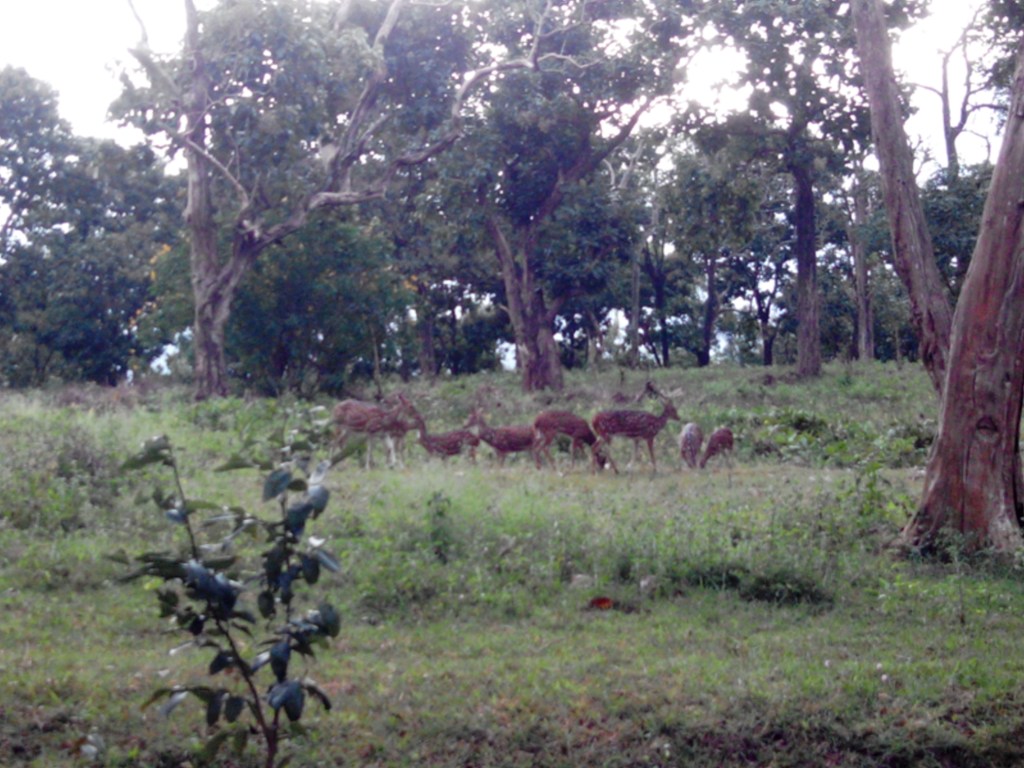
Deer at Sharavati Sanctuary

Bison

Dabbe Falls :

It is about 35 kms from Sagara town. Guides are available at Muppane nature camp which is 10 kms away.

Dabbe Falls

Linganamakki Dam:

10kms from Jog falls is the Linganamakki dam. One can view the dam from a distance.

Linganamakki Dam

Travelling to Jog Falls:

The nearest airport is at Mangalore 219 kms away.

The nearest Railway station is Talaguppa 20 kms away.

Driving from Bangalore, it is 411 kms away.

Sagara and Shimoga are the nearest towns with plenty of hotels. But the best places to stay are The Mayura Gersoppa hotel run by Karnataka Tourism (bang opposite the falls with views from the rooms ) and Sharavati Adventure camp run by Jungle Lodges and resorts.

Sharavati Adventure camp

This is by far the best accomodation near Jog falls. As the name suggests, it has various adventure activities like hiking, trekking, bird watching. Besides, the views from here are beautiful with the backwaters of the Talakalale dam .Water sports activities are also available.

The Sharavati Adventure Camp

Well, that brings us to the end of this episode.

Next week, we meet up with some gentle giants; the elephants. Till then, let me say goodbye but not before reminding you to subscribe, comment or give your feedbacks.

The Hanging Pillar of Lepakshi

Lepakshi has been in the news recently , and so ; why not resume the India series with Lepakshi ? With the Ayodhya temple inauguration and the Prime Minister’s visit , Lepakshi has indeed come into focus . Till then , many of you may not have heard of this temple in the sleepy town of Lepakshi in the state of Telengana in India . A 16th century temple enriched with art and architecture of the Vijayanagar Empire has this as yet unexplained phenomenon of the hanging pillar.

The temple itself is dedicated to Lord Veerabhadra (fiery avatar of Lord Shiva) and has shrines dedicated to various Hindu Gods like Vishnu, Devi, Ganesha and Hanuman. Apart from religious attributes, the Lepakshi temple complex is considered an excellent art monument. This is because, most of the walls and ceilings at the temple are covered not only with sculptures, but murals depicting various scenes from Ramayana and Mahabharata.

Since the most intriguing and popular feature is it’s hanging pillar, let us first talk about that…

The hanging pillar

The hanging pillar is one of the pillars of the inner hall of the temple which does not rest on the floor. A clear gap is seen between the floor and the pillar and often people pass a cloth below the pillar to try it out.

The actual reason for this is still unclear and many theories have been put forward. They vary from anti gravity techniques known to the ancestors ,to magnetic causes, to the presence of some rod inside holding it up to the ceiling , to divine intervention ,to the balance of the artwork on the pillar.

The Hanging pillar

Trying to pass a cloth below the pillar

An English engineer is supposed to have tried moving this pillar when the other pillars started shaking and he had to abandon his efforts.

Shifting focus to the main temple….

Legend of Lepakshi Temple

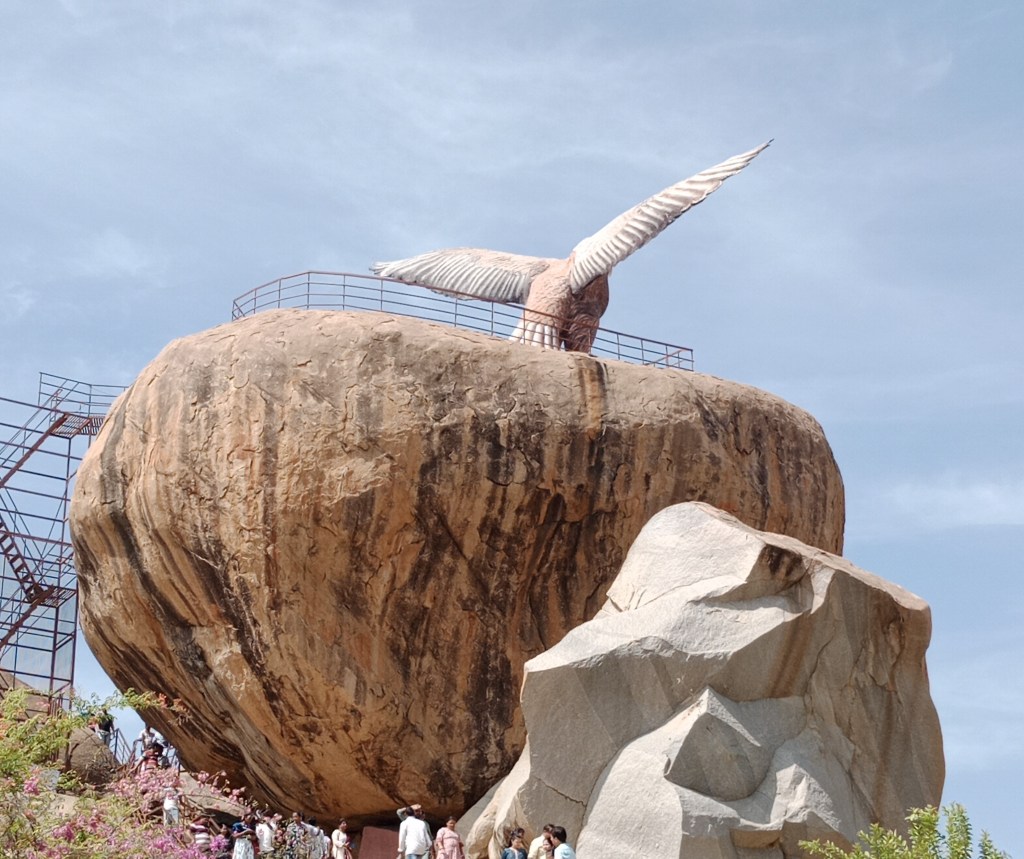
Most Hindu temples are associated with legends and Lepakshi has been associated with the epic of Ramayana. When Ravana, the demon king abducted Sita and was on his way to Lanka with her, Jatayu, the eagle tried to stop him. Ravana attacked Jatayu and the injured Jatayu fell down . When Rama came along and saw the wounded Jatayu, he uttered the words”Le Pakshi” which translates to “rise up bird” and helped him achieve salvation . The word Lepakshi stuck to the place and today we have a huge statue of Jatayu on a rock here.

The temple dates back to 1583 during the reign of the Vijayanagar Empire. Two brothers, Viranna and Virupanna are believed to have built this temple in typical Vijayanagar architectural style. A large number of frescos adorn the ceilings of this temple; some of it faded and peeled off. This temple is designated a monument of national importance by the ASI (Archaeological survey of India) and is on the tentative UNESCO World Heriage Sites list.

Visiting Lepakshi

A 120 km drive from Bangalore on NH 44 and a left turn and then15 km on highway 544E takes one to this temple.

As one reaches the junction to turn off the highway there is a decorative arch with jatayu on the top and a small Nandi in front.

The Jatayu arch at the entrance to Lepakshi town

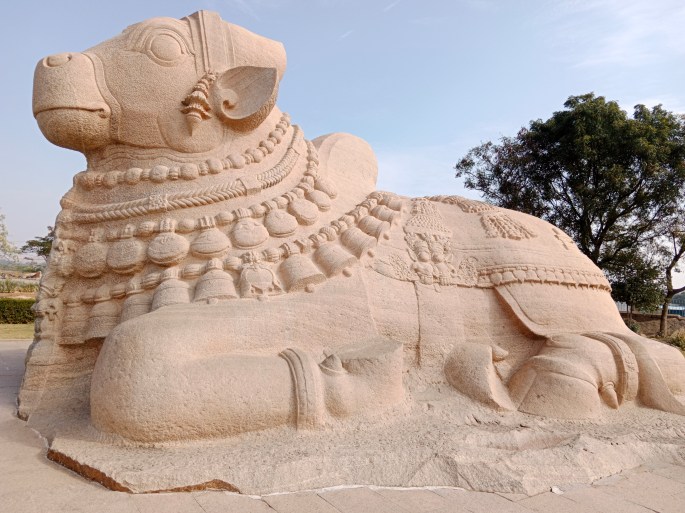
At Lepakshi, the first structure that one encounters, is a giant Nandi Statue. This is actually called the Basavanna temple.

Nandi (Bull)

The Nandi (Bull) is a monolithic granite bull in sitting posture, 10 mts in length and 6 mts in height . Considered the largest Nandi in India, it is depicted with short horns and decorative bells and ornaments around the neck. A lily pond adds to the beauty of this small temple .

Shiva temples usually have a Nandi statue looking at the sanctum and this Nandi looks at the giant Nagalinga statue located inside the main temple. This Nandi however has its head aloft at a slight angle which makes it unlike most Nandis where a submissive posture is the rule.

The Giant Nandi

The front view and the lily pond in the complex

A short walk down the road takes one to the main Lepakshi Temple.

The entire temple is built on top of a tortoise (kurma) shaped hill(saila) or Kurmasaila and has towering walls around. A giant banyan tree adorns the entrance and a board explaining the origin of the temple gives one a little perspective of the temple.

The board explaining the history and the outer walls

The main temple is laid out in three parts : the Natya Mantapa ,the Artha Mantapa and the sanctum or Anthrala.

The Natya Mantapa

Located inside the outer fortress wall, this hall has multiple pillars with sculptures of gods, goddesses, horses, lions, musicians and dancers.

The ornate Natya Mantapa

Pillars with beautiful sculptures

Two giant monolithic sculptures greet us inside the temple.

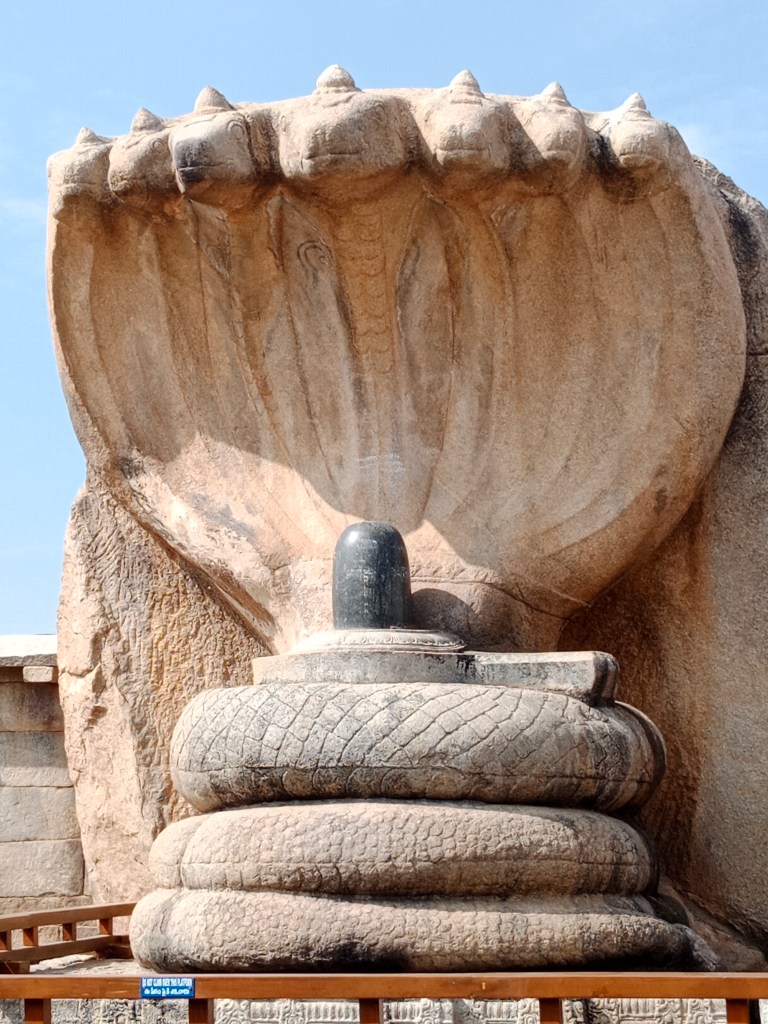
One is a monolithic Ganesha with a protective canopy with pillars and the other is the Nagashivalinga.

The Giant Ganesha

The shivalinga is made of a huge rock while the seven headed serpent or Naga is monolithic and appears to be protecting the linga.

Nagashivalinga (7 hooded serpent sheltering the Shivalinga)

Sita’s footprint

As one circumambulates along the outer walls, one comes across a giant footprint believed to be that of Sita.

Another image that strikes us are two red marks on the wall. Legend has it that Virupanna who built the temple used funds from the treasury without the approval of the king. He was ashamed to face the king and so he gorged out his own eyes and threw it which hit the wall. This spot has two red marks attributed to this incident.

Sita’s footprint and Virupanna’s eyes.

This then brings us to the unfinished Kalyana Mantapa.

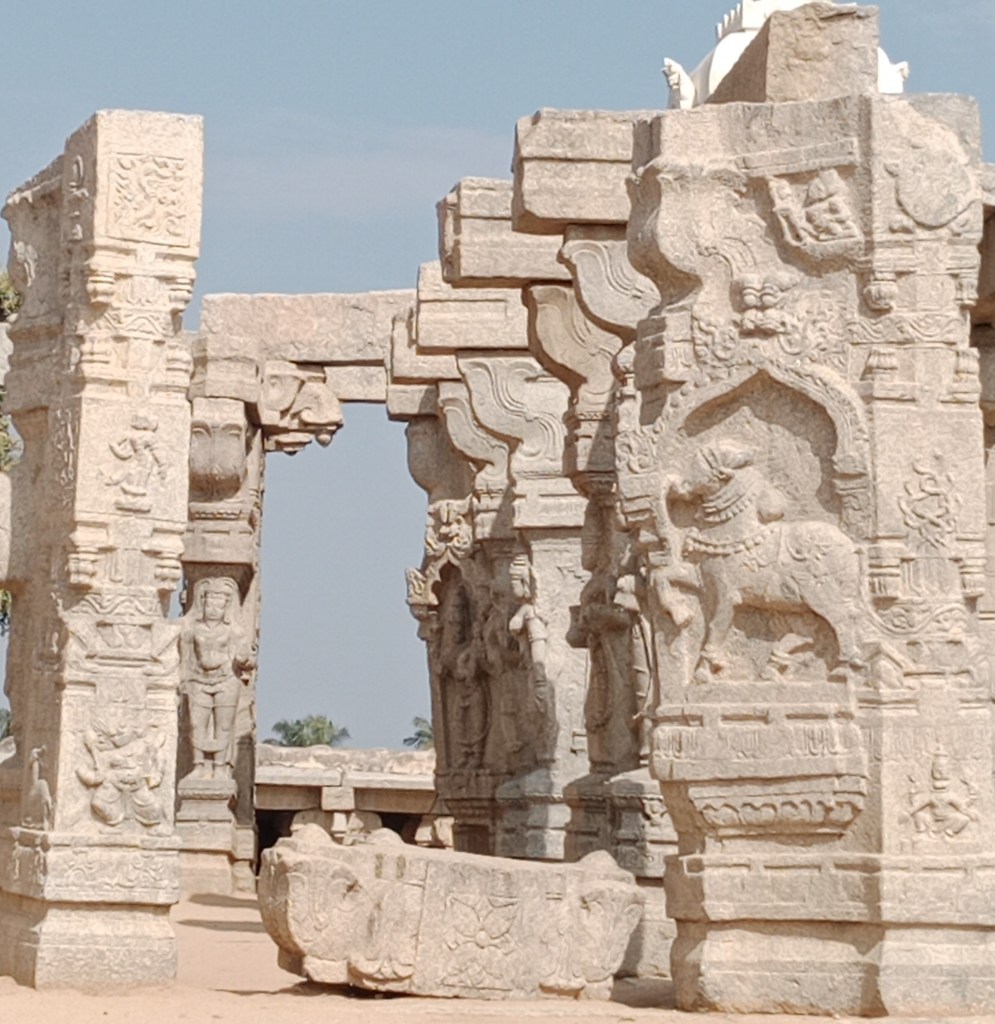
After Virupanna punished himself , no further construction was undertaken ; leaving an incomplete Kalyana Mantap. However, the sculptures on the pillars of the Kalyana Mantap are beautiful and exude the art of the Vijayanagar era.

The unfinished Kalyana Mantap

The exquisite art work on the pillars of Kalyana Mantap

The Artha Mantapa

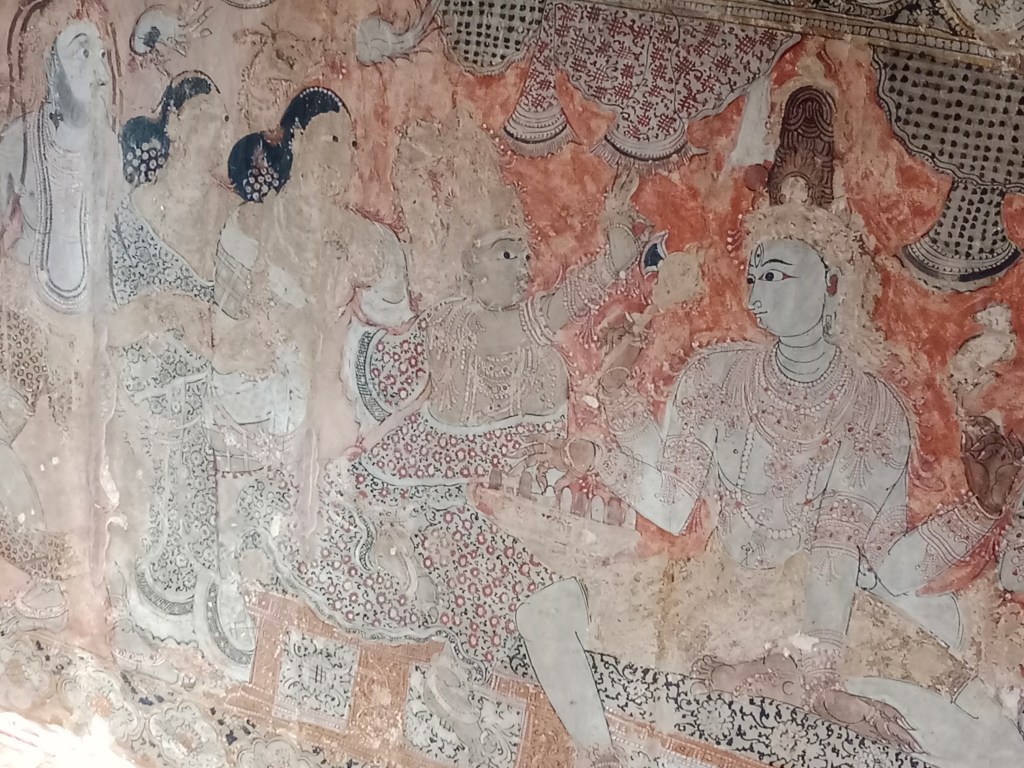
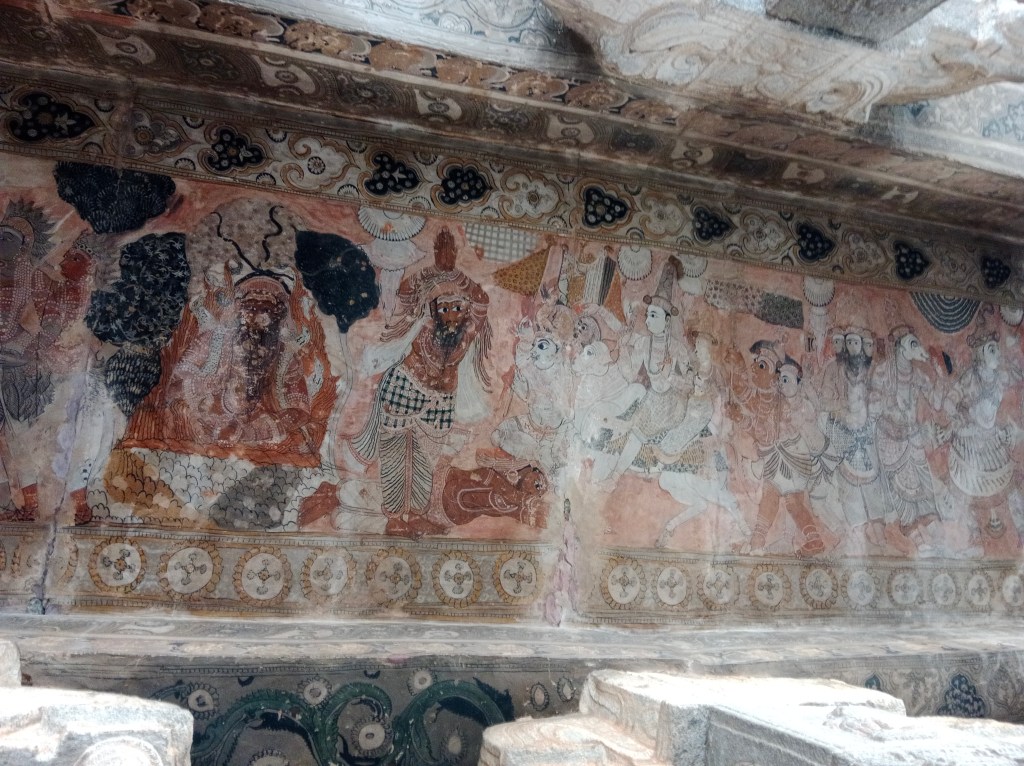
The innermost segment of the temple leading to the main sanctum is the Artha Mantap . The hall itself has multiple pillars decorated with sculptures and the ceiling has murals of various sizes but many of which have faded or have been damaged. The columns are located on an elevated plinth and have eaves overhanging in a curved fashion.

One of the frescos on the ceiling of the Artha Mantapa is supposed to be the largest one in Asia. The paintings depict the costumes of that period but due to age related fading, many of the features are not very clear.

Some pictures…

Sculptures on the pillars of the Artha Mantapa

The frescoes

The damaged ceiling and frescoes

The Garbha griha

The Artha Mantapa leads to the sanctum sanctorum or garbha griha where the shrine of Veerabhadra swamy is located. A small cave chamber where saint Agasthya lived when he installed the linga is also seen. The ceiling at the sanctum has the paintings of Virupanna and Virupaksha who constructed the temple.

A shrine dedicated to Durga, the goddess is located just outside the main shrine and has a huge mirror in front so that, one can see the reflection from far.

The side view of the main entrance and the cave chamber

The Giant Jatayu

As explained in the legend, Jatayu is intricately connected with Lepakshi . No wonder then that a huge Jatayu image is constructed on a rocky hillock close to the temple. It is called the Jatayu theme park. The giant Jatayu seems to be overlooking the whole town.

To reach the Jatayu, one has to climb up some steps on a rocky hillock.

Some pictures…

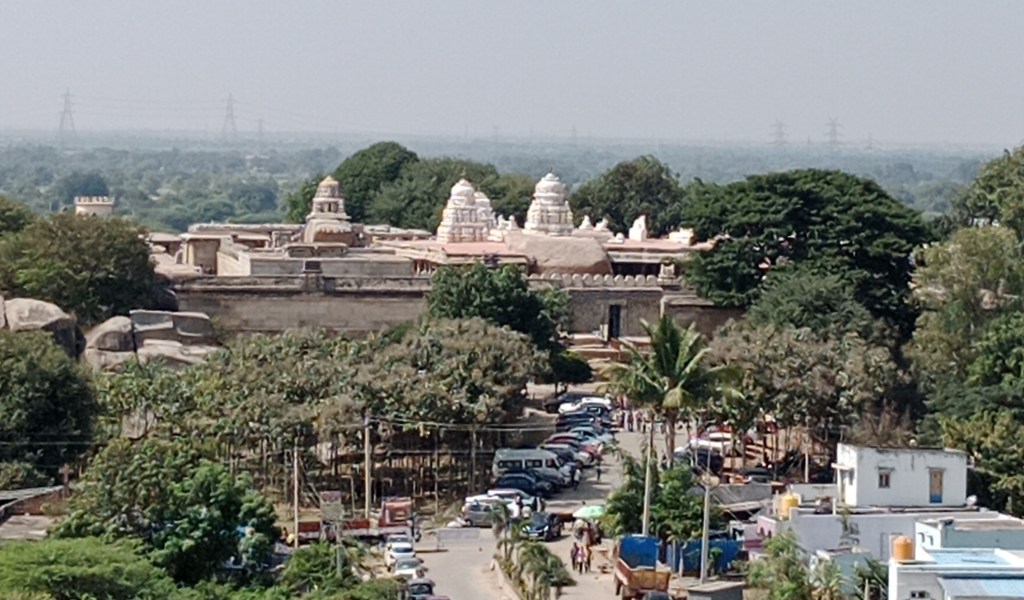
Jatayu park and the view of Lepakshi Temple from there

The giant eagle Jatayu

It was noon by the time we finished walking around the temple and the Jatayu park and we returned to the comfort of our hotel room .

Well, I hope I have kindled your desire to visit this temple and admire its art and architecture.

See you next week from an amazing waterfall of south India…till then,

do give me your feedback and comments….

Hollywood and Beverly Hills

Looking at the “glitz and glamour” of Los Angeles, let’s peep into Hollywood…..
Hollywood

This neighbourhood of LA needs no introduction. Well known for it’s association with the US film industry, it is home to many of the famous studios like Paramount pictures, Sony , Universal and WarnerBrothers.

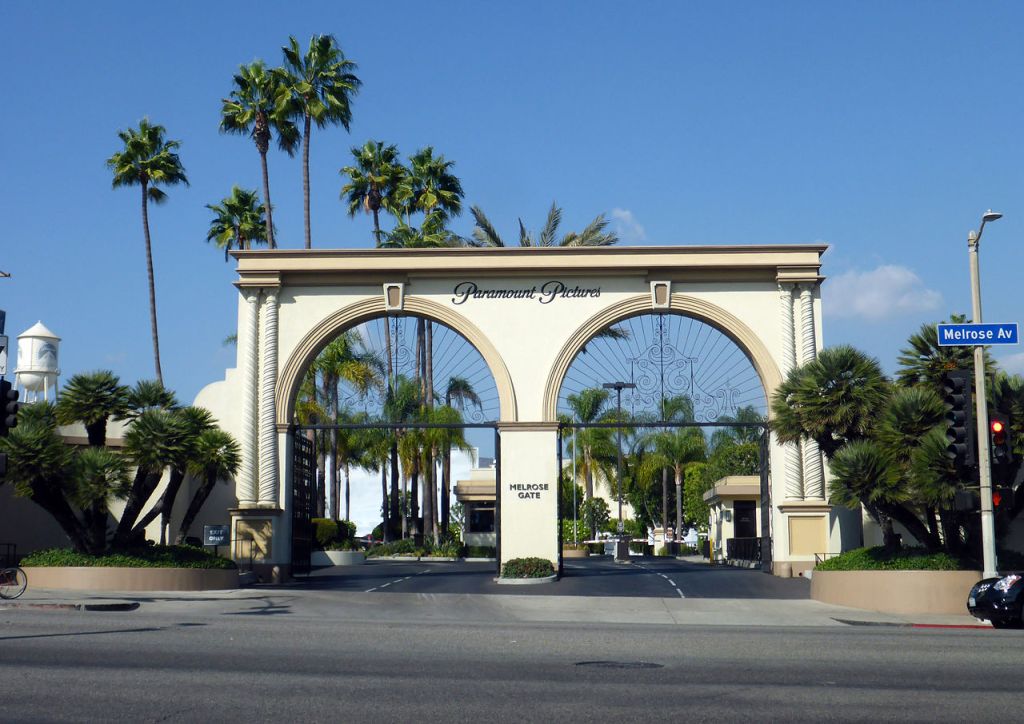
As we drove along Melrose Avenue, we saw some of these renown studios…

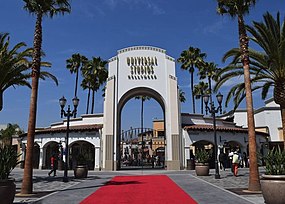
Paramount and Universal studios

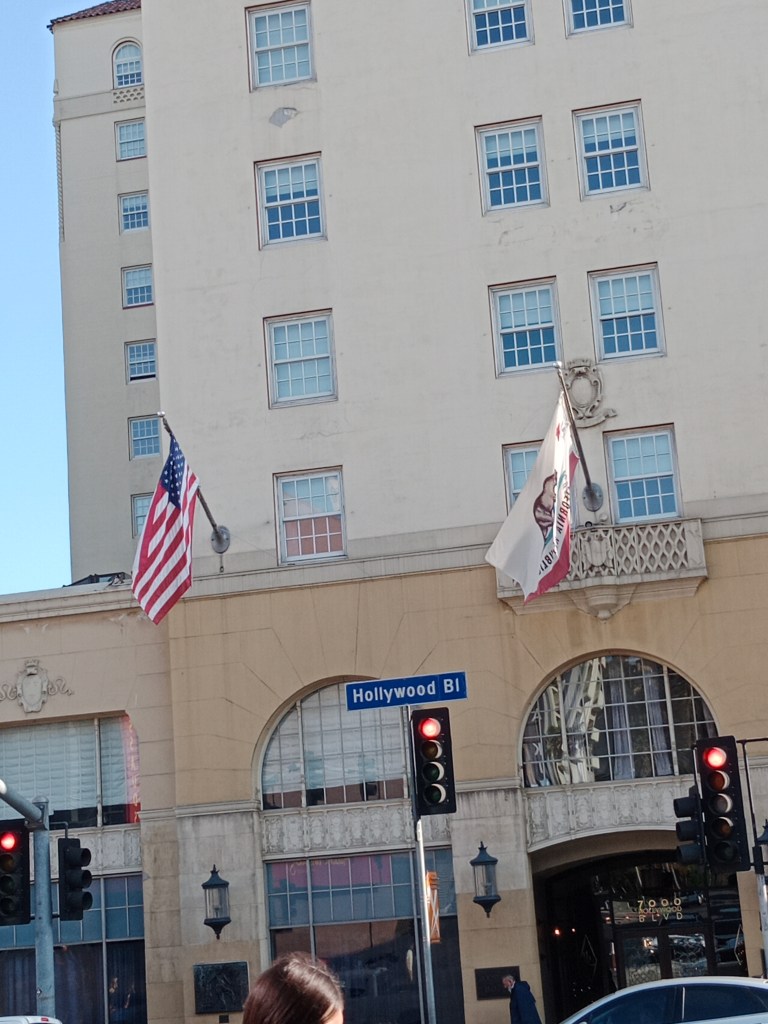
Steven dropped us off near the Hollywood Walk Of Fame.

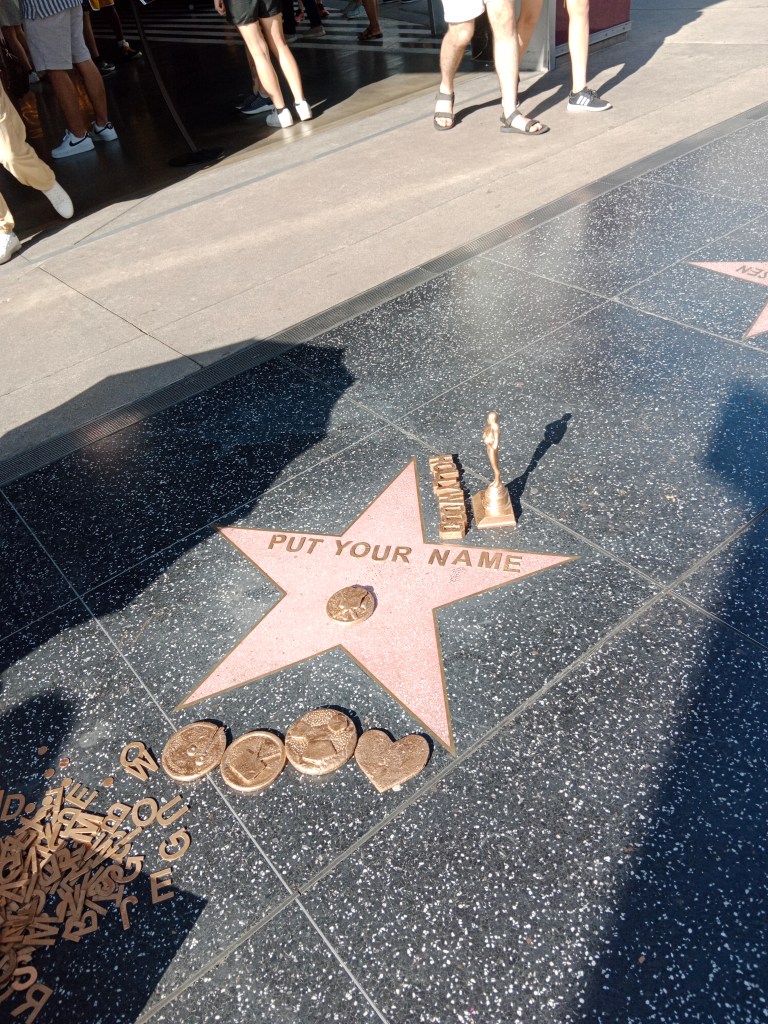
The Walk of Fame lies on Hollywood Boulevard where more than 2700 stars are embedded along the sidewalk. These stars bear the name of achievers in the film industry including actors, musicians, singers, directors and fictional characters. Some have multiple stars in their name…

Hollywood Walk Of Fame with the embedded stars

Hollywood Boulevard and one of the stars!!

We walked along the sidewalk looking at the embedded stars trying to find familiar names and there he was, a cut out of Micheal Jackson near one of his stars.

If one wants a picture with one’s name on the star, it can be done on payment.

Cutout of Micheal Jackson and having a picture with one’s name on one of the stars!!

At Hollywood Boulevard near the Walk of Fame is the famous Chinese Theatre.

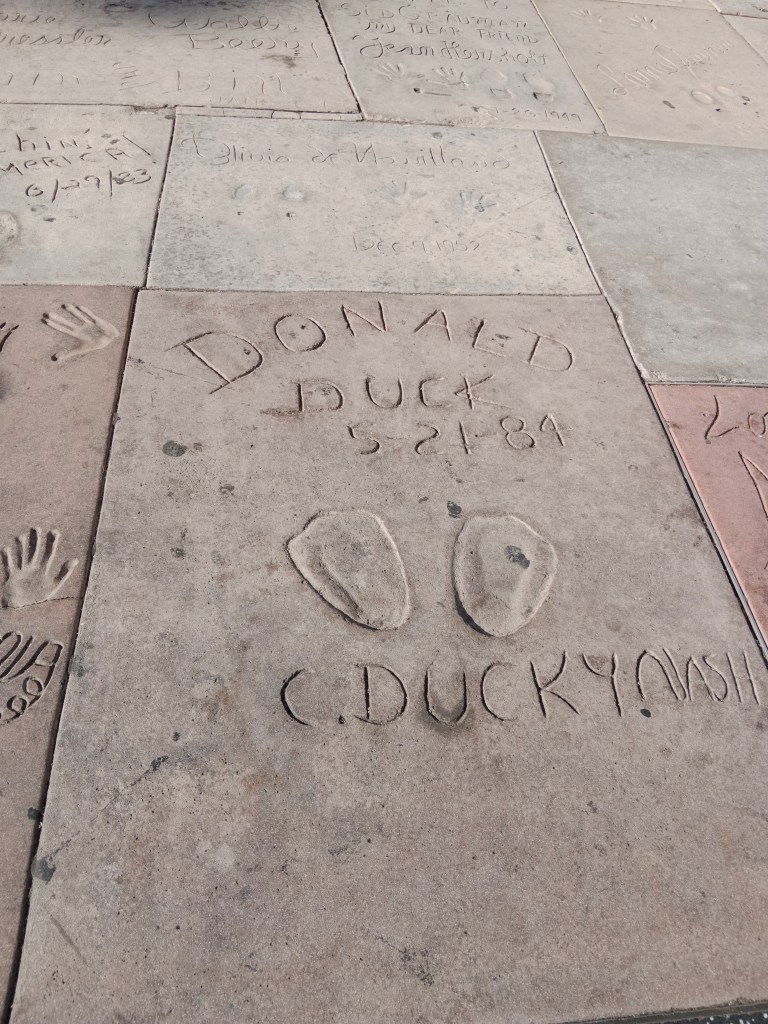
The Chinese Theatre premiers many of the hollywood movies and is also the venue for birthday parties and corporate events. One of the peculiarities is the forecourt where concrete blocks on the floor bear the signature , hand prints or foot prints of famous motion picture personalities.

The Chinese Theatre

The signatures and limb impressions outside on the walkway

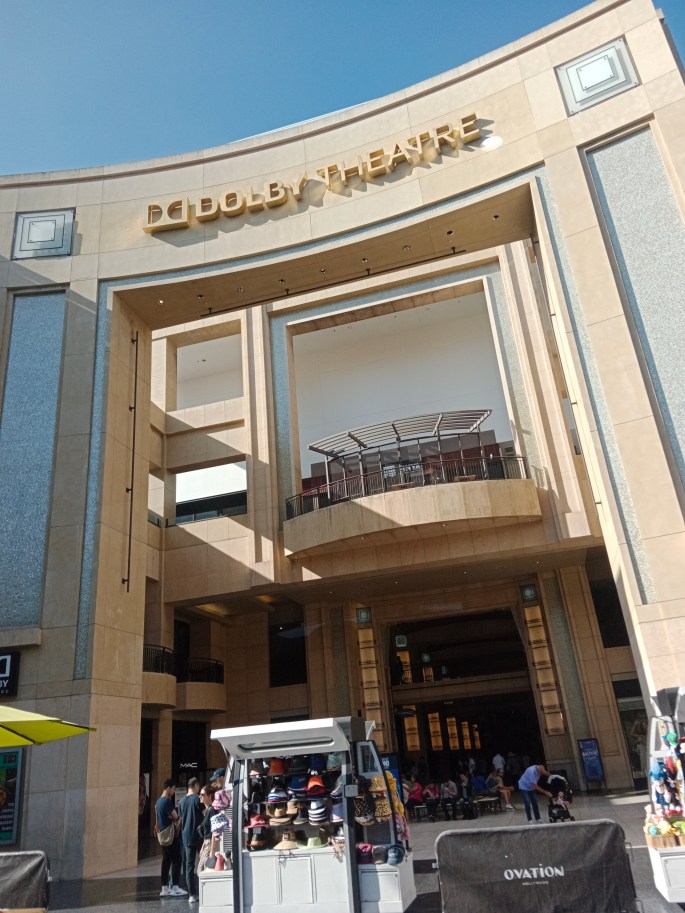
Another attraction on Hollywood Boulevard is the Dolby Theatre which is a live performance auditorium and also the venue for the annual academy awards.

Dolby Theatre

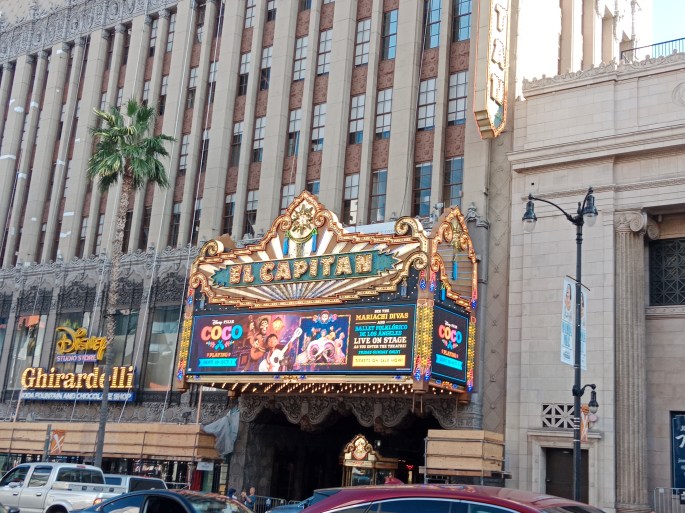
The El Capitan Theatre

Owned by Walt Disney Company, this serves as the venue for premieres of Walt Disney films.

El Capitan Theatre

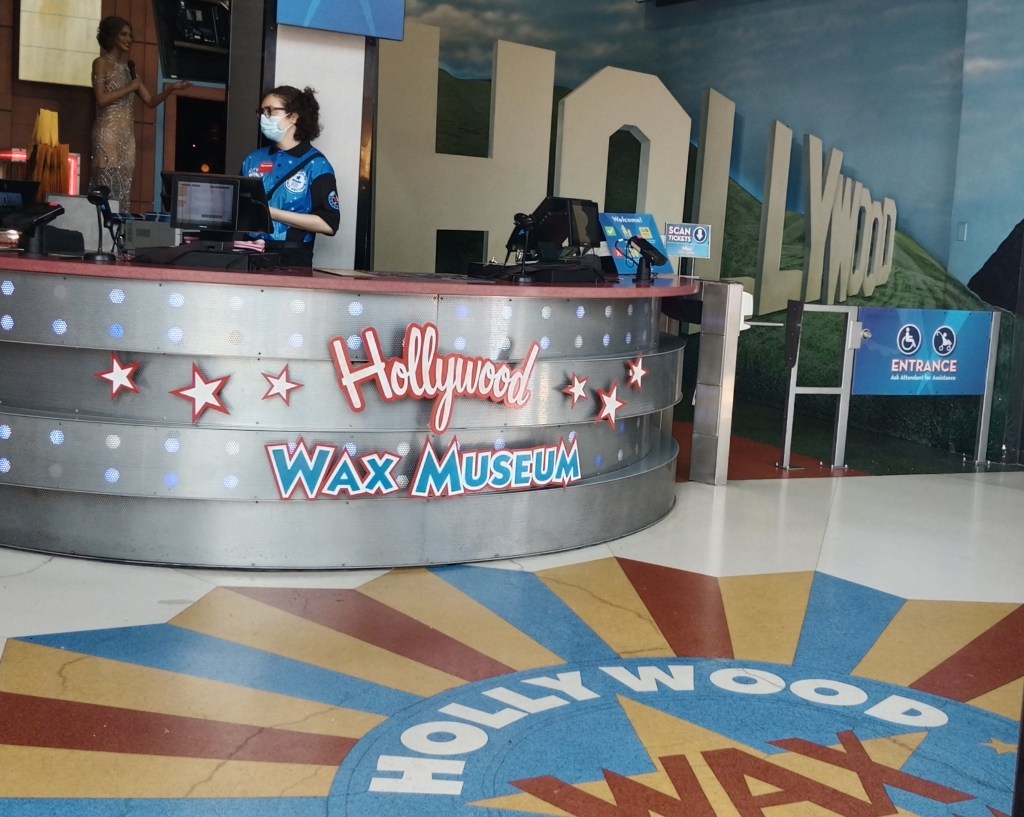
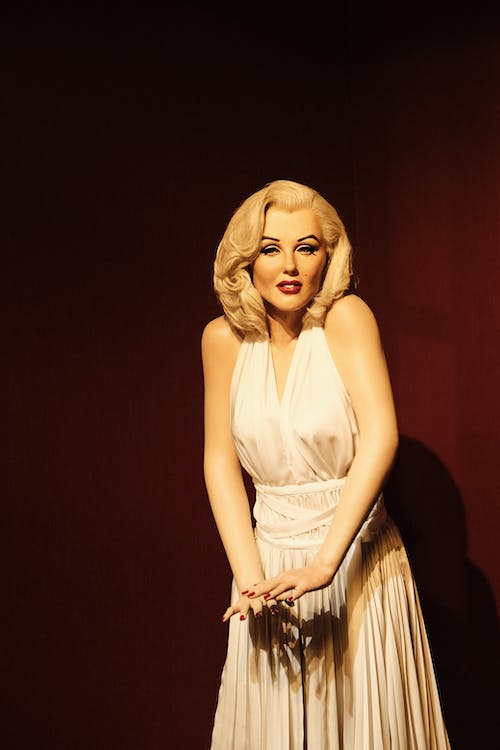
Hollywood Wax Museum

Featuring wax replicas of celebrities, this museum is one of the attractions on Hollywood Boulevard.

The Hollywood Wax Museum and Marilyn Munroe in wax…

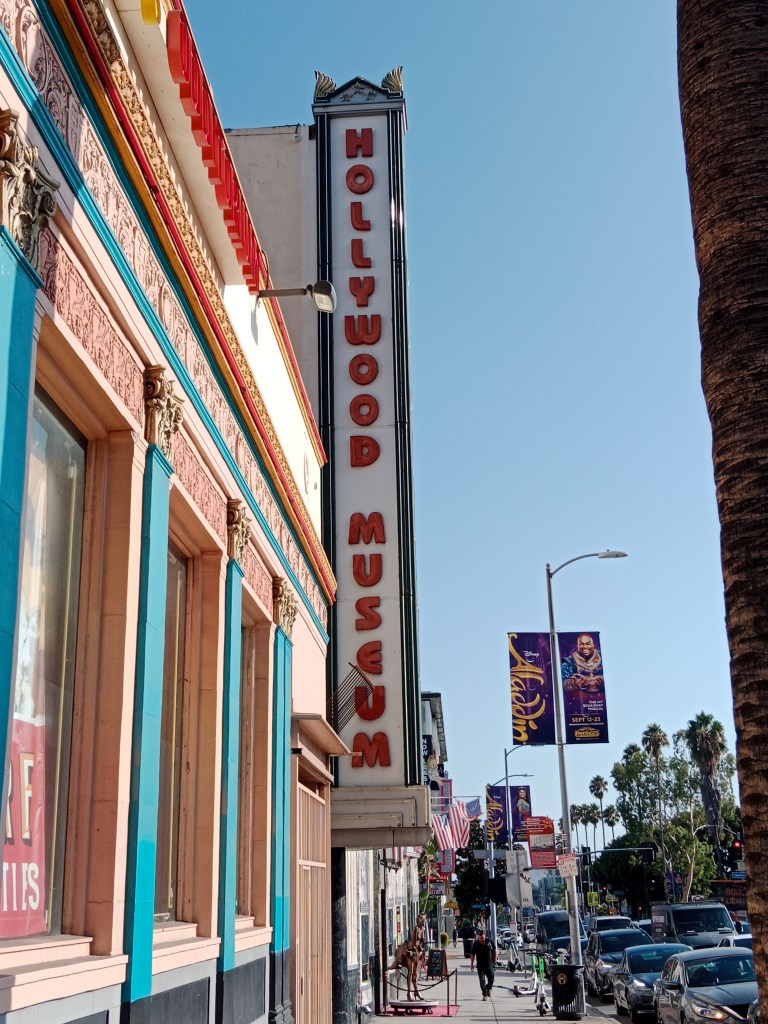
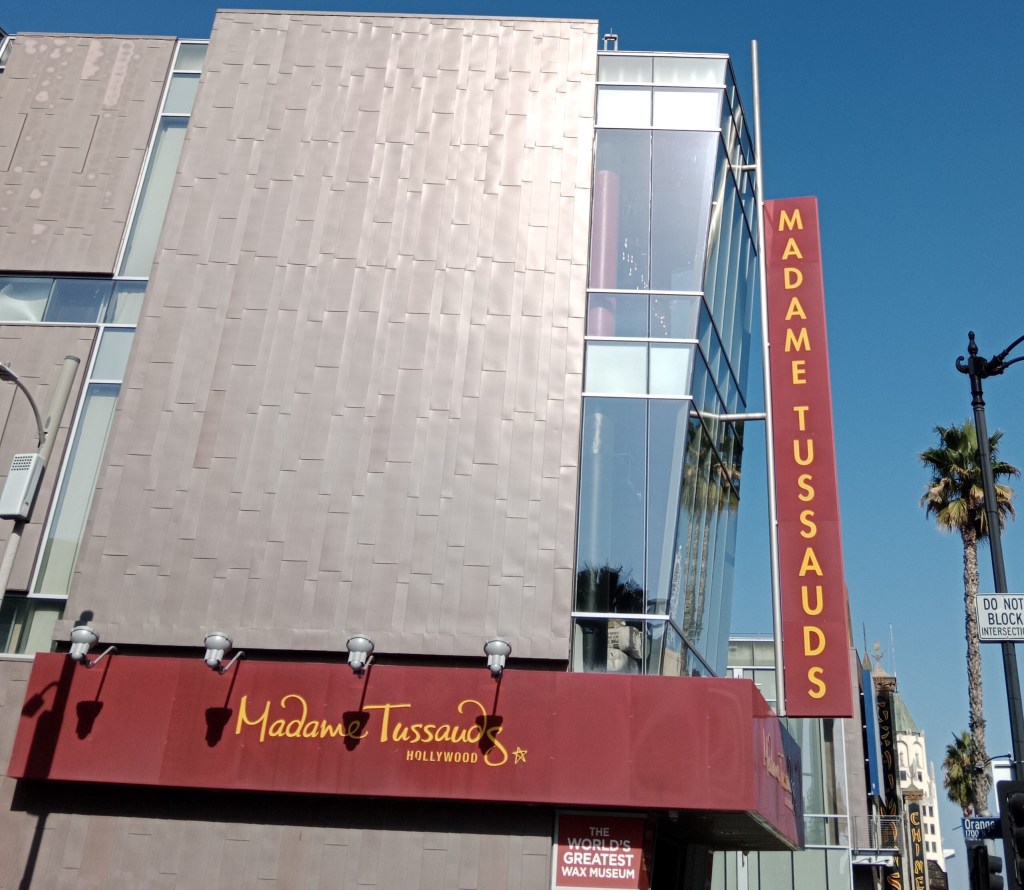
Besides this, the Hollywood Museum featuring memorabilia from Hollywood and Madame Tussaud’s are other attractions at Hollywood Boulevard.

Hollywood Museum and Madame Tussaud’s

Hollywood Boulevard also hosts many restaurants and pubs besides plenty of street vendors selling a variety of food items.

A cafe and street food

Besides this, shopping opportunities are also plenty here. Most of them deal with Hollywood memorabilia and souveniers. Tourists throng these shops and they do brisk business!!

But I must admit that my mental picture of Hollywood was not what I saw. I had imagined it to be more posh and stylish. Much to my surprise, the Walk of Fame was like any other street except for the stars. It neither looked posh nor clean. Most of it looked dated and worn out!! As we walked along, touts kept thrusting pamphlets at us for various shows which kept us tense as we had been warned of pickpockets. All in all, my impression…overhyped place!!!!

A variety of shopping experiences !!

Soon, we were headed to Beverly Hills….

Hollywood and Beverly Hills are inseparable. Home to the rich and famous from Hollywood and elsewhere, it has an upmarket shopping street named Rodeo Drive. Celebrity homes are the speciality of the area. Some high end hotels and restaurants dot the roadside and Steven had a story to say about each of them and how they were connected to a celebrity!!

Parking is extremely difficult here with heavy penalties and so Steven took us around and dropped us off at a spot promising to pick us up again after an hour. So we walked along looking at the shops and hotels.

The Beverly Hills Hotel with its poolside cafe and Beverly Gardens Park with the pink “Beverly hills beautiful” sign was a photo spot….that is my featured image today…

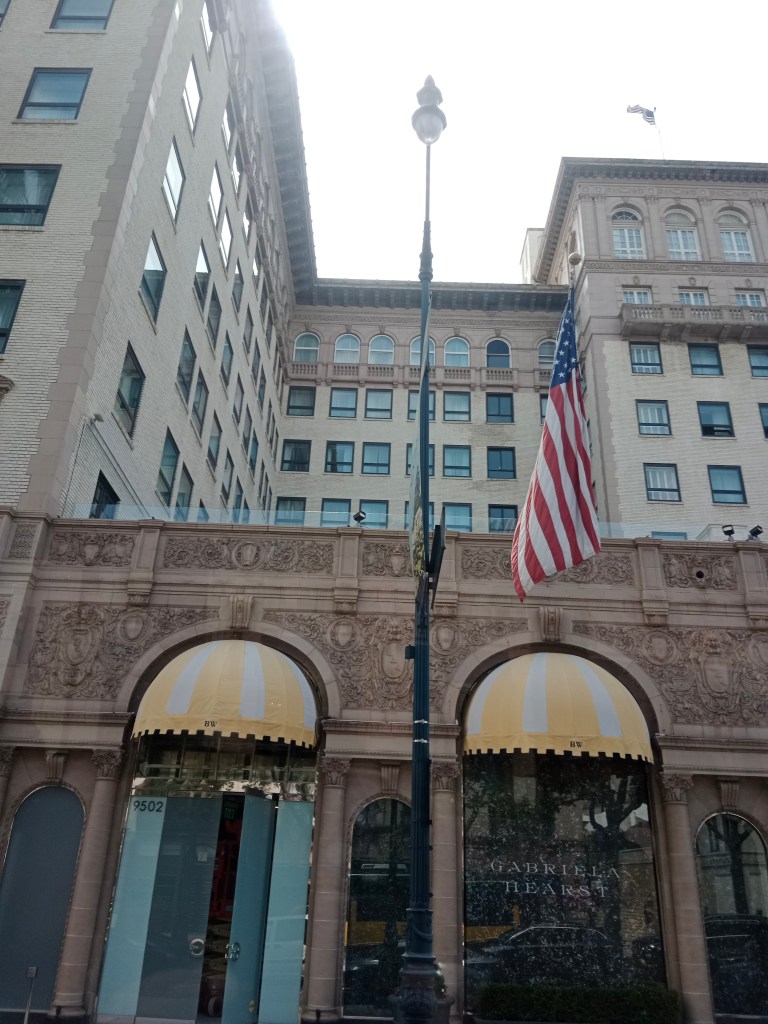
Rodeo Drive and Wilshire Hotel which was supposedly President Obama’s favourite

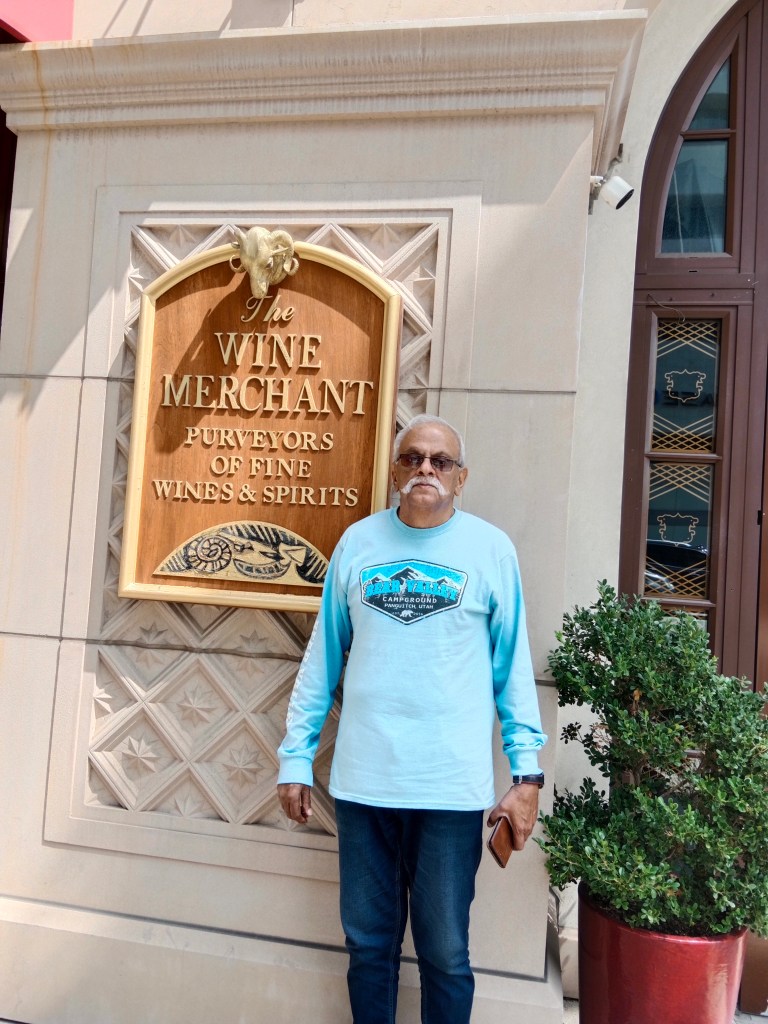
Upmarket shops and a wine shop where one has to fix an appointment to enter!!!

Steven was waiting at the appointed time for us and we all got back into the bus with memories of Hollywood and Beverly Hills. Dropping us off at our hotels, he bid goodbye to us as we bid goodbye to Los Angeles. We flew back to India from LA marking the end of a wonderful trip to Alaska.

So, with this episode, the series on Alaskan Adventures concludes. However much I enjoy the country I visit, the feeling of flying back to one’s motherland is something undescribable….See you next week in Bharat….our own Bharat….

Till then, do subscribe, like, comment and give your feedback…

Beaches of Los Angeles

Los Angeles has some great beaches ; some very famous and others, not so much. Some are extremely touristy while others are more quiet and peaceful. I happened to visit two of the famous beaches at Los Angeles to which I take you today.

Starting from the smaller to the bigger, let me take you to Venice Beach first.

Venice Beach….some insights:

This place has its own history and make no mistake; it is named after the city of Venice which had fascinated Abbott Kinney, the millionaire who wanted to recreate his favourite European city , Venice, in the US. In 1905 Kinney made his dream come true by digging several miles of canals and lining it with structures in Venetian architectural style. He also brought in gondolas and gondoliers from Venice and had it running very much like Venice. It came to be known as “Venice of America”. In addition to that, it was developed into a beach resort town with an amusement park and an ocean walk promenade.

However, a canal system of this nature needs continous maintanence and upkeep to prevent water stagnation and it’s perils . Unfortunately after the death of Kinney, his family tried to keep it going but it soon lost its glory. In 1926, the area was annexed into Los Angeles and some of the canals were paved in . By 1950, the area came to be known as the “Slum by the Sea”. Besides the neglect in infrastructure terms, gangs and drug cartels thrived here and it was a while before the area got back to normalcy.

Today Venice is a fun beach destination apart from being a popular film shooting venue. The piers, the boardwalk, the skating rink, canals and restaurants have featured in several TV shows and films.

Our Trip

As we were driving to Venice beach itself, our guide gave us a sneak peek of the canal system and what remains of it today. He mentioned that there are some very small houses near the canals which are very expensive property.

Some pictures…

What remains of the canals….

A gondola preserved at a roundabout and one of those expensive houses!!

Driving along, we reached the beach area . A large mural on the wall of one of the buildings attracted us. It was a black and white mural named “Touch of Venice”. This mural captures the essence of the 1958 film “Touch of Evil”and is dedicated to the history and culture of this place.

The “Touch of Venice” mural

From here on , we walked along the streets to the beach . One of the signs that welcomes you to the beach is a huge sign of the alphabet “V”.

At Venice beach and the” V “sign

Along the beach were trees painted in multiple colours adding to the funky look ….

The typical funky appearance of the area

Venice beach also has a skating rink and many competitions are held here…

The famous skating rink

Another peculiarity of the beach is what is reffered to as Muscle Beach. Venice beach is supposed to be where Arnold Schwarzenegger pumped muscle in a gym. Our guide showed us that gym enroute!! Venice Beach also has an outdoor gym for working out.

Some pictures…

Muscle beach and a shop display near it !!

Walking along, we finally reached the Boardwalk area lined with shops on one side. The whole place had a Bohemian look with all kinds of shops and graffiti displayed outside. Must be a fun place specially in the evenings.

Some pictures…

The Walkway and the shops

Interesting displays !!!

So , to sum it up Venice is a place famous for quirky happenings on it’s boardwalk where mimes, jugglers musicians and street performers create an ever changing ambience. One can sit around and enjoy the bohemian character of the place while savouring local dishes at the several restaurants along the boardwalk. All in all, a fun place…..
Moving on to a more upmarket beach; Santa Monica….

Santa Monica

Santa Monica is a city in Los Angeles with views of the Pacific Ocean which has long been admired. Apart from a beach, a pier called Santa Monica pier was built here and then on developed into an entertainment venue . It contains the Pacific Park which is an amusement park, a solar powered ferris wheel which is brightly lit in the evenings, an aquarium and a hippodrome with a carousel. Besides these, there are innumerable restaurants, bars,souvenier shops and whatever you can think of! Entertainers,video games,concerts and such other activities also take place here.

Within walking distance from downtown Santa Monica, this place was abuzz with revellers when we reached there one evening. Close to the pier is a small garden which is located at a slight elevation and offers great views of the ocean and the pier. Across the road are luxury hotels which have ocean and pier views and charge exorbitantly for them!!

Some pictures…

The park opposite the pier and the homelessluxury and poverty!!

Santa Monica beach and pier

Entrance to the pier

Restaurants on the pier

Gift shops and Video game arcades on the pier

The Pacific Park and Ferris Wheel

The pier has also another landmark, the end of route 66, the famous highway from Chicago to California…

End point of Route 66

The pier ends with great views of the Pacific Ocean.

End of the pier and the Pacific Ocean behind

Evenings see the lighting up of the pier and the Ferris wheel…

The lit up pier, ferris wheel and the crowds….

With this I have covered two of the most famous beaches in Los Angeles. There are many more of course. Hope you enjoyed the beach views. Do give your comments and feedback.

See you next week from Hollywood, Los Angeles….

Los Angeles , some sights

Returning from Alaska, we halted at Los Angeles for a couple of days. The sights and sounds of this vibrant city forms the content of today’s episode.

We decided to do a conducted tour of Los Angeles so that we can get a quick roundup of the city and then, we could do in detail whatever interests us later on by ourselves .

Booking a tour with “A Day in LA”, we reached the designated pickup point in downtown SantaMonica for our tour.

Our tour bus and Steven, our guide

We were picked up near the Santa Monica Place, a mall in downtown Santa Monica…This is close to third street promenade in downtown Santa Monica.

Santa Monica Place with shops and restaurants

The third street promenade in downtown Santa Monica is a pedestrians only street with fountains, restaurants and shops making it a lively place in the evenings…

Some pictures from downtown Santa Monica…..
Third street Promenade Santa Monica

The Broadway Theatre and Tesla showroom

Ocean Avenue next to the Santa Monica pier

Steven , our guide ,gave us an overview of the plan for the day and we set out to Santa Monica Pier which was our first halt and then proceeded to Venice Beach with Steven pointing out various sights along the way. Santa Monica pier and Venice will be covered in the episode on beaches of LA.

As we drove around ,Steven pointed out the Santa Monica civic centre which was once an academy awards venue and a peculiar looking building with an entrance shaped like a pair of giant binoculars which houses the LA office of Google!!

Santa Monica civic centre and the binoculars outside the office of Google…

A pair of towers caught our attention and Steven pointed out that they were built by the same architect who designed the Twin Towers in the US . The CAA building in front of it is so designed with a huge window that one can see the twin towers through that…

The twin towers and the CAA building

Downtown Los Angeles

Driving along some parts of LA downtown, the skyscrapers of various sizes and shapes kept appearing. Off and on, the homeless and their misery contrasted with the plush looking apartments and skyscrapers. Some pictures…

Plush skyscrapers

And the contrasting misery of the homeless!!!

Steven dropped us off at Farmer’s Market for lunch….

Farmer’s Market

This market is a historic LA landmark opened in 1934. It is an area of foodstalls, eateries, food vendors and local produce market. Unlike such markets elsewhere, this market is permanent. We were spoiled with choices here. Too many appetising looking stuff kept us confused on what to have. Finally we settled down for some pizza and local icecream recommened by Steven.

Farmer’s Market with the eateries

After lunch, we headed to Griffith Observatory…

Griffith Observatory

This is an observatory in Los Angeles located in Griffith Park and overlooking downtown LA and the famous Hollywood sign .

The observatory, constructed in 1935, was envisioned and funded by Col. Griffith J. Griffith. With decorative concrete elements and distinctive components, such as an 85 ft diameter copper-clad planetarium dome and cupola, coelostat, and telescope domes, it stands out against the usual buildings.

It has an extensive array of science related displays particularly related to space.

The Griffith Observatory

At the observatory, visitors can look through telescopes, explore exhibits, see live shows in the Samuel Oschin Planetarium, and enjoy spectacular views of Los Angeles and the Hollywood Sign. It houses a Zeiss refracting telescope which allows night visitors to star gaze!

In front of the main building of the observatory as you walk up towards it, you come across the Astronomer’s Monument which was built to pay homage to six of the greatest astronomers of all time and is quite beautiful to see in real life.

Astronomer’s Monument

Los Angeles city as seen from Griffith Park

The main entrance to the observatory and the beautiful inside of the dome

As soon as you enter, there is a huge pendulum called the Foucault Pendulum which provides proof of the earth’s rotation…

Function of the pendulum explained…

Foucault Pendulum (click on the video)

The observatory has also been a filming location for many movies and has made it an international emblem of LA. Talking of landmarks, we move on to another such landmark….the hollywood sign.

The Hollywood Sign

This iconic sign of LA is best viewed from Griffith Park outside the Griffith Observatory. The sign is situated on Mount Lee in the Santa Monica mountains which overlook the Griffith observatory. The alphabets are 50 ft tall and was initially erected in 1923 by a real estate developer as a temporary advertisement. Due to its popularity, it was retained and redone in 1978 with more durable material.

The sign is located on rough steep terrain in the Griffith Park and protected by barriers to avoid unauthorised access. Visitors can hike to the sign .

The Hollywood sign

After the visit to Griffith Observatory, we visited Hollywood and Beverly Hills which will be touched upon in a later episode.

As we drove around LA, a couple of local sights that attracted us were….

The Big Blue Bus which serves as the public transport system and is very user friendly and reasonable. We did try this out a couple of times….

The Big Blue Bus

The food delivery robot….

A food delivery robot was doing it’s rounds and we got to see it wait and cross the road with pedestrians at one of the signals….much to our amusement!!!!

The food delivery robot outside one of the restaurants and one on his job!!

The US postal service delivering letters…

The postman on his daily trot…

And last but not the least, a beautiful wall full of succulents!!!

The succulent wall….

Well that just about rounds up the general sights of LA. Next episodes will be on the beaches of LA and Hollywood.

Till then do continue to comment and give your feedback…

And finally we flew!!

Not knowing how the Alaskan weather would treat us, we woke up to a partly cloudy day ; much better than the previous day , but clearly not an ideal day for flightseeing. So we were very skeptical about the flight taking off. But to our surprise, we got a call from the tour operator that they were offering us a flight over the Knik glacier and the Chugach National Park as Denali and Alaskan Ranges still seemed difficult. They also offered us a refund in case we did not want to take this . This; they said would me a much longer flight and so it would be like a bonus for all the inconveniences of the previous day. So we decided to take it .

Soon, we were ready and got picked up at the hotel and reached the K2 Aviation office. We were weighed at the counter and completed some formalities and were asked to wait for our pilot. Soon more tourists started arriving and we could see the aircrafts getting readied. The weather didn’t seem too good and we kept our fingers crossed.

K2 Aviation office, our flightseeing tour operator

The aircrafts getting ready

Soon, a group of pilots arrived and each of them had a list of people flying with them. Each aircraft had around nine people assigned and we were with Dave…

With Dave, our pilot

Dave gave us some safety instructions and demonstrated the correct use of the headphones provided and we boarded and took our seats. The headphones were primarily for the commentary that Dave would give as we flew over different areas but we too could call out to him at anytime.

Inside the aircraft and all set to fly….

And finally, we took off…

K2 office and Talkeetna airbase as we took off…

The swollen Talkeetna river and the onset of autumn colours came into view…

Talkeetna River

Fall colours over Talkeetna

Soon we were on top of the Talkeetna mountains….

Talkeetna mountains

Contrary to arid snow covered glacierland that we expected, what came in sight was the town of Palmer, the Matanuska river and the Mat Su Valley…

Mat Su Valley

This is the local name for the Matanuska-Susitna valley which is famous for its farmlands producing giant size vegetables besides the salmon bounty in the rivers. This valley carved out by glaciers is located between the Talkeetna mountains, Alaskan Ranges and the Chugach mountains.

Palmer and Matanuska river

The fertile Mat Su Valley

Once we passed this, it was on to the Chugach ranges and the glaciers. Enjoy the views ….

Heading to the glaciers…

What is that black line on the glacier?

Did this question not pop up in your mind?

Well, they are called moraines. They are actually rock and silt debris that the glacier picks up on the way and when the ice mass moves, they are left behind.

Terminal part of glacier feeding the lake

Floating icebergs broken off from the glacier

Nothing but ice for miles around….

Blocks of ice

The end of the glacier clearly visible…

Beautiful colour of glacial lakes

We also got to see the debris of an airplane that had crashed sometime back on the glacier…

Debris of crashed airplane…

Soon we were on our return journey over the glaciers with Dave turning the plane at many places for both sides to get the views. Enjoying every bit of it we landed back safely at Talkeetna air base.

As a parting shot, a short video for you to enjoy….

Enjoy the flight video…..

It was definitely a once in a lifetime experience. I have tried to bring it to you as clearly as I can . But as I always say, nothing like experiencing anything oneself !! So do go in for the flightseeing over the Alaskan glaciers…you will never regret it..
Do continue to encourage with your comments and feedback….