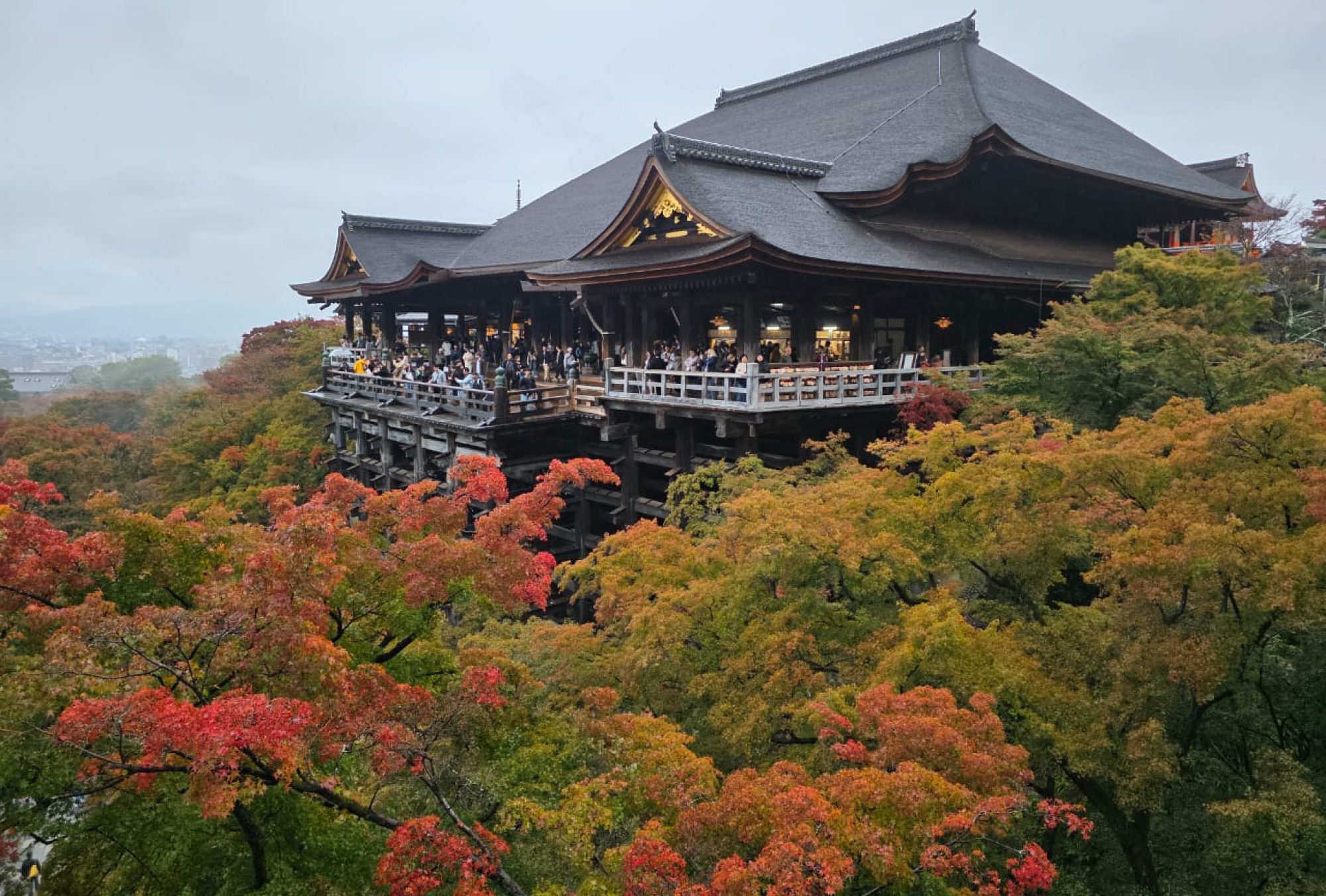
Tonle Sap and the Floating Villages

Most people associate Cambodia with Angkor Wat and the ruins of the Khmer dynasty. Let me take you on an unusual journey today, to the Tonle Sap lake and the floating villages around this lake. This is perhaps not on everyone’s list of places to see near Siem Reap; but let me tell you, it is a rather unique place, with a sad story behind it . A little bit on how these villages came to be ; will answer the natural questions that arise in your mind as you read along and see the pictures. The Tonle Sap is located south of Siem Reap. A short drive of about 40 minutes takes one to the northern tip of the lake where the floating village is situated.

Let me first tell you about my first encounter with Tonle Sap. I had a window seat on my flight from Ho Chi Minh city to Siem Reap. As the captain’s voice over the audio system heralded our landing at Siem Reap, I could see large water bodies and something that looked like marshlands below. It was not one of those clear days and it was nearing 6 pm. Wondering what this could be, I clicked some pictures for what it was worth. It was only two days later that I realised that what I had seen was the Tonle Sap lake and the floating villages. Take a look….

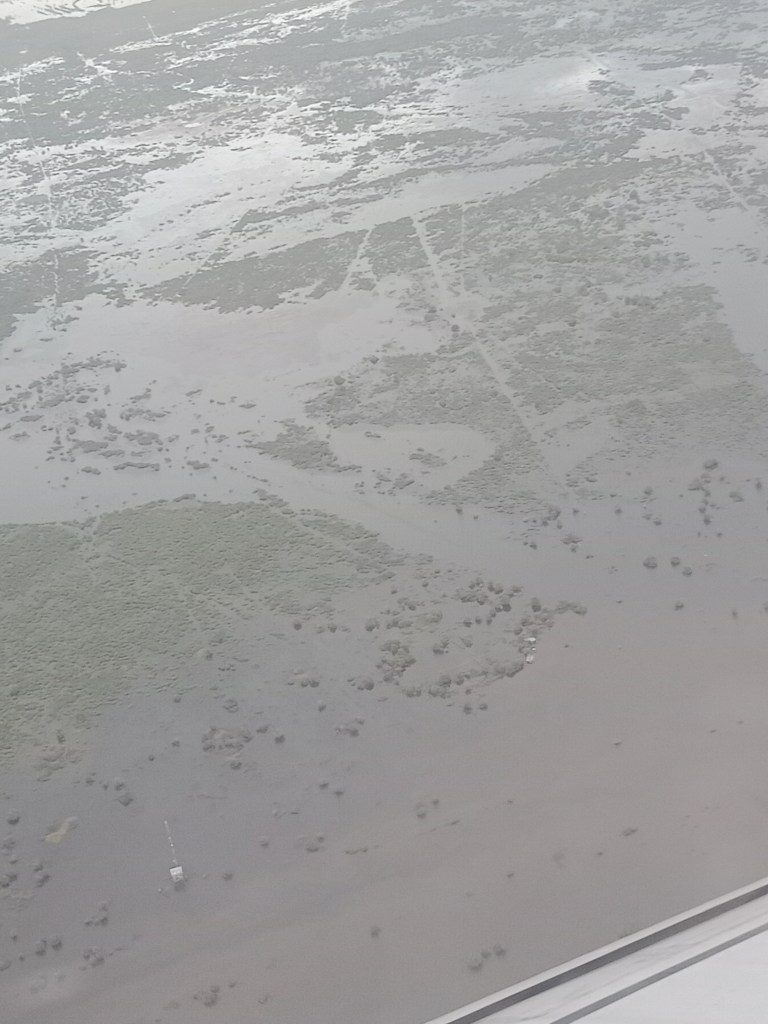
Tonle Sap and the villages ….an aerial View

The Tonle Sap [Sap is lake and Tonle is saltless in Khmer]

Tonle Sap is the largest fresh water lake in South East Asia. It is not only a lake, but a complete eco system and a biosphere reserve. It provides water to half of Cambodia’s crops and almost all the requirements of fish . Apart from that, it is an important transportation link here. The Tonle Sap was a source of abundance to the ancient Khmers. In fact many historians attribute the prosperity of the ancient Khmer empire to the bounty provided by the Tonle Sap.

I have heard of increase and decrease in river water and drying up of lakes in summer but I was not aware of seasonal changes of this magnitude any where else.

During the dry season the Tonle Sap lake covers an area of 2500 sq. kms with a length of 160 kms. During the wet season, the lake grows over 16000 sq. kms with a length of 250 kms. That is a drastic increase in volume by 6 times !!!. A very unusual phenomenon occurs here. The Tonle Sap river takes water from the Tonle Sap lake and merges with the Mekong River. The flow of water towards the sea reverses during the wet months depending on the pressure of water in the Mekong river and the lake swells up enormously. Effectively the Tonle Sap lake is a large bowl which fills with water when the river flows into it and empties out when the river changes direction as it does every year!

The Tonle Sap is the focal point of life for a large section of Cambodians who depend on it directly or indirectly for their livelihood. Fishing , particularly exporting fish products like fish paste is the backbone of their survival. There are at least 300 species of fish living in the Tonle Sap . The floods help growth of large fish and they are easy to catch when the water recedes as they get caught in shallow pools or in the bamboo wires and nets.

The silt deposited during flooding is extremely fertile and local farmers have developed indigenous rice varieties that grow here.

There is a forest, a mangrove forest at the edge of the Tonle Sap that is an important eco system in itself. It is an important spawning and breeding ground for fish. This vital eco system harbours fish, snakes, turtles, otters and even crocodiles. A large number of water birds like storks and pelicans thrive here.

There are environmental concerns around this entire eco system. There has been a notable decrease in the numbers and variety of fish partly due to excessive fishing and partly due to conversion of traditional spawning grounds into agricultural areas. Dams built across the Mekong River are also a threat to the eco system of the Tonle Sap.

Floating Villages

The people who live in these floating villages are mainly immigrant Vietnamese who suffered heavy losses during the Khmer Rouge period. Many of the immigrants were killed in the civil war. The others who decided to stay in Cambodia continued in refugee camps and finally settled in these floating villages. As they do not have certification proving their Cambodian identity, they are considered stateless migrants and cannot own land. They are caught in the cycle of poverty and statelessness.

Life in these floating villages is quite a challenge and 90 percent of the villagers earn a livelihood from fishing and agriculture. Life of the villagers is intertwined with the lake, the fish, and the cycles of rising and falling waters of the lake. Pollution is threatening their health . No public sewage system exists and they use the lake (which is also the source of water supply) as a toilet and garbage dump!!

We took a drive from Siem Reap in our tour bus and reached the ferry boarding point. From there we boarded a Tara boat which took us on this tour of the floating villages.

Kampong Phluk

This is one of the four floating villages near Tonle Sap and the one we visited. The houses are made of bamboo and stand on stilts 6 to 10 meters high which are anchored to the bottom of the lake. It tends to give a feeling of a nomadic settlement but far from it; it has houses, schools, markets, churches, monasteries, hospitals and even a police station! The only mode of transportation is by boat and everyone is familiar with it.

As I said earlier, the muddy waters of the lake are used by these people for their daily requirements. The extreme poverty of the inhabitants of the village can be judged from this!

During the dry season, the water recedes and the stilts are clearly seen. During the wet season, the lake fills in and the villagers use the water for all their needs.

As the boat went past the houses, we saw the villagers going about their routines like fishing, washing and cooking. There are dogs, cats , poultry and pigs living there too!

As we reached the floating village.

A close up of the floating houses

The villagers go about their routine life

Trash and filth surrounding the houses

Man and animal coexisting under trying circumstances!!
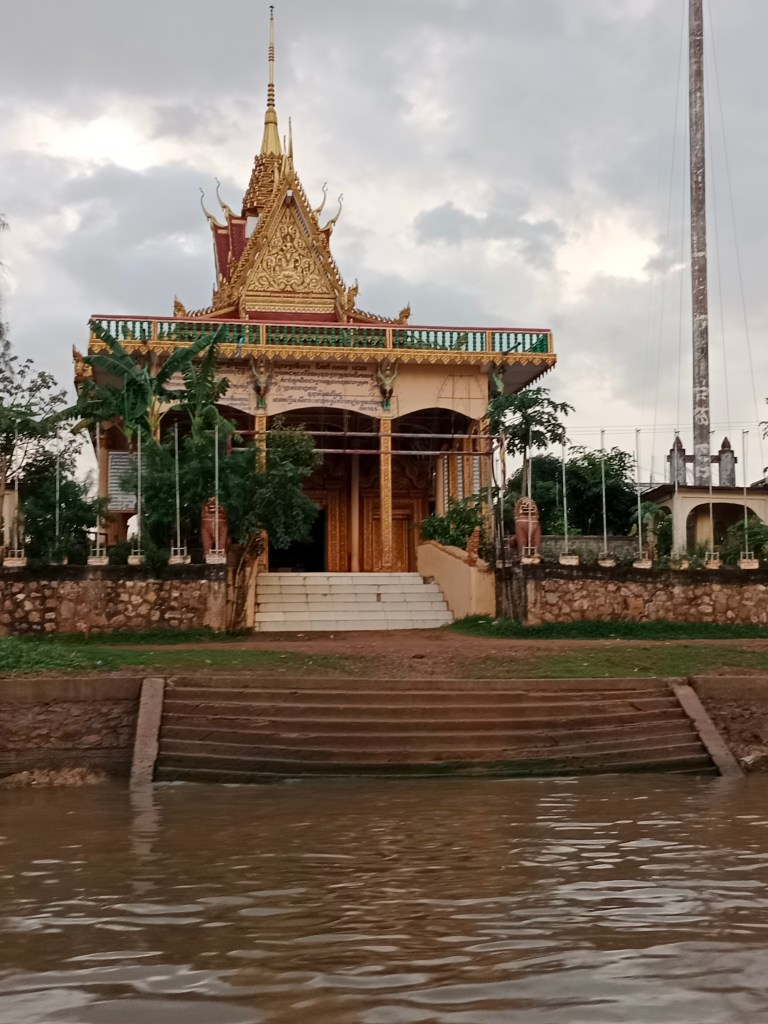
A Floating Shrine

A floating restaurant

As I sat in the boat and looked at the houses and it’s people, something pulled at my heart strings. Am I not indirectly also causing pollution and environmental damage here as a tourist? That was a question I had no answer to. You see, it a chicken and egg situation. The villagers do benefit from the tourism that has started flourishing here. Many of them have left traditional occupations and turned to the tourist industry. All the same, I wouldn’t like tourists continuously looking at my house and surroundings as if it were a zoo! The helplessness of these people really touched me…..

Honestly, when our guide mentioned about floating villages, I only thought of some beautiful elite luxurious floating village. It was only when I reached the boat jetty and took the boat that I realised how wrong I had been!!!

As I was lost in thought, the sun was slowly going down on the Tonle Sap Lake. We just sat there on the boat and witnessed the sun setting on another day of our Viet Cam holiday. Share the feel….
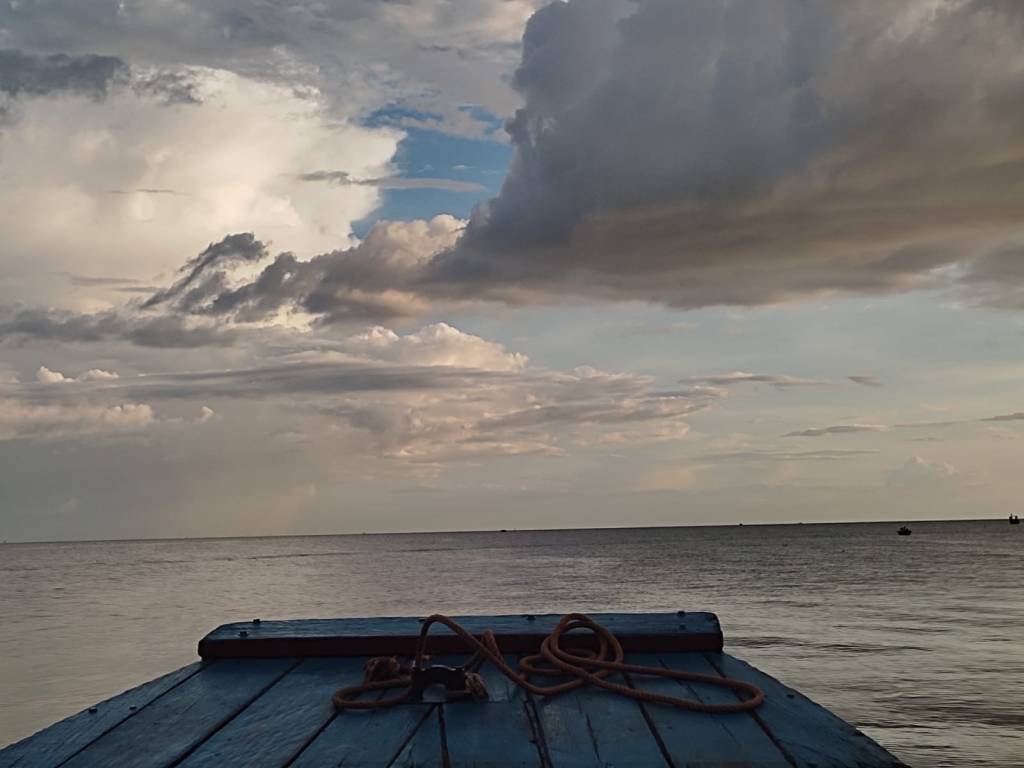
The Sun sets on Tonle Sap….

With mixed feelings, we returned to our hotel for the night. As usual, the exchange of pictures took place and quietly, the sad thoughts took a back seat as we continued on our holiday.

This was my last blog on Cambodia and from next week, we move on to Vietnam. See you next week at Hanoi. Till then, do subscribe, like and comment on my blog. Your feedbacks are welcome too!!

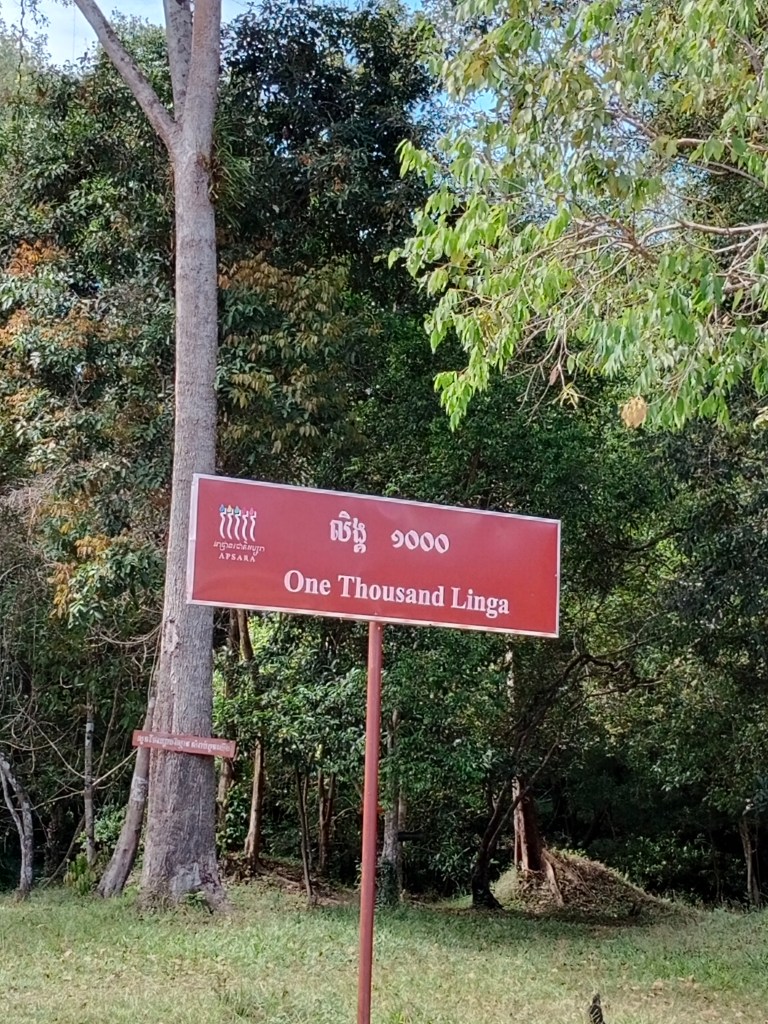
The river of Thousand Lingas

Located 30 kms northeast of Siem Reap, is the Phnom Kulen National Park. This was not part of our original itinerary but we visited this place as per our guide Sarath’s suggestion. A long drive along a mud road through a jungle took us to this destination. A giant reclining Buddha, a waterfall and a thousand lingas carved on the river bed are the attractions here.

Brief history :

Phnom Kulen (Mountain of Lychees in Khmer) is the birthplace of Khmer civilisation. It was here that King Jayavarman II declared himself the King of the Khmer Empire . He started the Devaraja cult where the King is equated to God and that is reflected in many of the faces in the ancient temples we saw at Angkor

His successors expanded the empire and built several temples and monuments here. Today, this area is a partially forested site with temples, ancient reservoirs, ponds, plots ,ceramic kilns and rock paintings sites ; all part of an ancient urban complex. Mahendraparvata or Phnom Kulen represents a significant milestone in urban development.

Legend of Mahendra Parvata

During the Khmer period, this area was called Mahendraparvata…… Mahendra ( The Great Indra in Sanskrit) and parvata (mountain). It is very significant as it is one of the earliest capitals of the Angkor period ranging between the 9th and 15th centuries. . Legend has it that Mahendraparvata was the mountain lifted to Lanka by Hanuman to extract Sanjeevani ( a lifesaving herbal plant)

Mahendraparvata on Phnom Kulen has suffered damages from the ravages of time, looting during the Cambodian war, climate change and other factors. Following the collapse of the Khmer regime in the 15th century, Phnom Kulen was largely abandoned except for the reclining buddha which was a pilgrim centre. During the Khmer Rouge period, it became their strong hold and many statues were relocated to Phnom Penh while others were looted and fell into private hands.

It was only in 2008 that the Angkor authorities have started excavations, explorations here leading to many new findings. Restoration and conservation activities are now on.

The river of Thousand Lingas

This mountain range is also the place of origin of the Siem Reap river. It occupies the position of a local aquifer for the entire region draining most of the plateau before reaching Angkor. It is believed that water which flows over the images of Gods is purified. The King wanted his subjects to get pure water and that is probably the cause of The Thousand Lingas and other images carved on the river beds. The entire water from the rivers, channels and other aquifer network ultimately enters the Tonle Sap lake which we will visit in our future episodes.

The Kbal Spean river which is a small tributary of the Siem Reap river flows through this National Park. The Kbal Spean river is known as the Sahasralinga River( River of thousand lingas). [Sahasra in Sanskrit is thousand and Linga is the symbol of Shiva the Hindu God.]

It was indeed amazing to see the innumerable lingas carved on the stones of the river bed. They are carved in grid like fashion and often vary in size. Take a look…

A board displayed by the roadside tells us the location of the lingas.

The site of the Thousand Lingas

A short walk along a trail in a jungle leads us to the Kbal Spean river and the lingas.

The Lingas carved in grid like arrangement

In addition to the lingas, there are other carvings on the riverbed too. Take a look at one of Lord Vishnu…..

The face of Lord Vishnu carved on the river bed

A 250 metres walk along the trail by the river side takes us to a pool which has different coloured water. It looks like a spring from which the water is flowing out.

The spring pool with different coloured water

Our next destination was Kulen Waterfall.

Kulen Waterfall

A long walk on an uneven road with occasional slippery boulders lead us to the first stage of the Kulen waterfall. This waterfall falls from a height of around 5 metres .

Kulen Waterfall level one

Some more walking on uneven boulders and finally a steep metal stairway led us to the second level of the waterfall. Here the water falls from a height of around 20 metres. There is a beautiful swing chair close to the falls. Many locals were enjoying a bath in the falls.

Kulen Waterfall level two

A beautiful swing chair close to the waterfall

The other important location in the National park is the Pagoda or temple of the reclining Buddha.

Preah Ang Thom

Preah Ang Thom is the most venerated and worshipped Buddha statue in the Kulen mountain from the post-Angkorian period. (12th to 16th centuries) It is 8 meter long statue of the reclining Buddha reaching nirvana. The statue is carved on to the side of a huge natural sandstone boulder. A staircase and a shelter over Buddha has been added later.

A statue outside the temple entrance.

As one reaches the temple parking area, there are plenty of stalls selling eatables ,souvenirs and flowers.

A lady selling lotuses, hats and souvenirs and a stall selling local herbs outside the temple

A flight of stairs with a Naga balustrade on either side and an arch leads one into the temple.

The stairs with Naga balustrade and the arch at the temple entrance

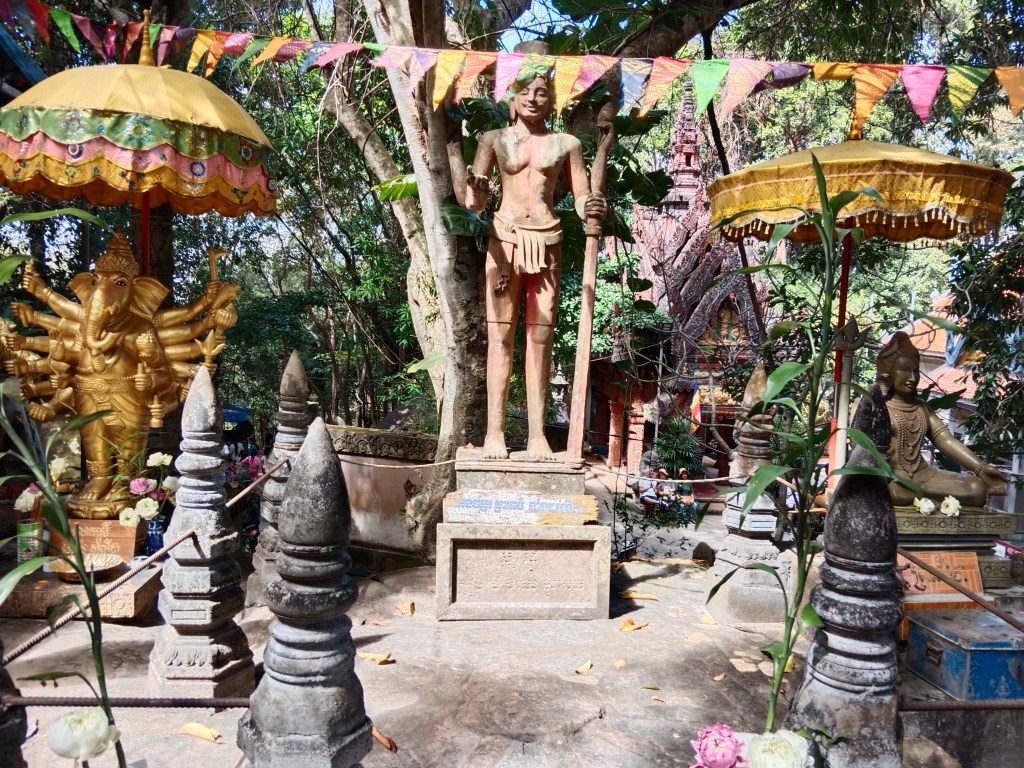
This is a very sacred place of worship for the Khmer people and it can be sensed as we enter through the arch. The complex has plenty of shrines of various sizes with statues of Buddha , Shiva, Ganesha and other Hindu Gods. Some pictures…

A beautifully carved shrine at the complex

A Buddha shrine

A shrine with Hindu Gods Vishnu, Shiva, Ganesha

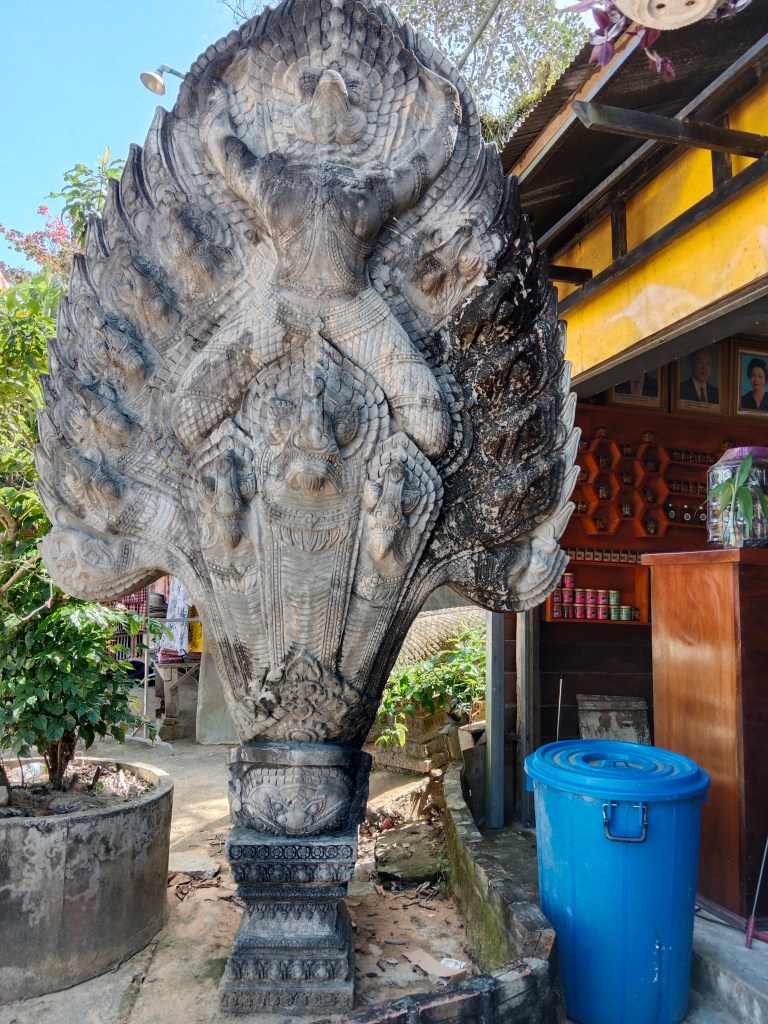
The beautifully carved Naga statue ( well preserved unlike most others which were in ruins)

A music performance at the temple complex

Many Buddha statues at the base of a huge boulder

The temple itself is at various levels and after each level, there is a flight of stairs.

The Shrine and the steps leading to the top most level on the side of a boulder

At the top most level is the most important deity of the temple, the Reclining Buddha.

Face of Reclining Buddha

With the Reclining Buddha

Outside the shrine of the reclining Buddha is a huge gong which all the devotees strike as they leave the shrine.

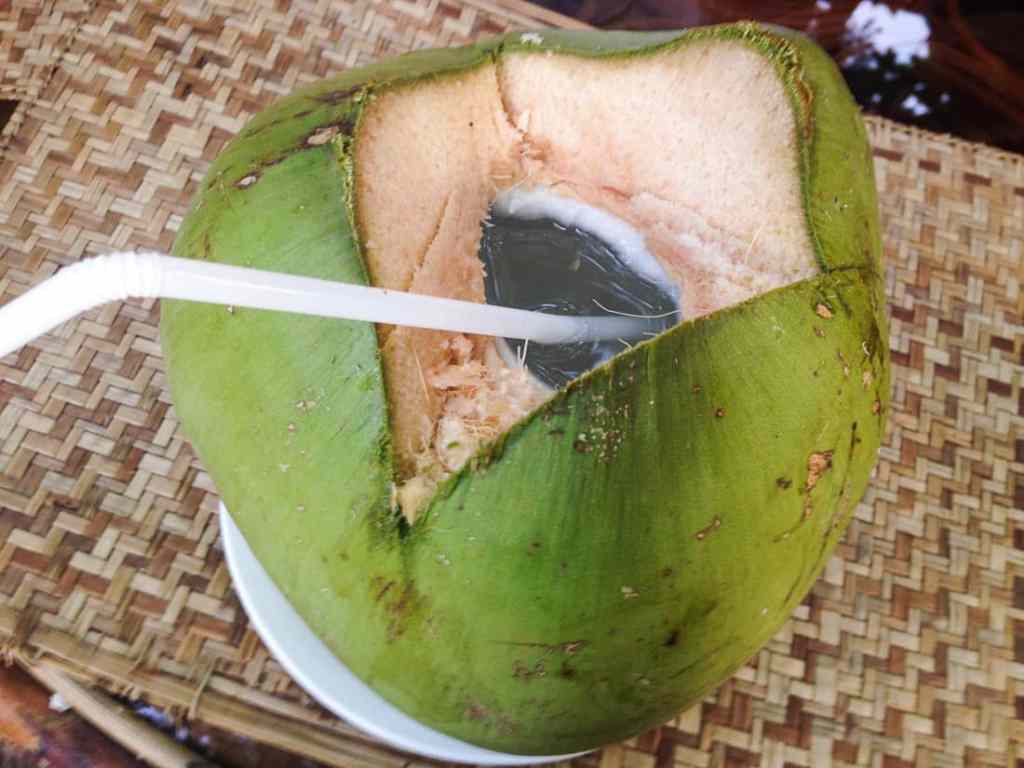
After the climb up to the top of the temple and the climb down, a cool tender coconut was very welcome. The coconuts here are huge and more sweet than what we find in India.

The sweet and cool tender coconut water rejuvenated us

Boarding the bus once again with Sarath, we headed to the Floating Villages and the Tonle Sap Lake , the largest fresh water lake in South East Asia.

See you next week at the Floating Village near Tonle Sap Lake. Till then, do subscribe, like and comment on my blog. Your feedbacks are very welcome too!

Angkor Thom

Angkor Thom ( Nogor Thom in Khmer meaning Great City) was the last capital of the Khmer Regime. Established in the late 12th century by King JayavarmanVII , this is one of the most visited tourist spots today. Covering an area of nine square kms, it has several temples and monuments built by King Jayavarman and his predecesors.

Angkor Thom was established as the capital of King Jayavarman’s Empire and the centre of his massive building programme.

The city lies on the banks of the Siem Reap river around seven kms north of Siem Reap city and around two kms north of Angkor Wat.

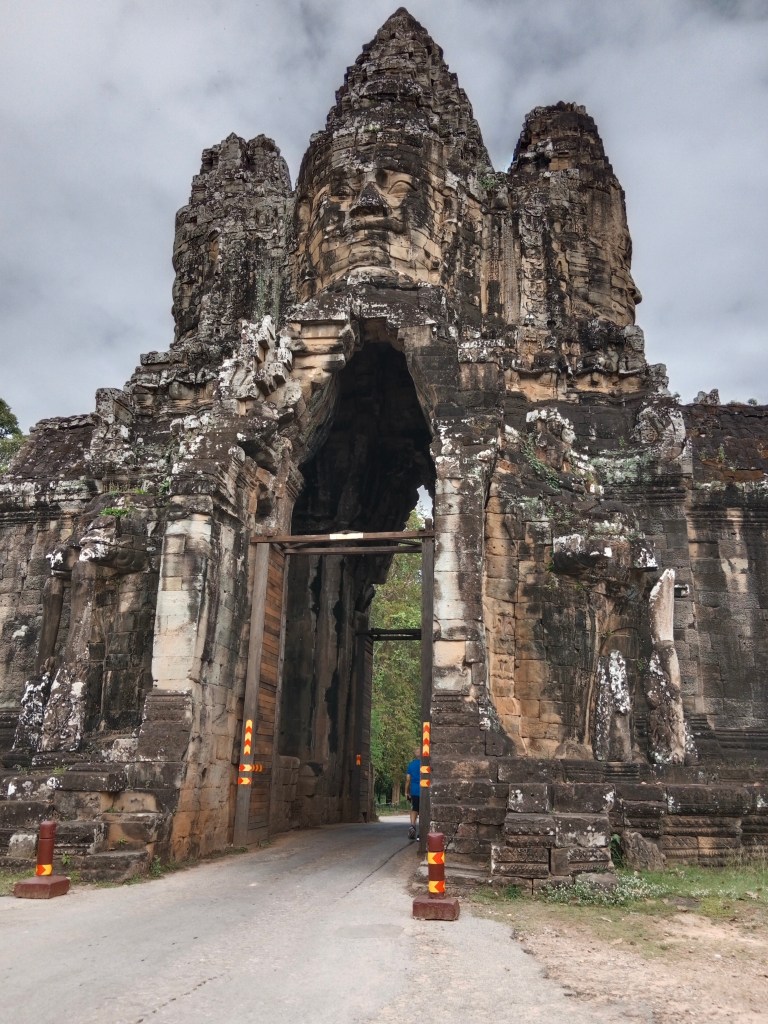
The walls of the city of Angkor Thom are flanked by a moat and made of laterite .There are gates at each of the cardinal points from which roads lead to the Bayon at the centre. The gates have towers with faces on them which are similar to the faces on the Bayon and probably represent the King himself, the Bodhisattva Avalokiteshvara, guardians of the cardinal points or a combination of these.

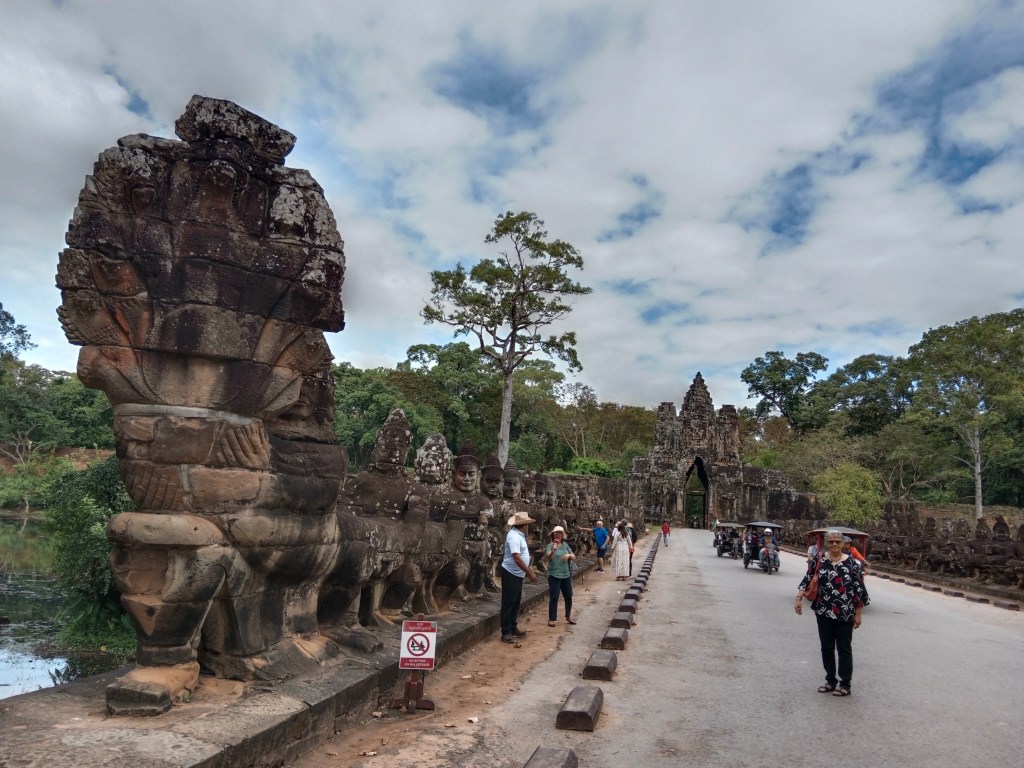
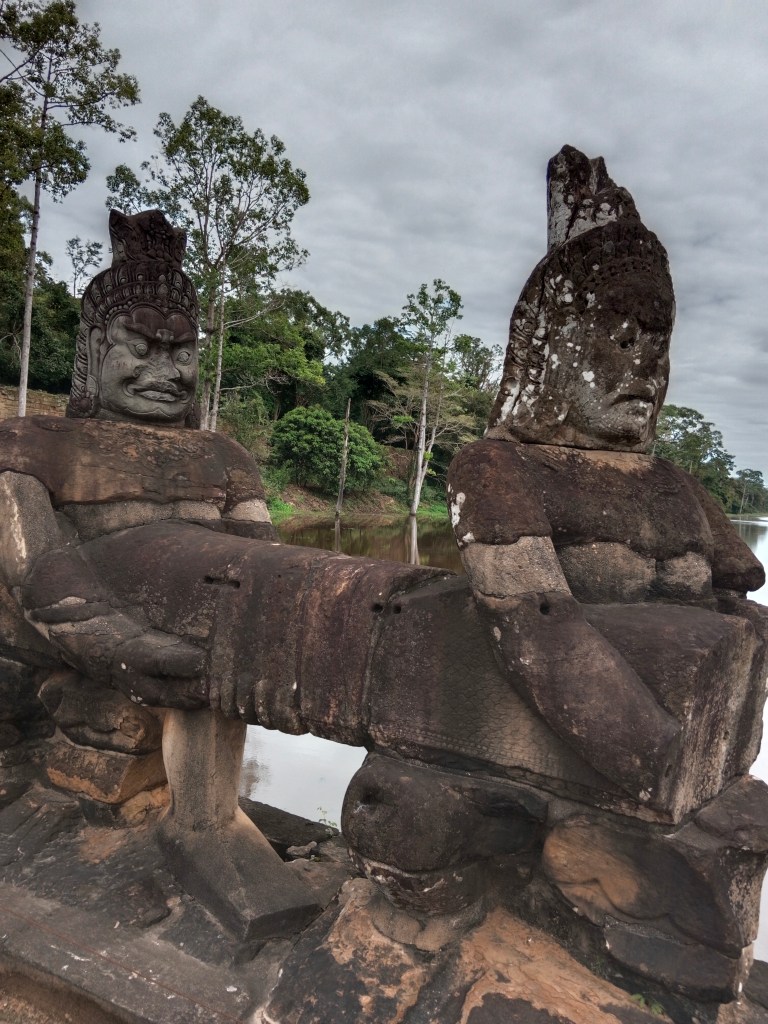
A causeway spans the moat in front of each tower. This causeway has a row of faces of Devas on the left and Asuras on the right holding a Naga. The gates were probably closed with wooden gates. The South gate is by far the most visited as it is now the main entrance to Angkor Thom.

The supporting wooden poles at the gate gives us the feeling that some major repair work is on. Yes, that is true; renovation and restoration of the temple is going on in full swing.

South gate of Angkor Thom , the road , moat, causeway, Naga and the Devas and Asuras.

The tower at the South gate with the face on the tower (note the supporting wooden poles for renovation)

The Deva statues on the left side of the causeway

The Asura statues on the right side of the causeway

The Bayon

This richly decorated temple at the centre of Angkor Thom was the state temple of King Jayavarman VII.

The original name of Bayon was Jaya Giri or Mountain of Brahma ( Jaya is another name of Brahma and Giri means mountain). The most distinctive feature of this temple is the smiling faces of Brahma on each of the four sides of the towers.

The Banyan tree is very sacred to the Buddhist ideology as Buddha got enlightenment under the banyan tree. This temple is called Bayon from the word Banyan.

As one reaches the temple, one is greeted by a flight of stairs with the guardian lions on either side. Climbing up the stairs, one reaches a platform from where one enters the main temple.

View of Bayon temple from the road.

The stairs with guardian lions on either side.

The main entrance.

As one enters the temple, one reaches a narrow corridor with pillars on either side. As one walks along the corridor, there are blocked doorways, stairs and small yards and the labyrinth of the temple becomes obvious.

The first enclosure opens up into two inner galleried enclosures. All these are crowded together and unlike Angkor Wat which gives one a feeling of space , Bayon gives the feeling of being cramped together.

The walls of the outer enclosure features bas reliefs depicting historical events and the daily life of the people. The outer enclosure encloses a courtyard with two libraries. Beyond this level, entry was restricted due to restoration work . But they are believed to contain bas reliefs of the Hindu Trinity of Brahma, Vishnu and Shiva and Ravana.

The Upper Terrace appears to a later addition to the plan as there is hardly any space between the inner gallery and the terrace. This level features the famous Face Towers of Bayon. There are 49 towers and more than 200 faces on these towers. In various stages of ruin, it is not possible to give the exact numbers of these.

There is some disagreement on the identity of the faces. The similarity of the faces led historians to believe that they represent King Jayavarman VII himself. Some scholars believe that the faces represent Bodhisattva of campassion called Avalokiteshvara. Locals still believe that the faces represent Brahma and not Buddha as they have three eyes and Buddha does not have three eyes. The predecessors of Jayavarman VII were Hindus but Jayavarman VII was a Buddhist.

The Face Towers of Bayon

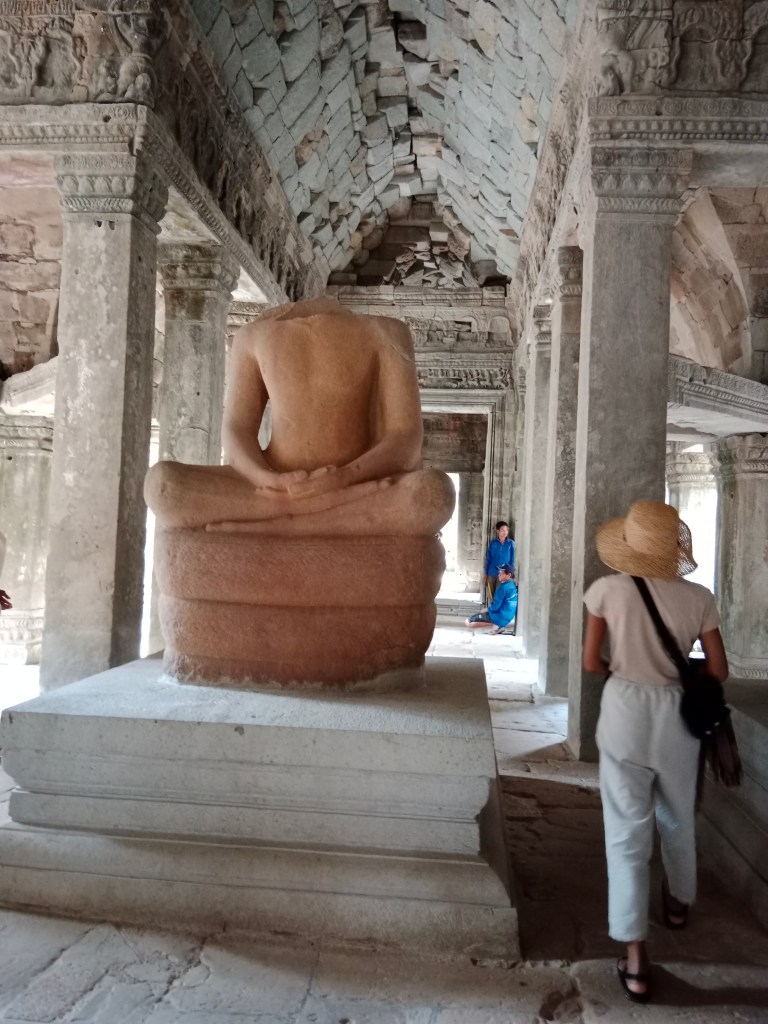
The central tower and sanctuary is believed to have contained a Buddha statue in a meditative pose shielded by a serpent hood. This was removed by the next King, Jayavarman VIII who followed Hinduism and was recovered in a damaged condition from a well.

A closeup showing the obvious reconstruction attempt

After the visit to Bayon temple, we started for another popular temple near Angkor Thom….The Ta Prohm.

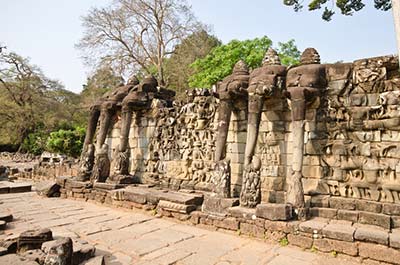
Enroute, Sarath pointed out the famous Elephant terrace to us.

Elephant Terrace

The terrace is named after the sculptures seen on it. Several elephant heads protrude out from the wall and their long trunks almost extending to the ground. It was used as an audience hall and for public ceremonies. The King often listened to the complaints of the people from here. Many parts of the terrace are in a state of collapse.

Elephant Terrace

Ta Prohm (Ancient Brahma)

Our next halt was at Ta Prohm, a unique temple in Angkor Thom which many of you would have seen in English movies. This temple is a very popular film shooting destination and one of the most popular movies shot here is Tomb Raider.

History of Ta Prohm

Built by Jayavarman VII between the 12th and 13th centuries, this temple was originally called “Rajavihara” meaning Royal monastery. He built this temple in honour of his family. The main image here was modelled on the King’s mother. The site was home to more than twelve thousand people including high priests and dancers. In addition, the surrounding villages has lot of inhabitants.

After the fall of the Khmer Empire in the 15th century, this temple was abandoned and neglected. Restoration and reconstruction work started here in the 21st century. But the location and the way the temple had merged with the jungle and the trees had grown all over the structures, it was decided to not alter the overall picture as it was unique in many ways.

Architecture

Ta Prohm is slightly different from Angkor Wat and Bayon in that it is built very flat and at one level. There are entrance gopuras at the four cardinal directions but many of them are in various stages of collapse. There are libraries , bas reliefs depicting Buddhist mythology and images of devatas. The temple was highly ornate and decorated in art styles of different periods in time.

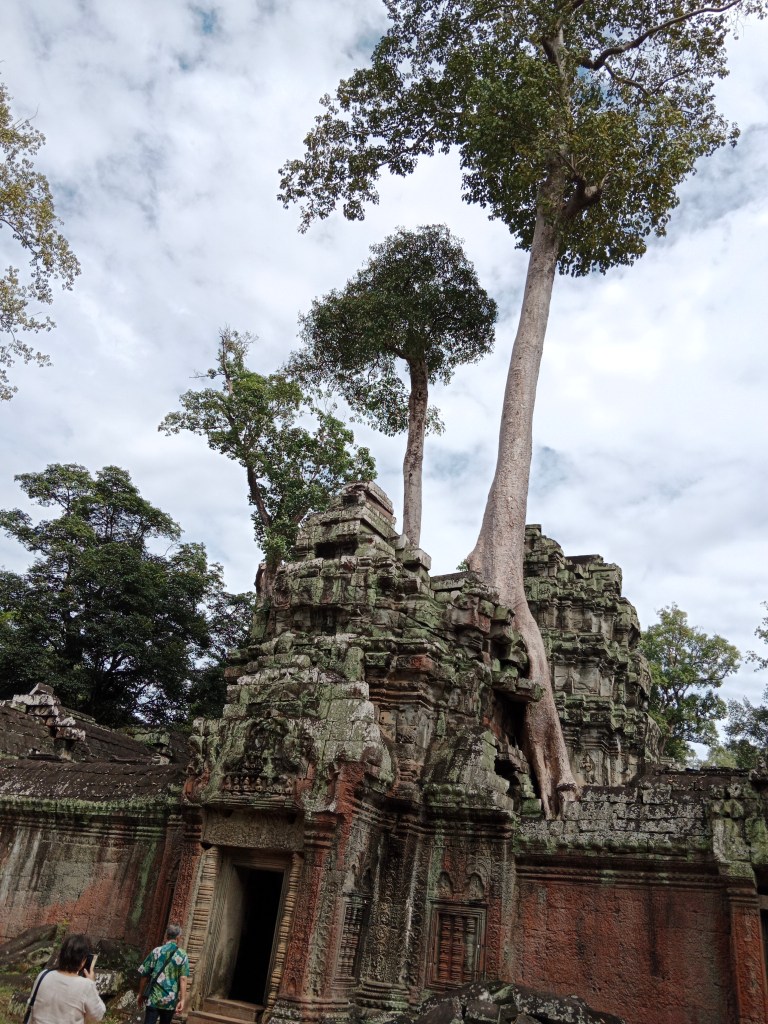
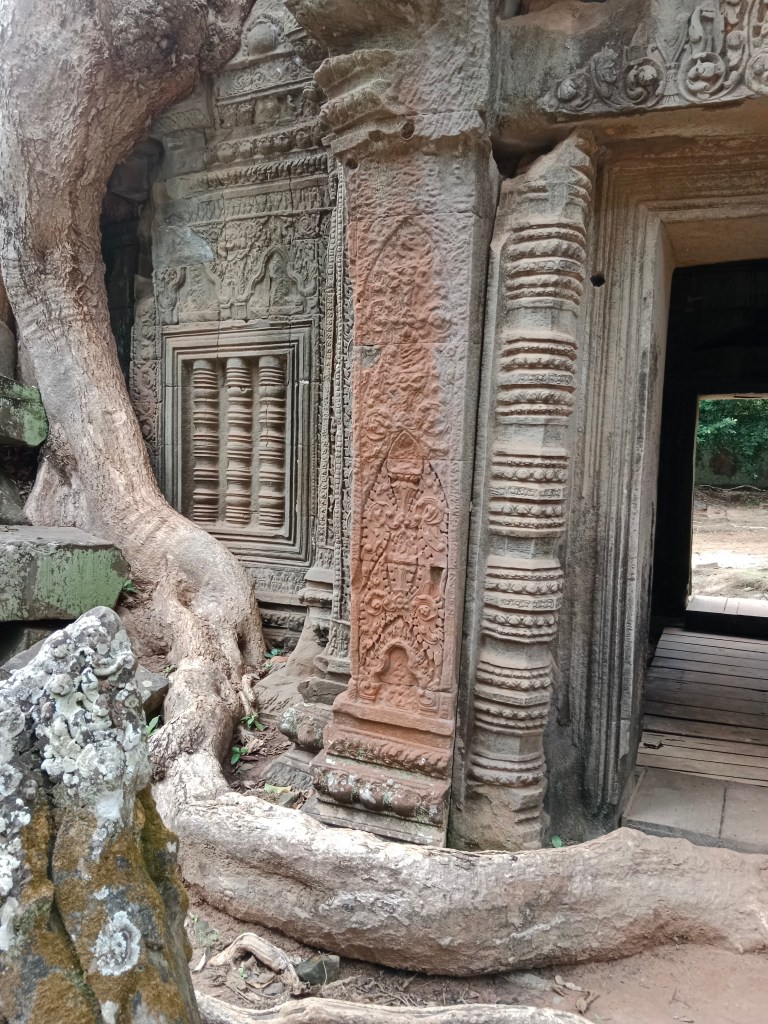
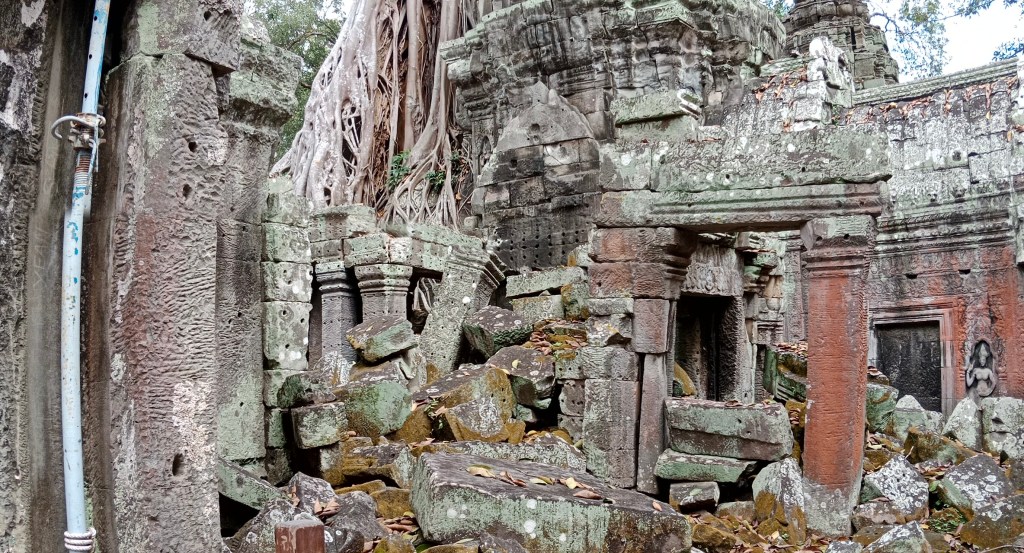
But the most captivating feature of this temple are the trees. The trees growing out of the ruins is a distinctive feature of this temple. The silk cotton tree and fig tree are the main species of trees growing out of the ruins. When one visits the temple, one forgets about the gopuras and sanctum sanctorum and gets spell bound by the tall trunks of the trees growing from in between the stones of the temple wall and ending in a green canopy against the sky on one end and the huge roots encircling the monument walls and spreading on to the ground. The trees have so encircled the complex that one looses orientation of the place as one manoeuvres in between the giant roots.

The main gate used as the entrance by visitors today is the western gate. Outside the gate were plenty of shops selling curios, souvenirs and other articles. Lot of vendors, particularly women tried to woo us with their wares. Needless to say, they were successful to some extent!!

The western gate has a gopura with the faces as seen at Bayon. The gate itself was supported by scaffolding poles probably as a support to prevent collapse. We also entered through the western gate.

At the west gate of Ta Prohm ( note the supporting metal poles as part of reinforcement and restoration)

Soon we were inside the complex. Surprisingly, we entered a vast expanse of farmland and jungle with a trail in the centre . This area was probably the place where the inhabitants in service of the temple lived in dwellings which no longer exist. A long walk of around two kms took us to the main sanctuary. There are signages all along but most people find their own way, some even exploring the jungle on either side.

Walking along the trail, I was attracted by some melodious music and I approached a small shelter where I found around six men playing different musical instruments in harmony. A closer look , and I noticed that many of them were handicapped and then I noticed a board saying these people were the unfortunate victims of landmine blasts during the various conflicts that the country had seen.

What wars and conflicts do to humanity!!!

Melody from pain….

A moat with a bridge, a few terraces and a couple of gopuras and we finally reached the location of the most iconic pictures of Ta Prohm.

No amount of description by me is going to give you a perspective of the trees and their massiveness. So, I leave you with these pictures which speak a thousand words. Take a look…

Note the huge trees at the back, they are actually growing on the back wall

This is perhaps the most iconic picture of Ta Prohm, the entrance with the roots encircling it!!
Sarath obliged us with this picture at this iconic location….once in a lifetime!

The sheer massiveness of the roots and branches require support from scaffoldings to prevent it from falling

From the pictures above, it must be obvious to you that what we see at Ta Prohm is perhaps an ongoing battle between the trees and monument. It seems like the trees have taken a vice like grip on the monument and the monument is struggling to free itself. At places, the trees seem to have not been able to undo the artistic monument but at places, they have won the battle with the monument in ruins!!

A spot which nature has still left for us to admire the artistic work (partly reconstructed)

A spot where the trees have won the battle !!!

It left all of us in complete awe and disbelief….

Restoration of Ta Prohm

India is very much involved in the restoration work at this temple that is a UNESCO World Heritage Site. The Archaeological Survey Of India has restored parts of the complex. Wooden walkways, platforms and roped railings have been put in place to protect the monument from further damage. The Hall of Dancers has been totally renovated.

A board at Ta Prohm that made us proud…

Leaving Ta Prohm with mixed feelings we headed back to the hotel for a relaxed evening after taking in a lot of history, architecture, art and nature.

Ta Prohm’s ruins left me with delight and awe at what one man did and despair and regret at what has befallen it over the years. The overpowering forces of nature are in full display here. NATURE HAS FULL CONTROL OVER ANYTHING MORTAL…..

Hope you enjoyed your visit to Bayon and Ta Prohm with me. Do give me your comments and feedback to keep me motivated!

See you next week at another destination in Siem Reap that speaks of the grandeur of the Kings…Phnom Kulen

Angkor Wat

How about a visit to the largest religious edifice in the world?

Well, the Angkor Wat temple complex in Siem Reap in Cambodia , is just that. A UNESCO World Heritage site; it is today a very popular tourist destination.

We have it all here, just sit back on your armchair and visit this architectural masterpiece .The Guinness Book of World records calls it the largest temple in the world and the largest structure ever built by man.

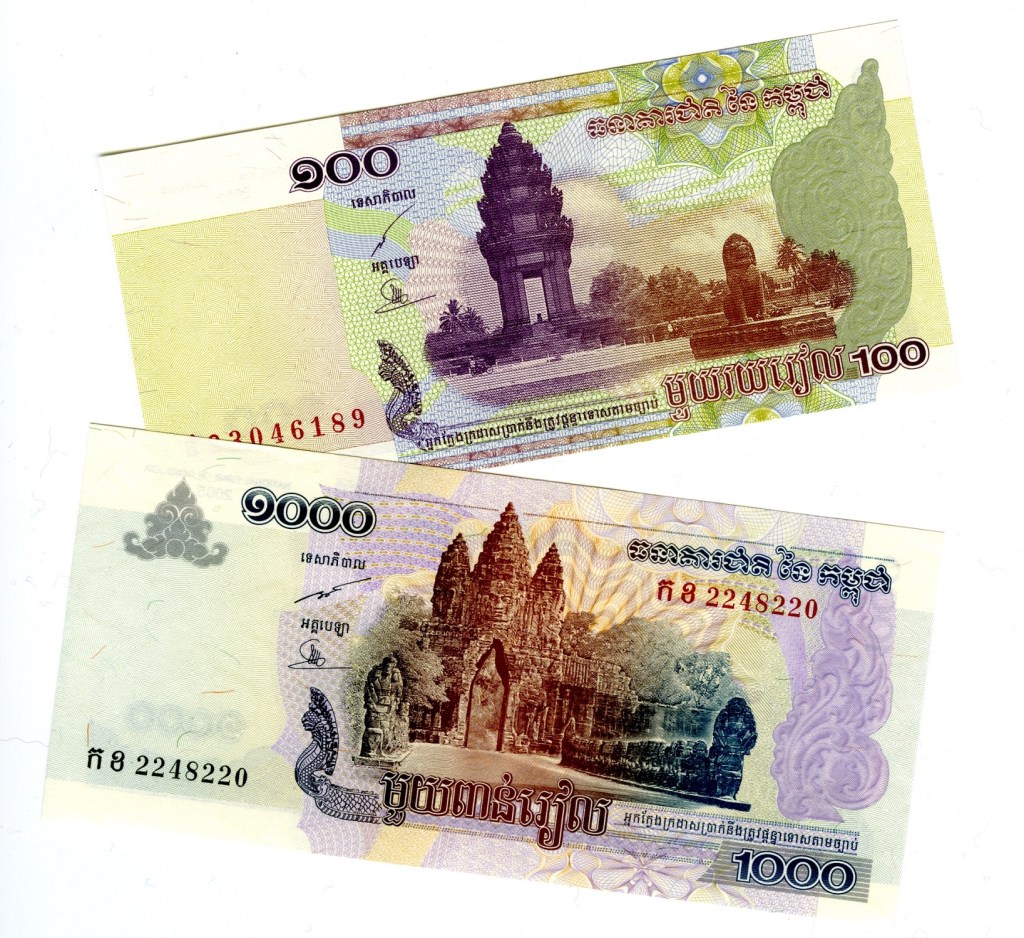
Angkor Wat literally means City of Temples in Khmer, the local language of Cambodia. Angkor is so much an inherent part of the Cambodian culture that the image of Angkor Wat has found itself on their national flag, their currency, the fuselage of their airline, and even on bottles of their best selling beer!!!!

Angkor Wat is an integral part of the Cambodian ethos!!

A peep into history

In order to understand the soul of this historic monument, we need to know a little about its history. Angkor Wat was built by King Suryavarman II in the first half of 12th century as a Hindu temple dedicated to Vishnu. The original name of Angkor Wat was Vrah Vishnuloka meaning the sacred abode of Vishnu.

Suryavarman II was regarded as a great ruler and built homes and workshops , markets and roads all around the temple complex. The temple was never fully completed as he died before that.

Gradually the followers of Hinduism grew but a large proportion of Khmer also practiced Buddhism. Its function as a Hindu temple fell out of use in the late 13th century and it was taken over by Buddhist monks.

In the 14th century Angkor Wat was rededicated as a Buddhist temple. They however respected the beliefs of the Hindus and all of the original statues were left behind but statues of Buddha and related structures were added. The name Angkor Wat became prevalent around this time.

After 1432 when the capital was moved to Phnom Penh, the importance of this temple reduced further and ultimately it was cared for by Theravada Buddhist monks.

By the 16th century the temple fell into disuse and decay. The presence of the moat protected the temple from being totally taken over by the jungle around but it still crept up the walls and cracks.

The first Westerner to visit the temple was the Portuguese monk Madalena who in 1586 made a note of its location. Subsequently, French archaeologist Mouhot took active interest in Angkor Wat and publicized it.

The paradoxes of Angkor Wat…

Historians and archaeologists are yet to arrive at what exactly was Angkor Wat built as. Was it built as a temple, a shrine, an observatory, a mausoleum, or a combination of one or more of them.? There are many paradoxes seen in the structure that has led to this uncertainty.

It looks like a temple but traditionally, Hindu temples have their main entrance facing East but at Angkor Wat, the main entrance faces West, the direction associated with death. This has led to the postulation of it being a funerary temple for King Suryavarman II . But no evidence to this has been found as yet.

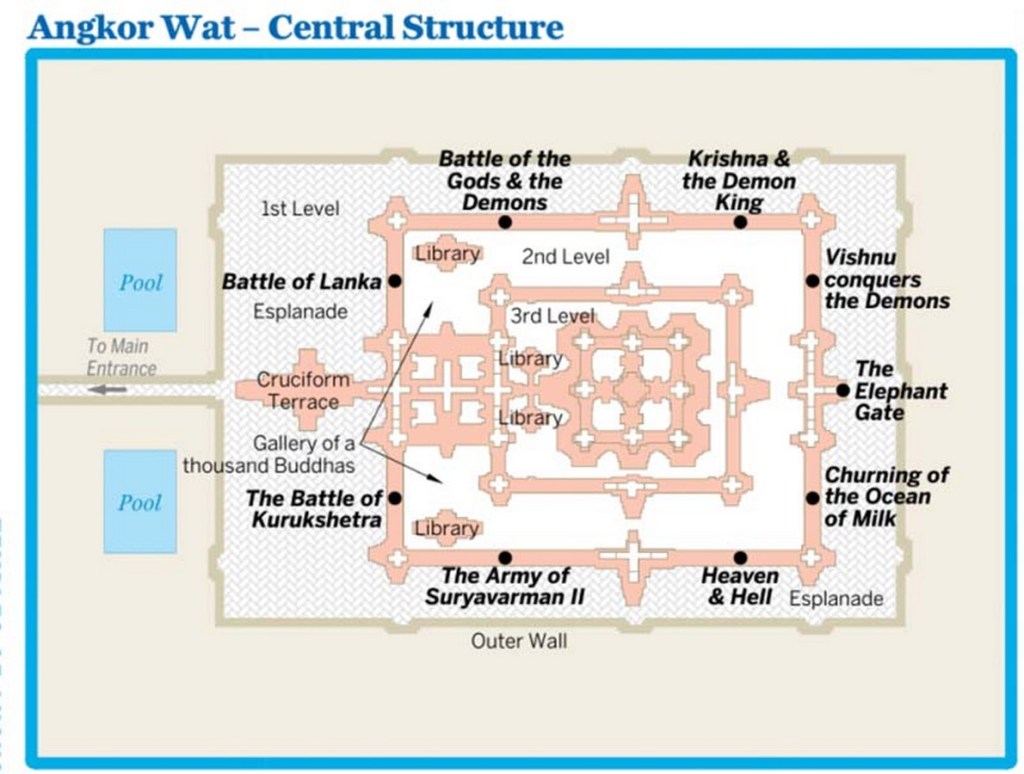
Architectural plan of Angkor Wat

The plan of Angkor Wat is difficult to understand when one is inside due to the sheer vastness of the structure.

At first glance it appears to be a colossal mass of stone but up close one sees that it has different levels, covered galleries, courtyards and chambers connected by staircases.

Basically a rectangular structure built at three levels with each higher level being progressively smaller and higher than the previous one. The temple covers a rectangular area of approximately 420 acres, defined by a laterite wall.

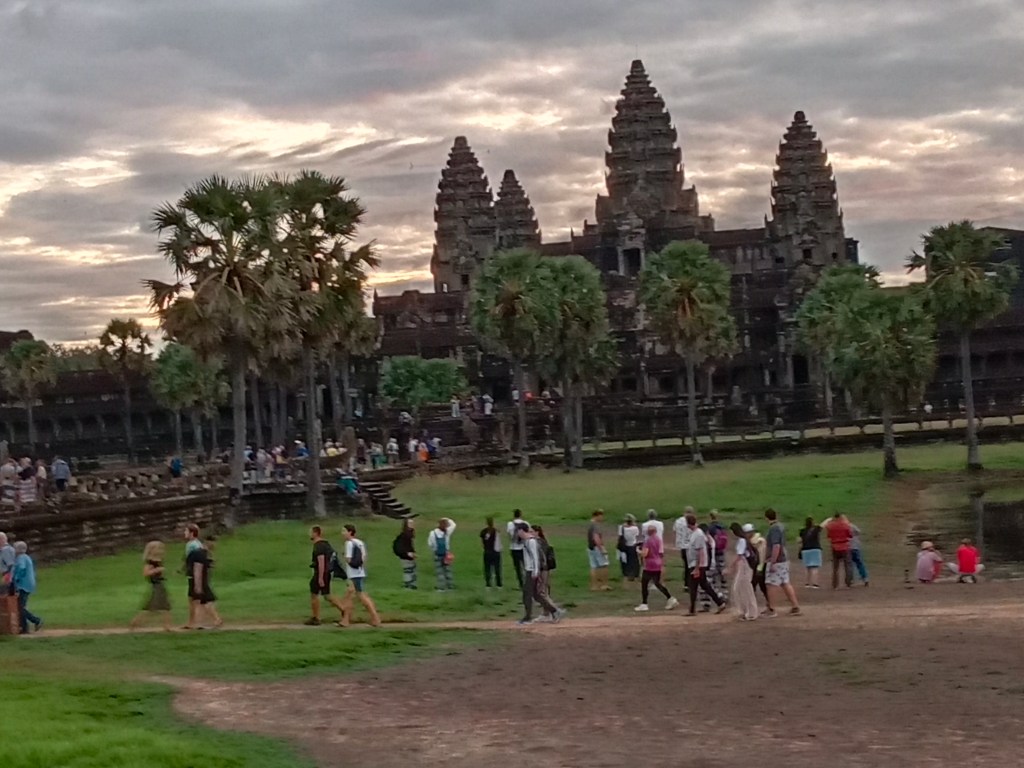
The most prominent part of the structure are the five towers at the third level The four corner towers are of equal height but the central tower is the tallest and is 213 feet high. These towers are shaped like lotus buds.

The unique design makes simultaneous viewing of all five towers possible only in certain positions.

The temple has a 650 feet wide moat surrounding it with a depth of 13 feet.

A diagrammatic representation of the temple and various levels.

All five towers are visible in this angle

The stone required for building this was brought from the Kulen mountains located about 22 kms away. Just consider all these statistics and put it in perspective that it was built at a time when no modern transportation or equipment was available. It is widely believed that the complex was built (1113-1150 CE)over 37 years, a remarkable feat considering the period in history when it happened.

Symbolism

Most scholars believe that the temple is a miniature replica of the universe in stone . The central tower represents the mythical mountain Meru of Hindu Cosmology situated at the centre of the universe and the other towers representing the peaks of Meru .The outer wall represents the mountains on the edge of the universe and the moat representing the oceans.

My Visit

I visited Angkor Wat in December 2022 along with a group of friends. Accompanied by Sharath , our guide at Siem Reap, we set out before dawn to watch the sun rise over this wonder of the world.

We groped in the dark following Sharath’s torch light and soon found ourselves walking on a very foamy ,wobbling surface. That was the floating bridge across the moat. After that we climbed a few stairs and almost trampled a little baby snake and reached one of the vantage points to view the sunrise as per Sharath’s advice. Later I learnt that this place was one of the libraries in the courtyard. Waiting patiently in anticipation, we slowly started seeing the first rays of the Sun and a pinkish hue in the sky and could see Angkor Wat against this. As the day dawned, the sheer vastness of the monument dawned on us. We had all heard about the temple and read about it but nothing had prepared us enough for what we saw…

A feeling of awe and amazement engulfed us as we stood admiring this creation.

Talking about sunrise at Angkor Wat, the temple is so designed that on one particular day ; the spring solstice, the sun rises just behind the main tower every year. Such is the precise astronomy that these ancient kings practiced.

Angkor Wat at dawn

The light increased and so did the crowds!

Now that the initial sunrise part is over, let me start from the time we entered the complex.

We initially encountered the moat on which is the floating bridge about which I had talked earlier on.

The moat and floating bridge

Once we crossed the moat, we walked along a stone causeway at the beginning of which was a guardian Naga.

The guardian Naga with the reflective pond on one side

On either side of the causeway are reflective ponds. The north pond is where visitors throng at dawn to get the reflected image on the water.

I did manage to get a picture of the reflection but the wind played spoilsport and created some ripples…

Angkor Wat and the elusive reflection!!

Two buildings called libraries stood in the courtyard on either side of the causeway. It was on the stairs of one of these libraries that we had perched in the dark to view the sunrise over Angkor Wat!

Our group on the stairs of one of the libraries

At the end of the causeway are a flight of stairs that lead to a terrace .Lions stand guard on either side of the staircase .

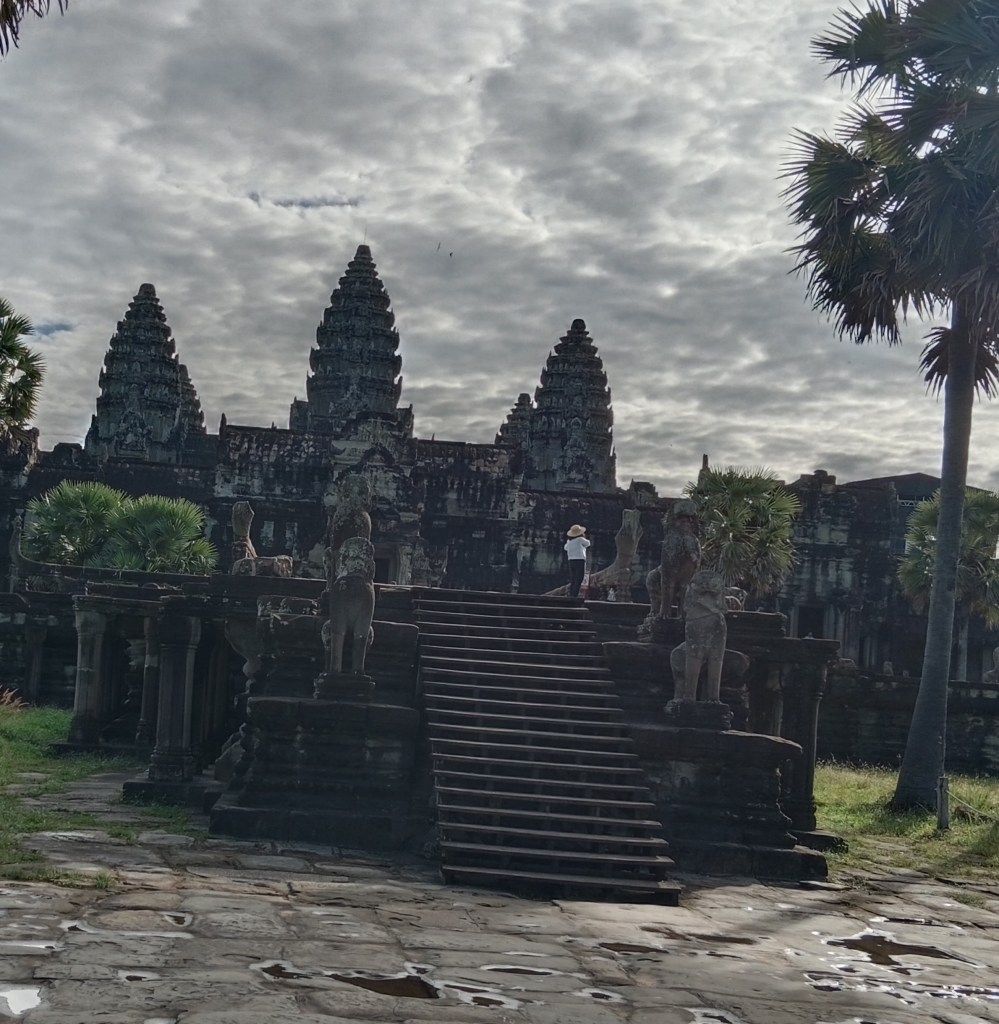
The staircase and the guarding lions

From the terrace, in front of the main entrance, we saw the three towers of varying heights. In this position, the other two towers are not visualised. A long covered corridor with columns and a curved roof extended on both sides of the central tower. This is the majestic appearance of Angkor Wat and a tribute to Khmer architecture.

On the terrace leading to the main entrance with three towers and covered corridor on either side

The overall layout of Angkor Wat :

There are three levels to the temple.

First level: The rectangular gallery with bas reliefs, north and south libraries and four basins

Second level : Terrace

Third level :The four corner towers with a central tower.

We explored the temple with our guide explaining the nuances

First level

Stories in stone

The Temple complex is literally like a mythological book with important religious and cultural tales etched out in stone.

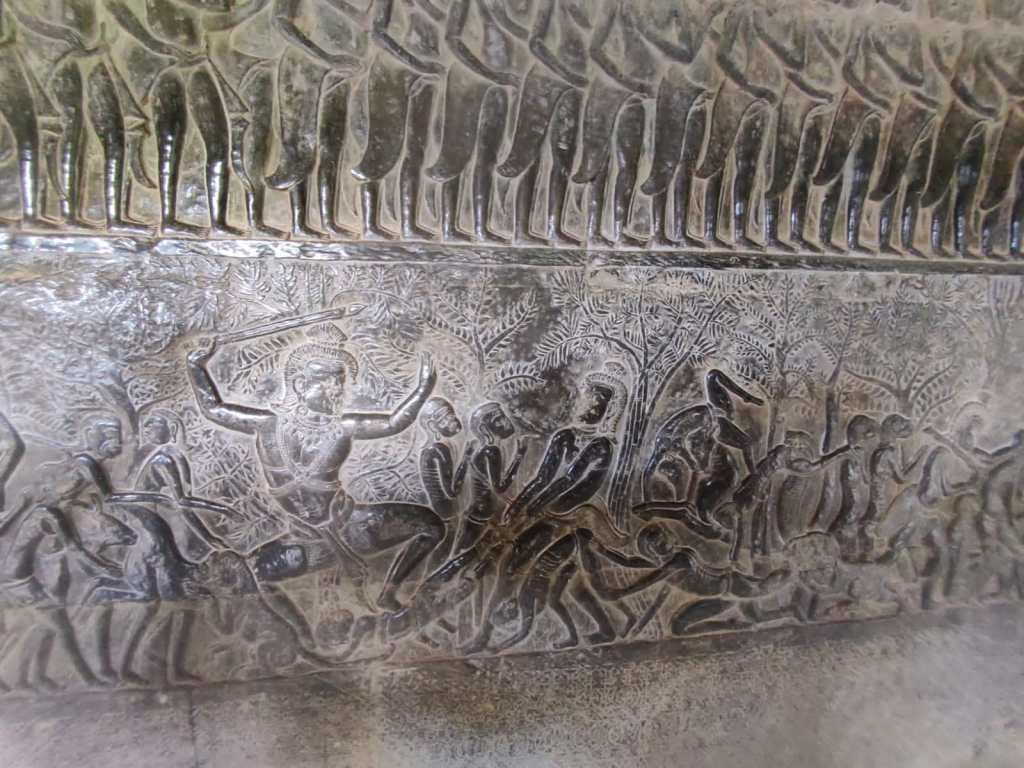
After one enters the temple through the central entrance which is the Western entrance, one can see long corridors on either side. These corridors have square pillars with intricate carvings towards the outside but the walls of the corridor has multiple bas reliefs. These bas reliefs are mainly related to Hindu mythology .Stories from the Ramayana and Mahabharata form a big part of the bas reliefs seen here. These bas reliefs are neatly divided into sections with each epic being depicted along one wall.

The corridors with square pillars on the outer side and the walls with bas reliefs

Many of the Bas reliefs have undergone varying levels of damage due to natural causes and the pictures may not be very clear due to this. Here are some pictures of the bas reliefs we saw . Take a look…

Bas relief of the battle of Kurukshetra

Krishna counselling Arjuna during the battle of Kurukshetra

Bas relief depicting heaven and hell

Bas relief of Ravana shaking Kailasa and Shiva sitting in penance

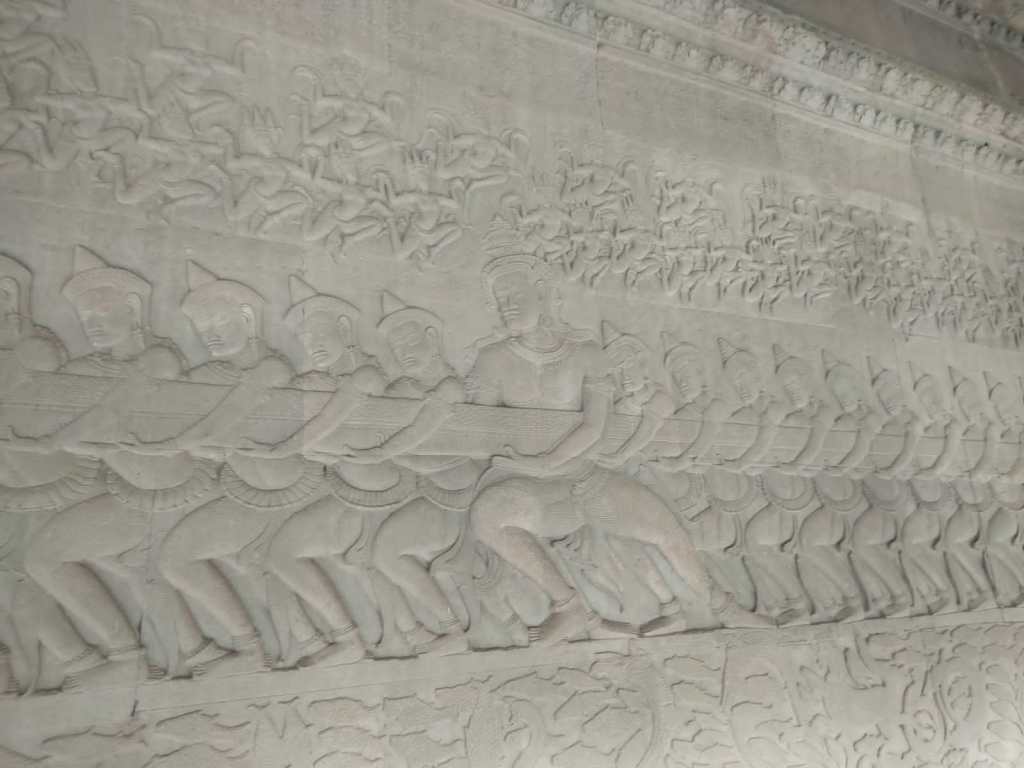
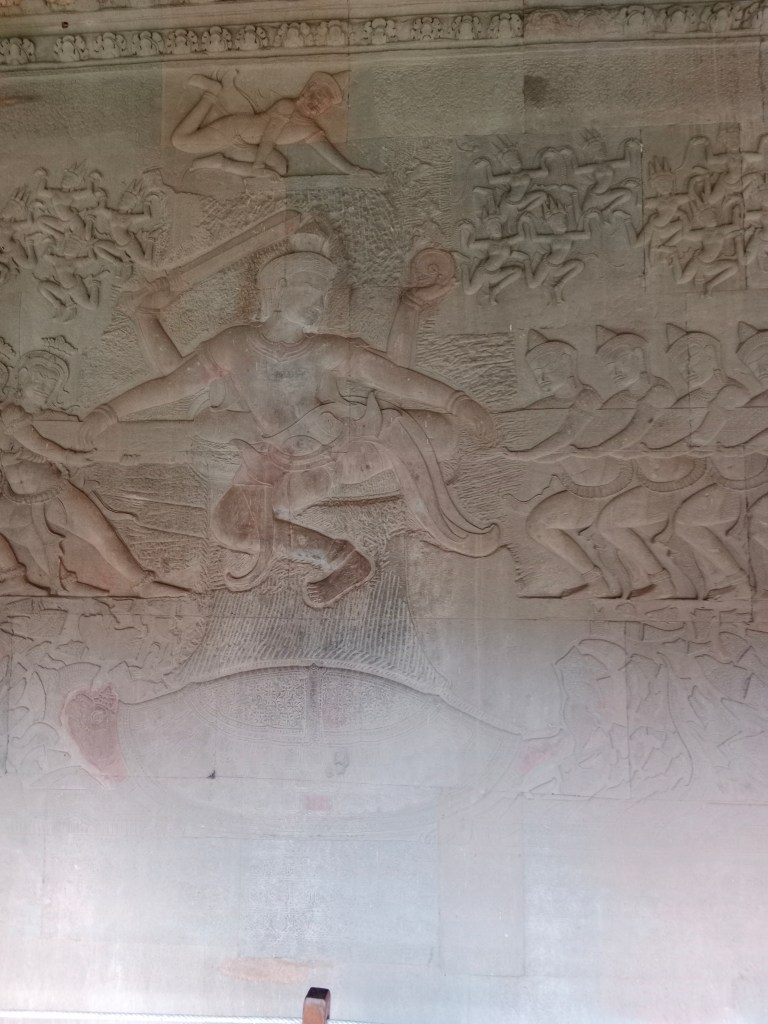
Bas relief of the Churning of the Ocean of milk

Bas relief of Avatars of Vishnu with Kurmavtar (tortoise) at bottom and Krishna on top.

And finally one of the king himself…

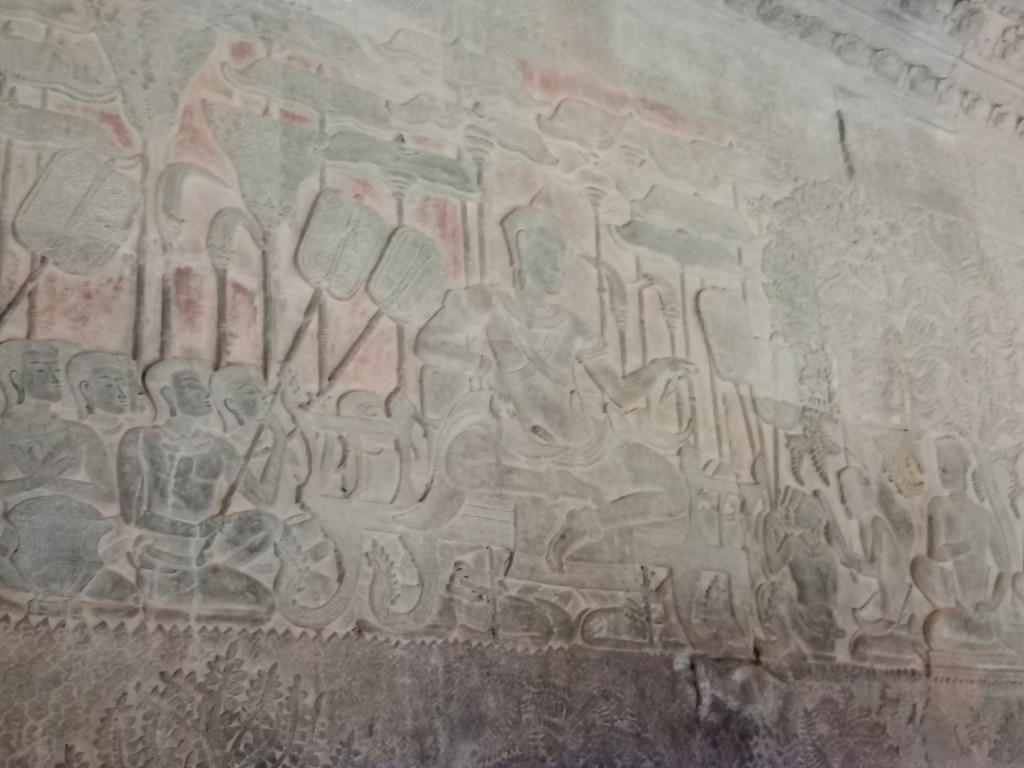
Bas relief of King Suryavarman II

As we walked around the complex, we got a side view of the galleries.

The side view of the galleries

The Middle Level Terrace

The middle level is less ornate than the lower level. Though there are bas reliefs from various epics here too, the images of Apsaras and devatas is the striking feature here. Apsaras are heavenly beauties of Hindu mythology who used to entertain the Gods with their dances.

The Apsaras:

Standing in graceful postures with intricately carved crowns, and ornaments adorning them, these Apsaras reflect the richness of the Khmer culture and how people lived in that period.

The Apsaras… notice the head gear and ornaments

Inspired by the beauty and elegance of these images, Apsaras make up a significant part of the cultural dances of Cambodia. The dress and ornaments of the dancers are similar to the images here and the movements are also very slow and graceful. We visited one such event and the performance was featured in the previous episode.

In addition to the apsara carvings on the wall, there were several Buddha statues at this level. Most of the statues are beheaded . In fact it is believed that there were many Buddha statues here and many were destroyed by the conquerors and also as part of the civil war. At least some of these statues were discovered during excavations and have been reinstated.

The disfigured Buddhas

One can look out of the galleries at this level to get an overview of the temple complex.

View from the second level

The Third Level or Bakan :

The ascent to the third level is via a steep stairway . Since the principal sanctuary of the temple was at the third level, the ascent along these stairs to reach God was symbolic of separating oneself from this world.

The steep stairway leading to the third level

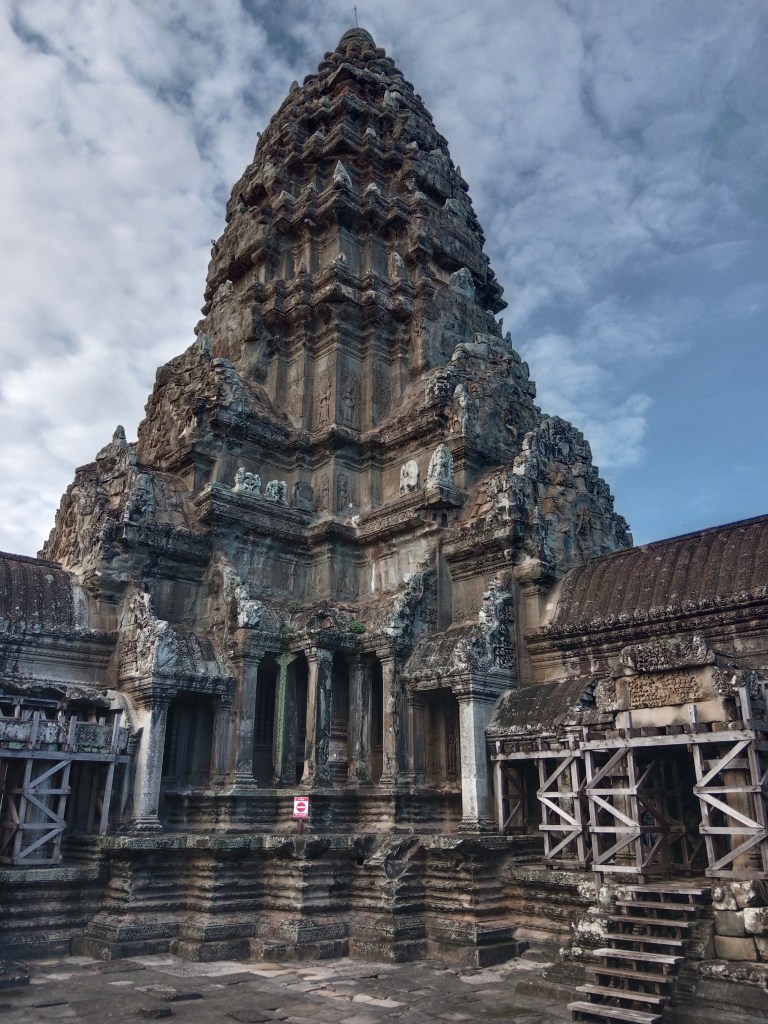
This principal sanctuary of the temple at the third level had access restricted to the king and high priests. There are four equal sized towers at the four corners with a larger tower in the centre. This arrangement is called quincunx, The upper portions of some of these towers have collapsed and are in various stages of restoration.

All towers are shaped like the lotus bud which is very sacred in Southeast Asia.

Details of one of the lotus bud shaped towers (note restoration work in progress)

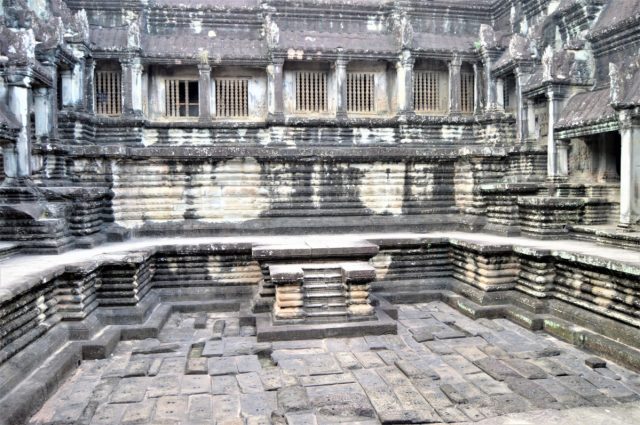
The corner towers are connected by galleries . Each of these towers are connected by axial galleries to the central tower .This arrangement is called a cruciform cloister. The cruciform cloister has chambers that look like tanks and it is believed that at one point in time, these tanks had water in them.

A cruciform cloister

Looking out from the galleries of this level, one can really see the vastness of this complex and get an overview of its plan.

An over view of the complex from the third level

The upper level , especially the towers are also believed to have had lot of wealth , gems, jewellery and other valuables stored by the King. They have all been systematically stolen by conquerors, during the civil wars and even by local vandals.

After a tour of the different levels of the temple we descended down to the first level.

Ashtabuja Vishnu ( 8 handed Vishnu)

A huge Vishnu statue with 8 arms is still being worshipped here. This is now in the south gopura of the outer gallery at the western entrance. It is believed that this was the deity in the central tower at the principal sanctuary of the temple.

It is also believed that the corner towers had statues of Shiva and his consort and other Hindu Gods. These are all now missing.

The Ashtabhuja Vishnu

We also find Buddha statues draped in yellow here. It is believed that many of these were Vishnu statues which were converted to Buddha statues at different periods in history.

The Buddha draped in yellow

Restoration

You must have noticed in my pictures that many parts of this monument are in need of restoration. This is also happening here and many areas are being redone. The French have done lot of restoration work. India has also taken up lot of restoration work here and we can see many galleries where the damaged images and carvings have been restored.

One such example is an ornate ceiling which was originally made of wood and now redone.

The restored ornate ceiling

With continuous work towards this ; hopefully , the magnificence of this monument will be restored to a great level if not to its original glory.

We continued our visits to other parts of the Angkor Complex , which will be featured in forthcoming episodes.

It has been my endeavour to put the maximum information across to you with minimum overload. Hope you all enjoyed it. However much one describes this monument, it will never match the glory of a personal visit.

So do add it to your wish list. Till then, do give me your feedback and comments.

Siem Reap

I had the opportunity to visit Siem Reap in Cambodia as part of a group tour where we covered Vietnam and Cambodia. We did Vietnam first and then moved to Cambodia. The forthcoming blogs are part of this group tour that I undertook in late 2022.

Let me first introduce you to the wonderful group of people with whom I did this amazing trip. We were a group of fun loving seniors, some of them my medical college classmates. The others in the group were also very warm and friendly and you will get to see glimpses of all the fun we had as I take you along. My travel buddy was Dr Margaret, my classmate whom we all fondly call Maggie. Since the word Maggie is associated with a brand of noodles and we were buddies, I got the nickname Pasta. From this itself you will get an idea of the camaraderie in the group. This warmth and friendliness went a long way in making the tour more enjoyable!! Many of them had carried loads of snacks and other items which we all thoroughly enjoyed especially during our long bus rides.

Our Viet Cam tour group.

We arrived Siem Reap from Ho Chi Minh City Vietnam, one beautiful day in December 2022. This was my first visit to Cambodia.

Siem Reap is a resort town in North western Cambodia best known for the Angkor ruins. It is home to the World famous Angkor Wat temple, and various other temples at Angkor Thom. It served as the seat of the Khmer kingdom between the 9th and 15th centuries. Today, it is the capital of Siem Reap province and the second largest city in Cambodia.

Siem Reap literally means Siam (Thailand) defeated. French colonial architecture still dominates the streets . It was a quaint village once upon a time. With the Angkor Wat and other temples gaining popularity as a tourist destination, Siem Reap today sees lot of construction and modern amenities to suit the requirements of the tourists.

As we landed at Siem Reap I could see large waterbodies and probably swamps. More on this in my future episodes. For now, let us look around Siem Reap city.

The airport itself is built in traditional design and looks quite different from any regular airport. It is located 7 kms away from the town centre.

Aesthetically designed Siem Reap airport ( in contrast to most airport buildings)

Our Guide was Sarath and he received us at the airport and escorted us to our Hotel.

Our Guide in Cambodia Sarath

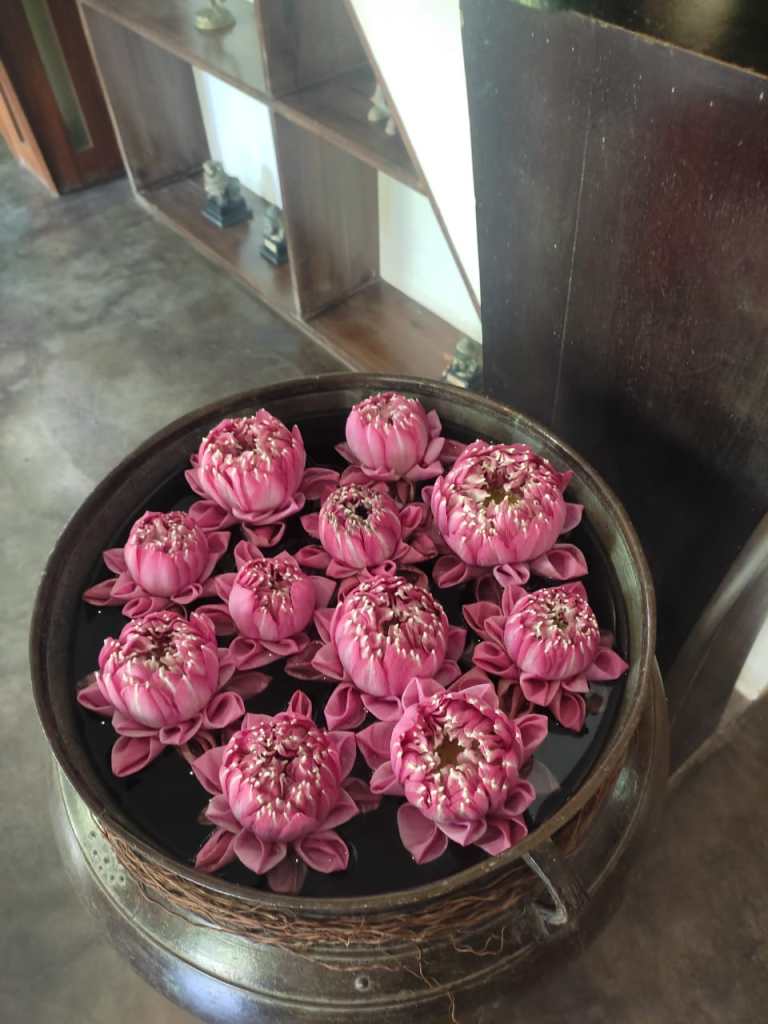
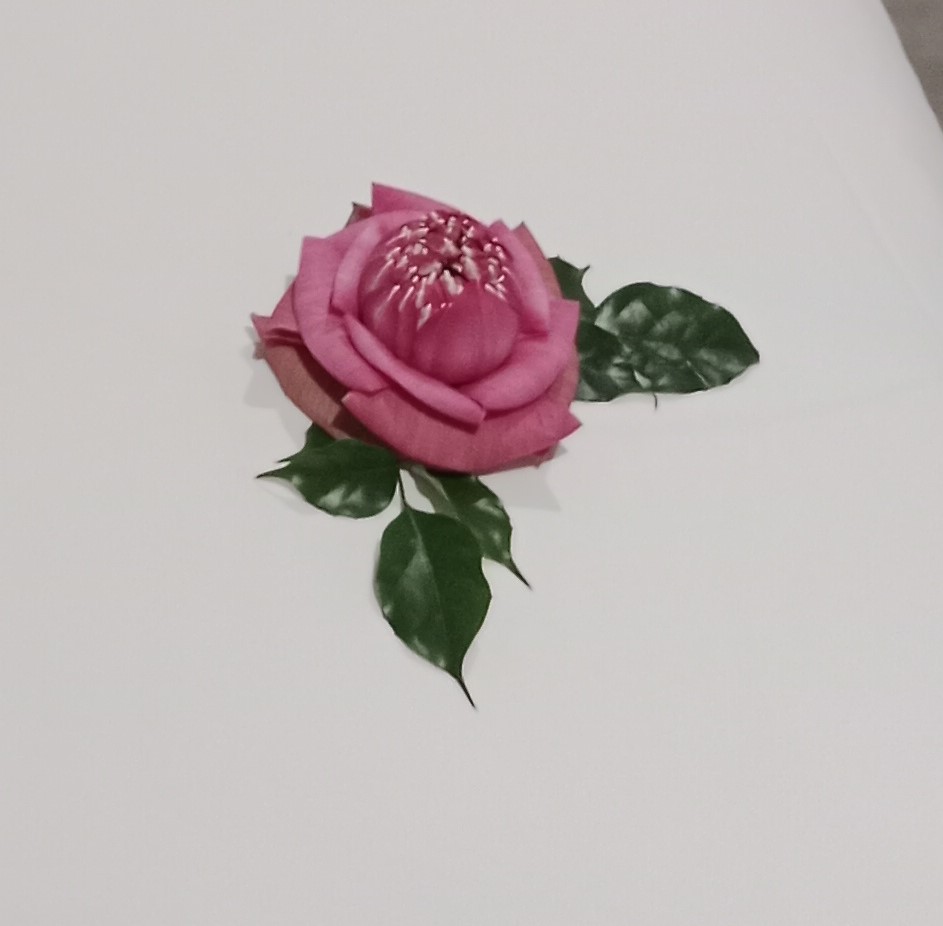
The hotel room at the Lynnaya Resort was done up in typical Cambodian style with lotus flowers taking the centre stage of the decor. The lotus is omnipresent in Cambodia and is used extensively for various purposes. This is typical of Cambodia and even the towers of Angkor Wat temple are shaped like lotus buds!!

Various artistic expressions using a lotus….

Glimpses of Siem Reap….

Angkor Enterprises office

In preparation for our Angkor Wat tour, our guide took us to the Angkor ticket office and purchased our entry tickets which had to have our photos and so we all completed that formality and were given the tickets for our visit. This ticket is very essential to enter any of the temples here. The ticket was checked at multiple entry points.

The Angkor Enterprise office

Angkor Museum

Siem Reap also has an Angkor Museum.

This museum has exhibits covering the history, art, architecture and culture of the Khmer Empire.

The Angkor Museum

Pub Street

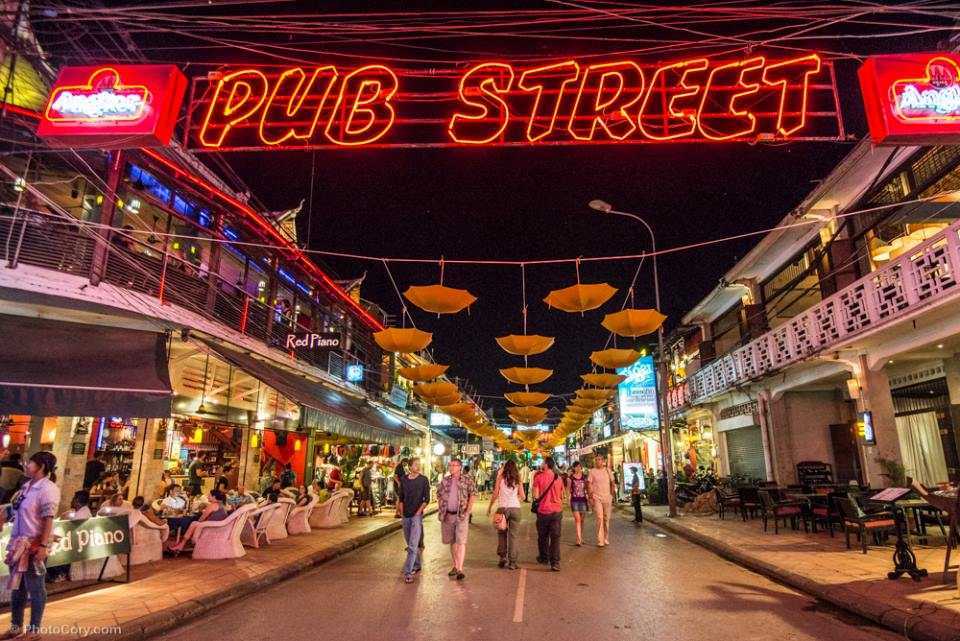
Pub Street ; traditionally known for its bars, is at the heart of tourist activity in Siem Reap. It has a wide selection of restaurants , bars, nightclubs, street food, shops, stalls and just about everything. Initially this area was primarily residential. Walking around Pub street and soaking in the ambience is in itself an experience. Traditional Cambodian street food stalls attract lot of tourists.

Many places here function round the clock but comes alive after 7 pm .As the evening gives way to night, the streets become active with loud music, and the party spills on to the streets.

Pub Street

A Tuk Tuk is the local equivalent of an autorickshaw and is seen everywhere on the streets of Siem Reap.

Tuk Tuk

Local Food

Cambodian street food or local food is similar to that in most South East Asian countries. Predominantly non vegetarian with frogs, insects, snakes and other reptiles forming a part of the menu. Rice of course; sticky rice as they call it, is the staple food. Apart from that, lot of coconut and coconut milk preparations are seen particularly as desserts.

Roast Frogs, fish and beef in that order

A sweet made of rice and bananas, rice dumplings and roast bananas in that order

Cambodian Rice

Cambodians eat rice at every meal. No surprise then, that they grow some of the finest rice varieties in the world. Just out of the city, and you can see plenty of rice fields. The heavy monsoons, the Mekong river and the Tonle Sap lake ensure that the crop gets its share of water.

They grow both fragrant rice and white rice. Jasmine Rice from Cambodia is considered the best quality rice in the world.

A rice field

Exotic Fruits Of Cambodia

I love fruits and this was something I really enjoyed here. Cambodia had a real good variety of exotic fruits.

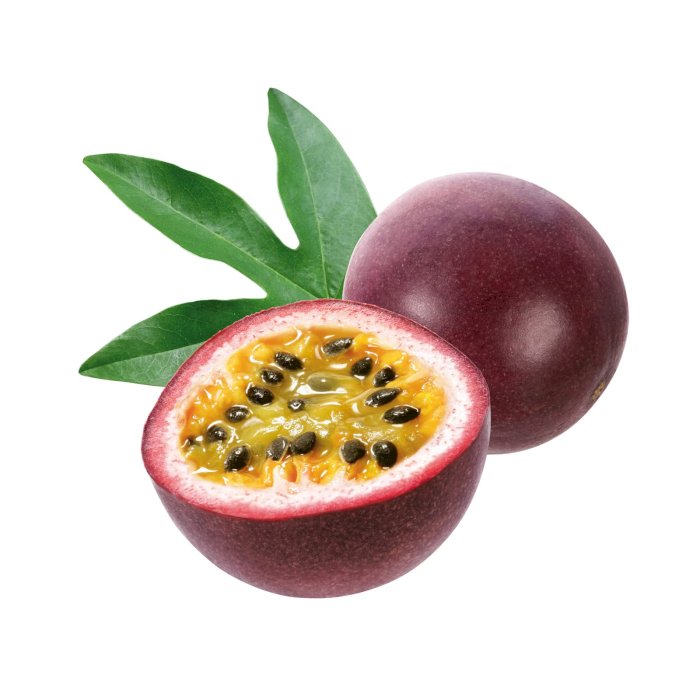
The Durian (similar to jackfruit), passion fruit and the extra large tender coconut

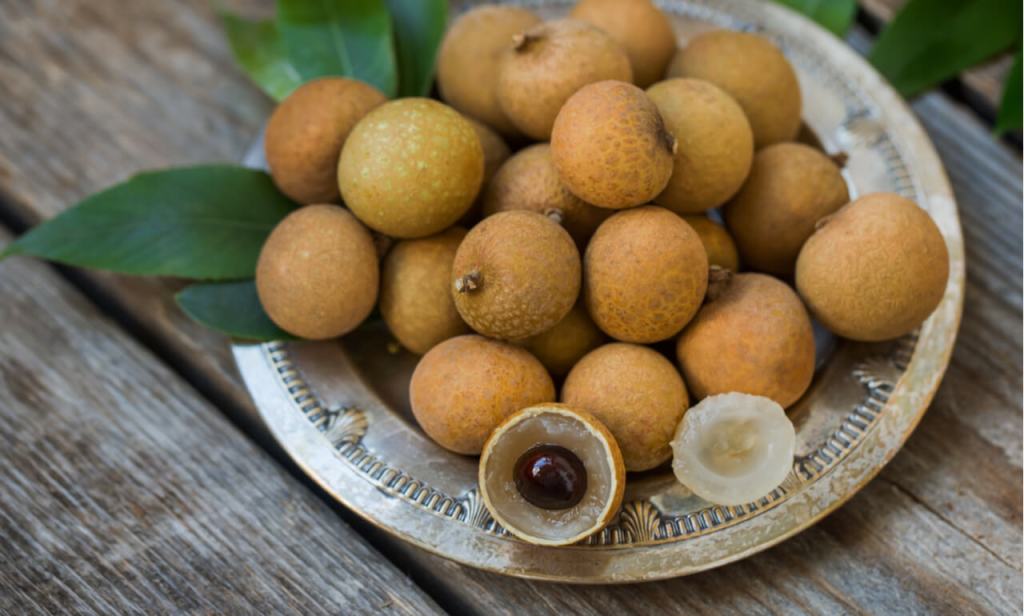
The Longan ( similar to lychi ) and the pink coloured dragon fruit

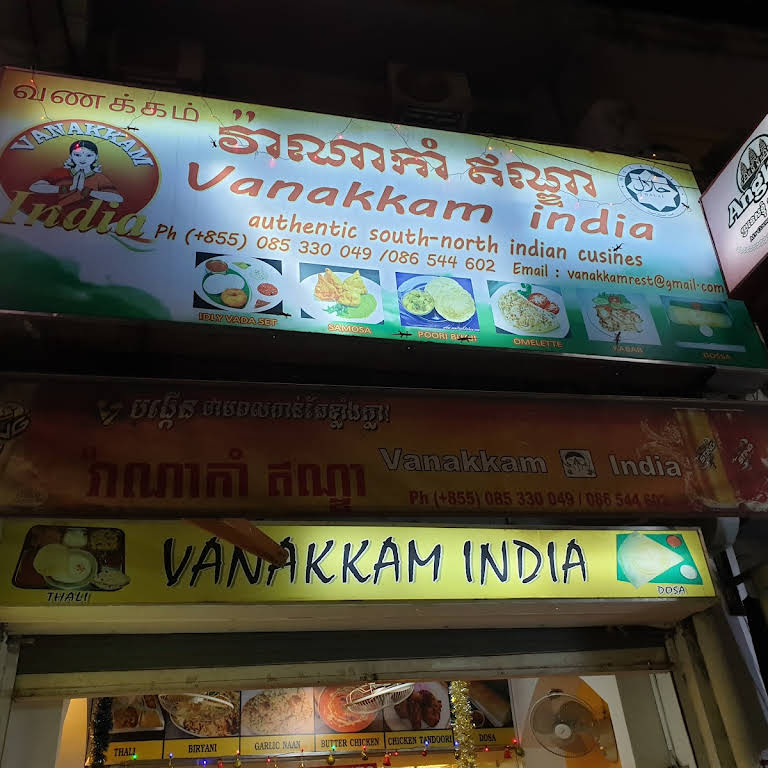
Being a vegetarian, these fruits formed a large part of my daily breakfast in Cambodia. Ours was a vegetarian group and as such we visited a couple of vegetarian Indian restaurants during this tour for lunch and dinner. There are good vegetarian restaurants and Indian restaurants in Cambodia about which I shall mention as I go along.

An authentic Indian Restaurant in Siem Reap which we visited.

The Spirit houses

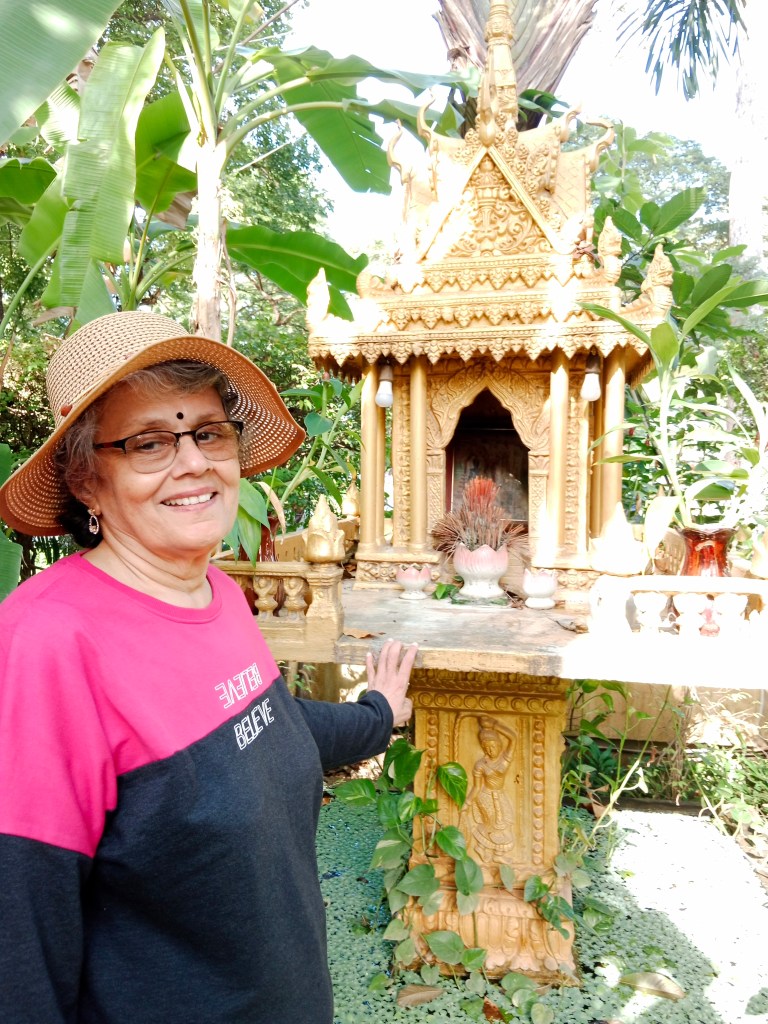
Have you seen a structure like the one in the picture below and wondered what it is?

The Spirit House outside our hotel

They are the spirit houses seen in front of most houses in many South East Asian countries. Cambodia is no exception and you find them all over. Some are very well maintained like the one in front of our hotel . Others are less ornate. It is a shrine dedicated to the protective spirit of a place. The belief is that the spirits have to be appeased to ward off evil and bring good luck. Bunches of burnt incense sticks can be seen in front of these spirit houses.

Apsara Dance show

We had the opportunity to see the Apsara Dance show which is a traditional Cambodian dance performance. The singers , instrumentalists and dancers together put up a wonderful show of traditional Khmer culture as we enjoyed dinner at the theatre.

A traditional Cambodian orchestra with as many as twenty musicians with strong emphasis on percussion instruments is called “Pinpeat”. The dance performance was accompanied by a traditional orchestra too.

Apsara dancers displayed remarkable poise , agility and grace with slow and rhythmic movements of the body and the limbs synchronous with the music. The dancers were extremely slim and petite and wore headgear and ornaments similar to those seen on the Apsara statues seen in the Angkor Wat temple walls. These dancers practice for years to stretch and flex their bodies as required in this dance form. These dances are inspired by the traditional apsara dancers who entertained the Gods as per the epics.

The Cambodian version of Ramayana is called Reamker and features in many of the traditional dances of Cambodia. In addition to the Apsara dances, other traditional Cambodian dances were also enacted.

Here are some pictures and videos from the show. Take a look…

A statue of King Suryavarman II at the entrance to the theatre.

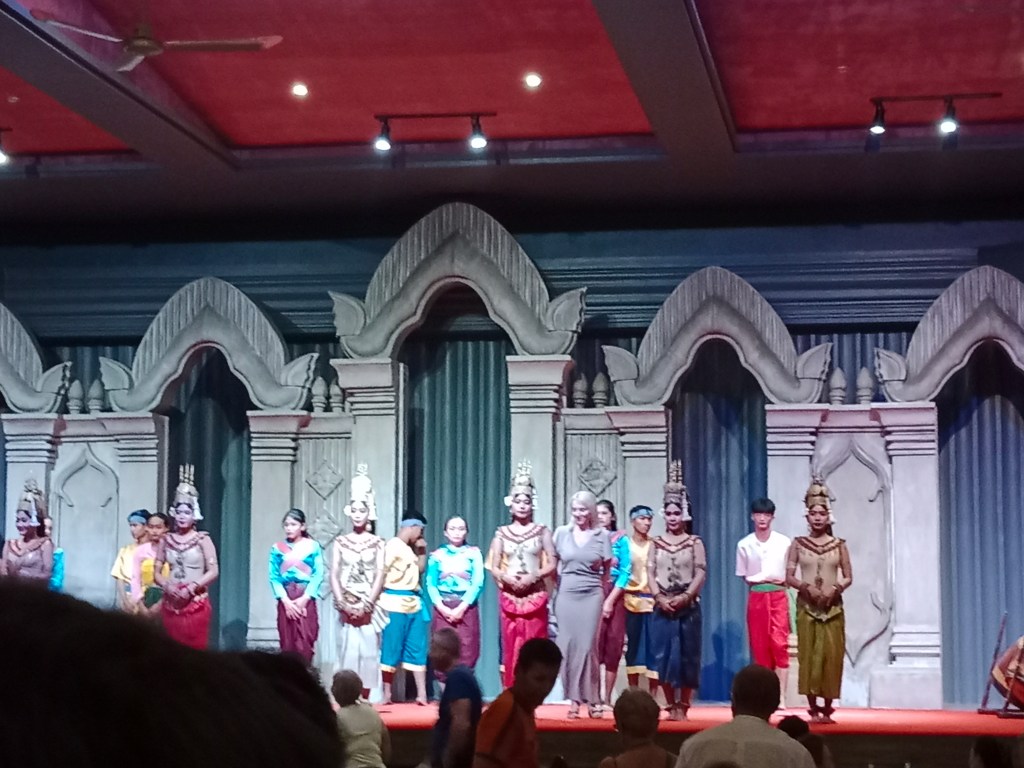
The Apsaras…note the headgear and ornaments.

A visual demonstration of an epic with the audience in the foreground

The dancers pose with a member of the audience

A traditional Khmer Dance

A video of the Apsara dance with traditional music

A video of a traditional Khmer dance . Note the beat of the music.

These were just glimpses of our stay at Siem Reap. The main purpose of visiting Siem Reap was to visit the Angkor Archaeological Complex. We visited that and also some other archaeological places of interest like Mahendraparvata, the Thousand Shiva Lingas, Phnom Kulen etc. In addition we also visited Tonle Sap, the largest freshwater lake in S E Asia and a remarkable floating village on its banks.

So you can look forward to some remarkable destinations in the forthcoming episodes starting with the main attraction; Angkor Wat which features in my next episode.

Meanwhile do continue your support with feedback and comments .