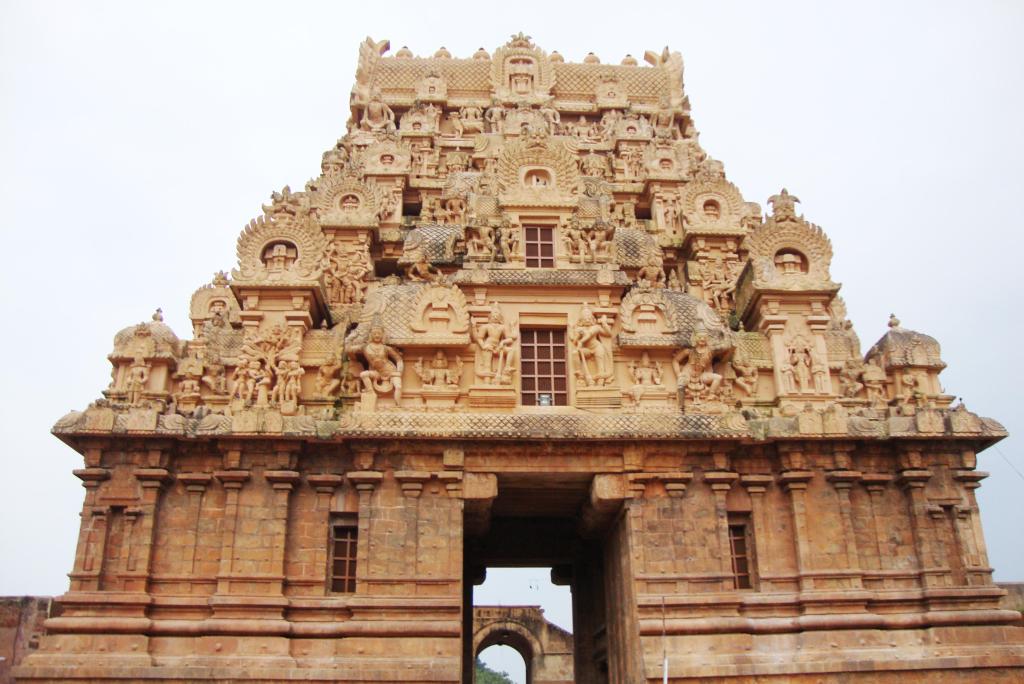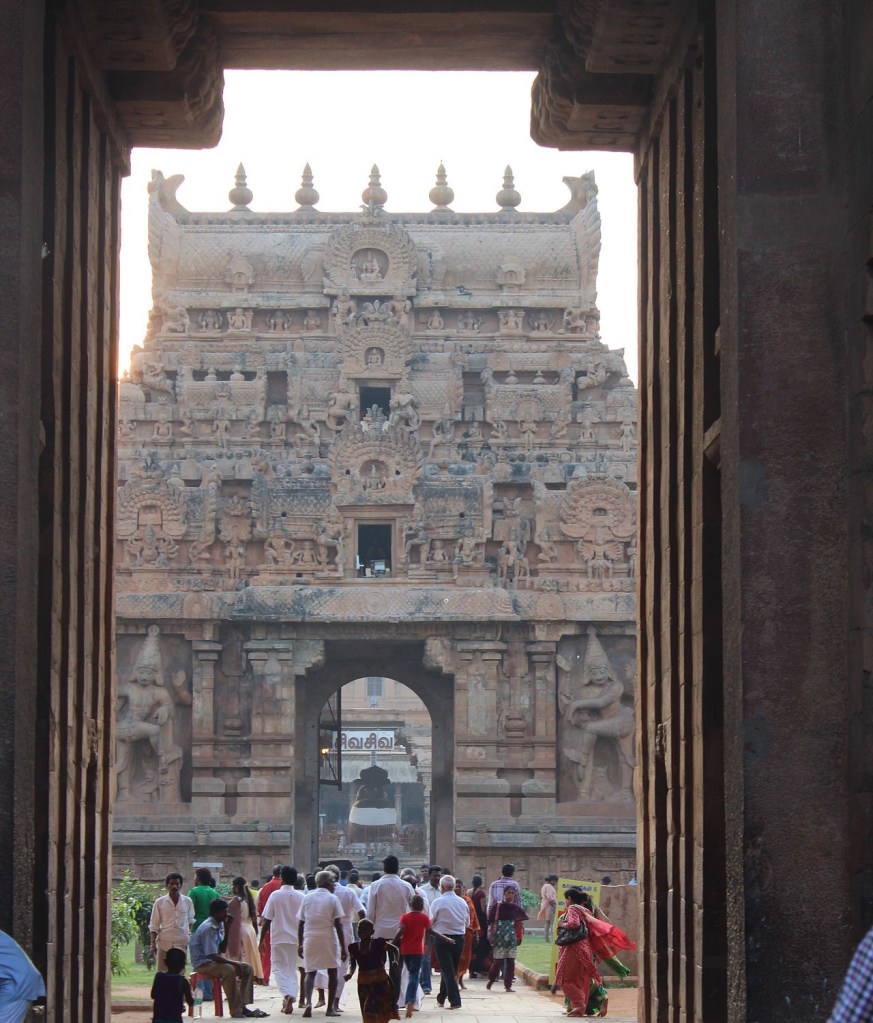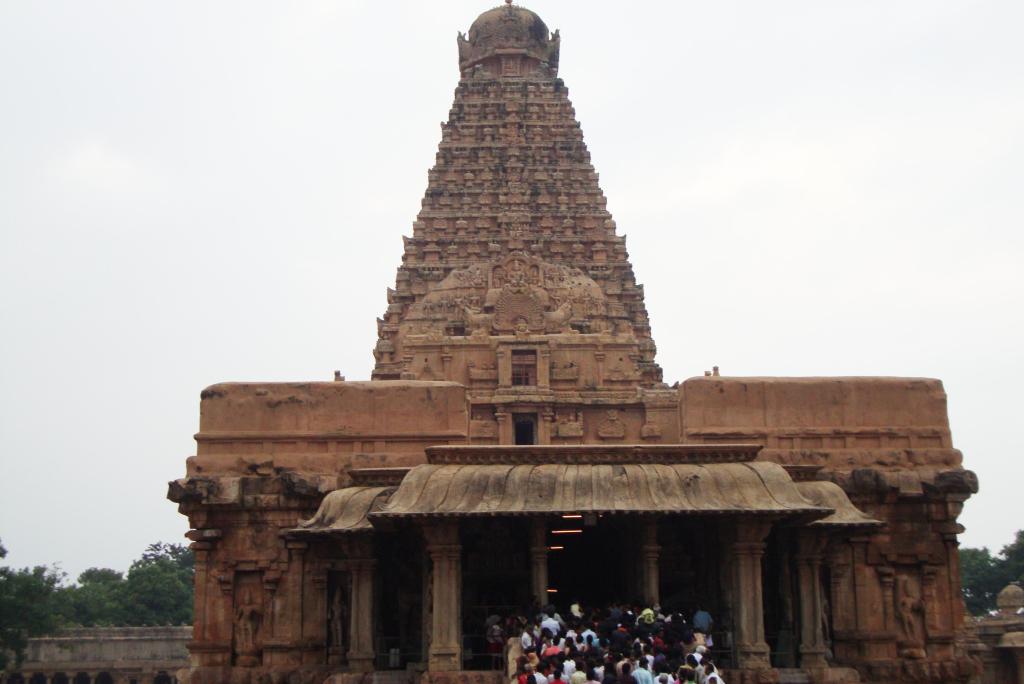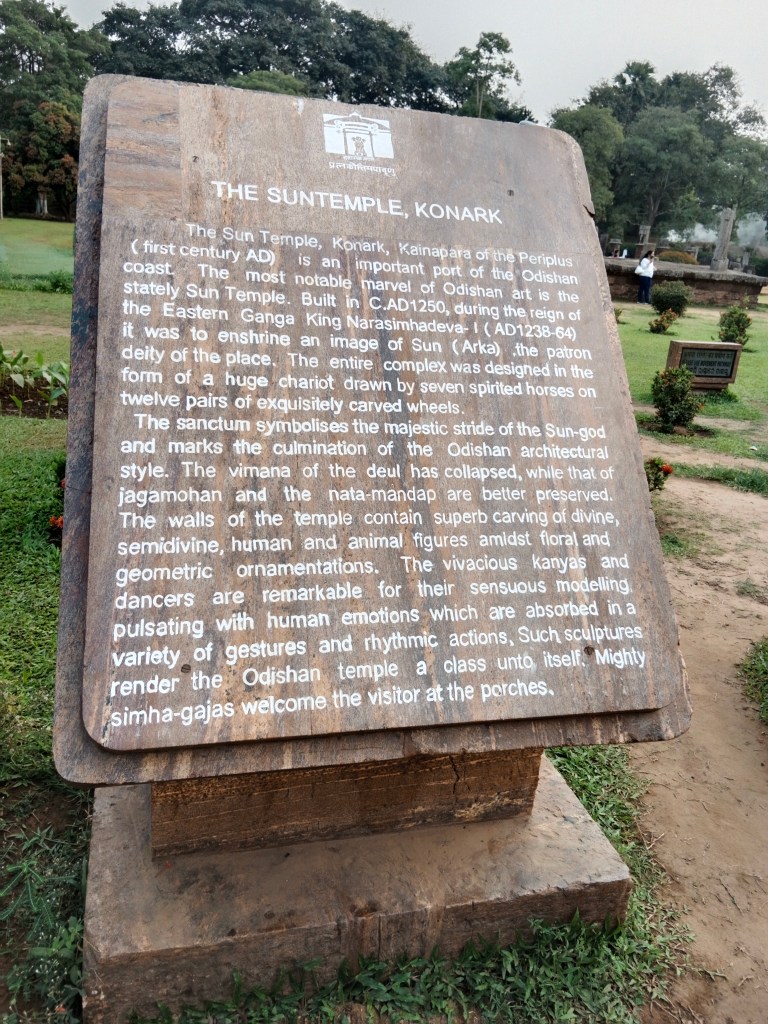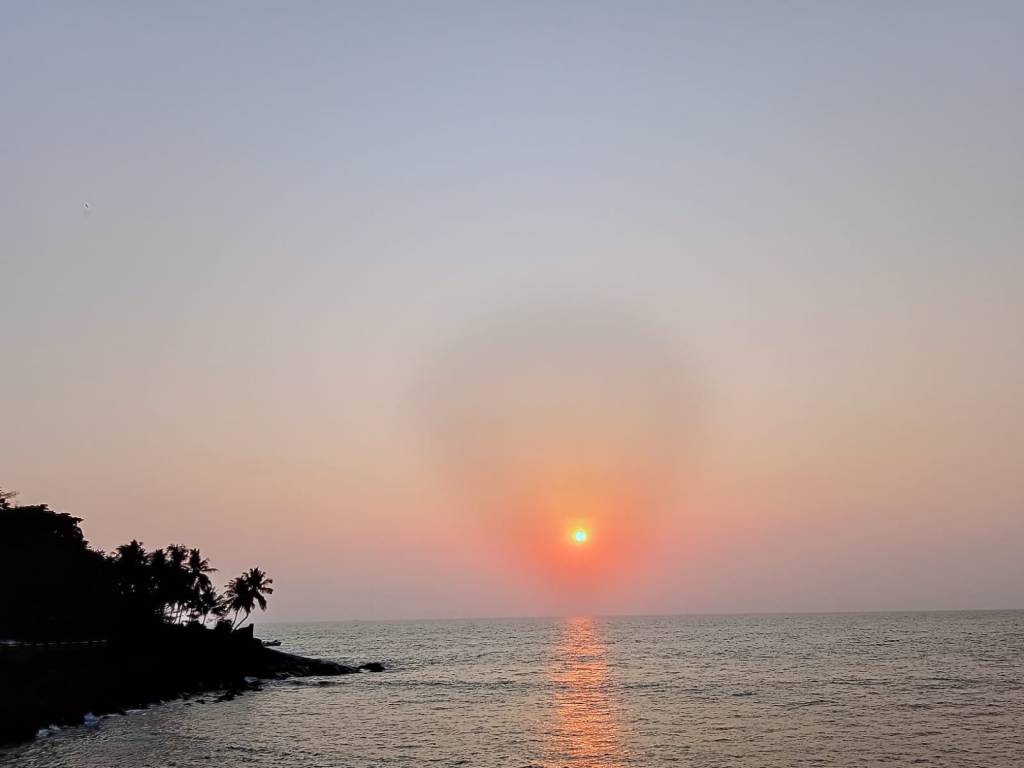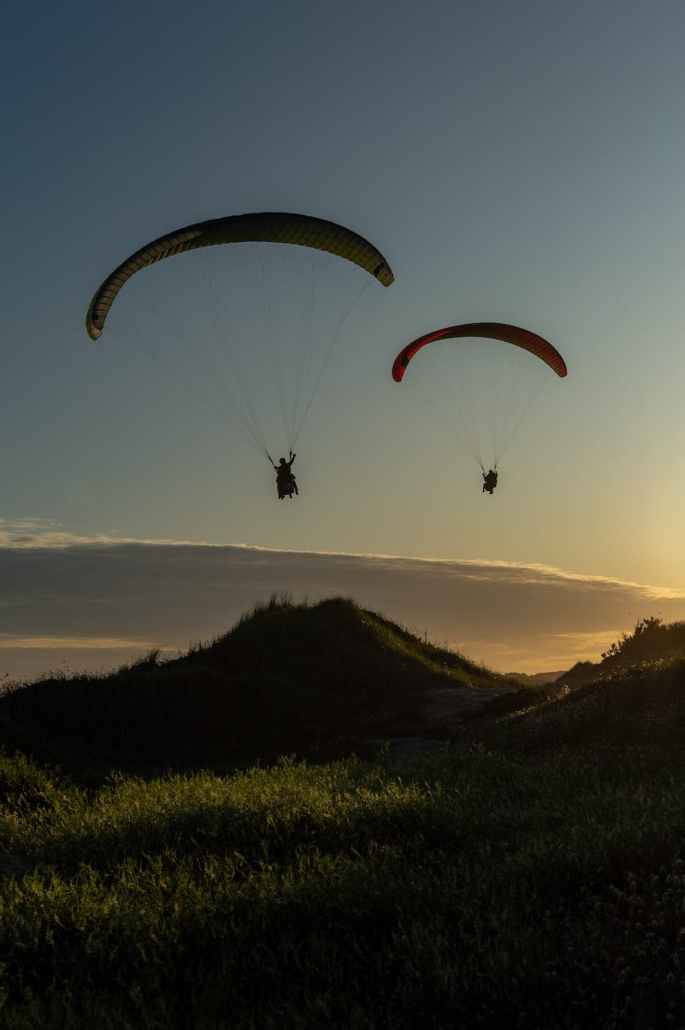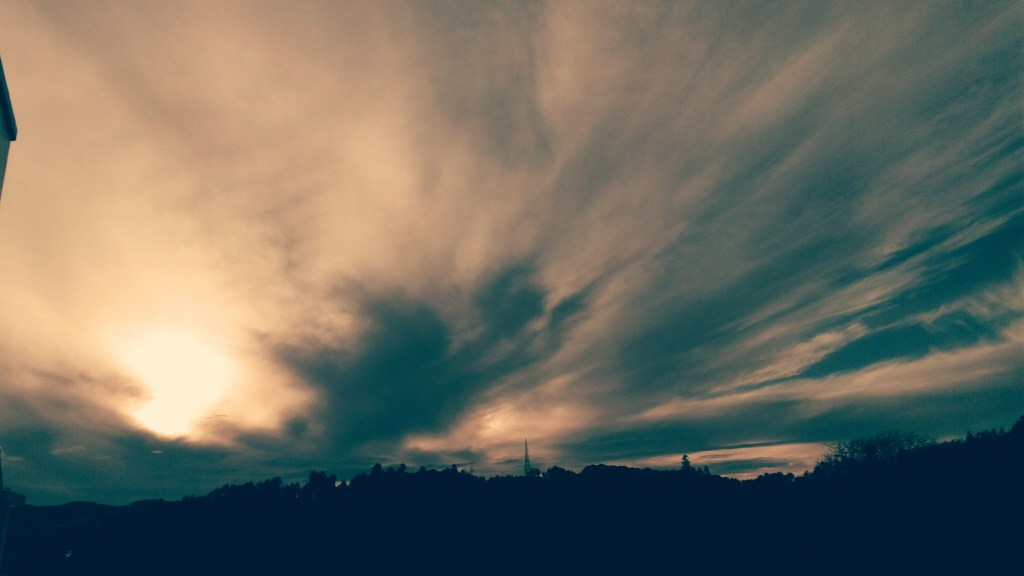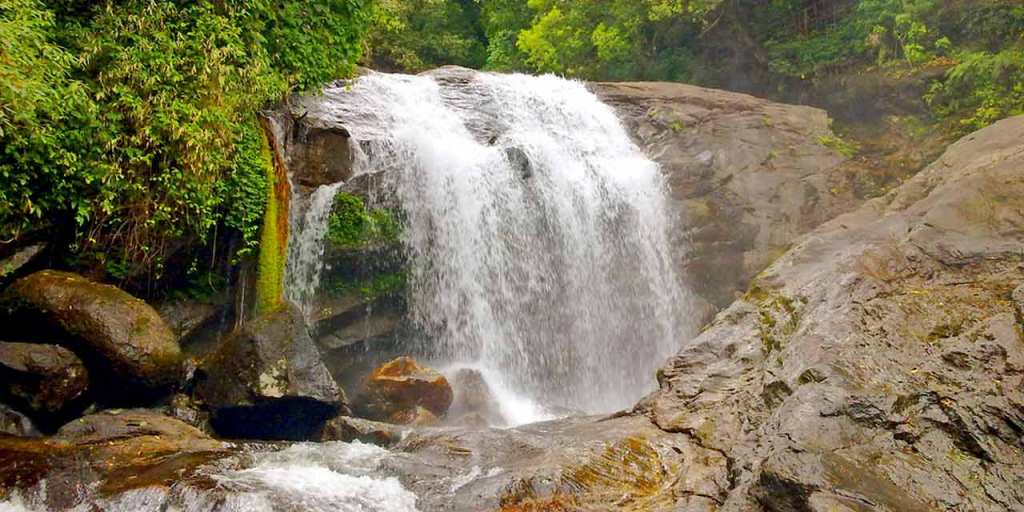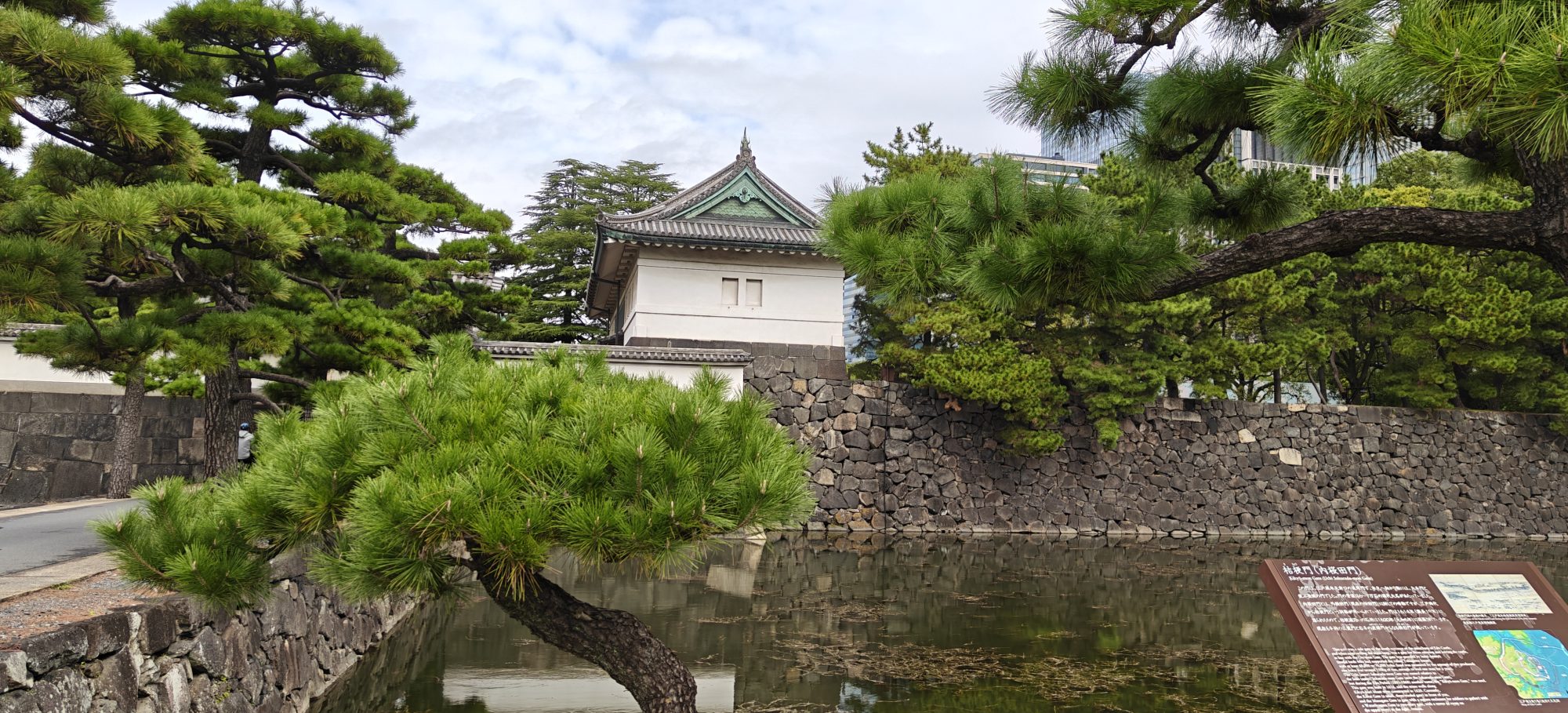
The Jagannath Temple at Puri in Odisha is one of the most revered Hindu temples in India. The main deity is Lord Jagannath, an incarnation of Lord Vishnu.
[Though I have had the opportunity to visit this temple complex, I have not taken any pictures. Photography is prohibited and even the outer areas are difficult to photograph as we have to leave the camera/phone outside far away.] The pictures that I am putting up are file pictures.
A lot of uncertainty exists on the actual building of this temple. It is believed that King Indradyumna built the main temple sometime before the 10th century and King Anantavarman of the Ganga dynasty rebuilt the remaining part of the complex. The temple is claimed to have been plundered multiple times by invaders.
The temple is one of the magnificent remnants of Kalinga architecture of India.
A small introduction on JAGANNATH
The term Jagannath literally means “Lord of the Universe”. He is worshipped by the Hindus in India and Bangladesh , along with his brother Balabhadra and sister Subhadra. In a larger context , the Hindus in India are either Vaishnavites ( followers of Lord Krishna/Vishnu) or Shaivites (followers of Lord Shiva). The Vaishnavites call Him an incarnation of Vishnu while for the Shaivites , He is a tantric form of Bhairava, a fierce manifestation of Lord Shiva.
Lord Jagannath
Structure
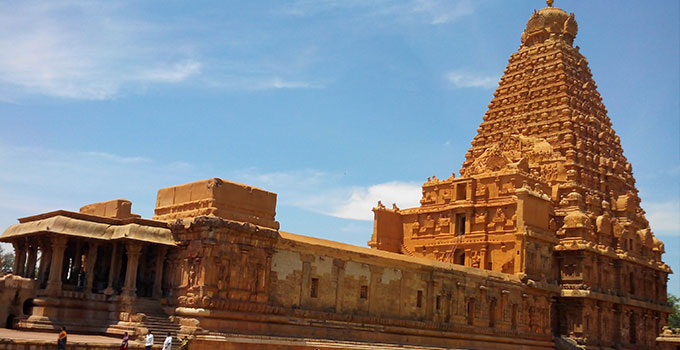
The temple complex lies inside a 20 ft. high fortified wall and the main temple is surrounded by another smaller fortified wall. The main tower under which the principal deities reside is built on a platform and is 214 ft. high. Other shrines within the complex have roofs and towers that rise up in step like fashion to the main tower.
The main tower dominates the skyline in the vicinity.
The towers of the temple
Inside the wall, the complex has four main sections. The Sanctum Sanctorum where the main deities reside , The Frontal Porch, The Nata Mantap or dancing hall and Bhog Mantap or offerings hall.
Neela Chakra
An eight spoked wheel called the Neela Chakra is mounted on the top of the main tower. This is made of eight metals and is considered sacrosanct. The wheel is more than11 ft high and is the most revered iconic symbol of Jagannath.
Neela Chakra
The flag hoisted on the Chakra is called Patita Pavana and is considered equivalent to the deities placed in the Sanctum Santorum. This flag flutters in the direction opposite to the wind and this is one of the peculiarities of this temple. A priest climbs up to the top( as tall as a 45 storey building) and changes the flag every day.
The Singhadwar (Lion Gate)
This is one of the main entrances to the temple and has two huge crouching lion statues giving it the name. This is the gate that faces east and on to the main road. A giant monolithic pillar called Aruna Sthamba stands tall in front of this gate. This pillar was originally in the Sun Temple at Konark and was relocated here. It has the statue of Aruna, the charioteer of the Sun God on top.
The Singhadwar with ArunaSthamba
The gates in the remaining three directions are named after the animals guarding the gate .
When one enters the temple through the Eastern gate, one passes through a series of steps before we reach the Sanctum Sanctorum.
Sanctum Sanctorum
The three siblings … Jagannath, Balabhadra and Subhadra are the main deities at the Sanctum. The idols are not of stone as in other temples but carved out of Neem trees. They sit on a raised bejewelled platform.
The sibling deities
The idol of Jagannath is actually a carved and decorated wooden stump with large round eyes and conspicuous with absence of limbs and neck and the face merging with the chest. He is painted black and this feature is similar to Lord Krishna . The “U” shaped mark on his forehead is typical of Vaishnavite traditions.
The idol of Balabhadra is depicted with a white face and Subhadra with yellow face. Both of them have oval eyes.
The idols are made of neem wood and replaced every 12 or 19 years; depending on the Hindu calendar when the year has two months of Ashadha.
Multiple small shrines
Inside the temple complex are multiple shrines dedicated to various Gods.
Architecture
The architecture of the towers at the temple is simply outstanding. The detailed artistic work and images carved in stone are really marvellous. Unfortunately no pictures are available to depict this. In fact I visited this temple soon after I had visited Angkor Wat and I was amazed at the architecture and complexity of design of this complex. Due to lack of pictures, the artistry is lost to the world unlike Konark or Angkor Watwhere photography is allowed.
The Temple Kitchen
The temple kitchen is considered one of the largest in the world. Cooking is done in earthen pots using water drawn from wells. The food is sold to devotees in the Anand Bazar within the temple after offering to the Lord.
Rath Yatra
The most famous festival of Jagannath Temple at Puri is the Rath Yatra.It is this festival that has been instrumental in bringing this temple global recognition. In fact the word Jagannath is also supposed to have etymologically originated from the word “Juggernaut” signifying the movement of the huge chariot and the people along the streets.
Every year, this festival is celebrated in the month of Ashadha (June/July) and the deities are brought out of the temple in chariots in a procession on to the main road and travel for about 3 kilometres to the Gundicha temple. The deities stay there for seven days and then are ceremoniously brought back to the main temple in the same chariots.
The chariots are wheeled wooden structures built newly every year and they are pulled by the devotees. The Chariot of Jagannath is the biggest and is approximately 45 feet high. It takes months of work on the building and decoration of these chariots.
Visuals of the Annual Puri Rath Yatra
Rath Yatra is not a temple festival for the locals but an integral part of their lives. They celebrate it with much fanfare and the whole area gets a festive look at the time of the Rath Yatra.
Some amazing facts about this temple :
The sacred flag on top of the tower flutters in the opposite direction of the wind. This flag is changed manually every day by climbing the tower which is as high as a 45 storey building.
The idols are made of wood and carved by carpenters. They are replaced periodically and the old idols are buried. This is called Nabakalebara
The temple casts no shadow in any direction of the sun.
The Mahaprasad consists of 56 delicacies and is available for sale to devotees.
The food is cooked in earthen pots placed one above the other and the food in the top most pot gets cooked first.
Though located close to the sea, the sound of the waves stop as soon as you enter the temple.
Nothing flies over the tower of the temple.
The Neela Chakra appears to be facing the same way when viewd from any direction.
Many scientists and religious leaders have tried to investigate these strange phenomenon but no one has as yet got an answer.
Well, let us leave it to the Glory of Lord Jagannath
See you next week with some other great temples. Till then, do like, comment and give your feedback.
Poetry in stone dedicated to the Sun God; that’s a simplistic definition of the Sun Temple at Konark. Writing such a definition is so simple !! but building such a monument is definitely not !!! A visit to Konark will authenticate what I just said. So, come along with me on this virtual tour of this masterpiece in stone.
A brief history
The Sun temple at Konark was built by King Narasimhadeva of the Ganga dynasty in the 13th century in typical Kalinga architectural style. Located 35 kms. from Puri city in Odisha , along the shores of the Bay of Bengal, the temple was built as a giant chariot of the Sun. Many parts of this masterpiece is in ruins and the cause of destruction of the temple remains a mystery with natural disasters at one end of the spectrum and deliberate destruction by Muslim invaders in the 15th to 17th centuries at the other end.
The Architecture
Known originally as Surya Devalaya ,the main temple is in the form of a huge chariot with 24 wheels drawn by seven horses. In Hindu mythology the Sun God is seen riding across the sky from east to west on a chariot . That is what is depicted here in Kalinga architecture . Surya (Sun God) is seen flanked by Goddesses Usha and Prathyusha shooting arrows to dispel the darkness . If you felt this is the depth of the symbolism ; hold your breath….the 12 pairs of wheels represent the 12 months of the Hindu calendar. The conceptualisation and realisation of this symbolism will find very few parallels !
When viewed from front, during sunrise, the Chariot appears to emerge from the sea carrying the Sun….. more symbolism for you!
The intricate art work on the walls of the temple consist of various themes including scenes from contemporary life and erotic Kama scenes from the Kamashastra.
Any amount of description will not match the beauty of this stone marvel and so, let me just put up some pictures for you to decipher it….
Walking through the temple complex…
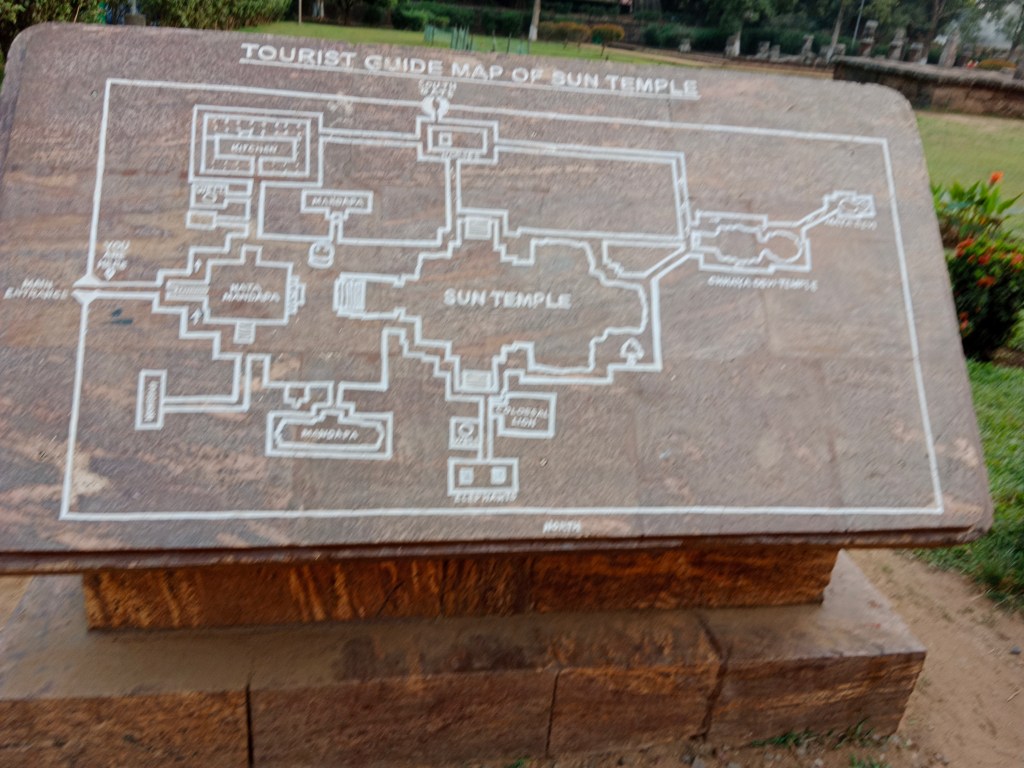
A stone plaque with the map of the temple complex guides the visitors at the entrance
A long neatly paved passage with well manicured lawns on either side leads one to the main temples. What one encounters first is the ruins of the Natya Mantap ( hall of dances ) with the main chariot behind it.
Standing in front of the Natya Mantap ruins with our guide
Right in front of the Natya Mandap is a unique sculpture. A lion on top of an elephant and a man below that. It signifies wealth, ego and pride crushing humanity.
The Natya Mantapstands on an intricately carved platform and the pillars forming the walls of the Mantap have delicately carved figurines similar to those found elsewhere in the complex. One can enter the Natya Mantap by climbing a flight of stairs.
View of the chariot standing on the Natya Mantap
Walking around the Natya Mantap we reach the Chariot .
In front of the Chariot
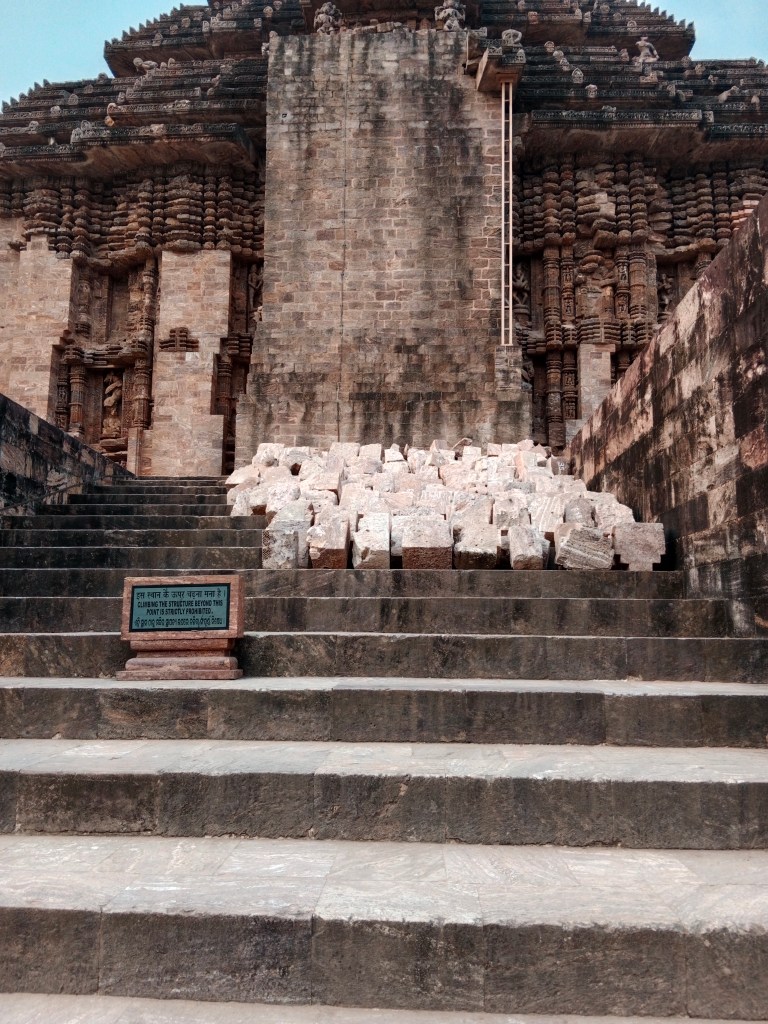
There was a pillar between the Natya Mantap and the Chariot which was known as the Aruna Stamba (Aruna Pillar) which has now been relocated to the Jagannath Temple at Puri. Aruna is considered the charioteer of Surya.
As we walk around the Chariot, the intricate patterns on the walls become clear. Some pictures…
A major part of the figurines depict musicians with various musical instruments and dancers in various poses…
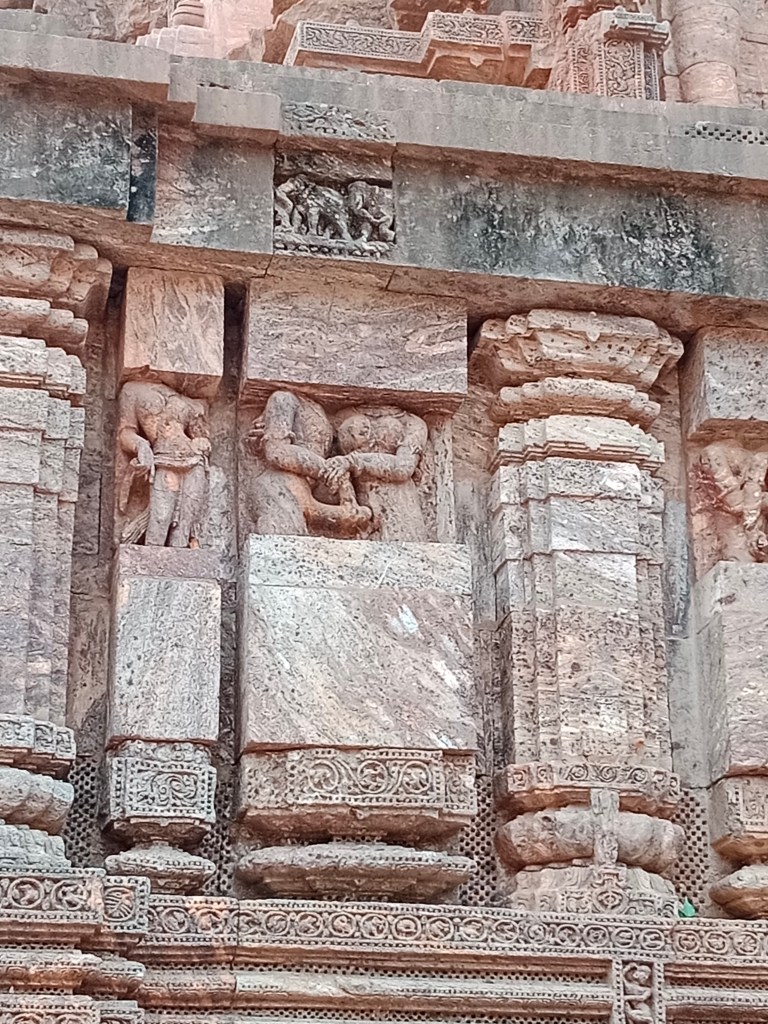
The walls with reliefs depicting musicians and dancers
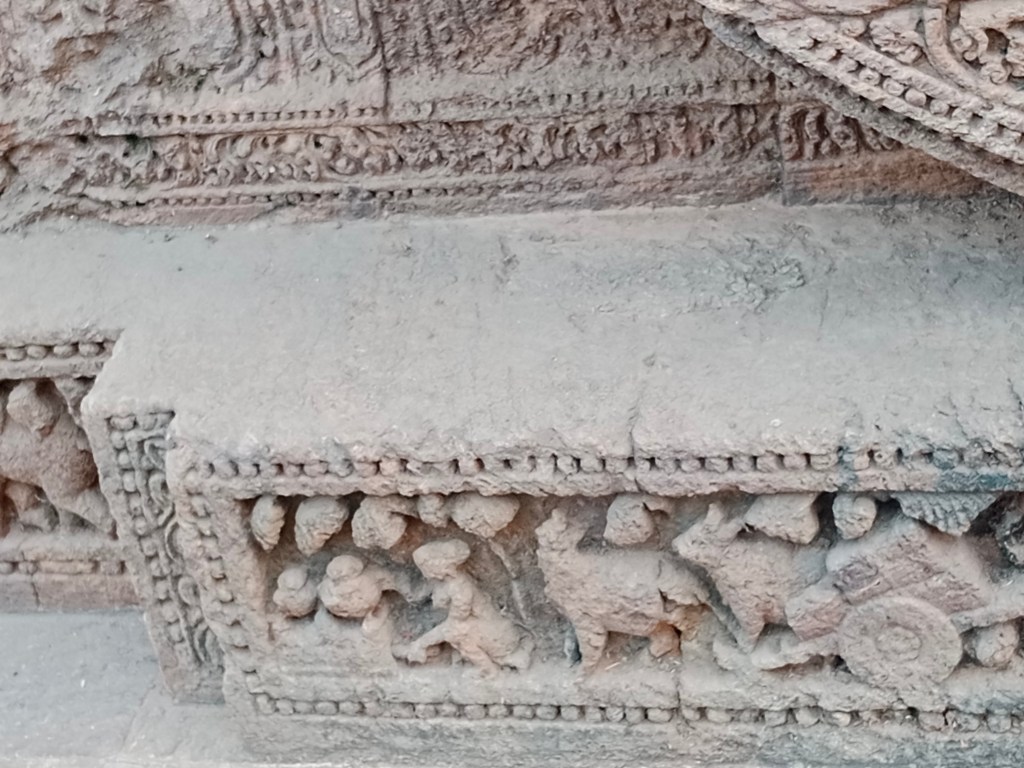
Apart from that, contemporary daily life is also depicted at many places….
Cooking on a choolah and pulling a chariot
There is a lot of emphasis on sexual life and the Kamashastra is also depicted by figurines on the walls including that of unnatural sex. This highlights the openness with which these were an accepted part of life in those times….
Kamashastra
Unnatural sex and punishment for infidelity
Wheels
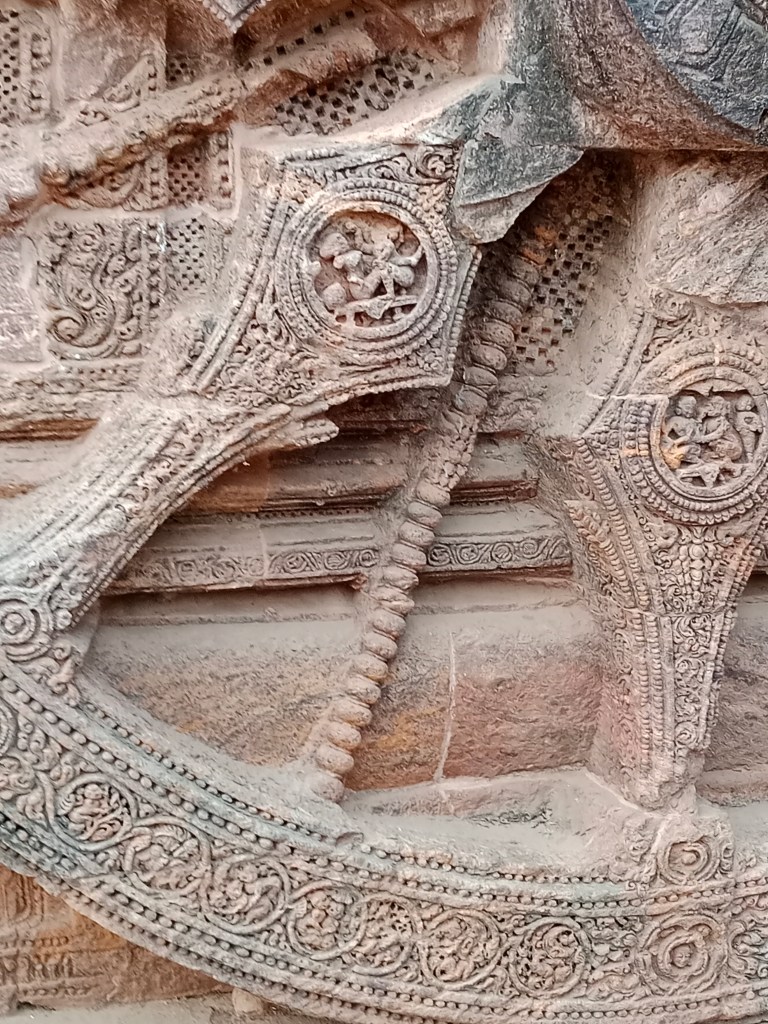
The chariot wheel is one of the iconic images of this temple. The 24 wheels of the chariot are so intricately designed with emphasis on time that it seems like they were used as sundials at one point of time and also for knowing the seasons and months.
One of the iconic wheels
The 24 wheels are 12 feet in diameter and intricately carved. Many of the wheels are in different stages of ruin.
Designs on the wheels and the small beads representing different units of time
The Chariot was shown as drawn by seven horses and many of the horses have been destroyed. One survivor….
One of the surviving horses literally on a walker!!
Metal strips
Another very interesting aspect of the temple is that many of the parts are held together by metal clips. A closer look at the junctions shows this …..
A metal block holds the top stone and metal clips between the stones
Now, one of the reasons attributed to the temple destruction is this particular element in its construction. The ships passing by with their powerful magnets may have disturbed these metal clamps and clips leading to the ruin.
Depiction of thedifferent phases of the day
As one circumambulates the temple, the image of the Sun God changes corresponding to the different times of the day. Take a look….
Sun God in the morning in blue granite and in the afternoon shaded with a crown
Sun God in the evening, appearing tired and riding a horse. Beheaded Sun God.
As one walks along, one realises the amount of destruction (natural or otherwise )that has taken place and the various restoration activities that are on.
The restoration work in progress.
Chhayadevi temple
At the back is the Chhayadevi temple which is roofless and in ruins
Chhayadevi Temple
The Monolithic lion
A monolithic Lion sculpture adorns the side of the chariot.
Monolithic Lion
In the evening, after sunset, the monuments get lit up and it presents another amazing sight…
The lit up Natyamantap entrance
A unique light and sound performance takes place here in the evenings after sunset.
It takes one through the history of the temple and also depicts various other historical events.
Glimpses from the show…..
Glimpses of the light and sound show
UNESCO World Heritage Site
The Konark Sun Temple is a proclaimed UNESCO World Heritage site and is being maintained so. Restoration work is on all over the temple and surrounding premises. The lawns and the environs are kept neat and clean and we find lot of evidence of restoration work going on…
Evidence of restoration work
Bisu Moharana
When we admire any artistic creation, we must always give credit to the creator. Well, the architect of this stone masterpiece is Bisu Moharana and in the later years, his son. So let me end this episode on The Sun Temple with reverence to the spirit of this man whose vision and conceptualisation has given us this marvel.
See you next week with more from Odisha. Till then do give your feedback and comments.
Puducherry or Pondicherry (as it was formerly called) was a French settlement colony on the east coast of India until 1954. Puducherry is the capital of the Union Territory of the same name ,comprising also of Karaikal, Mahe and Yanam. With a nice coastline along the Bay Of Bengal, it was known as “The French Riviera of the East” under the French. It’s new name Puducherry means “new town” in Tamil which is the official language.
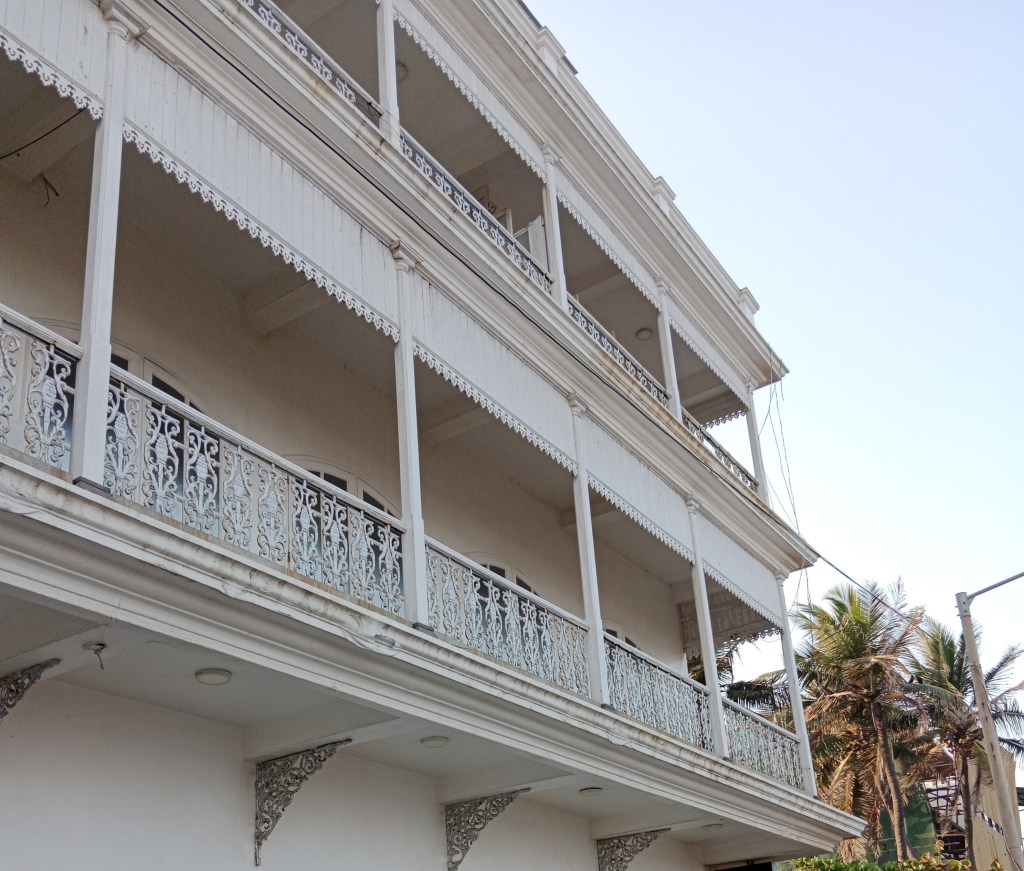
Puducherry is bounded by the state of Tamil Nadu with which it shares most of its culture, heritage and language. It still harbours remnants of its French past which is easily noticeable in it’s old quarter and even in the names of streets and buildings. French architecture can be seen in many of the old buildings here.
Apart from remnants of its French past, the Aurobindo Ashram , Auroville, and the beautiful beach and promenade are its main tourist attractions.
Puducherry has a small airport which handles only small aircraft but there are flights from Bangalore and Hyderabad to Puducherry. Chennai which is 135 kms away is the nearest major airport.
The nearest railhead is Villupuram situated 35 kms away.
It is well connected by road from all the major cities of South India.
The Beach and Promenade
Puducherry has a 1.2 km long rocky beach along the Bay of Bengal. The beach is well maintained with a nice promenade and a couple of small parks beside the beach. No vehicles are allowed on the beach road and so it is very peaceful.
Some pictures..
The Rock Beach
The Beachwith part of the promenade
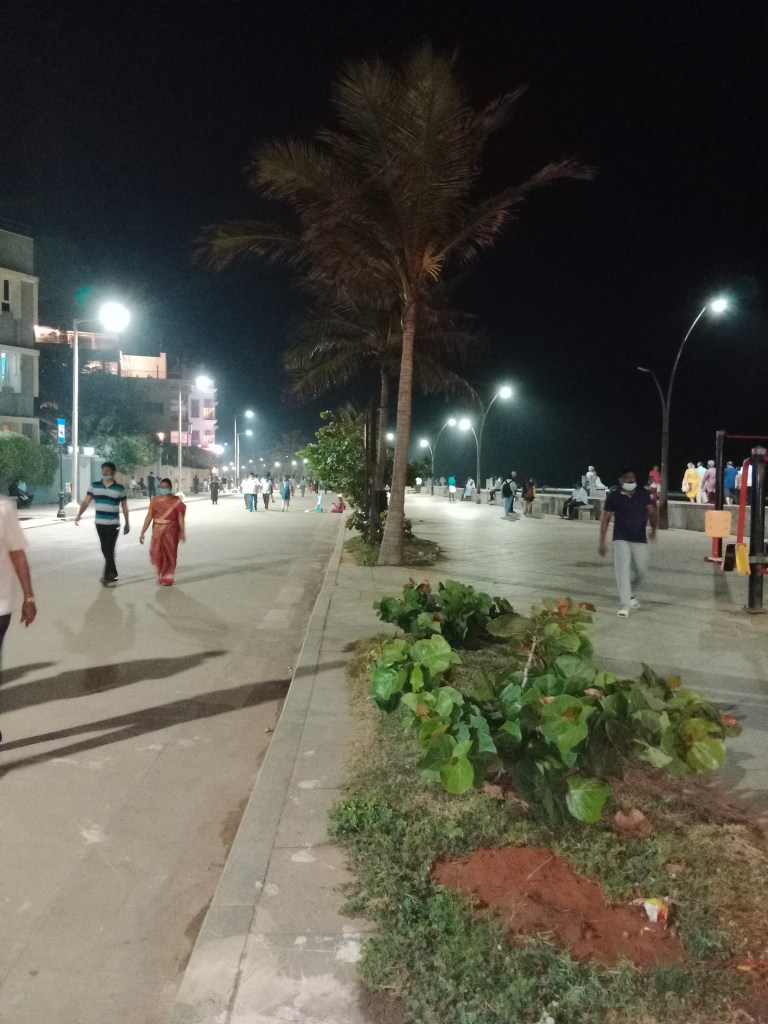
The Promenade stretches from the War Memorial to Dupleix Park and is well paved and lined by trees. Many of statues and memorials are located on the Promenade. Many Government offices also dot the Promenade.
The road at the Promenade is called Goubert Avenue and is one of the popular tourist destinations here and there are many memorials dedicated to eminent personalities here. Some of the landmarks here are:
The Gandhi Statue
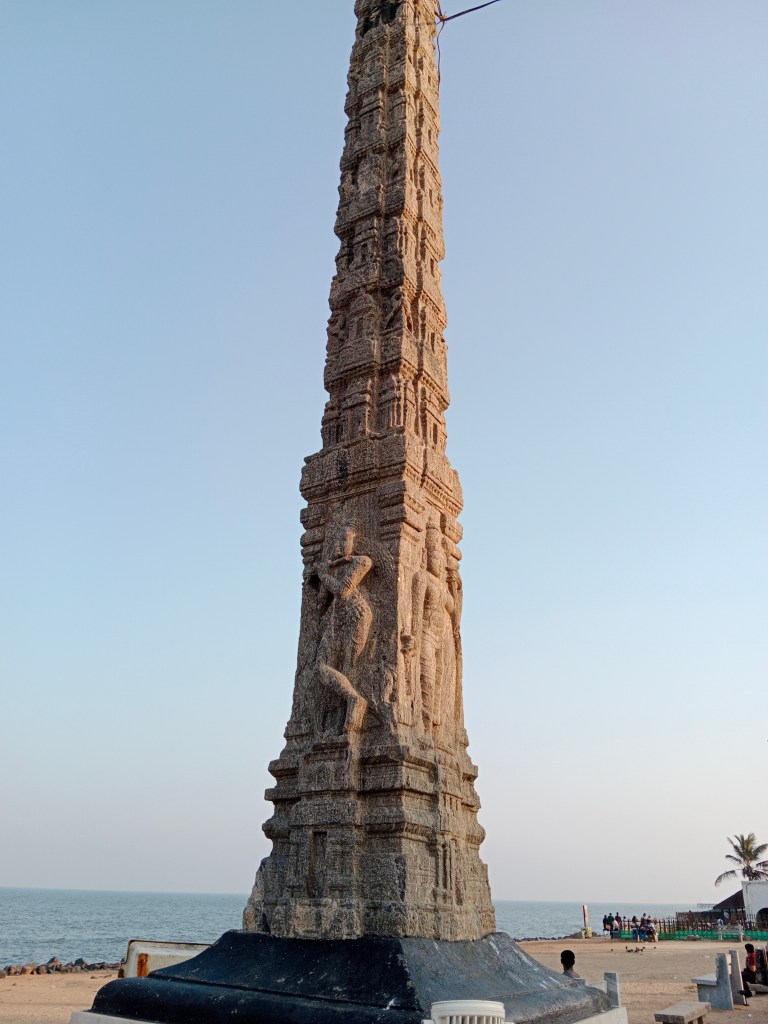
The Gandhi Statue at the Promenade is one of the iconic images of Puducherry.A four metre statue of Mahatma Gandhi, surrounded by eight granite pillars with intricate carvings is a landmark of Puducherry.
The Gandhi Statueand the intricately carved pillar
The Kargil War Memorial
The Kargil War Memorial was built at Puducherry beach by the Indian Army in memory of the soldiers of the Kargil War. It is lit up at night and on special occasions.
The Kargil War Memorial
The French War Memorial
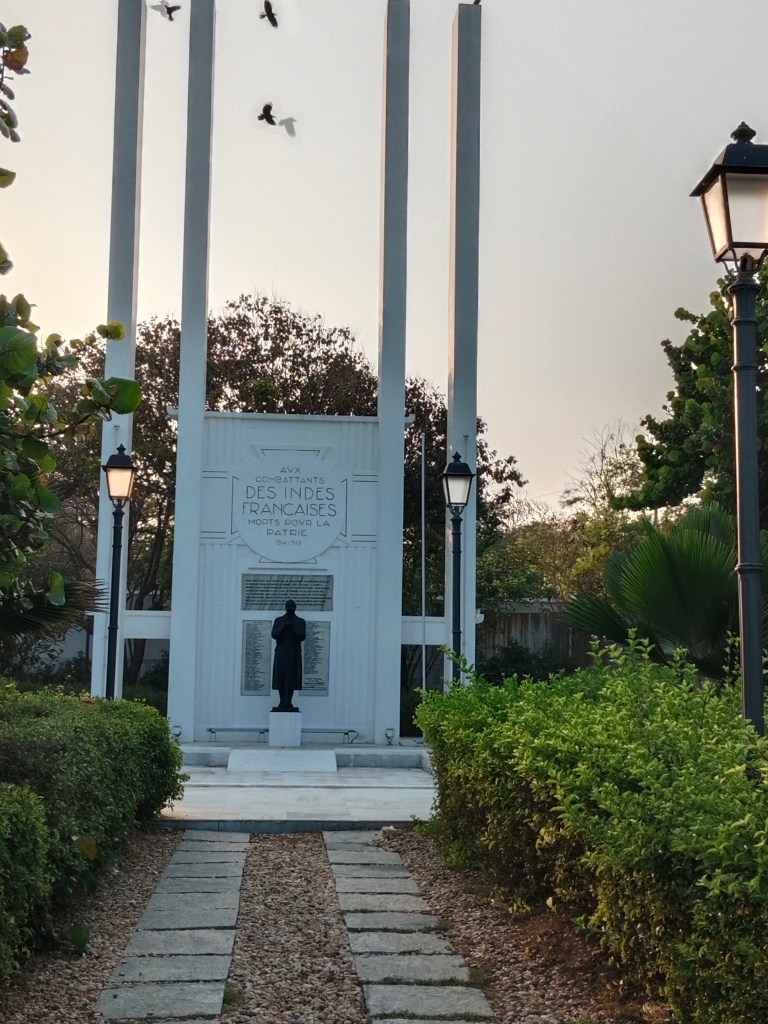
Located along the Promenade overlooking the sea , opposite the Gandhi Statue is the French War Memorial. This is a memorial dedicated to the residents of the former French colony who died in the first World War.
Ambedkar Manimandiram
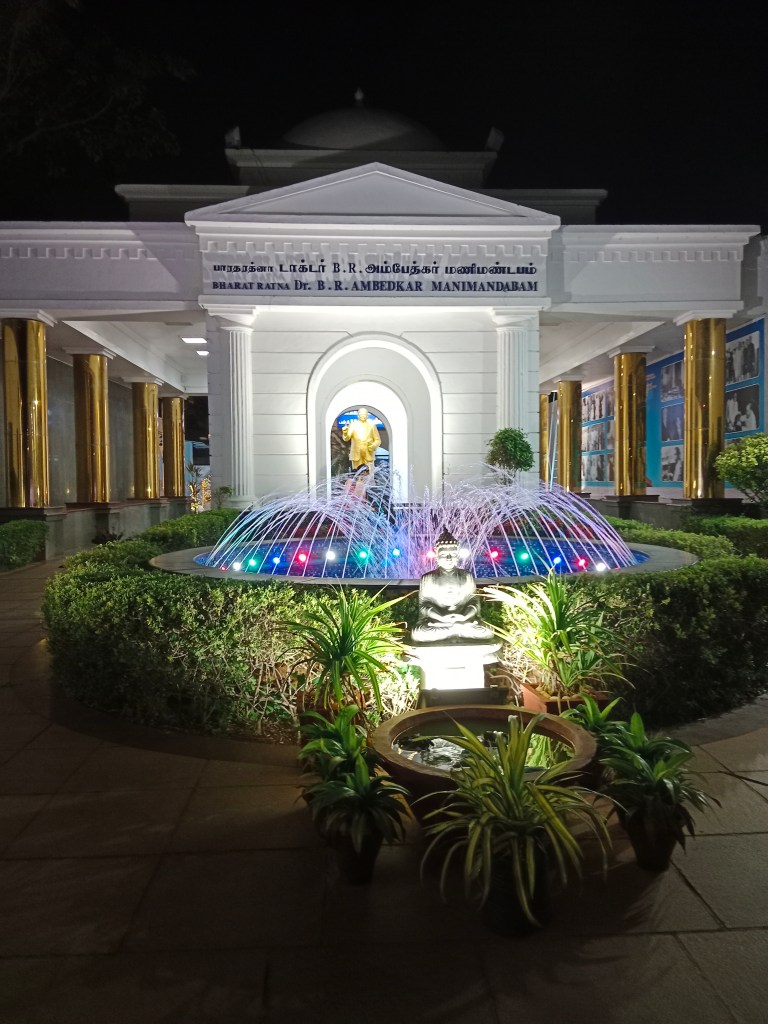
Dedicated to Dr. B R Ambedkar,(the architect of the Indian Constitution) this memorial stands next to the Tourist Information centre on Goubert avenue. Unlike the other memorials , there is a library and research centre here. A lit up water fountain adds to the attraction at night.
The French War Memorial andDr Ambedkar Memorial
The French Quarter
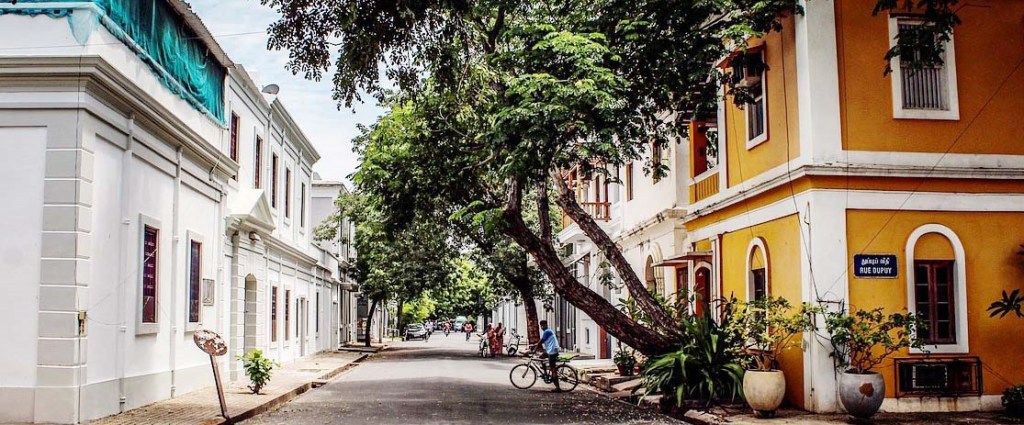
That part of Puducherry which still retains remnants of it’s French past is called the French Quarter. Puducherry having been colonised by the Dutch, Portuguese, English and French during various periods of history has had a very colonial past. But it is the French stamp that still persists.
When Puducherry was handed over to India, the citizens had a choice to choose their citizenship. So there are French citizens here, many people speak French, there are restaurants serving French cuisine and French architecture is seen in many places. Some of the street names are in French too.
Although the best way to explore this French past is to take a walk in this French quarter ; one can see remnants of the French past all over Puducherry.
Some remnants of a French past in pictures….
French architecture
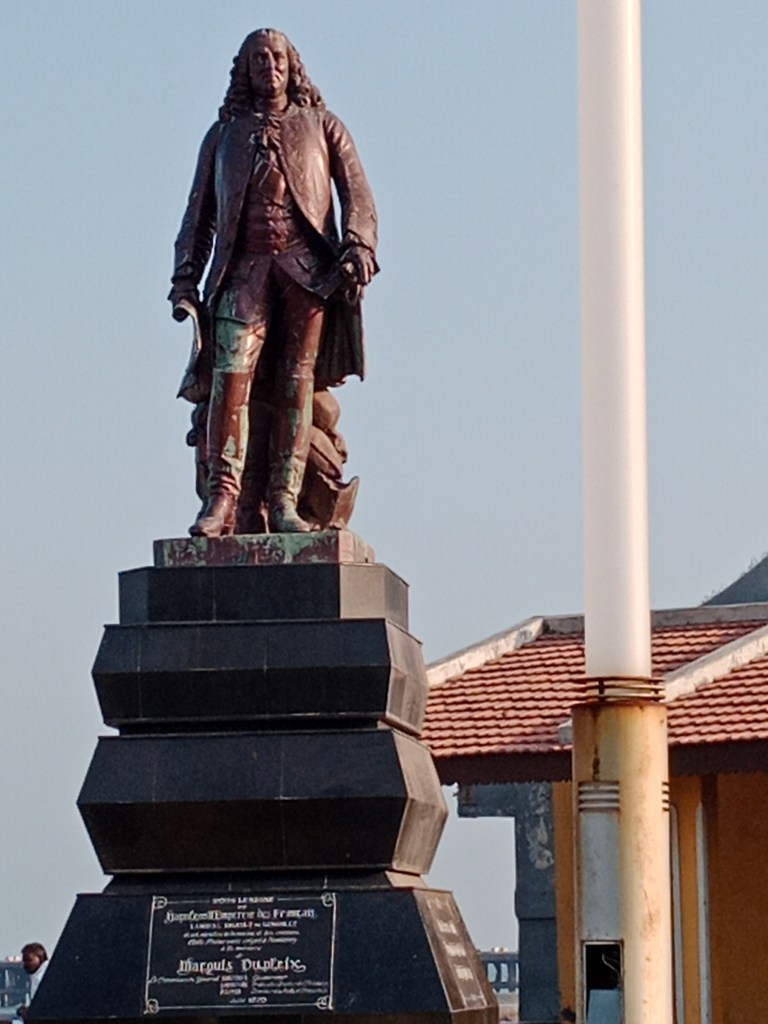
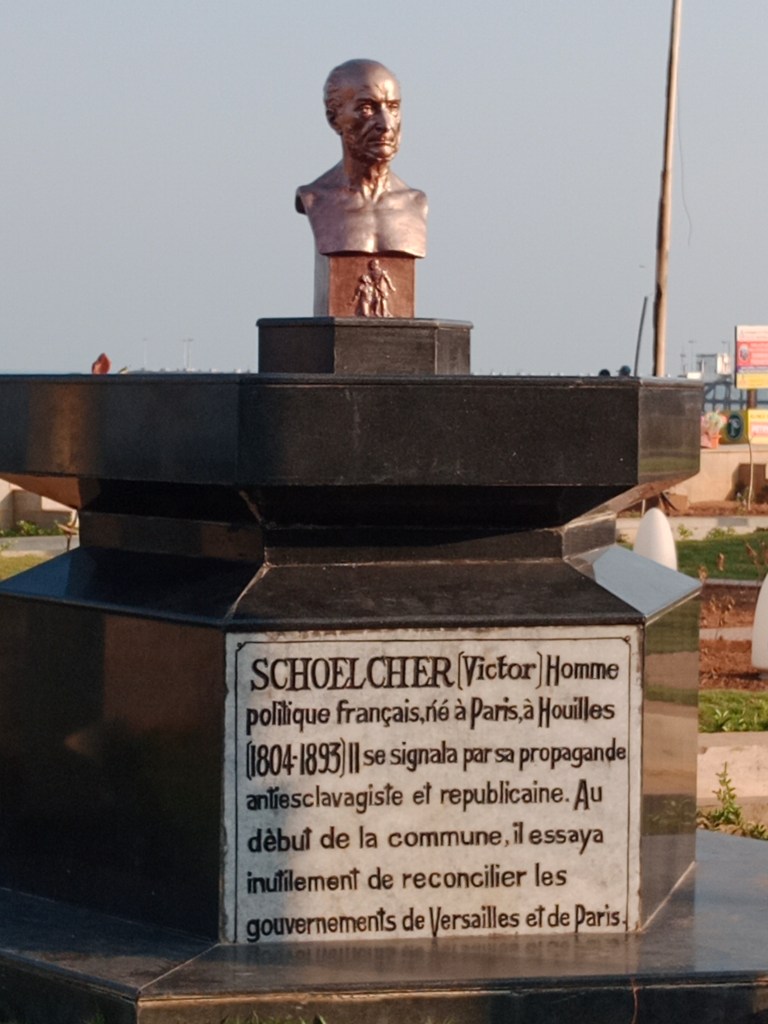
Statues of Dupleix and Schoelcher with french inscriptions
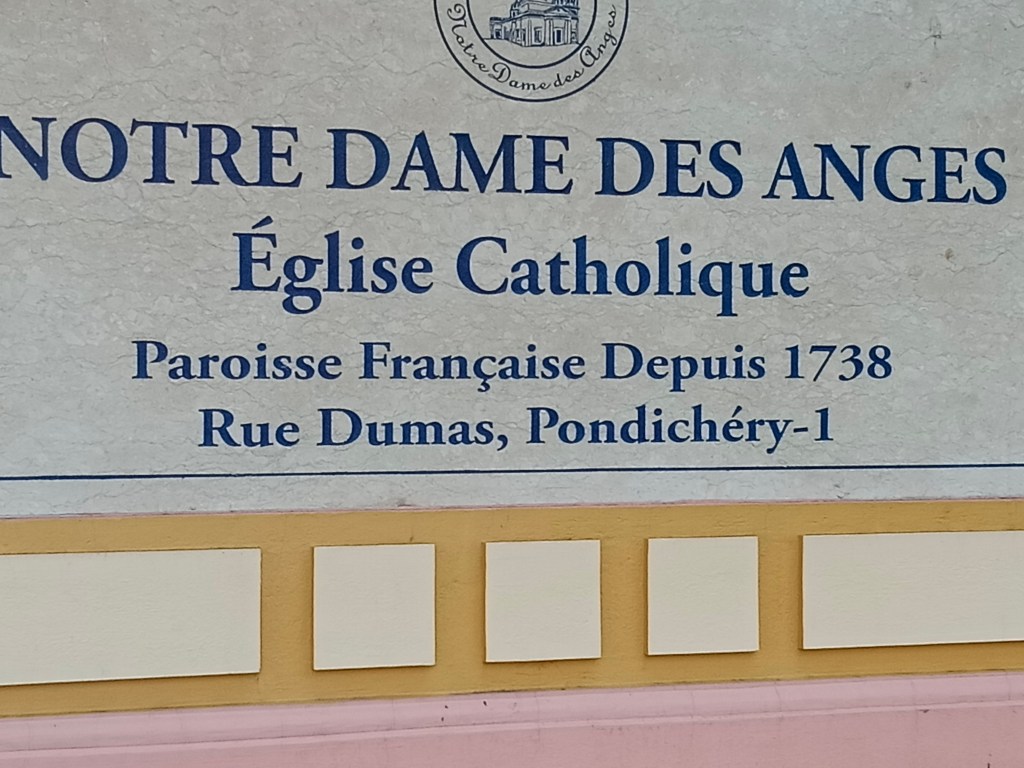
A street name in French with Tamil translation!!! andThe name and address of a church in French
Another feature of Puducherry just like Goa, are the large number of liquor shops. Liquor is cheaper here.
Something to lift your Spirits!!!
From Spirits to Spiritual……
Sri Aurobindo Ashram
A place for inner peace and meditation, Aurobindo Ashram is another popular landmark of Puducherry. Unlike most ashrams, Aurobindo Ashram is set in a modern setting. Founded by the Indian philosopher and yoga guru Sri Aurobindo in 1926, it now has nursing homes, a dining room, library, a playground and even offers accommodation at reasonable rates. After the death of Sri Aurobindo in 1950, the responsibility of the ashram was taken over by Mira Alfassa ( “The Mother”) who was one of Sri Aurobindo’s ardent followers.
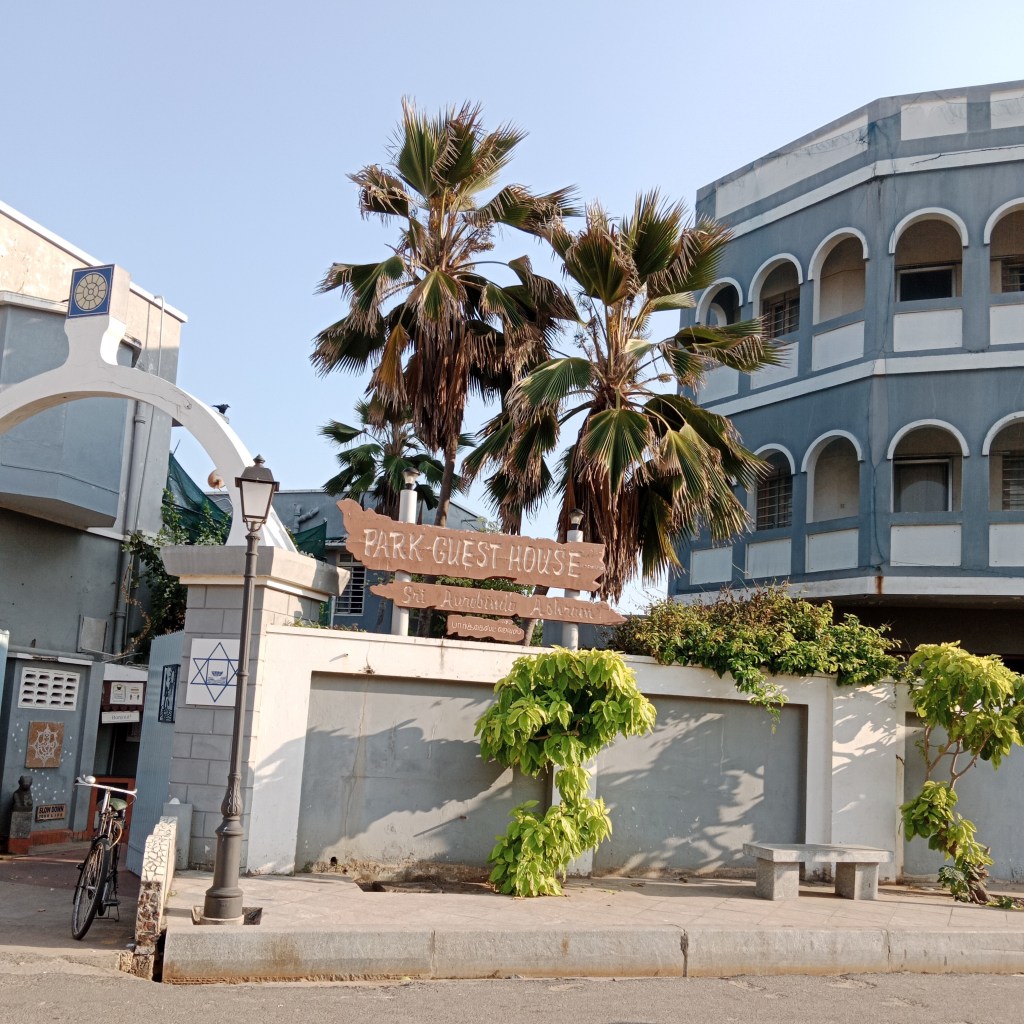
The Ashram Guest house on Goubert Avenue overlooking the beach has affordable accommodation which can be pre booked. The views of the sea from this guest house are really beautiful.
The Ashram and guest house
Auroville
Auroville which is also called The City of Dawn is a township built to realise human unity in diversity.This concept of Auroville as an ideal township of human unity was the vision of “The Mother”. It later got the backing of the Govt of India and was taken to the UNESCO which gave it a status of project of importance for humanity. It is also an experiment in sustainable living.
Auroville was formally inaugurated in 1968 with around 5000 people from 124 countries assembling near the central banyan tree. They had brought soil from their own countries and the soils were mixed in a lotus shaped urn which is now the focal point of the Amphitheatre.
Located 10 kms north of Puducherry city, most parts of Auroville township lie in the state of Tamil Nadu with some parts in the union territory of Puducherry .
The residents of Auroville come from various social and cultural classes and backgrounds representing humanity as a whole. The population here is constantly growing and approximately one third of the population are Indians.
The township is well planned out with zones dedicated to cultural , industrial, international, residential activities with a central zone dedicated to Peace. The Peace area houses the Matrimandir and the Amphitheatre which contains the Urn of Human Unity which contains soil from different parts of the world. This area creates an ambience of peace and serenity.
The Green Belt which is another interesting part of this planned township has organic farms, dairies, orchards, forests and acts as a barrier to human encroachment.
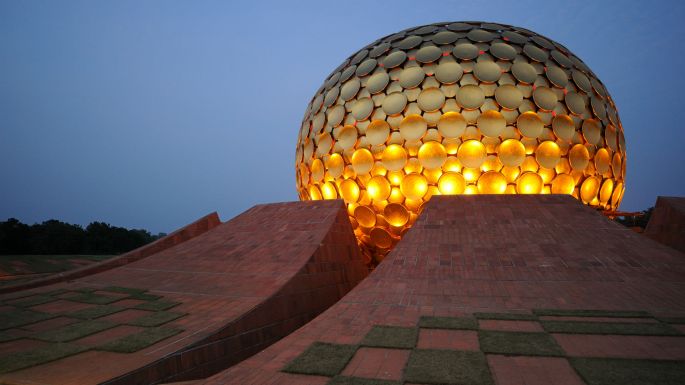
Matrimandir
Located in the centre of Auroville, this golden coloured metallic dome is considered the soul of Auroville. It is surrounded by a large open area called “peace” from where the future city will radiate. Absolute silence has to be maintained here. A spiral ramp leads to the “inner chamber” which is completely white and there is a pure crystal glass globe at the centre which suffuses a ray of electronically guided sunlight that falls on it through an opening at the apex of the sphere. The luminescent globe radites light to the chamber.
There are no guided meditations but one has to learn to be silent, concentrate, meditate and realise oneself.
Matrimandir Complex
The Banyan Tree
A magnificent Banyan tree more than 100 years old is part of the Matrimandir complex with peculiar aerial roots spread over a large area. Banyan trees are generally considered sacred in India and perhaps that prompted Mother to choose it at the centre of Auroville.
The Banyan Tree
The Amphitheatre
Guesthouse at Auroville
The Seagull Restaurant
There are many restaurants serving various cuisines with a definite French emphasis. But we go to the Seagulls restaurant whenever we visit Puducherry. The restaurant itself is pretty old and in need of maintenance. Nothing very spectacular about the food either. Then, what is it that attracts us? What we enjoy there is the ambience and the views from the restaurant.
This restaurant has an open air space partly jutting into the sea with palm trees around. Sitting there at night with the sea breeze wafting along and the moon playing hide and seek among the coconut tree fronds can be an enchanting experience.
The Seagulls Restaurant
Well, I hope this roundup of Puducherry has given you a fair idea of what to expect on your trip to Puducherry.
Do keep your comments and feedback pouring in till we meet next week at Cambodia. Yes, its going to be Vietnam and Cambodia for a few weeks ahead. No worries, no preparations needed; just sit back on your armchair and I will take you there…..
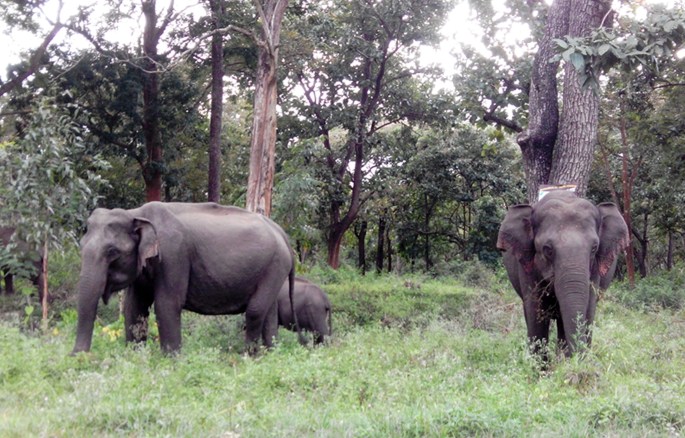
Elephant land….that’s our destination today! Am sure you all enjoy watching these graceful giants walking along majestically with a little baby trying to snuggle in between…..well that’s what we were looking for when we headed to Thekkady.
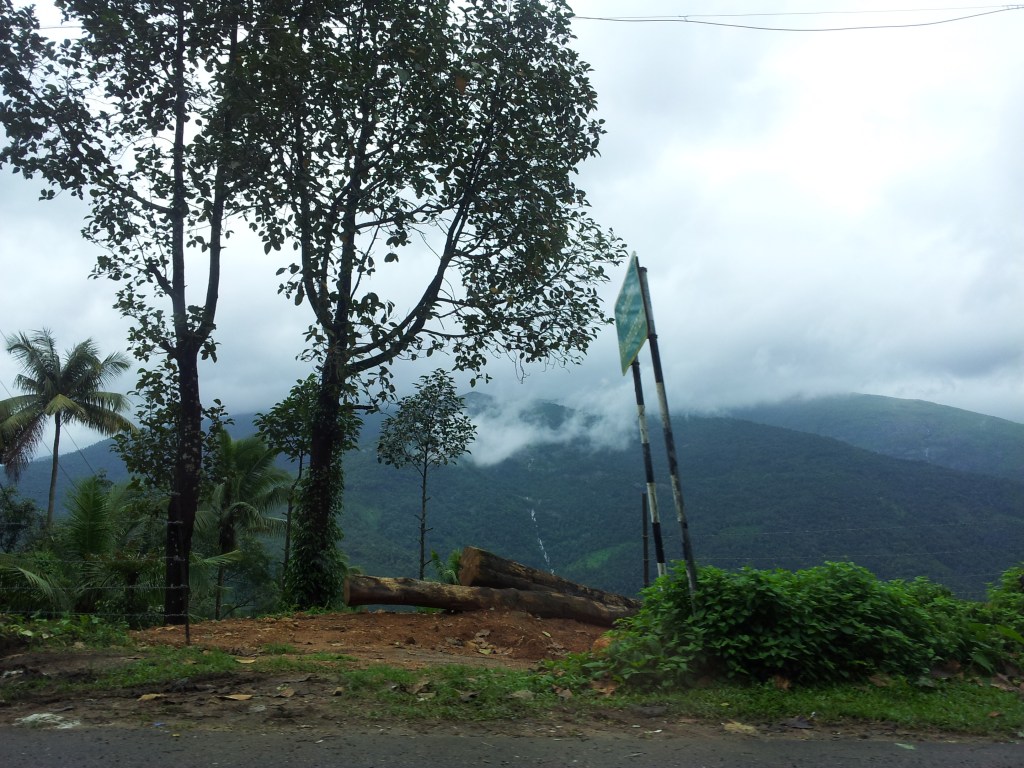
We were at Kochi for some work and decided to head to Thekkady for a break. So we drove down from Kochi and as we reached Thekkady, saw some awesome scenery including some waterfalls. Some pictures from the drive..
Scenery as we reached Thekkady
Thekkady
Thekkady , is a small town in Idukki district close to the Periyar Wildlife Sanctuary ; which is a famous jumbo habitat. “Thekku” in Malayalam is “teak” and Thekkady got its name from the teak trees you find in abundance here. Wonder why no one decided to associate the elephants to its name?….something like “Anathottam” or “Anakkadu”. ( Ana in malayalam is elephant).
It is 145 km from Kochi or Madurai which are the two nearest airports.
115 km from Kottayam, the nearest rail head.
Thekkady is also known for a variety of spices like pepper, cardamom, cloves ,cinnamon and nutmeg which are grown abundantly in the estates here.
Cardamom Estate
Cardamom flowers and pods at the base of the plant
Periyar Wildlife Sanctuary
Periyar Wildlife Sanctuary is famous for its dense evergreen forests, moist deciduous forests and grasslands. Spread over an area of over 700 sq kms, it is home to herds of elephants, sambar, tigers, gaur, lion tailed macaques, and langurs. It is a designated Tiger Reserve too. A beautiful lake called the Periyar lake lies here…a result of the Mullaperiyar dam built across the Periyar river. The lake acts like a watering hole to the herds of elephants and deer that live here and the lakeside is a great animal viewing point. Boat rides on the Periyar lake are the best way to catch a glimpse of the animals. The Sanctuary can be accessed by boat, trekking or by a jeep safari.
The Essence of Thekkady
Accommodation is available at Kumily town which is 4 kms away and is just a short drive. Outside the reserve area also private hotels and homestays are available . Apart from that, there are some good accommodation options available within the reserve area itself run by the Kerala government.
Periyar House
A budget jungle lodge located in the sanctuary ; about 500 metres from the lake. Since it is located in the sanctuary, it is not safe to venture out after dark .
There are lot of monkeys and one has to be careful with the room windows and any food items being carried.
The staff at the hotel said that elephants even visit the garden around the hotel. Initially we were not very convinced about this. We were just taking a walk just outside the reception area one evening and we did hear elephants trampling the bamboo bushes around. The sounds were both thrilling and scary. Since it was dark , we could not sight the jumbos.
Periyar House
Aranya Nivas
This is a luxury hotel situated close to the lake. The interiors look like the old English bungalows and since the lake is close by, animal viewing is also easy.
Aranya Niva
Lake Palace
The former summer palace of the Maharaja of Travancore, this is a luxury hotel on an island in the Periyar lake. This can only be accessed by a 20 minute boat ride from ashore. Offering amazing views of the lake, it offers opportunities to view the animals as they walk on the lake shores. No wonder the Viceroys and Governor Generals used this for their holidays.
The Lake Palace Thekkady
Some animal sightings from the resort…
We did not go looking for him…..he came looking for us!!!
Andthis Malabar giant squirrel was disturbed by our presence!
And this guy quickly scampered into the bushes as we drove by….
Periyar Lake
Also commonly known as the Thekkady lake, it was formed when the Mullaperiyar dam was built across the Periyar river in 1895. The lake is located inside the Periyar Wildlife Sanctuary and acts like a watering hole for the animals. Needless to say, most activities in Thekkady are centred around this lake.
What is striking here is the tree stumps sticking out of the water. These are the trees which got submerged when the lake was formed. These tree stumps provide resting places for the waterbirds that frequent this lake.
Don’t forget to take a pair of binoculars during the boat ride. Bird watching and animal spotting will be facilitated.
But I have a sad story to share. I have visited this lake many times and noticed that the water levels are sometimes abysmally low . We can only hope that it does not totally disappear one day!
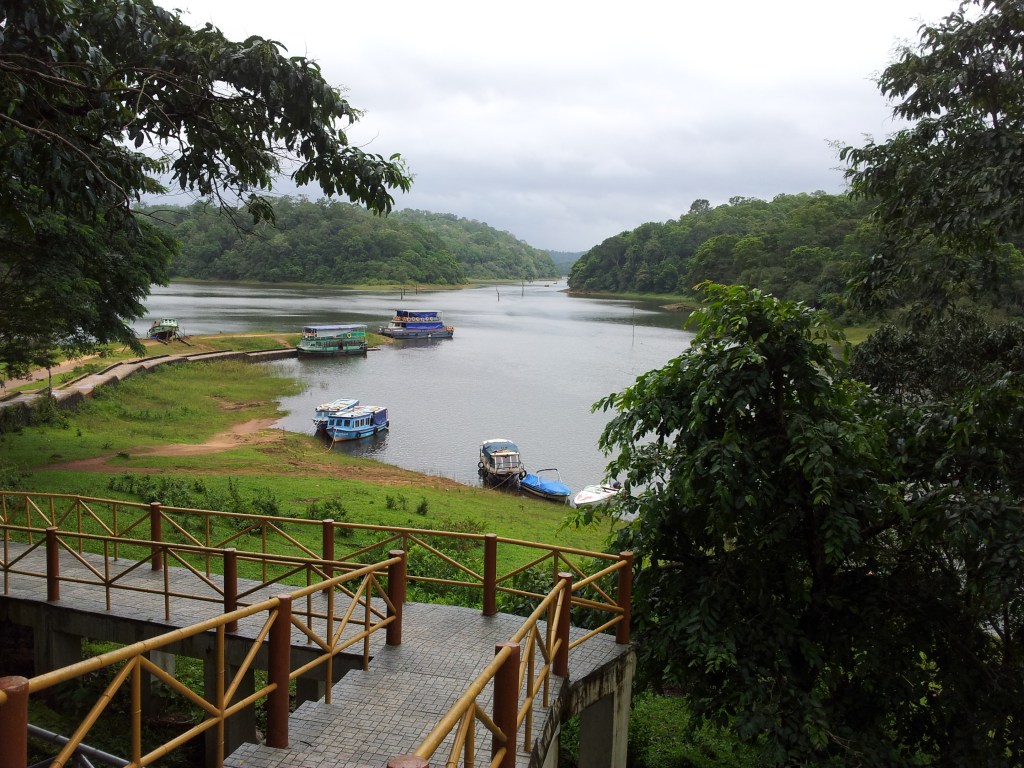
The picturesque Periyar lake with the anchored boats
The steps leading to the lake and boating jetty
The tree stumps that are so peculiar to this lake
Boating on the Periyar Lake
Now, imagine you are boating on the Periyar Lake. Look carefully at the picture below. Do you see some animals in the picture ?
Well….these are rocks that can be very deceptive . I am putting up this picture particularly to show how deceptive these can look to the eyes eagerly searching for animals!!!!
Now for some actual sightings…
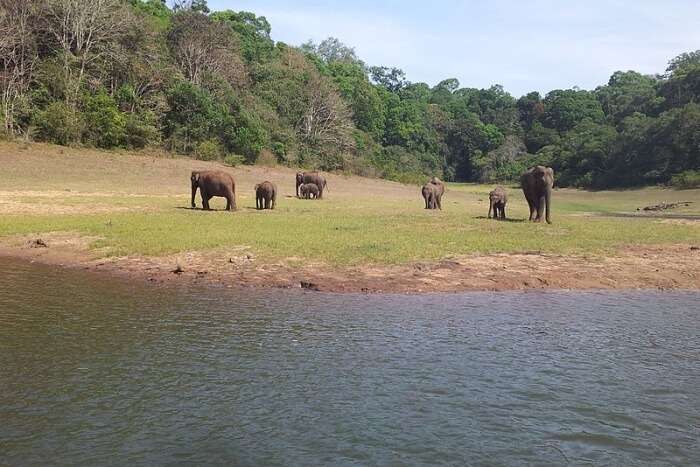
Some animal sightings during the boat rideon a bright and sunny day
One lucky day!…note the baby jumbo
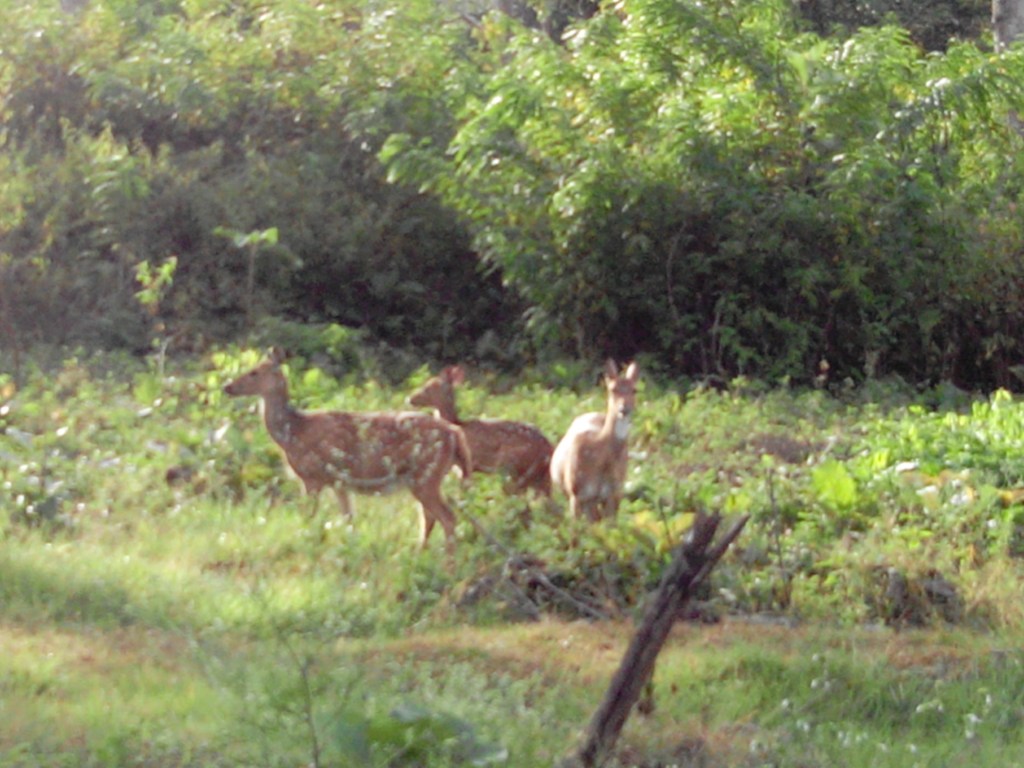
Deer
Sightings on a less favourable day….
A herd of Bison( the cloudy weather hampered visibility)
And some birds
After spending a couple of days among these amazing creatures , we returned back with beautiful memories to cherish. Wonder if the jumbos will remember us????
As I say goodbye today, I leave you with this message that I saw at the reserve…
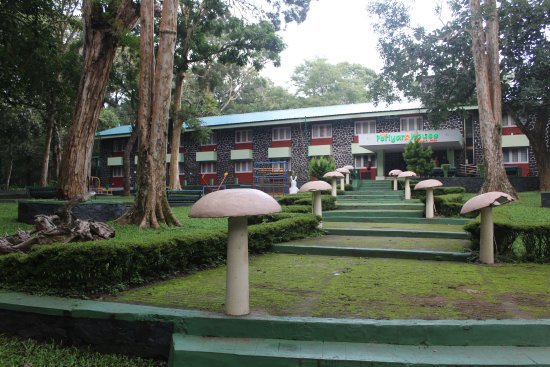
A message to humanity….
Till I meet you next week at a new destination, do not forget to subscribe, comment and give me your feedback…
Yet another temple and beach destination in Karnataka is Murudeshwar. Situated around 100 kms north of Udupi, Murudeshwar is also easily accessible by various means of transport and has grown in popularity over the years.
Murudeshwar Temple and beach
Murudeshwar lies on a projection of land into the Arabian Sea on the Karnataka coast. Due to this unique geography, it has sea on three sides and hence offers great views to visitors.
The place is surrounded by hilly terrain and the hills in the distance add to the beauty.
The peculiar location of Murudeshwar
Mangalore is the nearest airport.
Murudeshwar has a train station on the Konkan railway.
By road it lies just off the Mangalore Mumbai highway.
Murudeshwar Temple
As one leaves the highway and takes the road to the temple, there is an arch across the road. Driving further on the road, it gets crowded as one nears the temple. Shops selling trinkets, curios, religious pictures, pooja articles and food dot the road.
The temple dedicated to Lord Shiva is built on the Kanduka hill surrounded by water on three sides. The temple has a twenty storey Gopuram . A lift takes one to the top of the Gopuram .The main deity is Mridesa Linga or Murdeshwar.
A 123 ft high statue of Shiva is also part of the temple complex. This is the third tallest Shiva statue in the world and is visible from far away.
The temple complex is huge with smaller shrines dedicated to various Hindu Gods. Several shops selling puja articles and other necessities skirt the temple complex.
The Raja gopuram looks particularly attractive at night with lights at all the floors.
Some pictures…
The arch at the entrance
The Raja Gopuram
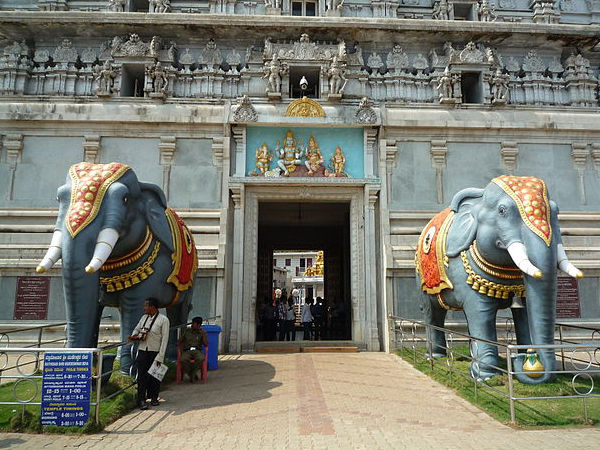
Two decorated elephant statues at the entrance
The Shiva Statue
Some of the other statues at the complex
The illuminated Gopuram and lights along the seafront
Murudeshwar Beach
The beach is located next to the temple and the activities spill over both ways making it difficult to separate the two.
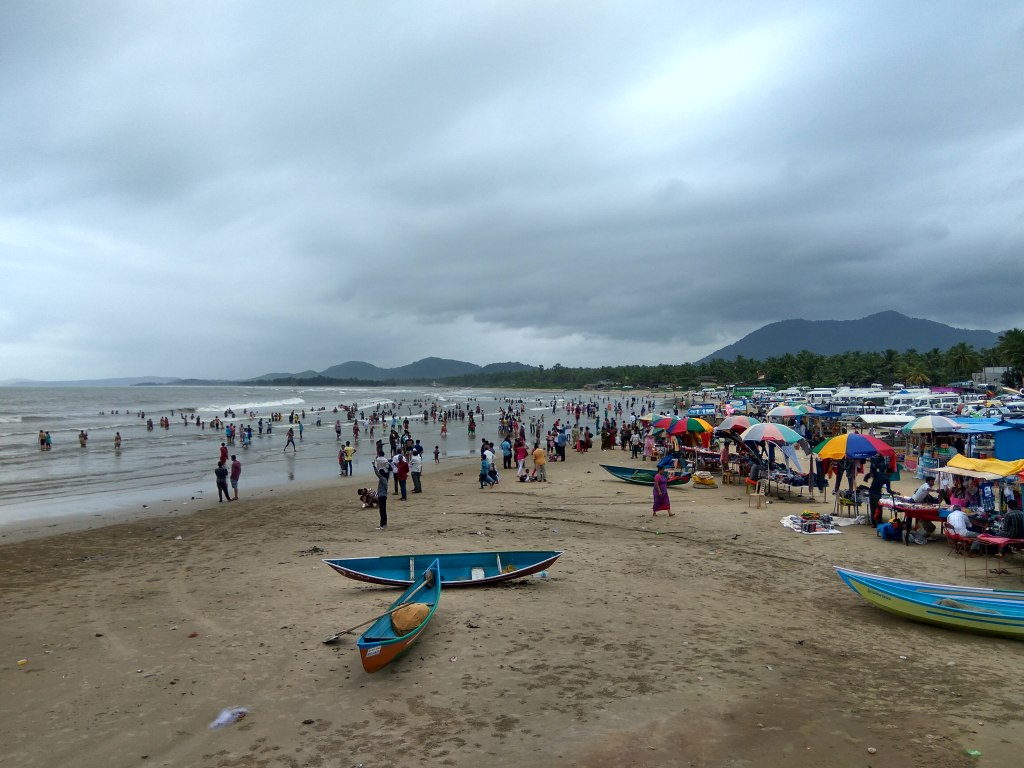
The beach is serene during the early morning hours but gets crowded by noon and in the evening it becomes almost impossible to even walk on the beach without bumping on to others especially during the holiday season. The unrestricted entry of vehicles to the beach front creates lot of confusion and difficulty for the visitors. So if you are averse to crowds, it is better to enjoy this beach early in the morning or from the peace of the hotel balcony in the evenings.
We were put up at RNS residency, a multi-storeyed hotel right next to the temple and the room offered great views of the beach.
Murudeshwar beach in the early morning
See the beach crowds in the evening with vehicles parked next to the water.
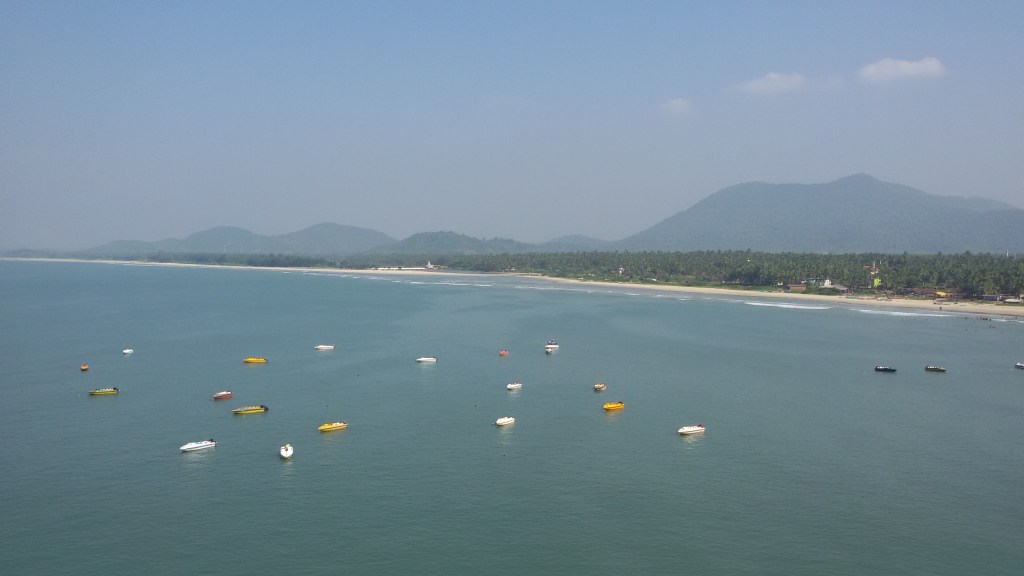
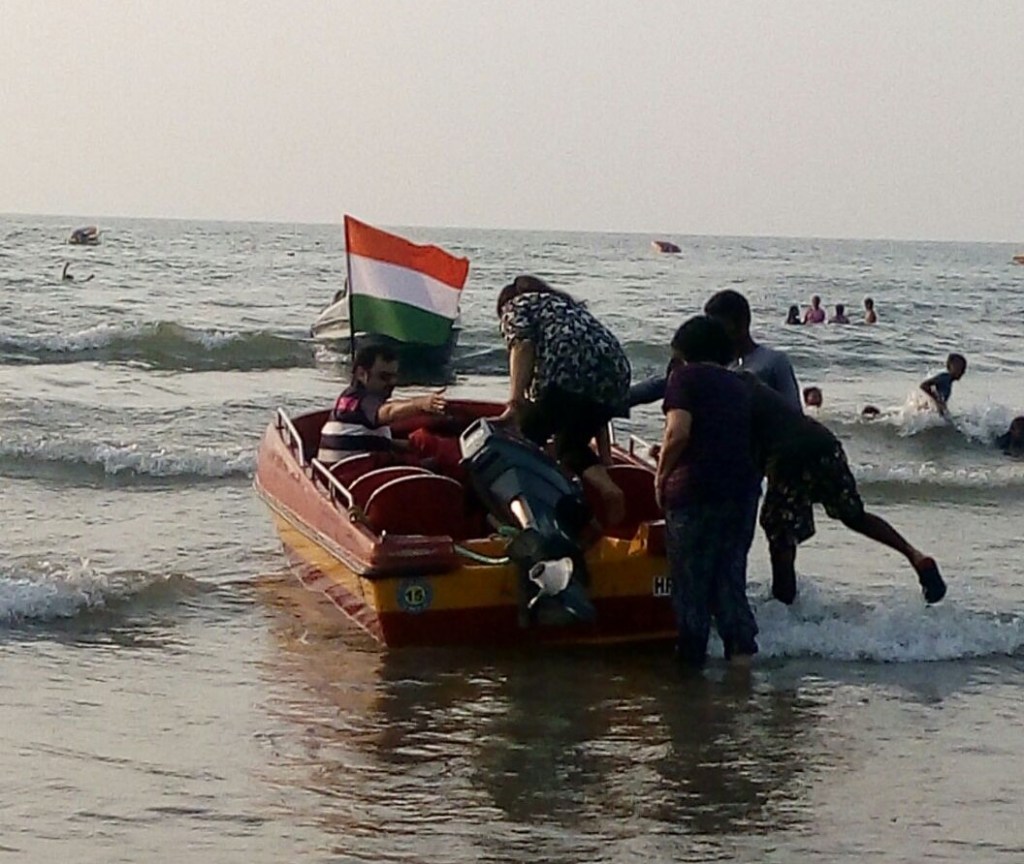
Murudeshwar beach also offers some water sports activities. Some pictures..
Preparing for a boat ride…
A boat ride….
Netrani Island
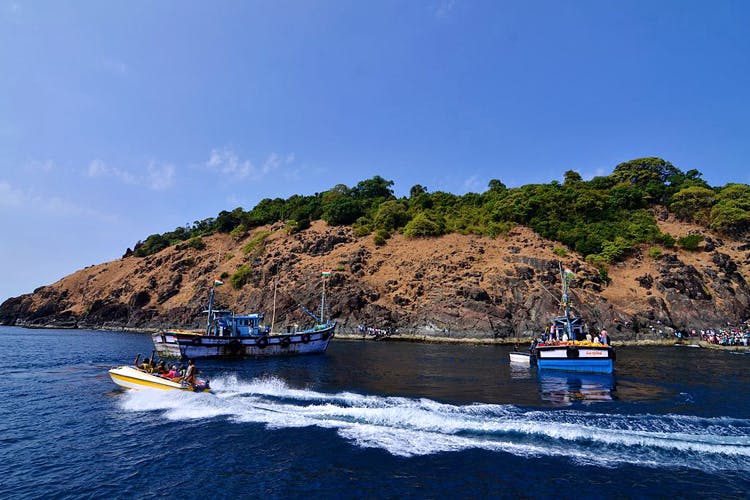
The more adventurous can venture to Netrani Island nearby. Another name for this island is Bajrangi Island .There are snorkelling and scuba diving facilities here. There are coral reefs around this island and they provide a nice spot for these activities. The boatmen on the beach organise the visit to Netrani island. Netrani Adventures is a company that offers scuba diving and snorkelling .
Netrani Island
As we are not particularly fond of crowds, we spent the evening at the balcony of the hotel enjoying the sea breeze and the views. Soon we were rewarded with a beautiful sun set view…
Sun sets on another beautiful day…
Next morning we visited the beach and it was calm and peaceful. Enjoyed a leisurely walk soaking in the views.
After returning to the hotel, standing in the balcony, I got a glimpse of a typical fisherman’s life as he went along doing his daily business.
A fisherman’s daily life….
After breakfast, we left Murudeshwar for Goa . A nice drive about which I have mentioned in my blog on the road trip. We reached Goa by late noon. More on Goa in a separate episode.
For now, let me take leave hoping that you enjoyed the trip to Murudeshwar. Do keep your comments and feedback flowing in…
Vagamon is a pristine hill station lying 65 kilometers from Kottayam at its border with Idukki district in Kerala. Fresh cool air, green meadows, pine forests, small waterfalls and tea estates welcome you to this beautiful place. It is called “Queen of the mist” and lives up to its reputation in all ways.
At a height of 1200 metres above sea level, it comprises a chain of three hills…Thangal hill, Murugan hill and Kurisumala. A series of green hillocks called Mottakunnu ( bald hill) is the highlight . One can walk along the misty winding roads or along the estates, and enjoy peace and quiet. The more adventurous can indulge in trekking, hiking and even paragliding. Thus it provides ample recreational opportunities suited for various tastes.
Resorts and homestays suited to every pocket is available here making it an attractive destination for all.
The nearest airport is Kochi about 100 kms away.
Kottayam is the nearest railhead 65 kms away.
It is an easy drive from Kottayam.
We drove down the Salem Kochi highway and drove via Angamaly, Perumbavoor, muvattupuzha, thodupuzha.
The winding roads leading to Vagamon with pine forests was very beautiful.
The winding misty roads as we reached Vagamon
After checking into our resort and enjoying some hot tea and snacks, we walked around the resort enjoying the peace and calm.
Views from the resort with plenty of tea gardens
A small stream provided a gurgling sound in the peace and calm….
Lost in the beauty of the place, we never realised the time pass by till ……
We were witness to an amazing sunset
After a peaceful night’s sleep, we woke up to a misty morning.
A misty morning at Vagamon
Enjoying local tea and the cold weather, we had breakfast and set off to explore Vagamon.
Some pictures….
Vagamon Meadows or Mottakunnu( Bald hills)
A collection of small hillocks with grass or meadows spread over a vast area , in fact stretching as far as one can see is quite unique to this place. This type of bare hills are without trees and provides a peculiar ambience. The sheer vastness of this area leaves one spellbound.
It is a popular film shooting location. The hillocks are great hiking and trekking destinations.
In the dry season, the grass disappears and then they are brownish hillocks which look totally different.
Vagamon Meadows or Mottakunnu
The Meadows from a distance
Pine forest
A man made cluster of tall pine trees on a hill slope overlooking a valley provides a nice backdrop for many a picture!
Pine Forest Vagamon
Suicide Point
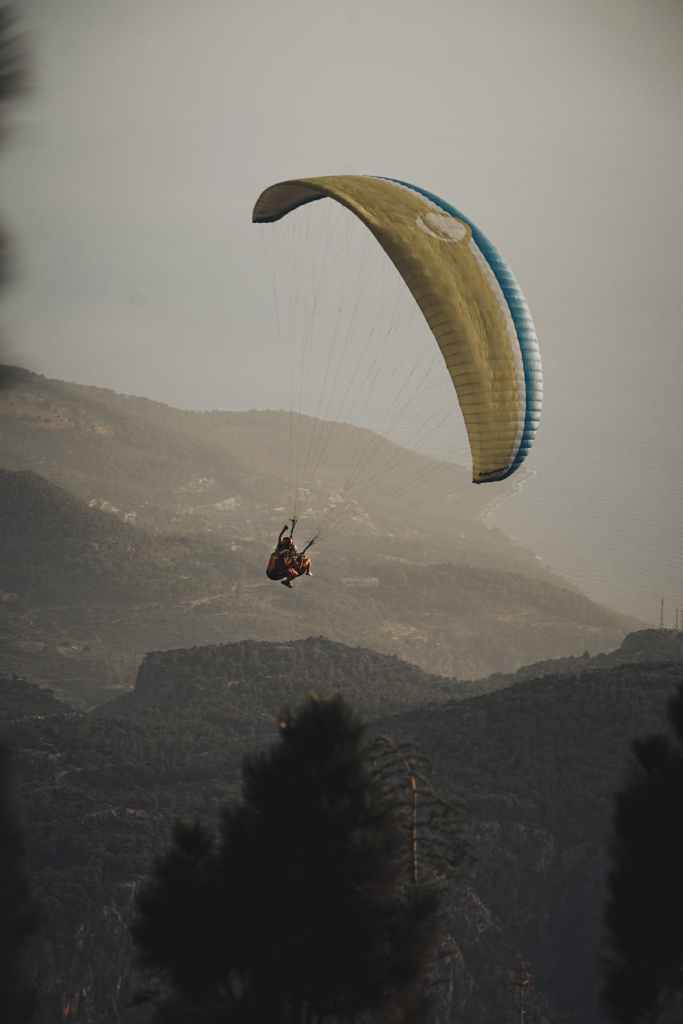
Also called Moonpara, it is a V shaped gorge and one can see the deep valley from here. Paragliding is an important activity here.
The abyss from suicide point
The valley below suicide point
Paragliding
All of us have at some point of time or the other wished that we could soar above the clouds like a free bird. Well Vagamon provides you that opportunity by way of paragliding.An emerging adventure sport activity , paragliding is thrilling and needless to say, requires special training to indulge in.
Vagamon is one of the paragliding destinations in India. Kolahalamedu hills , where this activity takes place at Vagamon; has a 10 km long ridge looking down at a valley 3000 ft deep. Paragliding depends on wind conditions and this location has ideal wind conditions for paragliding between the months of September and January. Most paragliding activities take place here during this period. International championships are held here usually in end September. Both professionals and amateurs indulge in paragliding here at that time.
The glider is a free flying foot launched aircraft and has a harness seat in which the pilot sits. The canopy is aerodynamic in design; made of nylon and attached to the harness seat by ropes. The pilot has full control of the glider and can manoeuvre it around. He can glide along like a bird enjoying the sights below. That sure must be a great experience!!
The pilot stands on the ridge and after ensuring all parameters are ready, runs down a slope. The wind soon starts filling the canopy and it opens out like a wing and the glider is airborne. For amateurs a professional pilot sits along with the person in a two seater glider and glides along.
Teams from the Indian Army and other Disaster management agencies regularly participate in the events held here apart from foreigners.
The colourful gliders soaring up and performing aerobatics is a sight to behold! When we visited Vagamon, the paragliding championships were due and we saw lot of people practicing for the event.
Some pictures….
A paraglider lands….
Soaring up in the sky….
Video of a paragliding session
Kuttikanam
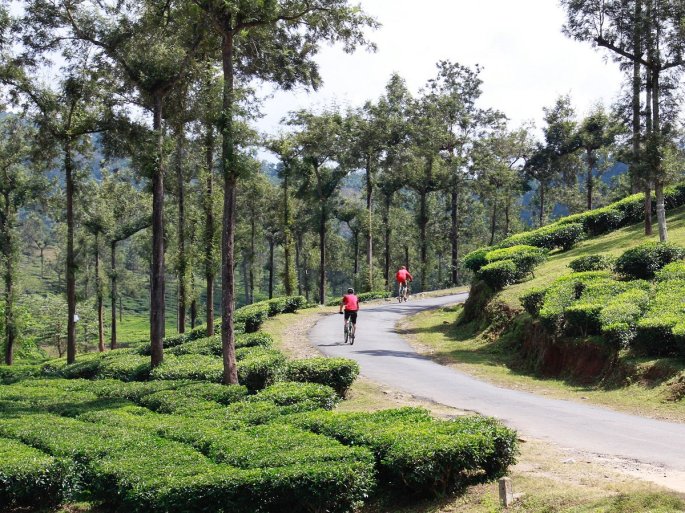
Just 24 kms from Vagamon is another misty hill station called Kuttikanam. Tea estates, and beautiful hills provide great opportunities for mountain biking, hiking and trekking here. There are beautiful waterfalls at several places and the town is mist covered many a time making it a beautiful destination.
Some pictures…
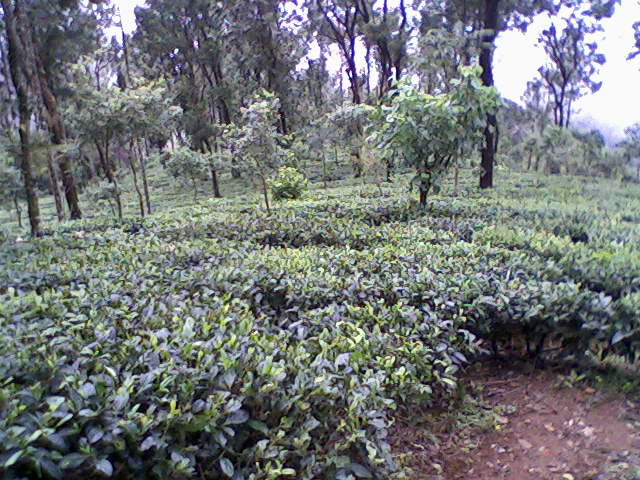
Tea gardens
A waterfall
After spending a few days at this beautiful destination, we returned with wonderful memories .
Anyone wants to indulge in paragliding?….head to Vagamon and indulge in your dream.
I had promised to do a detail blog on Malpe when I touched upon this jewel of a beach during my road trip episode. Well; here it comes….
Beautiful Malpe beach
Beach Umbrella typical of Malpe
Some of you will think….What’s so different ? A beach is a beach whether it’s in Goa, Kerala, TN, Maharashtra or even Pondicherry. Well it’s not like that…each of these beaches has it’s own flavour and ambience. Each of these beaches has its own colour of sand, the coarseness of the sand grains, the rockiness of the coast, the width of the beach, the drop of the sand ridge into the ocean and various parameters that make each one unique. Each of these beaches has its own unique water sports, food and local ambience too! I will be touching on most of these beaches in my forthcoming episodes and that should clear the air.
Located just 6 kms from the temple town of Udupi in Karnataka, Malpe beach is an awesome destination. Very few know about the wonderful beach that this temple town is home to.
Mangalore at a distance of 60 kms is the nearest airport and Udupi the nearest railway station. It is located very conveniently at a short drive from the Mangalore Mumbai highway.
Not as well marketed as the beaches of Goa, helps in maintaining its serenity and peace. I have visited this beach many times and I can tell you, its gaining popularity but simultaneously losing its peace. So those of you who love peace on the beach, you are running out of time!.. Head there before it gets to that stage of “just another beach”. Those of you who like crowded beaches can take it easy….the more you wait, the more crowded it will get…the popularity of this beach is growing!!!!!
A little history and geography…
Malpe is one of the exquisite unexplored beaches of the Indian West Coast. Located at the mouth of the Udayavar River, the rocky coastline has 4 islands, the most famous being St. Mary’s Island.
For centuries, Malpe has been an important trading port with the West. It is also believed that Vasco da Gama had made a short halt during his voyages at St Mary’s Island and it was he who gave the island its name. Malpe is also an important fishing harbour due to the diverse marine life here due to the mixing of the fresh river water and the sea.
Safety is what adds to the tourist attraction of a place. Being a very uniform and gentle sloping sand beach with no sudden depth , makes it one of the safest beaches in the region. As mentioned earlier, the popularity of this beach has grown and lot of tourists and locals reach this beach in search of a great beach holiday. The authorities have risen to the occasion and a lifeguard station functions here. Apart from that coloured flags indicating the level of danger are put up on the beach front regularly. Beach patrolling by the guards who monitor the swimmers also occurs.
Life guard station Malpe
Red flags on a risky day
Accommodation
Accommodation of various categories ranging from luxury hotels to backpackers and homestays are available close to the beach itself which makes it very convenient.
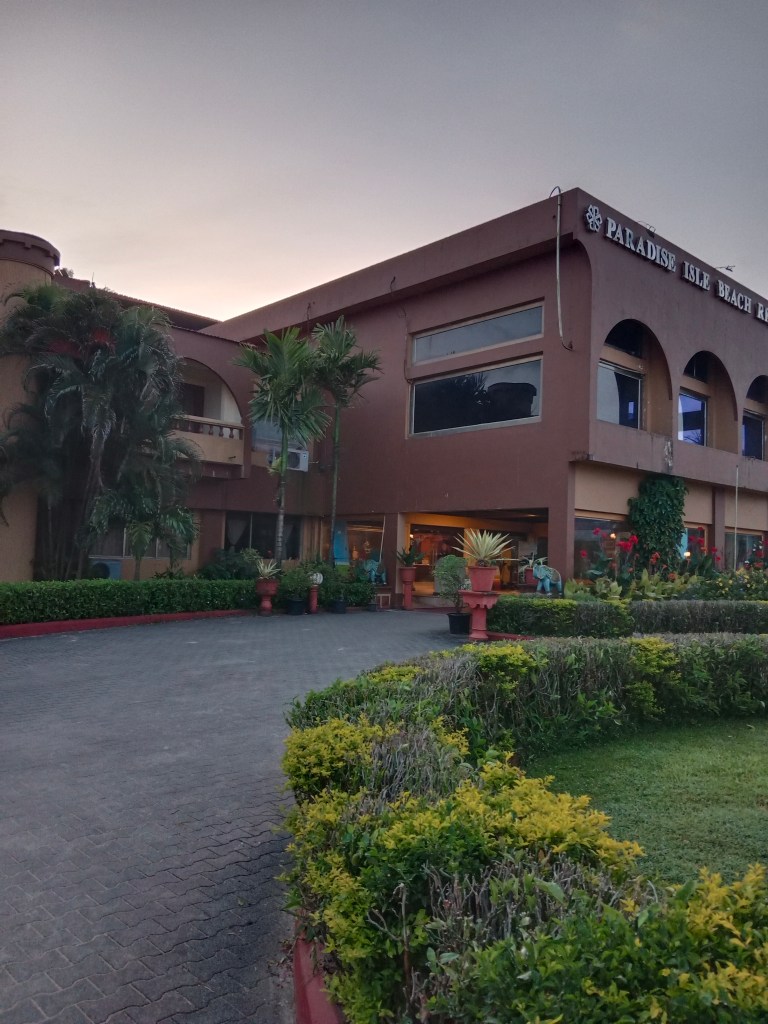
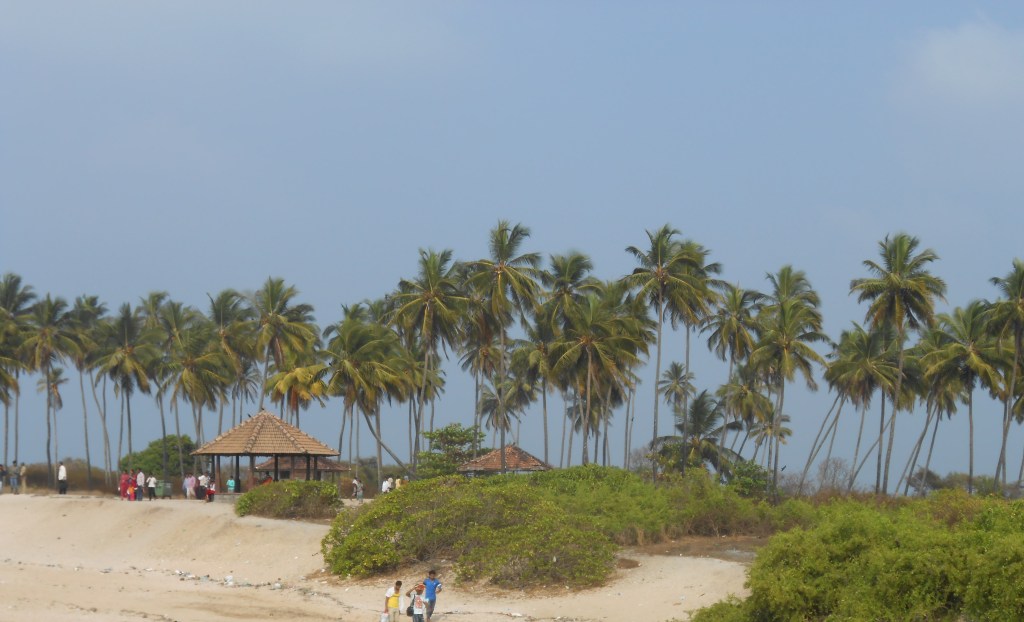
Paradise Isle Resort where we usually stay
Some other hotels overlooking the beach
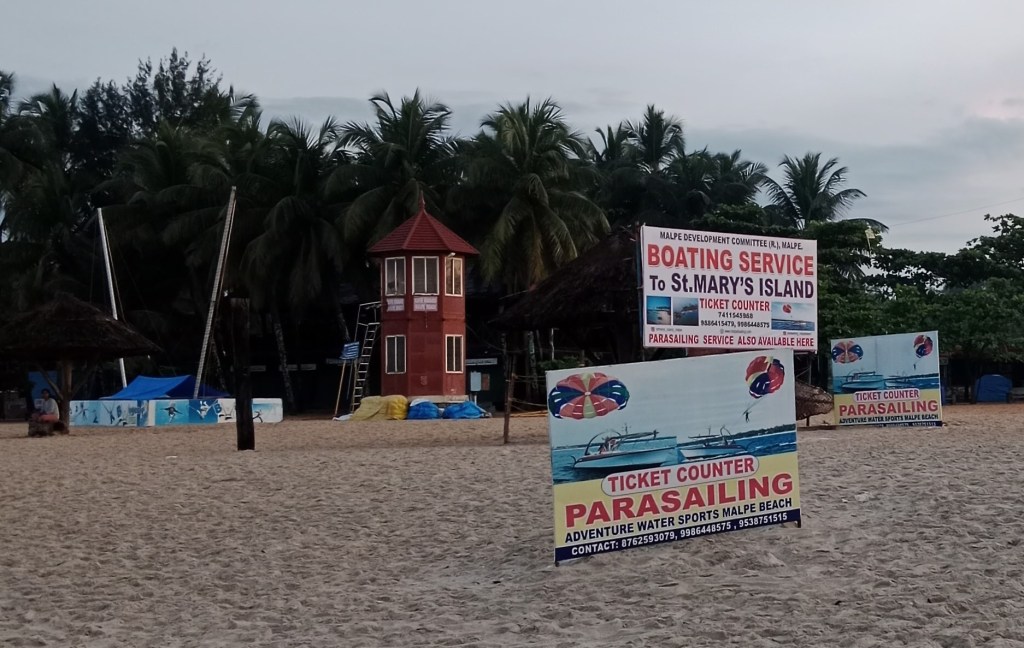
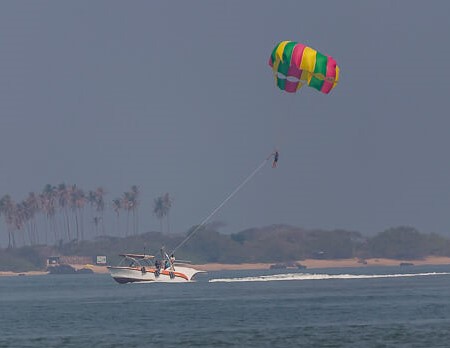
A variety of watersport activities take place here in the evenings. Indulging in them or even just standing by and watching them can be a very relaxing experience. Some pictures from my visit to Malpe…
Boards displaying various activities at Malpe
Some of the activities at Malpe beach
Sea Walk
A seawalk is one of the latest additions at Malpe that helps one enjoy the sunsets from an extended walkway into the sea.
Sea Walk Malpe
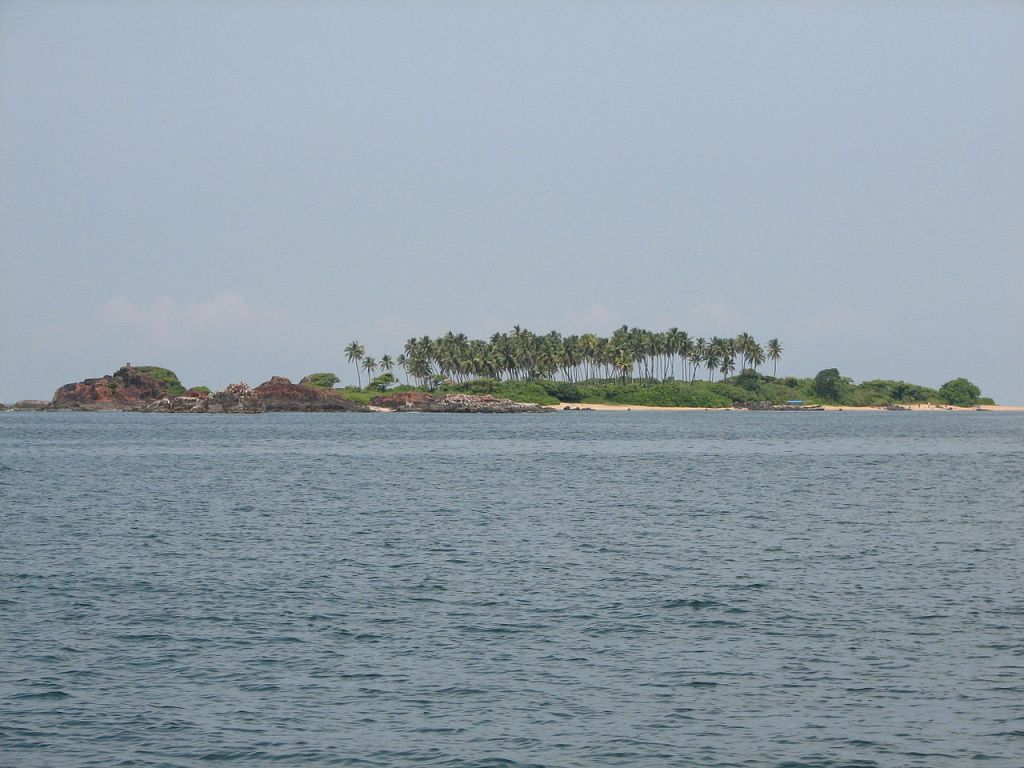
St Mary’s Island
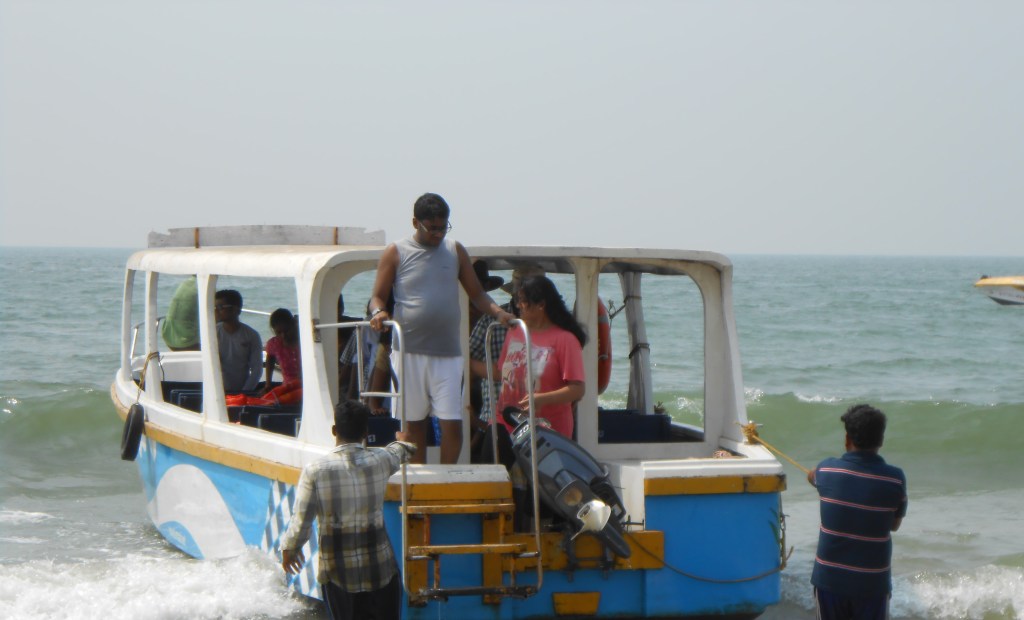
Another activity that one can indulge in, is a visit to St Mary’s Island. This island can be spotted in the horizon from Malpe. A short boat ride takes one to this palm fringed island.
The boat ride to St Mary’s Island
ApproachingSt Mary’s Island
St Mary’s Island
Rare basalt volcanic rocks are found here and it has been added as a National geological monument.
The Basalt Rocks
Food
The word Udupi is almost synonymous with typical South Indian breakfast fare of Idly,(a steamed rice cake) Dosa, ( savoury pancake made of rice),Sambar,( a gravy that accompanies the idly) and Vada (deep fried lentil fritters) . When we talk loosely of a Udupi Hotel, it refers to such vegetarian fare. But contrary to that, local food includes lot of nonvegetarian items too.
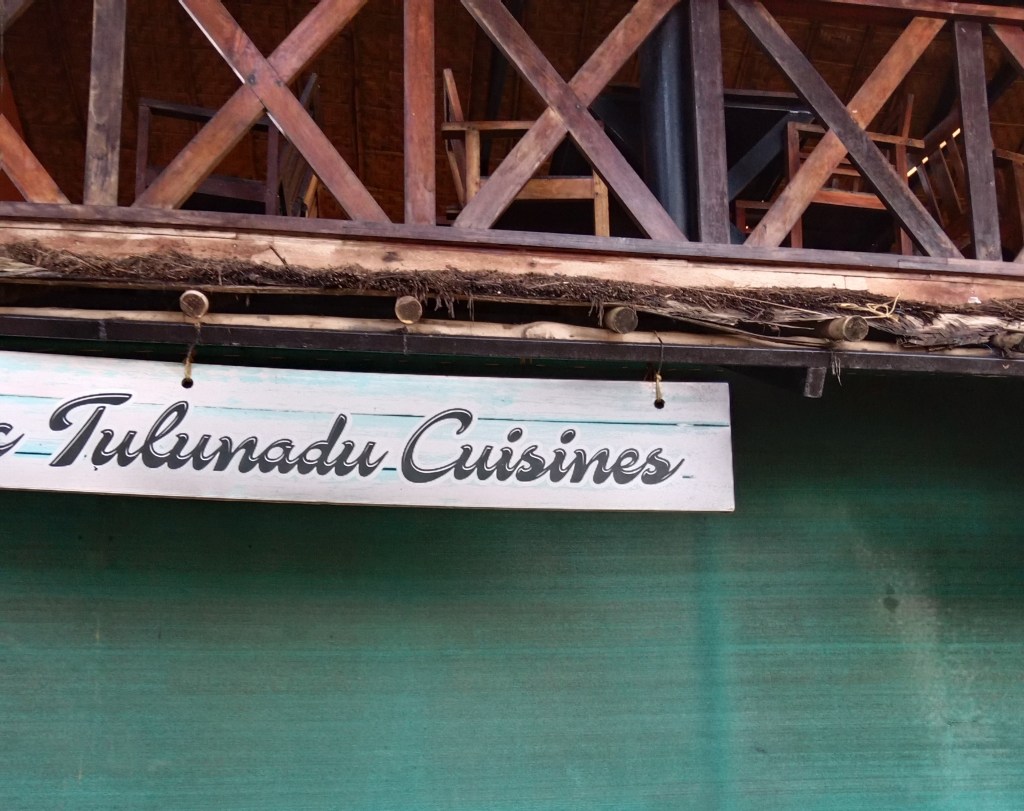
Malpe offers great non vegetarian cuisine especially fish. Tulunadu…that’s what this region is known locally , is known for its variety non veg fare. (“Tulu” is the local dialect of Kannada and “nadu” is country) Kori Rotti, ( chicken and wheat bread) Fish Curry, Prawn roast, Neer Dosai etc are part of typical tulunadu food.
A typical restaurant signboard
Just reaching the kitchen!!
A sombre ritual
I was witness to a religious ceremony one morning on the beach. A family was performing the obsequies of a relative.
It is customary for Hindu families to perform certain rituals after the death of their family members. It is performed close to waterbodies and Malpe is no exception….
Obsequies
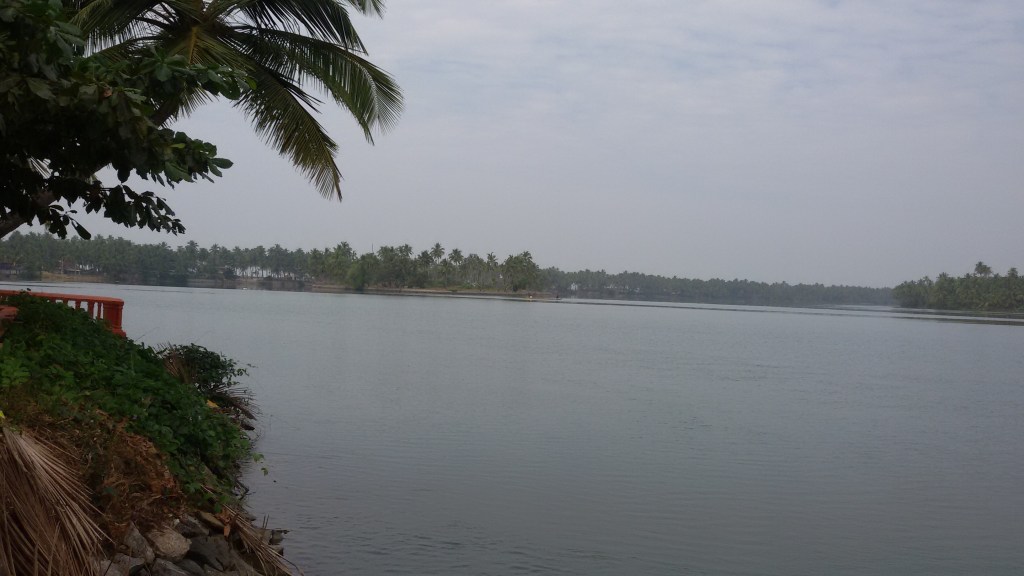
As you have seen, Malpe beach is a hub of activities that can keep anyone entertained. However, if you prefer a quieter place with the ambience of a lagoon, head to the mouth of the Suvarna river a few kms from the main beach. Here there are resorts on the banks of the estuary which have a quiet ambience.
Some pictures from one such place.
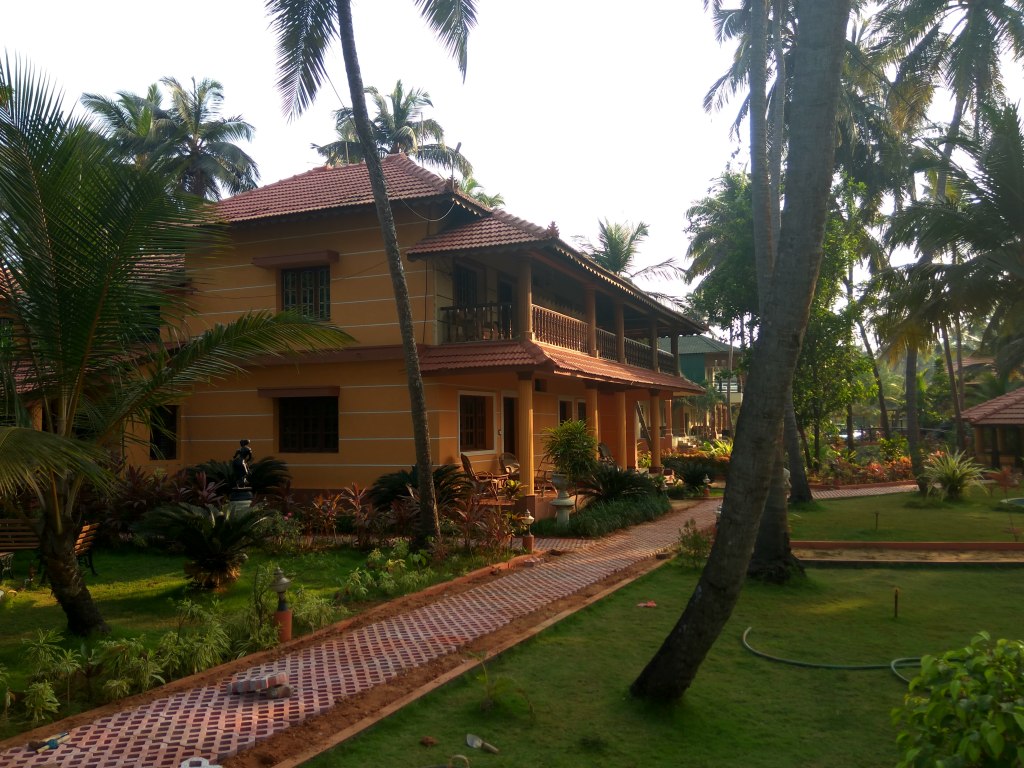
The resort
The beautiful views from the resort
With Malpe offering so many avenues of entertainment, it sure is finding its way into everyone’s bucket list. Apart from Malpe, one can visit other lesser known beaches along the Karnataka coast from here.
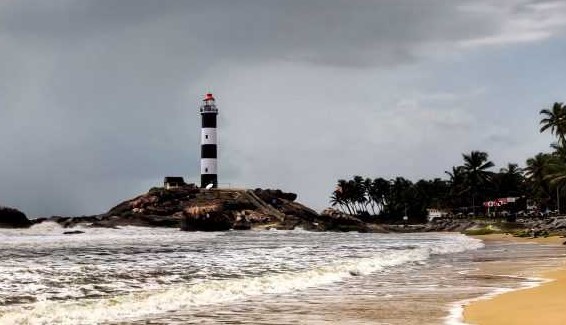
Kaup is one such beach destination where there is a famous light house. It is also a famous surfing destination.
Kaup Lighthouse
Maravanthe is also another beautiful beach close to Udupi on the highway.
Beautiful Maravanthe
So as you can see , there are lot of beach holiday options along the Karnataka coast. Easy to approach and pocket friendly, all of you should definitely try out some of these.
Before I bid goodbye , let me leave you with a sunset view from Malpe..
A cloudy sunset at Malpe…
As you plan your beach holiday, don’t forget to subscribe, comment and send in your feedbacks.
Munnar is a cute town nestled in the Western Ghats in the Idukki district of Kerala.
“Moonu” in Malayalam is three and “aar” is stream.Munnar got its name as it is located at the confluence of three rivers Muthirapuzha, Nallathani and Kundala.
It is known for its pristine green valleys, misty mountains, tea estates, spice estates, waterfalls, and dams. The Nilgiri Tahr, an endangered species of mountain goat is found here and in the adjoining Eravikulam National park.
At an altitude of more than 5000 ft above sea level, it enjoys cool winters and pleasant summers. It provides a nice escape from the hot and humid summers of the plains in Kerala and has hence grown into a popular tourist destination over the years.
Resorts and home stays abound in Munnar and provide accommodation of various categories to tourists making it easily affordable for everyone. It has also developed into a popular hiking and trekking destination in south Kerala.
It is easily reachable from Kochi which is the nearest airport located around 140 km away.
Angamaly and Kochi provide railway connectivity at a distance around 120 to 140 km.
It is also a pleasant drive after taking a diversion to Munnar on the Kochi Salem highway.
Our Trip
One beautiful morning, we drove down from Coimbatore to Munnar.
We took the route via Pollachi, Udumalpet and Marayoor which works out to roughly 200 kms.
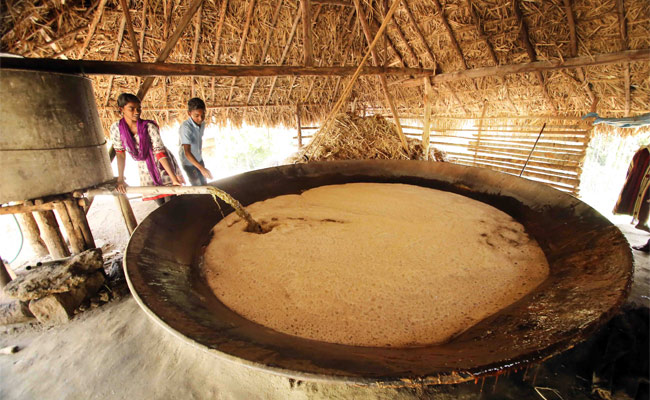
Marayoor is known for two things, the sandalwood forests and its jaggery.
The sandalwood forests of Marayoor
Molasses being processed into Jaggery
The finished product…jaggery balls
We also crossed Eravikulam National park on the way
Eravikulam National Park
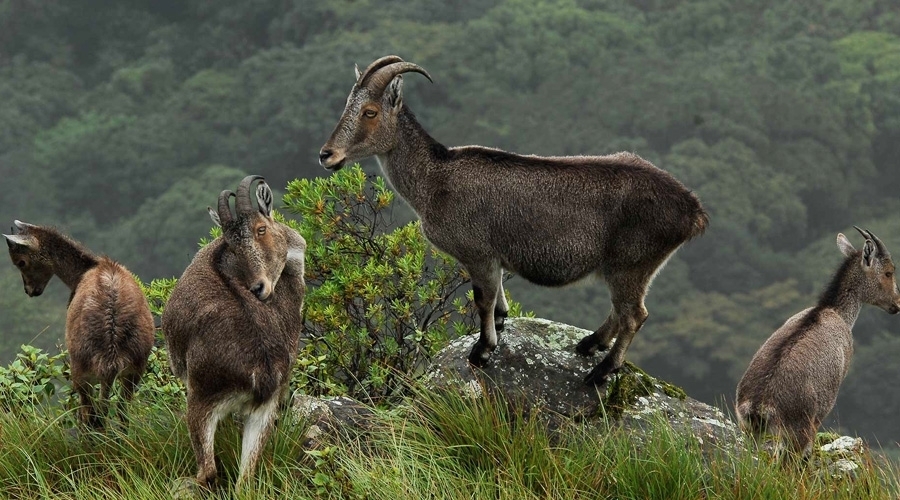
Eravikulam is a reserve forest area where tourists are allowed only in designated areas . It is home to the endangered mountain goat known as the Nilgiri Tahr.
The entrance to Eravikulam National Park
The Nilgiri Tahr
Reaching Munnar late afternoon, we checked into our hotel and rested for the evening enjoying the climate and the scenery.
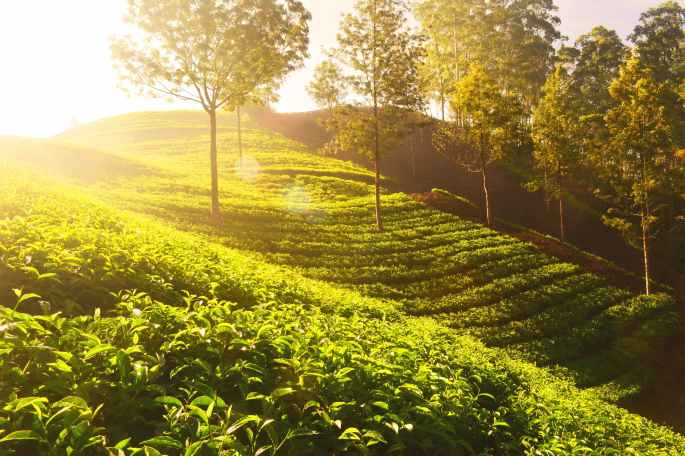
Tea gardens over acres and acres and over several hill ranges dominates the scene in Munnar.
View from the hotel
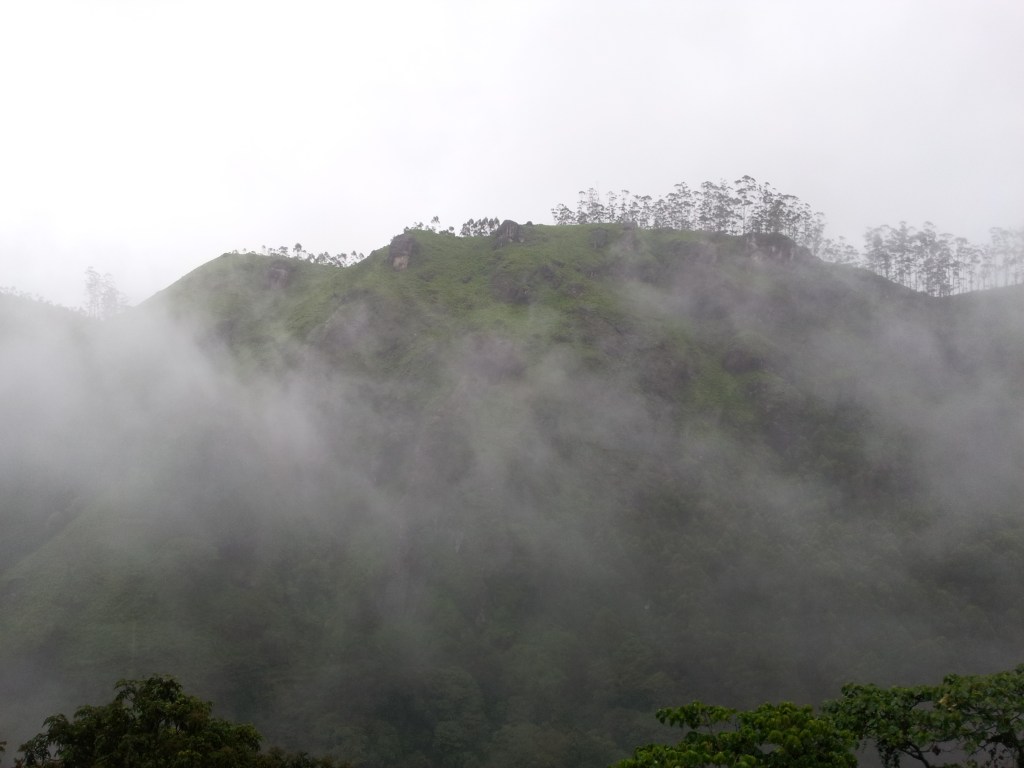
Mist covering the hills
Tea Gardens stretching as far as one can see….
Tea shrubs
Spice Estates abound in Munnar….particularly cardamom.
Cardamom plants
Over the next two days, we explored various points in and around Munnar.
Echo Point
Echo point lies about 15 km from Munnar town on the road to Top Station.
The Kundala lake provides a serene front to the hills on its backdrop covered with thick forests and lush green grass. These hills echo the sounds generated from across and hence the name.
Needless to say, one can hear a cacophony created by the tourists here!!
Echo Point
Kundala Lake
This pretty lake created by the Kundala Dam is another popular destination for tourists. Boating facilities in the lake in a backdrop of lush green mountains really make it a beautiful spot.
Earlymornings are less crowded here and one can get beautiful pictures particularly if clouds have descended here , as they sometimes do.
The serene Kundala Lake
Mattupetty Dam
Located on the Top Station road, this dam and lake are part of the Indo Swiss livestock project . It is a popular picnic spot even for the locals and one can go boating on the lake or undertake hikes and treks from here.
Mattupetty Dam
Attukadu Waterfalls
A multitiered waterfall, Attukadu falls can be seen even from a distance as one approaches Munnar. It is located in the middle of a rocky terrain and reaching close to the falls may be difficult for the less agile. As expected, this waterfall is in its full glory during monsoons or immediately after. A small pool at the end provides a nice bathing spot!
Attukadu falls from a distance
The water cascading among the rocks
Enjoy the falls in this video
Top Station
True to its name, it is the highest point in Munnar and offers unparalleled views of the Theni plains below. With green hills surrounding you on all sides. it gives a heavenly feel .
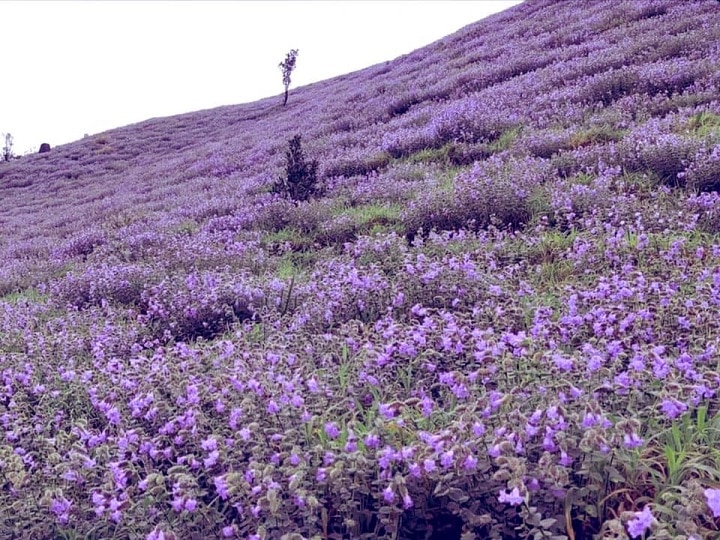
One of the highlights here is the blooming of the Neelakurinji in the hills once in twelve years. When in bloom, the hills literally turn blue in colour and adding to the beauty of the place
Top Station
The Neelakurinji in bloom
The Blossom Park
Situated close to Munnar town, this park is home to a variety of flora and fauna and is a popular picnic spot. When we visited Munnar, there was an orchid exhibition on at this park. We were treated to a feast of orchids in full bloom making us long to carry some of them home!!
The orchids….
Lakkam Falls
Another beautiful waterfall in Munnar is the Lakkam falls.
Lakkam Falls
Adventure Sport Activities
Various adventure sport activities like zip lining, mountain biking, rope climbing etc are available here for the enthusiastic tourists. Some pictures…
Adventure Sport activities
After enjoying the cool climate and the lush green surroundings, we were treated to this wonderful sunset over the hills on our last day at Munnar
The sun sets on a wonderful holiday….
Driving back via Pollachi, we were put off by the traffic and the heat ; but we were pretty sure we would go back there soon….
So do visit this tea paradise and of course pick up some tea from the factory outlets there….to savour the cup of tea ; if not the estates
Another lovely destination which is easily reachable but really refreshes one is Parambikulam. Parambikulam Tiger Reserve is located in Palakkad district of Kerala.It is located 40 km from Pollachi in Tamil Nadu. The tiger reserve is located in an area surrounding the Parambikulam Aliyar Project or PAP.
PAP
The Parambikulam Aliyar Project is a unique initiative aimed at augmenting the irrigation facilities in the drought prone Coimbatore and Erode districts of Tamil Nadu and the Chittoor area of Kerala. The project includes 10 dams , 4 power houses, 6 main tunnels and 7 irrigation canals. It accomplishes the integration and diversion of 8 rivers with reservoirs at various elevations and utilising this for generating hydro electric power. Most of these rivers are rain fed rivers in the Anamalai ranges. The canals, tunnels and reservoirs are located in picturesque surroundings in reserved forests. Thus , it utilises natural resources optimally and also serves the interest of tourism. It is also an excellent example of inter state cooperation between Tamil Nadu and Kerala.
The Parambikulam Tiger reserve is home to four tribal communities who live here in hamlets. These tribals work as guides for treks and safaris in the reserve and serve as an integral part of the comprehensive harmonious ecosystem.
The activities available here include Jungle safaris, treks, bamboo rafting and tree top experiences. There is a giant 500 year old Kannimara teak tree here. It is more than 41 metres in height and almost 8 metres in girth. This tree is worshipped by the indigenous people of Parambikulam. Legend has it , that it bleeds when anyone tries to cut it and hence the tribals preserved it. “Kannimara” means virgin tree .
Our Trip
We drove down from Coimbatore to Pollachi and after a sumptuous breakfast, headed to Sethumadai. The road was beautiful with trees on either side of the road.
Pollachi Anamalai road
From Sethumadai we first reached the Anamalai Tiger Reserve where the first check post is located.
Anamalai Tiger Reserve
Here we paid the entry fees and completed registration formalities and proceeded further and reached Top Slip.
Top Slip
From Top Slip, we proceeded further. As we proceeded further, we saw the Elephant camp at Top Slip.There were lot of deer in the forests around and very often they crossed the road in front of us.
The Elephant Camp at Top Slip
Deer roaming around freely at Top Slip
Proceeding further, we reached the Kerala border at Anapady where we entered the Parambikulam Tiger Reserve. Here again we had to pay the entrance fee and register the vehicle number .
Parambikulam Tiger Reserve entrance
About 2 km after this check post, we reached the Parambikulam jungle safari area. From here on, only people with pre booked accommodation are allowed entry into the reserve. Others have to leave their vehicles here and join the jungle safari organised from here in special vehicles.
Since we had booked for accommodation, a guide who belongs to the local tribe accompanied us inside the reserve. As we drove along inside the reserve we saw some more deer. Langurs and peacocks were also seen. We also spotted a fish eagle.
A peacock and an inquisitive langur
As we drove on, we entered more forested areas. Soon we were at Thoonakadavu where there is a large reservoir. As we drove past the reservoir, we saw some crocodiles basking in the sun on the banks of the reservoir.
The forested roads near Thoonakadavu
Thoonakadavu Reservoir
We proceeded further down and reached another reservoir , the Peruvaripallam Reservoir.
We had booked accommodation at Peruvari Island nest, a beautiful tree top bamboo house on an island in the Peruvaripallam reservoir.The only way to reach this resort is by bamboo rafts.
So we had to leave our vehicle near the bamboo rafting point and we boarded a bamboo raft .The local guides including the guide who accompanied us rowed the raft.
The Bamboo raft
Starting our journey to the Island resort in the bamboo raft
This was really a unique experience. The surrounding areas had large bamboo clusters which looked beautiful against the waters of the reservoir.
The beautiful bamboo clusters on the banks of the reservoir
Reaching the Bamboo house….seen with green roof in the back drop
The beautiful tree top bamboo house called Peruvari Island Nest
The house was made of bamboo and had all modern amenities. In addition, there was a bamboo extension bridge built into the reservoir where we could walk up to and enjoy the scenery around
The bamboo extension bridge
Feeling happy and safe on grandpa’s shoulders
The local guide who accompanied us quickly provided us some tea and snacks which we enjoyed sitting in the balcony of the tree top house.
It was truly a great experience. Beautiful views of the reservoir and surroundings with cool breeze wafting in made us feel ecstatic.
Beautiful views from the tree top house
After sun set, it was a different experience with the sounds of the forest and occasional sounds of nocturnal birds.
The guide along with the local raft helpers cooked up dinner for us. We enjoyed the meal in the stillness of the night. Spending one night in an island in the forest was really something unique for all of us.
Next morning we enjoyed the views of dawn and the breakfast provided by the helpers. After that we took the raft back ashore and then visited the Parambikulam dam by car.
At Parambikulam dam
We wanted to see the Kannimara Tree but unfortunately the road leading to the tree was damaged and tourists were not allowed at that time.
From there we proceeded back home via Pollachi with refershed minds and wonderful memories of a day well spent in the lap of nature.
This is again a very easily doable option for a unique refreshing holiday. The experience of living on an isolated island in a forest is a rare opportunity. So just pack your bags and head to Parambikulam…..
To keep me refreshed and enthused to get you more destinations, do keep your comments and feedback flowing in like the gentle breeze of Parambikulam….
P.S
There are various accommodation options available at Parambikulam and one can pre book at the site
This time, I am on a road trip from Coimbatore in Tamil Nadu to Ratnagiri in Maharashtra…..a simple Indian road trip. Not focussing so much on the destinations as on the travel.We covered a distance of more than 2000 kms over 10 days, halting at interesting places along the way.
A map showing the route we took….
The Route Map
This blog will focus on the sights along the way…
Starting from Coimbatore early morning our target was 200 km to reach Mysore by noon. Drove to Annur where we had breakfast of idli, vada….traditional south Indian and topped it up with filter coffee.
From Annur we were headed to Sathyamangalam. On the way we passed a famous temple at Bannari
Bannariamman Temple
It was a cloudy day and the drive was pleasant. The road condition was good by and large. Crossed the town of Sathyamangalam and headed to the Dhimbam ghat road.
This drive took us through the Sathyamangalam Tiger Reserve . Some pictures captured as we drove through the reserve..
The entrance to The Sathyamangalam Tiger Reserve
A video to give the feel of driving through the reserve.
Soon we found ourselves on the Dhimbam ghat road. This road has 27 hairpin bends …some of them almost V shaped with significant lorry traffic making it a little challenging for anyone.
The Dhimbam ghat begins…
The Dhimbam ghat road
The view of the plains below
The sharp turns
Soon the fog started setting in hampering visibility…
Fog setting in
Dhimbam was the highest point and from there we started the descent.
As we descended, the fog reduced and we were in for some sunshine…and of course the vegetation also changed. There were bamboo clusters all along. This area is a elephant habitat and the bamboos are probably the reason , as it is a favourite of the giants.
Warm sunshine again
Bamboo clusters…change in vegetation
Soon we were at the town of Hassanur where everyone was taking a break….
The break at Hassanur
Hot vadas sizzling in oil
Soon after that we crossed the border from Tamil Nadu to Karnataka.
We crossed over to Karnataka
From there we headed to Chamarajnagar…a small town on the way. The road was bad for a few kilometers here.
Then on to the temple town of Nanjangud , and on to Mysore
Nanjangud Temple gopuram
Reaching Mysore just past noon , we took our overnight halt here. Checked into the hotel, rested for sometime and took a nice walk around The Radisson Blu hotel . Had some nice filter coffee and bonda in a hotel nearby.
Saw the excited crowds at the zoo which we were not interested in , as we had visited earlier. Returned to the hotel, had dinner and rested for the night.
Left Mysore next morning and took the Mysore Madikere highway NH275 en route to the temple town of Udupi which was our next halting point…..300kms drive
Authentic Karnataka breakfast of Dosa at Mysore
Mysore Madikere highway
The Mysore Madikere highway had good road condition and some pictures taken on the way...
Fruit shops like this one dotted the highway as we left.
Besides, there were lot of new developing housing projects on the outskirts of Mysore.
As we moved away from the city, more fields were seen on either side…..
Fields on either sides of the highway
Road signs like this one provided guidence and direction as we proceeded.
Some of the towns we passed was Hunsur, Periapatna and KushalNagar.
Just as we reached KushalNagar, we crossed Bylakuppe, the Tibetan settlement colony.
The Tibetan settlement colony at Bylakuppe
Tibetan monks in traditional attire is a common sight around KushalNagar.
A few kms away, we crossed Nisargadhama too. Nisargadhama is an eco park along one of the tributaries of the Cauvery river which offers various recreational facilities. It is one of the important to-do destinations from Coorg/Madikere.
Nisargadhama
Gradually the roadside scenery changed from fields to estates of coffee heralding our location to be Coorg. The climate was also getting little cooler and we had a slight drizzle. This added to the beauty though it hindered my photography.
A typical coffee plantation with pepper vines on the trees.
Another familiar site as one reaches coorg are the boards advertising typical Coorgi food .
Coorgi Pork recipe advertisements are typical here
Soon we were at Madikere ,where we bypassed the town. There is a proper bypass to this town and it helped a lot in saving time.
After that, there was a steady incline and the roads were more winding.
We passed several coffee and pepper plantations on the way. Coorg has plenty of spice plantations and the roads are dotted with spice shops.
The roads started getting more winding .
More coffee and pepper….
We did take a short coffee break among the coffee estates…
A short coffee break was welcome!
Another typical roadside sight are the spice shops like this.
After some beautiful scenic roads, the coffee estates were replaced by rubber estates heralding our descent to the plains….
Rubber estates on the way
We were entering south Karnataka and the main city there is Mangalore.
The first main town was Sullia where had a lunch break.
A typical south Indian Thali Meal
After lunch, we crossed Puttur and were heading to Bantwal when we had a stretch of real bad road for about 10 kms. That really slowed us down , but after that we took NH 73 which was again pretty good and reached Bantwal.
The Bantwal river was one of the first of the many rivers that we crossed on our way
After Bantwal, we joined NH 66 and headed to Mangalore but diverted off to Udupi from the outskirts ofMangalore . Again we did cross some bridges over rivers like this one near Mulki town
The Mulki river
Soon we were at Udupi the town known for its Sri Krishna Temple where we took a halt for the night.
We had visited the temple earlier and decided to stay at Malpe, a beautiful beach resort town near Udupi.
Malpe is a beautiful beach resort near the temple town of Udupi. One of the safest beaches in this area, it has various recreation activities. Some pictures from Malpe….
Beautiful Malpe beach
Resort at Malpe
Evening at Malpe
We also made a new friend here, a little lady who compared us to her grandparents ……
A new friend at Malpe
There is a lot more about Malpe which we can talk about in an episode dedicated to it. Here, Malpe is just one of our halts on the trip….
Next morning we departed from Malpe headed to Murdeshwar.
This was actually a break day after two long days of driving. So we did a short journey of around 100 kms only.
Continuing on our own “Route 66″…NH66
NH66…..our own “Route 66“
This route is dotted with bridges crossing beautiful rivers and backwaters ( difficult to distinguish) . Islands of mangroves can also be seen here in many places.
One of the many beautiful rivers on this route
There is a beautiful beach on this route at Maravanthe where the road is adjacent to the beach….some pictures from Maravanthe
Beautiful Maravanthe
Maravanthe….the beautiful beach
After this amazing beach comes the town of Kundapura from where one can visit the famous Kollur Mookambika temple.
The beautiful Sowparnika or Kollur River
Mangrove islands in the backwaters
Our destination for the day was the temple town of Murudeshwar where we halted .
Murudeshwar is a temple town with a huge temple dedicated to Lord Shiva.This templeis unique in many ways and more details will come up later.
Murudeshwar has a beautiful beach with lot of water sports activities too. More on Murudeshwar in an episode dedicated to it.
The arch at the entrance to Murudeshwar town
The beautiful beach at Murudeshwar with its water sport activities
Next morning after breakfast we were headed to Pernem in Goa, a distance of 300 odd kms for the day.
Joining NH 66 again we continued our journey northwards skirting the west coast.
One thing I noticed was the lurking danger of cattle crisscrossing the NH 66. I must mention this here as it is rampant. Cattle are left to fend for themselves on the road and they are a serious threat to the unwary driver. We did see a couple of cattle run over along the highway too. This trend continues into Goa and Maharashtra too. On city roads we do find cattle , but on a highway with speeding vehicles they really pose a danger.
Lurking cattle ….danger on NH 66
Some of the important towns we crossed were Honavar, Kumta and Gokarna.Also saw the roads to Sirsi and Jog Falls branching off the highway.
The River Gangavali was skirting the highway for some time too.
The River Gangavali skirting NH 66
Soon we crossed Ankola and Karwar and there was a clear change of landscape see. Muddy hill slopes dotted the highway. The highway was probably carved out from these slopes.
The muddy hill slopes from which NH was carved out
Soon we crossed the Karwar Naval Base, Karwar fishing village and Karwar Port
Karwar fishing village
Port of Karwar
Soon we were on a long bridge across the Kali River.
The Kali River
Soon after this we crossed the border to Goa.
One of the first signs that greeted us at Goa was this….
Welcome to Goa….
Crossed the Talpona river . Could see the muddy water clearly joining the blue sea.
The Talpona river…note the muddy water and the blue sea at a distance
Plenty of rice fields also dotted the highway…
The paddy fields of Goa
After entering Goa, for a considerable distance, it looked like an ordinary road and often with ghat sections. Soon we joined a 4 lane highway and then on to some amazing roads. A long flyover which crosses backwaters at places connects North and South Goa.
Was quite impressed with the infrastructure development in Goa. Crossed the Zuari River bridge. As we crossed it, we saw the new Bridge under construction….really impressive.
The new Zuari Bridge under construction
We also saw the Atal Sethu bridge which is a cable stayed bridge which is over 5 km long and is the third longest cable stayed bridge in India. It is built over the Mandovi river and one can see the River and the passenger terminal as one crosses the bridge.
Atal Sethu Bridge
The Mandovi River and Goa’s passenger terminal.
Proceeding further north we reached Pernem where we halted at Mandrem Beach which is one of the last beaches in North Goa.
At Mandrem, we halted at the Riva Beach resort. Some pictures..
A cute wooden bridge across a small backwater stream leading to the beach
The resort as seen from the beach…nestled among coconut trees
Beach bar
Some authentic Goan food was also on our radar
A typical Goan Thali with a big chunk of fish
After a day’s break at Riva Resort where we rested, we were headed further north towards Maharashtra’s Ratnagiri. Another 300 kms was our day’s target.
We continued on NH 66 for a considerable time and from Rajapur diverted towards Pawas.
Very less traffic once we left Goa and the highway was concreted probably keeping the high rainfall that these regions face in the monsoons.
The highway was dotted with huge mango orchards…
Mango orchards
The road from Rajapur was bad and it took us some time to reach Kohinoor Samudra Beach resort at Kurli in Ratnagiri. This resort is just 5 km from Ratnagiri town.
It is a huge resort with excellent views of the sea . Located on a hillock, we can see Bhatye Beach Ratnagiri from here. It looks awesome…the arial view..
Some pictures from Kohinoor Samudra resort where we spent Diwali 2022.
The open sea as we reached Kurli.
View from hotel, the Ratnagiri light house point is seen in the backdrop
Bhatye beach from resort
Sunset point at the resort with cliffs protruding into the sea.
Diwali celebrations at the resort
The sun sets on Diwali 2022
After a two day halt at Ratnagiri, we started our return trip
Benaulim beach in South Goa was our next destination.
Since we were following the same route down to South Goa, on NH66, the views were the same…some pictures
A typical Goan scene
One of the many churches that dot Goan roads
I must mention here one more dangerous trend on these highways. The 6 and 4 lane highways suddenly become 2 lane roads specially close to towns, With no proper warning boards, this can be dangerous and one has to be careful.
One such example
Sudden narrowing of the highway...a real nightmare on the drive
Well apart from being careful ourselves, nothing much can be expected….
Leaving the unpleasant things away….let’s talk about Benaulim…one of the best Goan beaches I have seen.
Really great broad beach with clean whitish sand.
We stayed at Benaulim for two days and enjoyed the beach ambience and of course also saw the rare solar eclipse from here!
At Fairfield Marriott Benaulim
Beach shacks at Benaulim
A parasailer looks down at the sands of Goa
And I managed a shot of the solar eclipse at sunset
Next day, we were headed to Koteshwar, a town close to Udupi where there is a beautiful beach at Beejadi. An unspoilt beach ; far from human intervention, it was a sort of private beach for us.
We were put up at Gluklich Beach Cottages, a cute small beach resort with direct beach access. Some pictures..
Gluklich Beach Cottages
Some of the offered activities
As you walk to Beejadi Beach
The long coastline along Beejadi beach Koteshwar
A lone unfortunate star fish was washed ashore!
Nature had sketched on this beach!
And we tried our best to get the sun home!!
The last beach sunset on this trip….had to be beautiful…..see the pink of the sky on the sand below!!!
After a nostalgic goodbye to the beaches, we returned to the hotel for the night.
Next morning we left Koteshwar for Hassan, a distance of 230 kms which we thought would be easy , but it took us some time due to the ghat roads, bad roads at Chikmagalur and nearing Hassan.
Some of the main towns we crossed were Haladi , Belve, Agumbe, Balehonnur, Chikmagalur and Belur.
After Haladi and Belve we were in to some winding roads with thick forests on either side. Arecanut and Cashewnut orchards were another common sight here.
Arecanut farms
Cashew orchards
Soon we were on the ghat road to Agumbe. Agumbe is one of the places in this region which receives lot of rainfall. Close by to Agumbe near Sringeri is also the most number of Indian King Cobras sighted according to National Geographic. The forested ghat road had some challenging hairpin bends where vehicles often stopped to give way to others. Some pictures
Thick forests line the ghat roads
Sharp turns at Agumbe ghat
The spectacular views from sunset point Agumbe ghat
After we cleared the ghat road, we were at Agumbe town and following SH 27 and 65 we were into Chikmagalur district. Coffee , pepper and arecanut plantations dotted the roads. Surprisingly we did pass through a small tea estate too. Some pictures
Coffee plantations
Driving through a coffee estate
The roads were pathetic in Chikmagalur area to say the least! There were no roads at places….felt like we were on a Himalayan rally!!!!!
After an overnight halt at Hassan, we left next morning to Bangalore and reached our son’s home by noon. Staying there for a couple of days, we took a breather after nearly ten days on the road.
After a nice stay at Bangalore, we drove back to Coimbatore.
A successful road trip of more than 2000 kms; a memory to cherish!
This blog has been different from my usual ones…
HERE I WAS FOCUSSING ON THE JOURNEY RATHER THAN THE DESTINATION! As promised, details on the various beaches will be covered in separate episodes . And as per popular demand, food was also included !!!