Road to Paradise and beyond

Here we go..

On to the series on Alaskan Adventures…

Today’s episode is geographically not an Alaskan adventure. This is in the state of Washington but I am putting it here simply to give you an idea of the sequence of travel and it was from here that our adventures started. So let’s go…

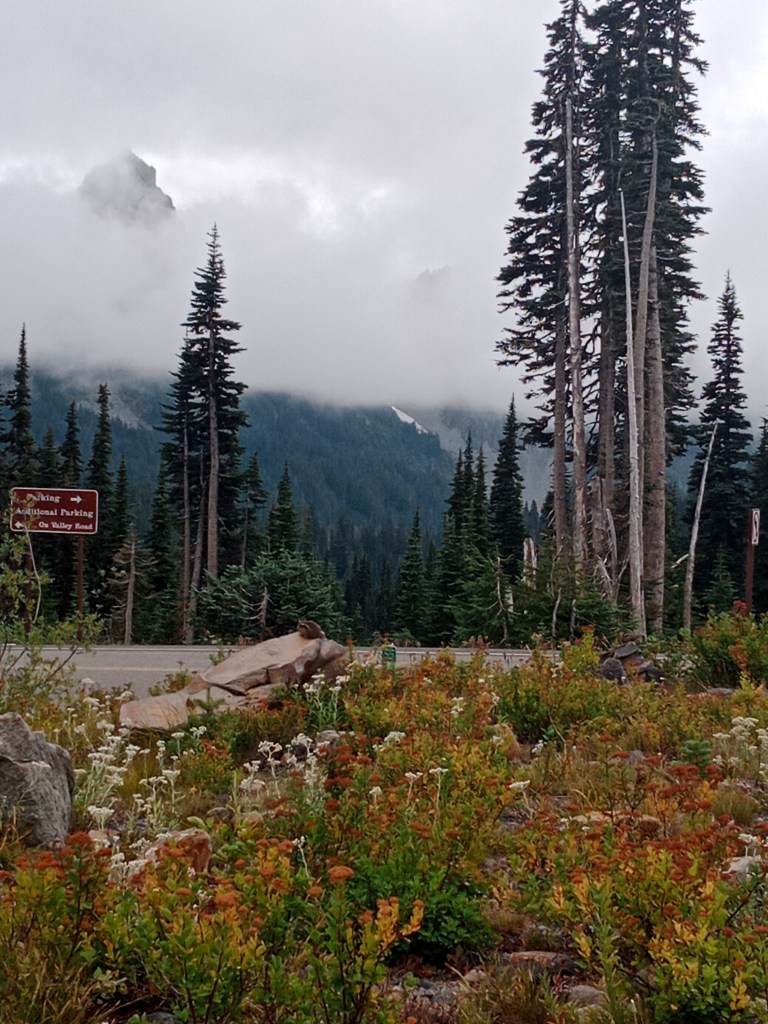
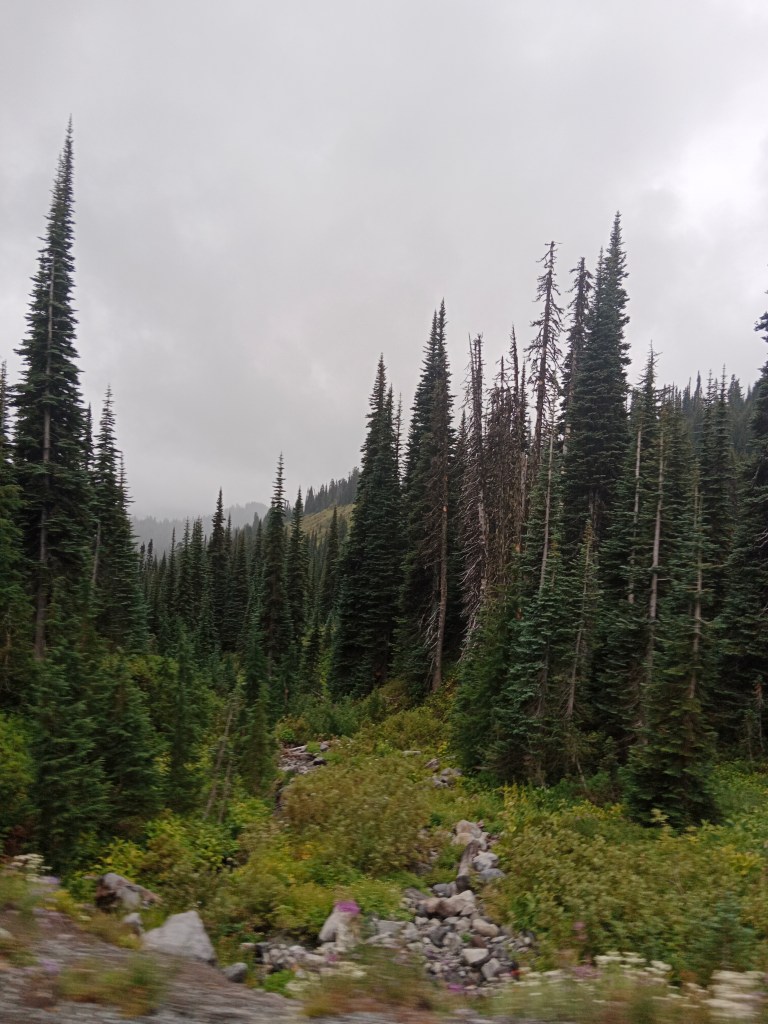
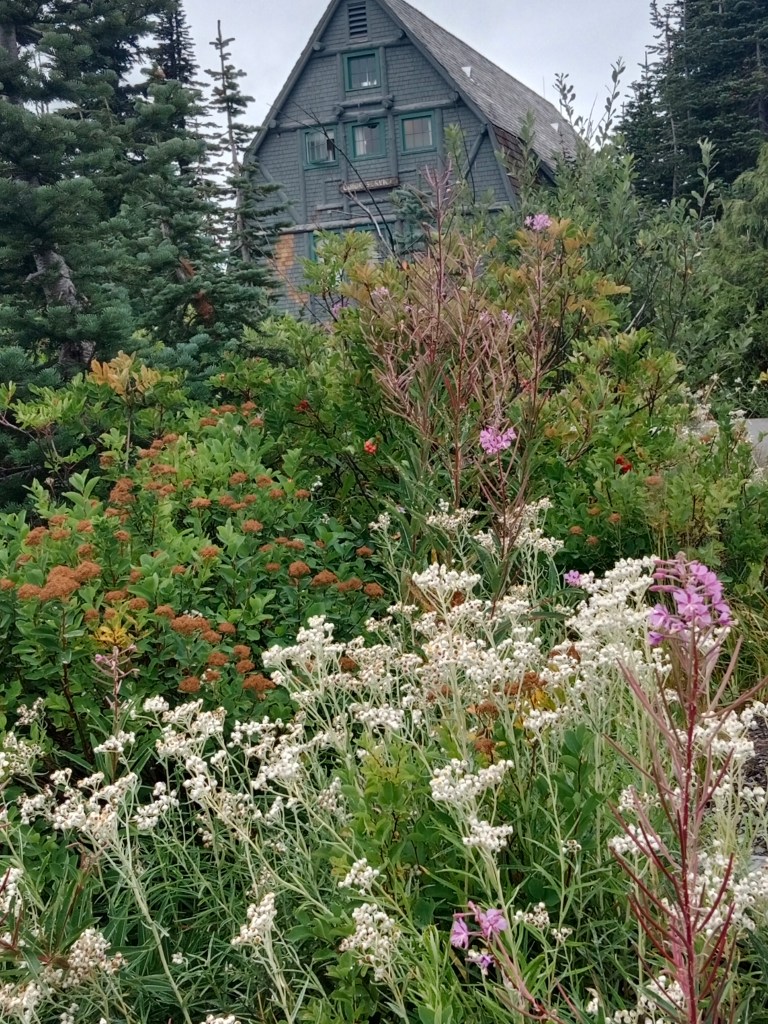
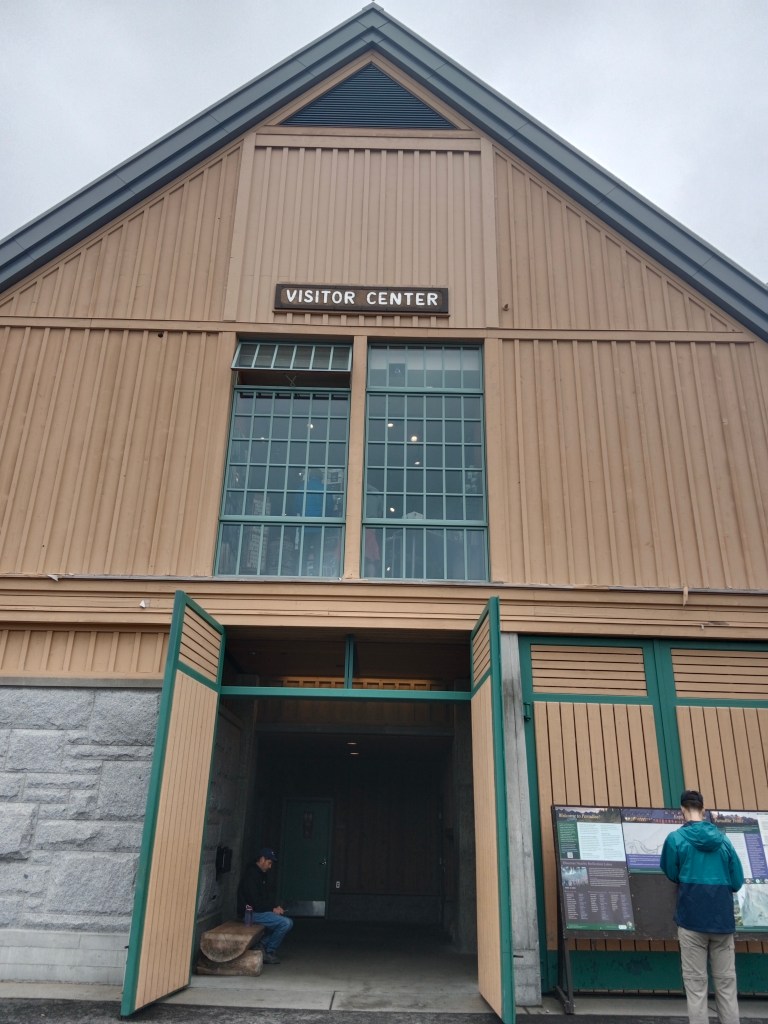
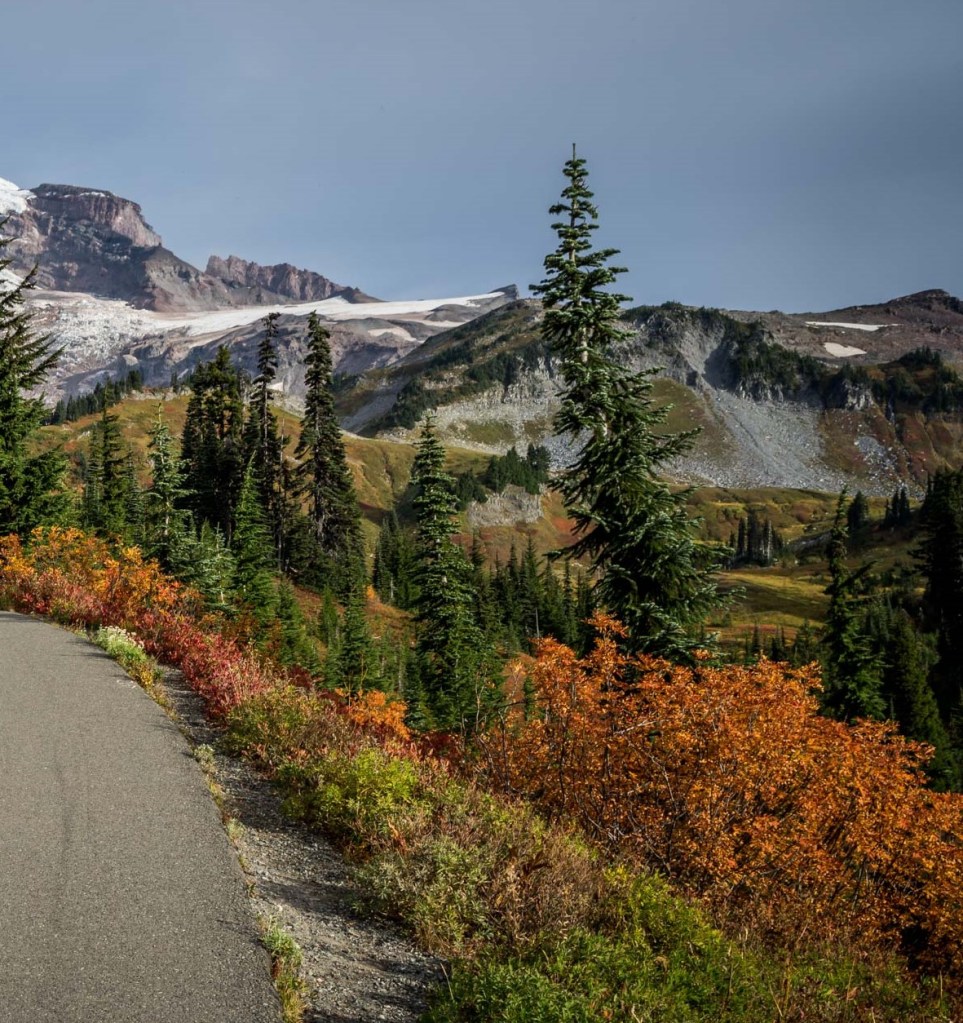
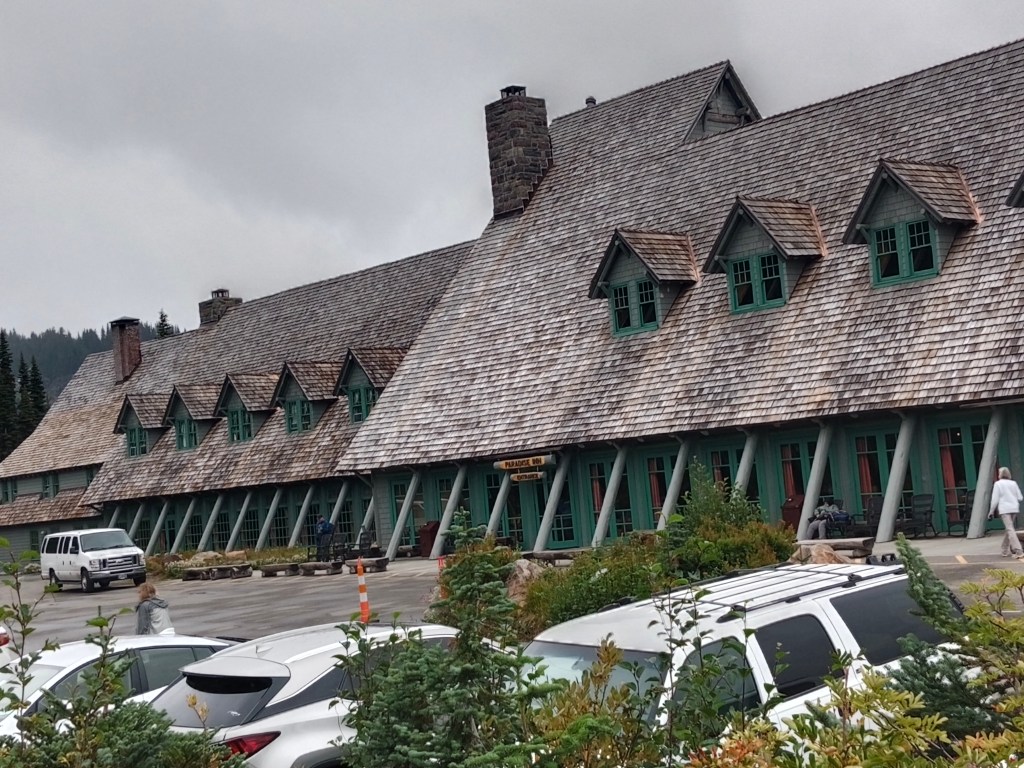
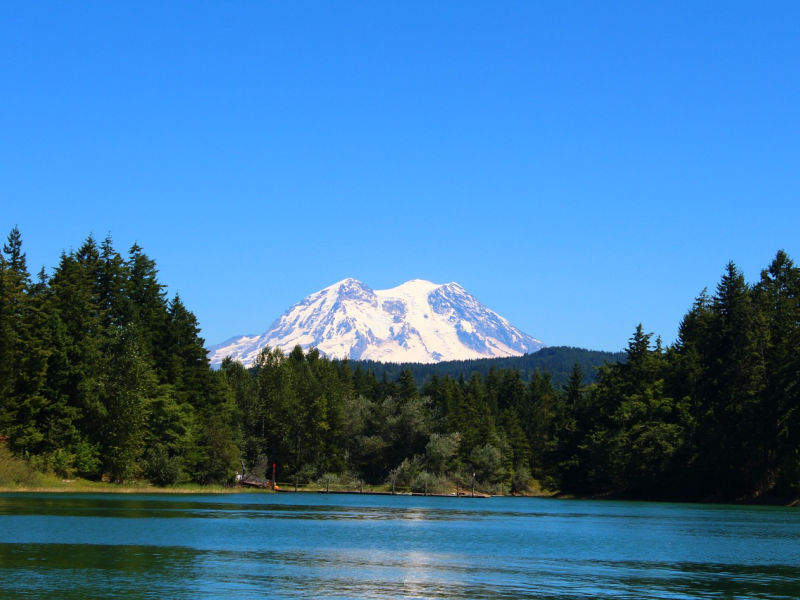
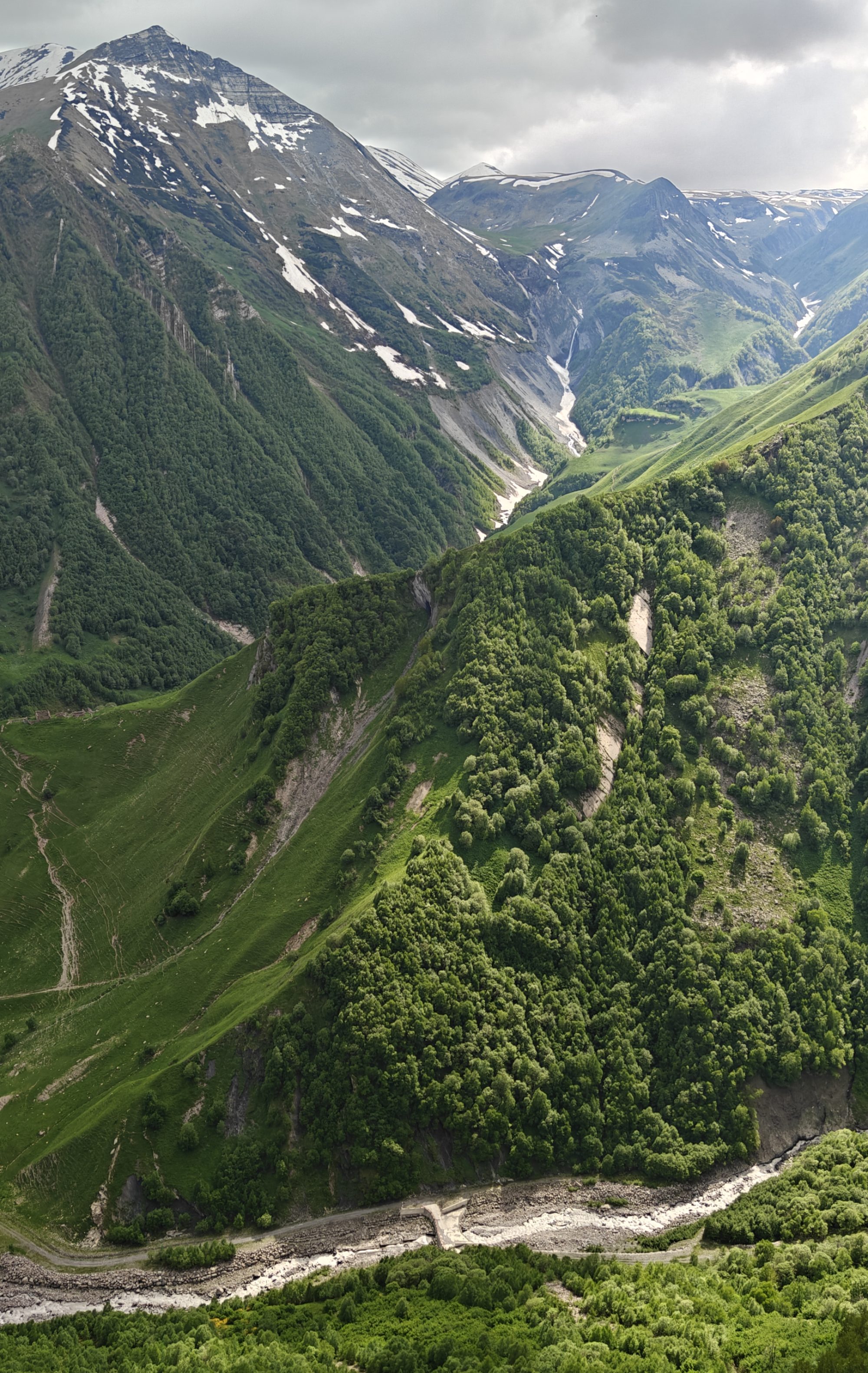
I am referring to a place called Paradise that lies in the Mt. Rainier National park area and the name truly befits the place. The pictures that come along as you read will convince you about this!! Much of today’s blog is on the sights that we encountered during our drive through the Mt Rainier National Park heading to Paradise to view Mt Rainier.

Paradise is also the place from where the best views of Mt. Rainier are seen and various trails are available to explore the wilderness of the park.

A road trip to Paradise and beyond; that’s what we were headed for, one late summer morning from Seattle. After the city sights and the semi urban vistas of the outskirts, we were on the road to Mt. Rainier National Park.

Mt. Rainier National Park

Established in 1899, this park encompasses Mt. Rainier, the majestic stratovolcano in the Cascade mountains and all of the wilderness that surrounds it. Including valleys, glaciers, moraines, lakes, waterfalls, meadows , old growth forests and of course remnants of old structures, buildings and rustic architecture covering an area of 91,000 acres; it truly is a world in itself.

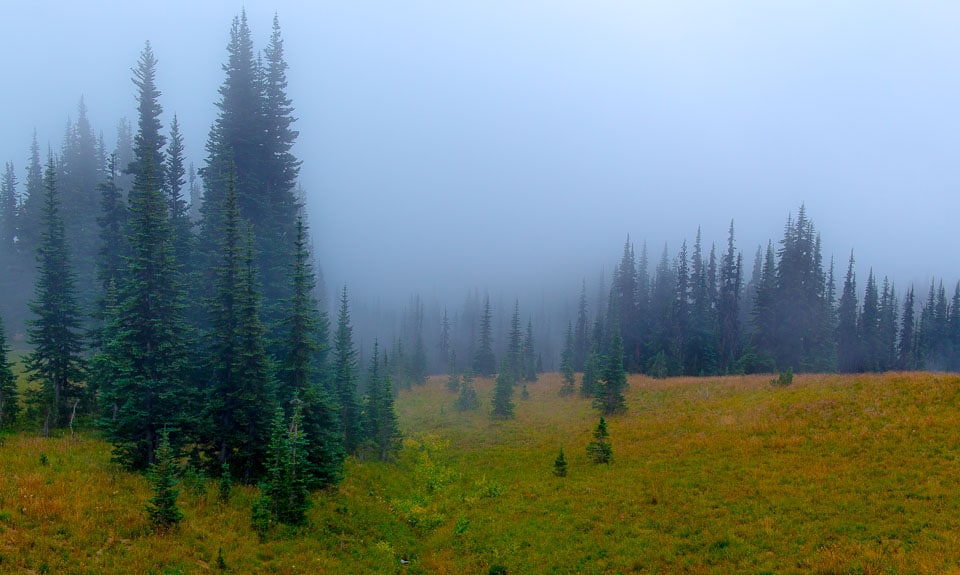
The park’s vegetation is diverse reflecting the varied climatic and environmental conditions seen across the 12,800 ft elevation gradient that it spans. Home to animals seen and unseen, this wilderness is an evolving forest landscape.

The Vegetation….

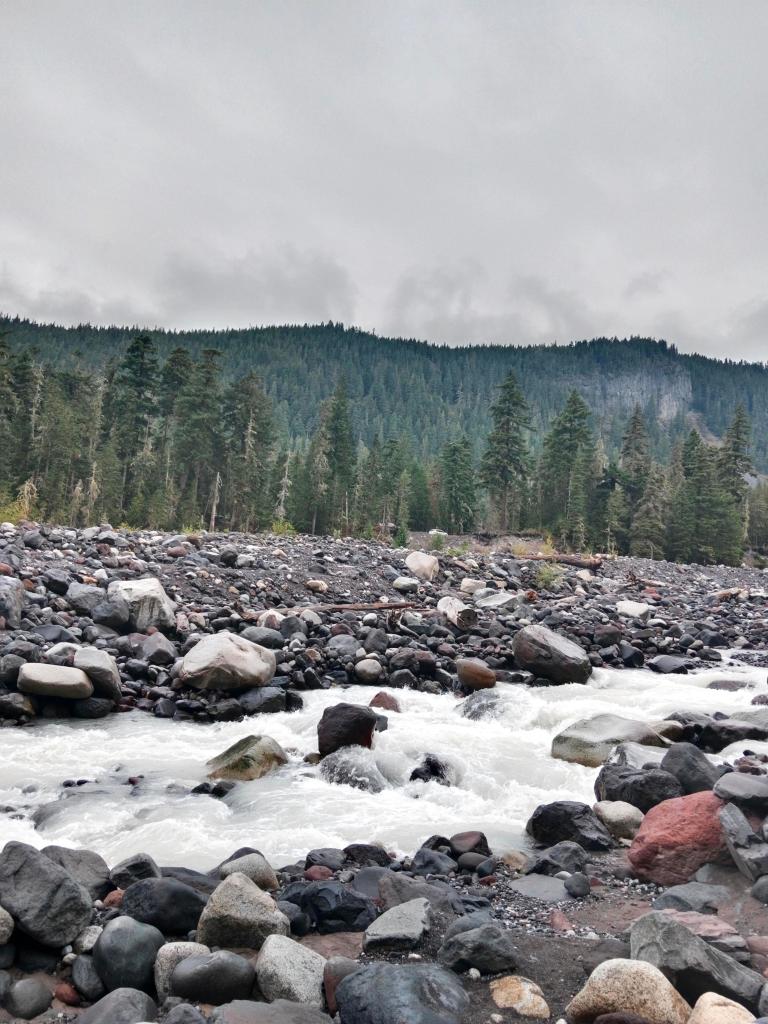
As we approached the park area itself, evidence of glacial activity was visible in the form of the glacial flour mixed Nisqually river with its unique blue- grey color and moraines left over by receding glaciers.

Nisqually river and moraine

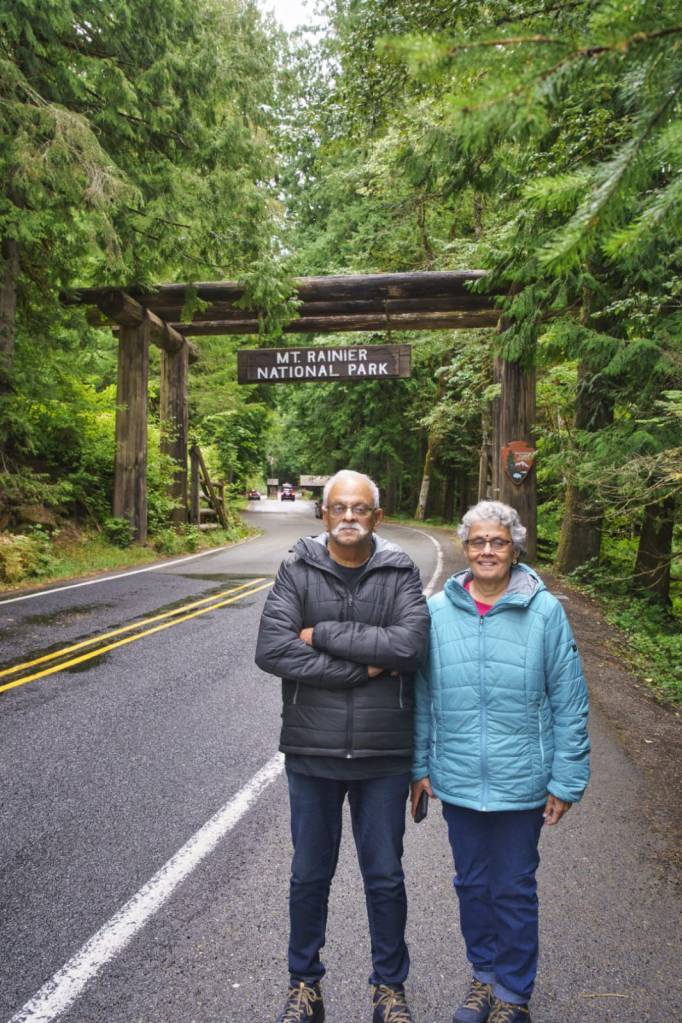
Entering park from the Nisqually entrance, we were at the entrance arch which is a great location for a picture and we did not miss that opportunity…

At the entrance to Mt. Rainier National Park.

After Mark, our guide finished the formalities at the entrance, we were well and truly in the park. Given the expanse of the park, the only way to explore it is by following designated trails and our first halt was at the Twin firs trail.

Twin Firs Trail.

This is a small half kilometer long loop trail that takes one through the old growth forests so typical of this park. What happened when we entered this trail?

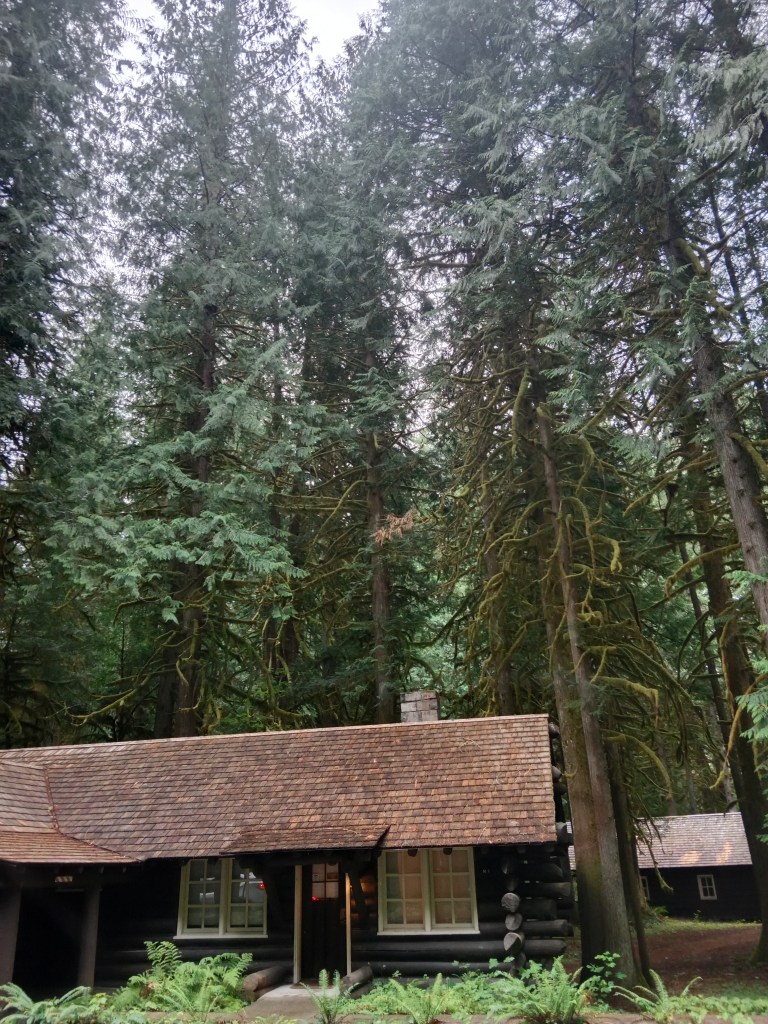
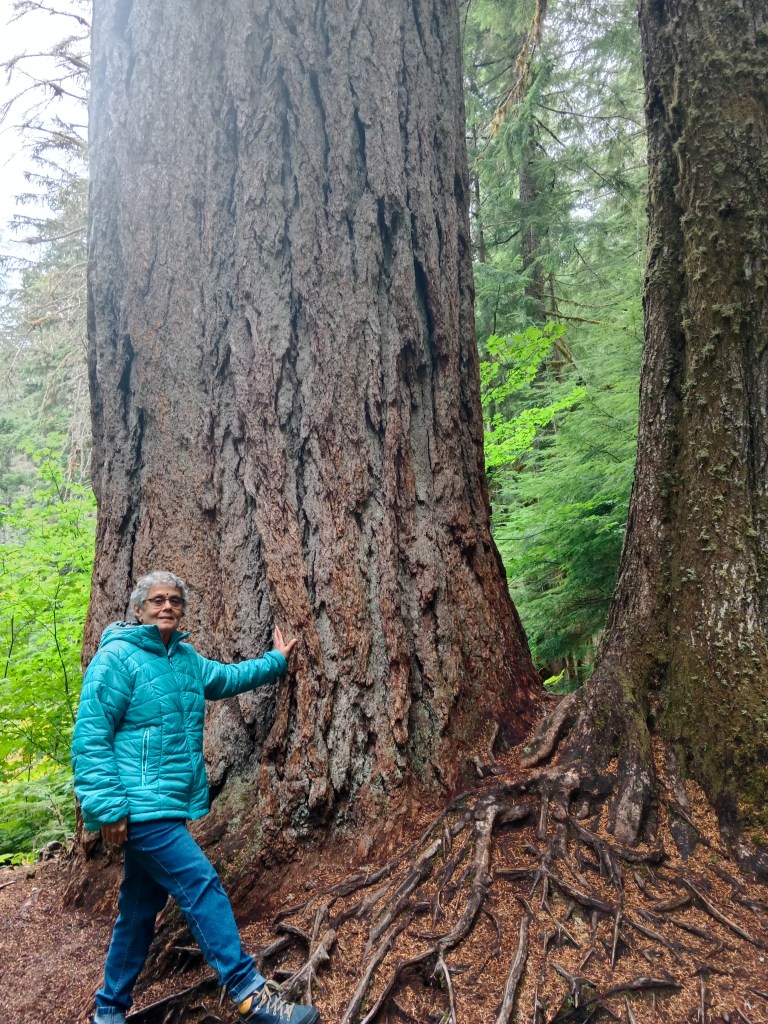
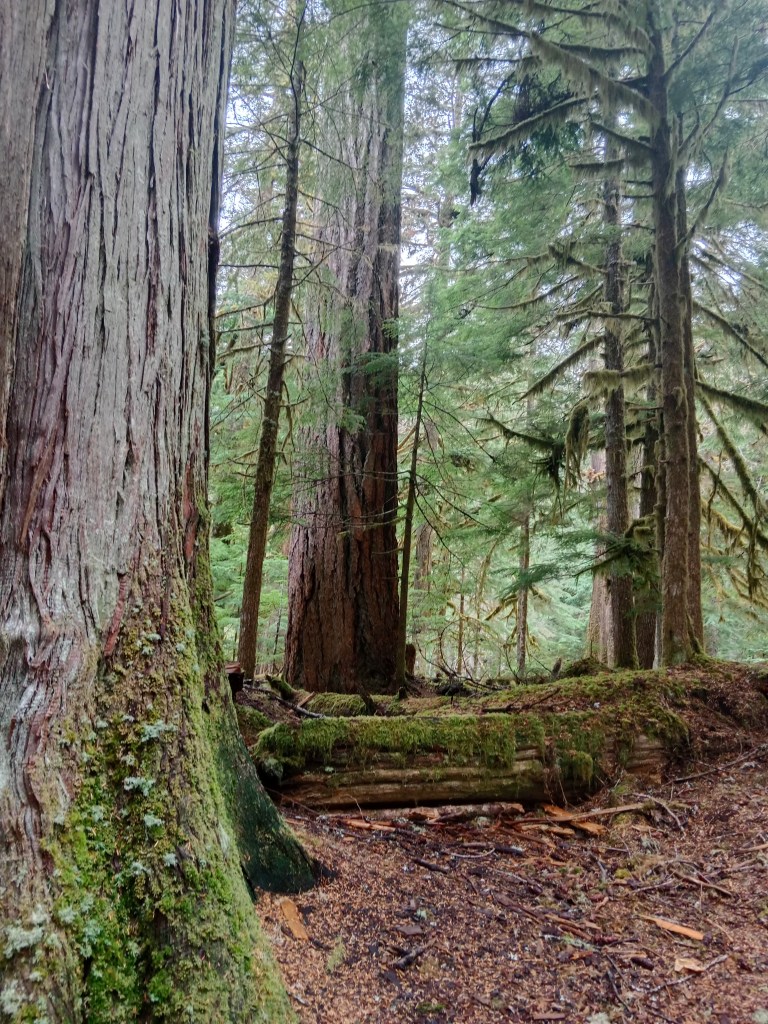
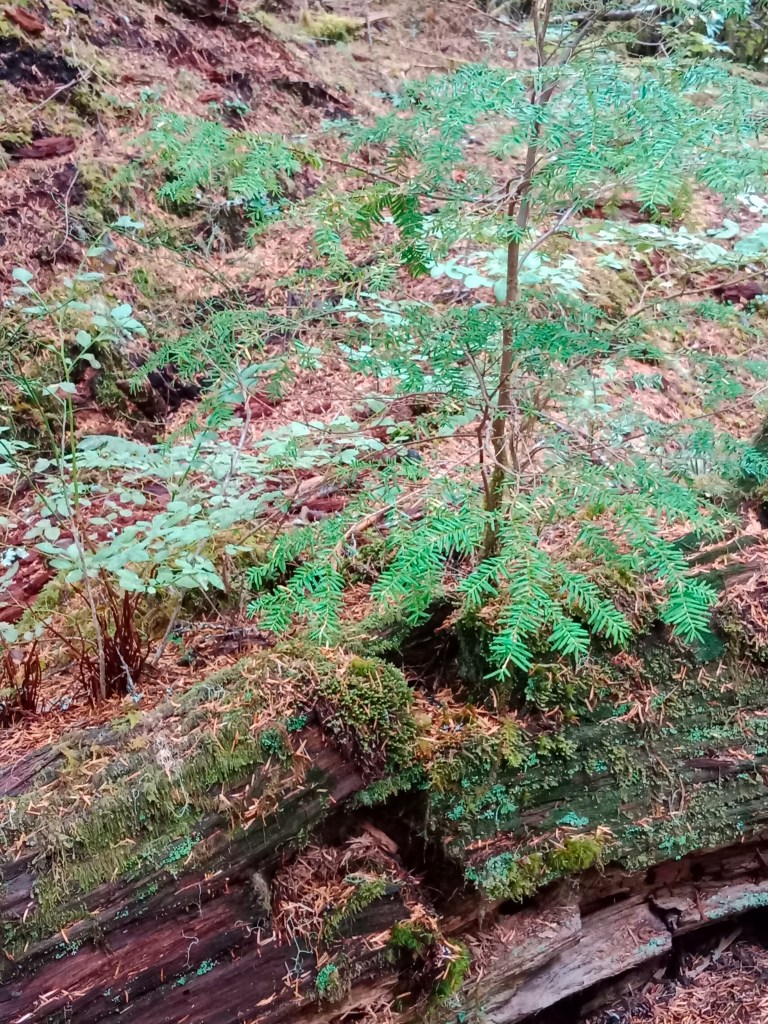
We found ourselves sheltered by giant trees reaching over 200 ft. height into the sky. Douglas fir, red cedar and hemlock trees lined the trail ; most of them being over 800 years old . Walking along we came across large fallen trees that act as nurse logs for saplings growing on it. The forest floor was wet and consisted of forest debris.

Much of the activity seen here is symbiotic. The moss on the trees helping to retain moisture, the nurse logs nurturing the saplings, the moss and other shrubs acting as fodder for the crawling insects of the forest floor and the fallen trees decaying and becoming one with the forest soil.

Some pictures….

The huge Douglas fir tree that greeted us at the beginning of the trail.

The general appearance of the trail with huge fallen trees and mossy trunks.

The forest floor with nurse logs and a Huckleberry shrub

The conjoint firs towards the trail end

After a walk through this amazing wilderness where one can easily lose one’s way, we religiously followed Mark who led us back into our bus. The next halt was at Longmire.

Longmire and the Trail of Shadows

Longmire has it’s own tryst with the history of Mt Rainier National Park.

It was originally the site of James Longmire’s homestead lodging and mineral springs resort. The mineral springs were claimed to have curative powers but were later disproved. The buildings then became the park headquarters in 1899 when the park was established. The headquarters were later shifted , and today, we have the Longmire Museum and Wilderness Information Centre.

The Trail of Shadows is a 1 km, trail through the wilderness , passing some of the mineral springs.

Some pictures…

An advertisement of the Longmire’s springs from the 1800s and the old homestead

The trail board and the trail wilderness

The mineral springs (click on the video)

After a quick walk around the Longmire area, we were back in the bus and reached a beautiful waterfall called Carter falls.

Carter Falls

This trail head along a wide rocky riverbed provides access to the Nisqually river. A log bridge across the river is a popular photo location . The walk can pose a challenge as the rounded rocks are slippery at places. Some pictures..

The walk along the rocky trail and the Nisqually river

On the log bridge across the Nisqually river

The next halt on this drive was at Christine Falls.

Christine Falls

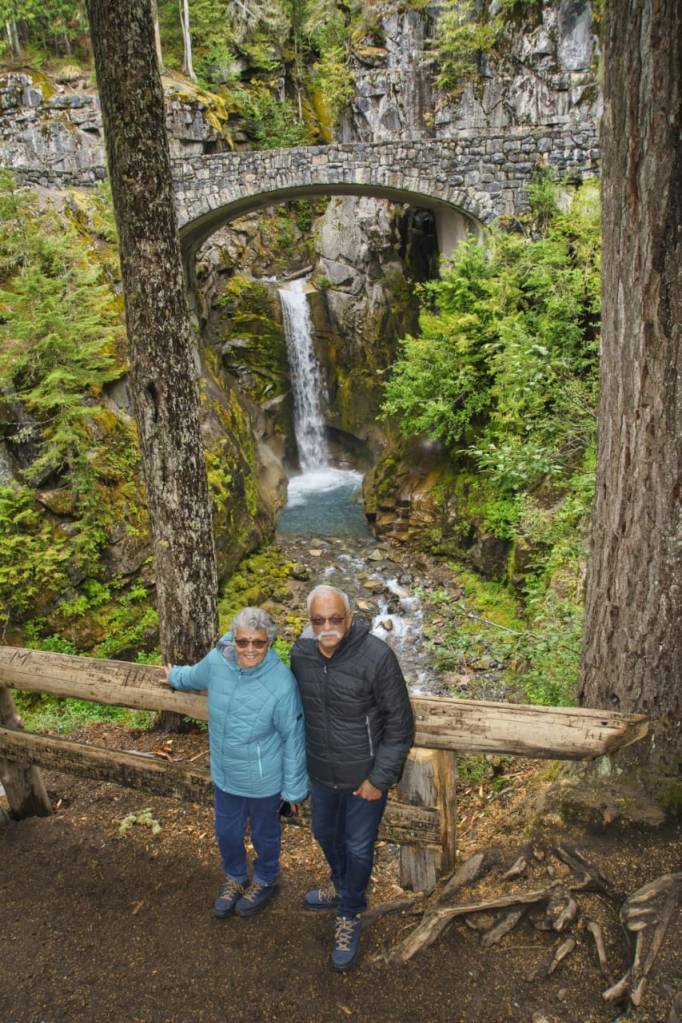
This is a beautiful waterfall with two levels. The upper level was seen as we drove past , but the lower level required a peep down from the bridge spanning the falls.

The lower level of this waterfall is an iconic image of Mt. Rainier National park.

The upper level of the falls

The lower falls and the bridge across

Enjoy this video

A short drive further down towards Paradise brought us to a bridge called Glacier bridge. This bridge now has moraine and a narrow stream of the Nisqually river flowing below it. The bridge was originally built across the Nisqually glacier and with the glacier receding, this is all that is left!!

Far away a wee bit of the last part of the present day Nisqually glacier can be seen.

The Glacier Bridge with the moraine and small stream . Arrow points to the Nisqually glacier seen far away.

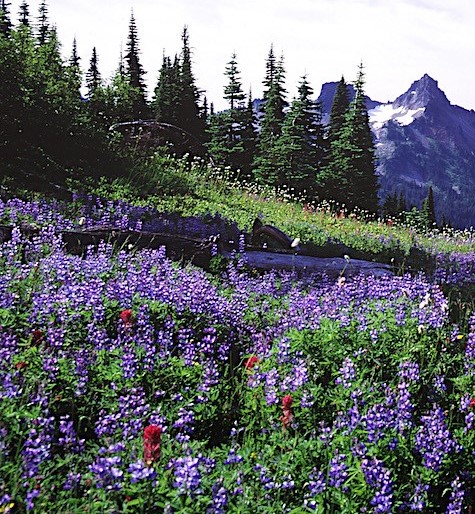
Driving further down we reached Paradise. This special area of the Mt. Rainier National Park needs more focus and will be dealt with in the next episode. For now, let me just tell you that we spent some time at Paradise and then continued further to Paradise Valley which was a beautiful sight as the bus meandered the winding roads. The wild flowers added color to the area.

Some pictures from Paradise valley road…

The Paradise Valley road with it’s wild flower covered hillsides

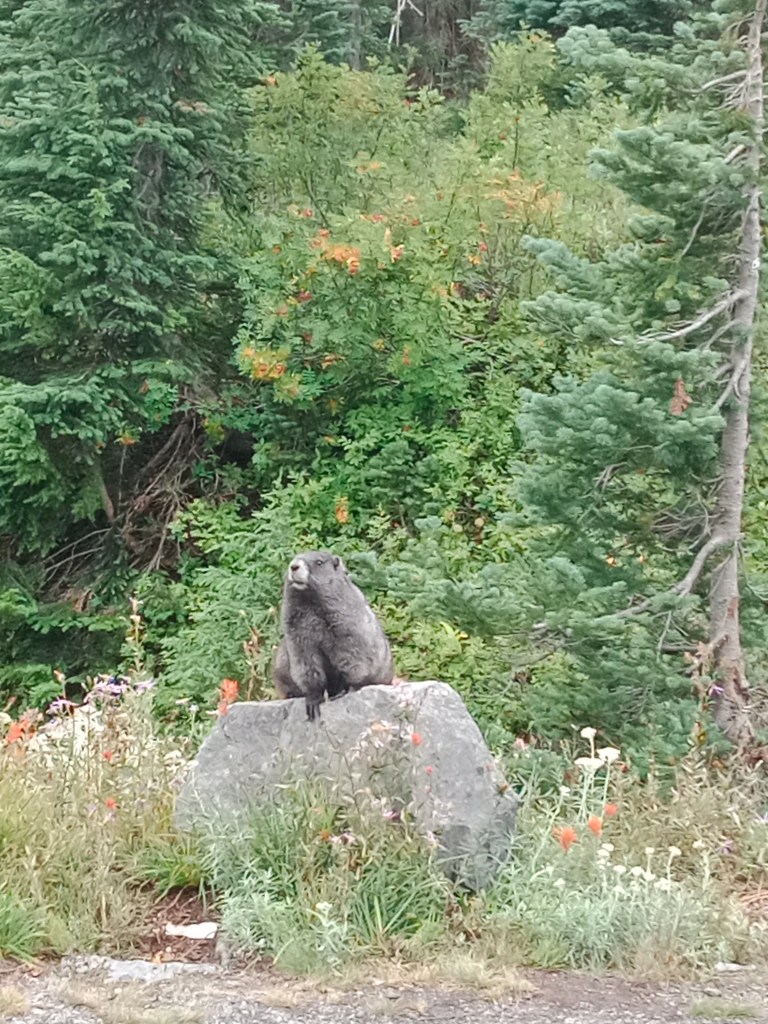
All of a sudden, we had a wildlife visitor on our path….an inquisitive marmot kept looking at our bus ….

This marmot seems interested in us!!!

As we drove down this road we reached the Reflection lakes area which is special for the reflections of Mt. Rainier that it offers on ideal days. We were not so lucky as it was one of those drizzly cloudy days and so we saw the lake with no reflection….

What was expected…

What we saw….!!!

But we were not so unlucky after all……

We had another marmot wanting to be friends with us….

One more friendly marmot..!!!!

The next halt was at Narada falls; the last of the many beautiful falls that we had seen. Mark warned us that this falls required some trekking down a slippery path . With careful steps, we made our way down the track following Mark. Soon , we were at the beautiful falls, a wide one at that….

Narada Falls

The Paradise River drops down 188 ft. with the upper part being wide and falling in several strands from a cliff into a canyon. In winter, this falls freezes attracting ice climbers according to Mark.

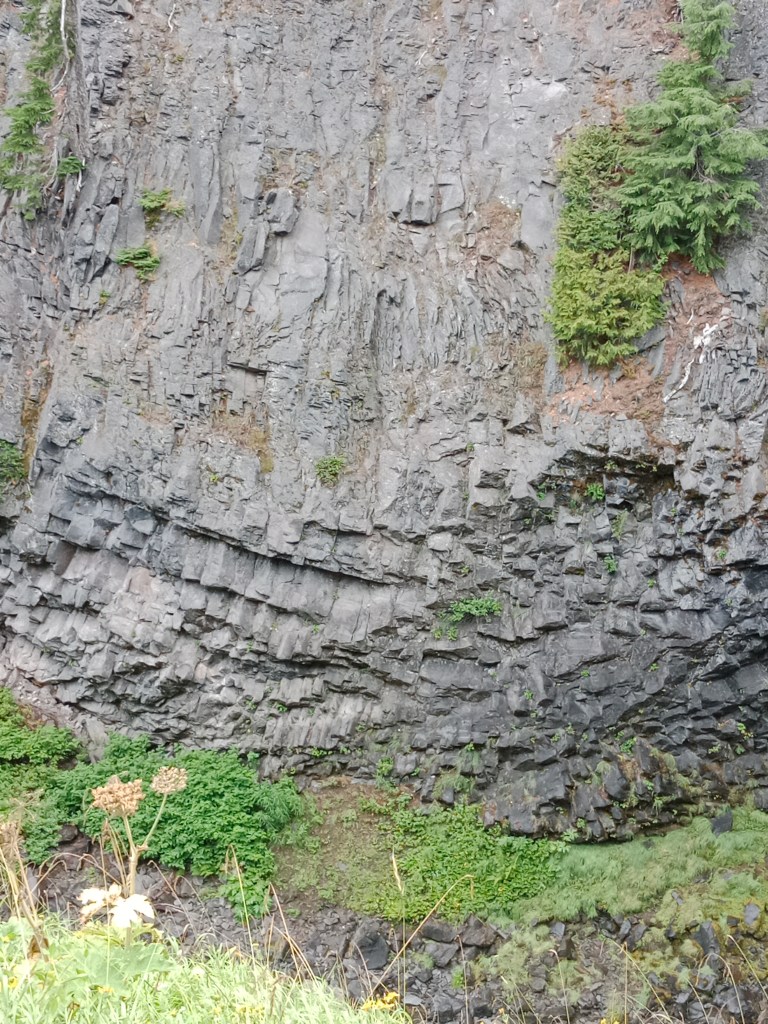
The columnar basalt rock formations along the sides of the falls is a special feature here related to volcanic rocks.

Some pictures…

Narada Falls

The Columnar basalt rocks so typical of the area associated with volcanic activity.

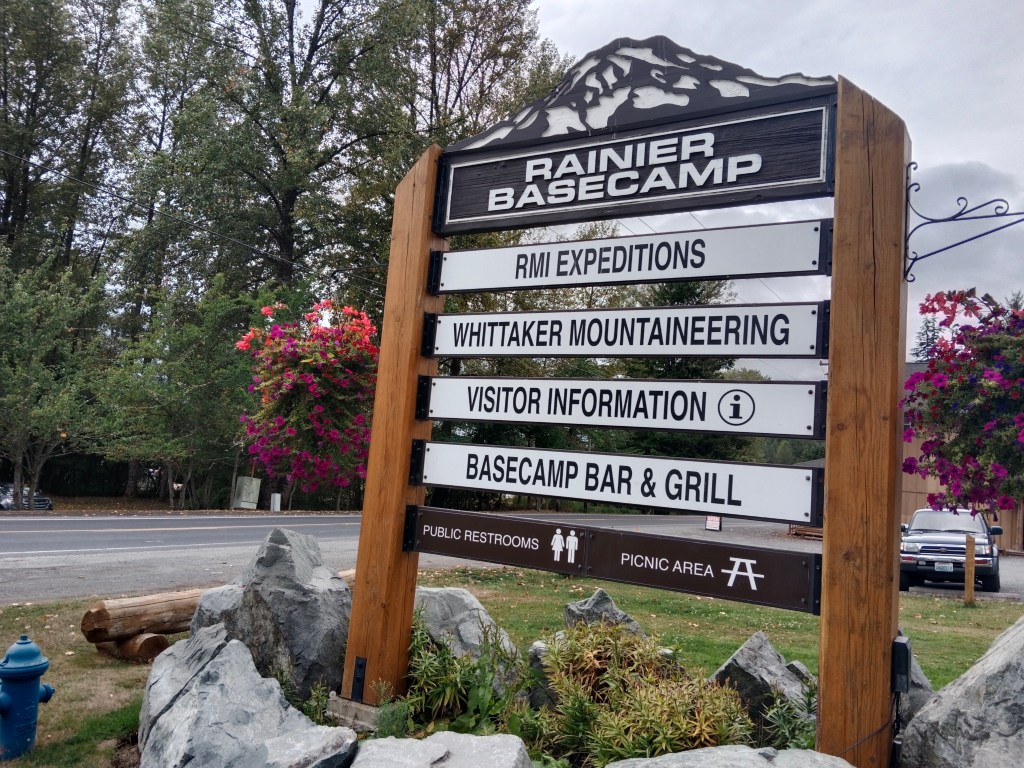
By now we were all tired with the walking and hiking that we had engaged in throughout the day. So Mark took us to Whittaker’s Bunk at Ashford, a small town that acts as a base camp for Mt. Rainier activities.

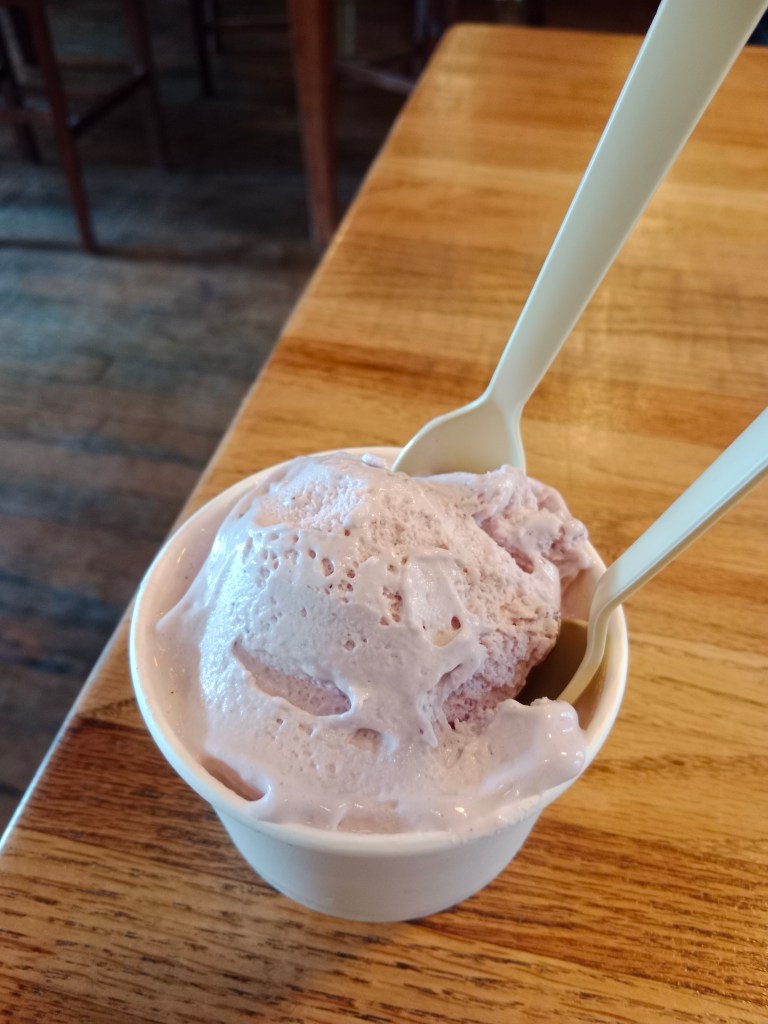
He suggested that the Huckleberry ice cream here is unique and we tried it…

Some pictures from the Ashford base camp….

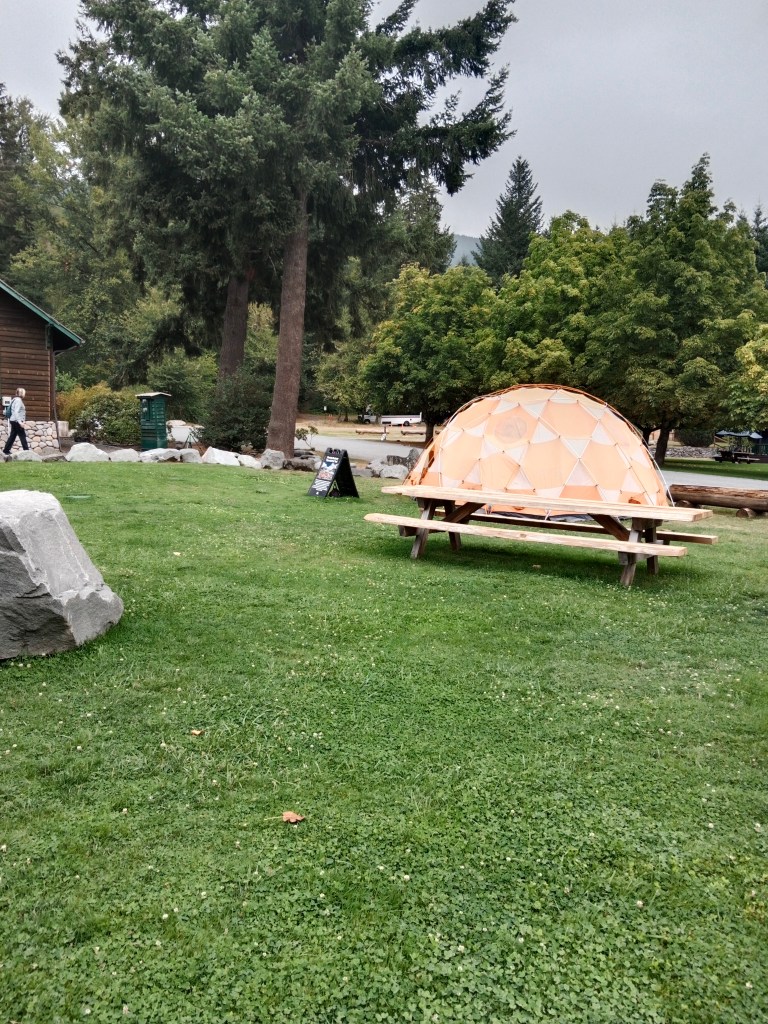
Rainier Basecamp at Ashford

The Huckleberry ice cream and activities at base camp

With this we wound up our trip on the road to Paradise and returned to the cozy comfort of our room for a good night’s rest.

See you next week at Paradise….the special place , with more on Mt. Rainier

Meanwhile keep your comments coming in like the marmots….

Pallava glory…Mamallapuram

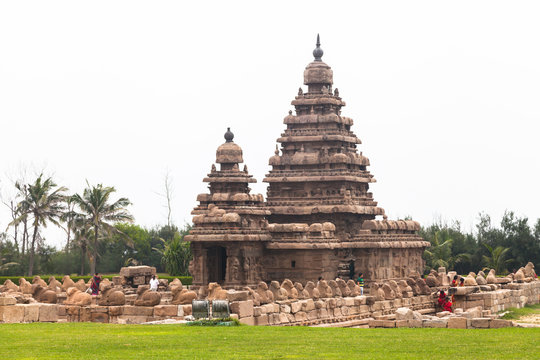
After seeing the grandeur of the Cholas at Thanjavur and Pandyas at Madurai, let us now shift focus to the Pallavas. Mamallapuram (Mahabalipuram) near Chennai in Tamil Nadu has a complex of temples and monuments built by the Pallava King Narasimhavarman II. The complex has cave temples and monolithic chariots or Rathas and a Shore Temple built with granite blocks; all built in the 7th and 8th centuries. The complex has more than 40 ancient monuments and temples including the largest open air bas relief in the world.

Mamalla in Tamil means great wrestler and refers to the King Narasimhavarman I. This explains the name Mamallapuram.

It is now believed that this complex is part of a group of submerged temples along the coastline. The tsunami of 2004 that struck the Bay of Bengal coast exposed another granite temple in ruins and large structures on the sea bed about a kilometer offshore. This has also led to the inference that this temple was part of the Seven Pagodas described by early European travelers. The tsunami however did not do much damage to the shore temple itself.

History

What we know today as Mamallapuram was an ancient port probably referred to as Sopatma. It was a very active trading port and that is what brought the western traders here and the shape of these temples led them to be referred to as the Seven Pagodas. Various references to the area by western traders have been recorded from the 13th century onwards. The area came more into focus in the 19th and 20th centuries. It was after Independence that the preservation and restoration of many of these structures was undertaken. In 1984, the site was declared a UNESCO World heritage site. The monuments here have been broadly classified as Chariot shaped temples or Rathas, Mandapas or cave temples, rock reliefs, Structural temples like the Shore temple and excavations.

They are all under the ASI (Archeological survey of India) and are UNESCO World Heritage sites.

Architecture

Pancha Ratha Complex (Five Chariots)

These are monolithic rock cut temples in the shape of chariots or Rathas; initially attributed to Narasimhavarman I, and subsequently to Narasimhavarman II ; after the discovery of some inscriptions .

Named after the five Pandavas and Draupadi; they date back to the 7th and 8th centuries. Though they are grouped together by these popular names, they are neither true chariots nor are they dedicated to the Pandavas. They are temples dedicated to Shaivism, Vaishnavism and Shaktism; the three main stream Hindu cults.

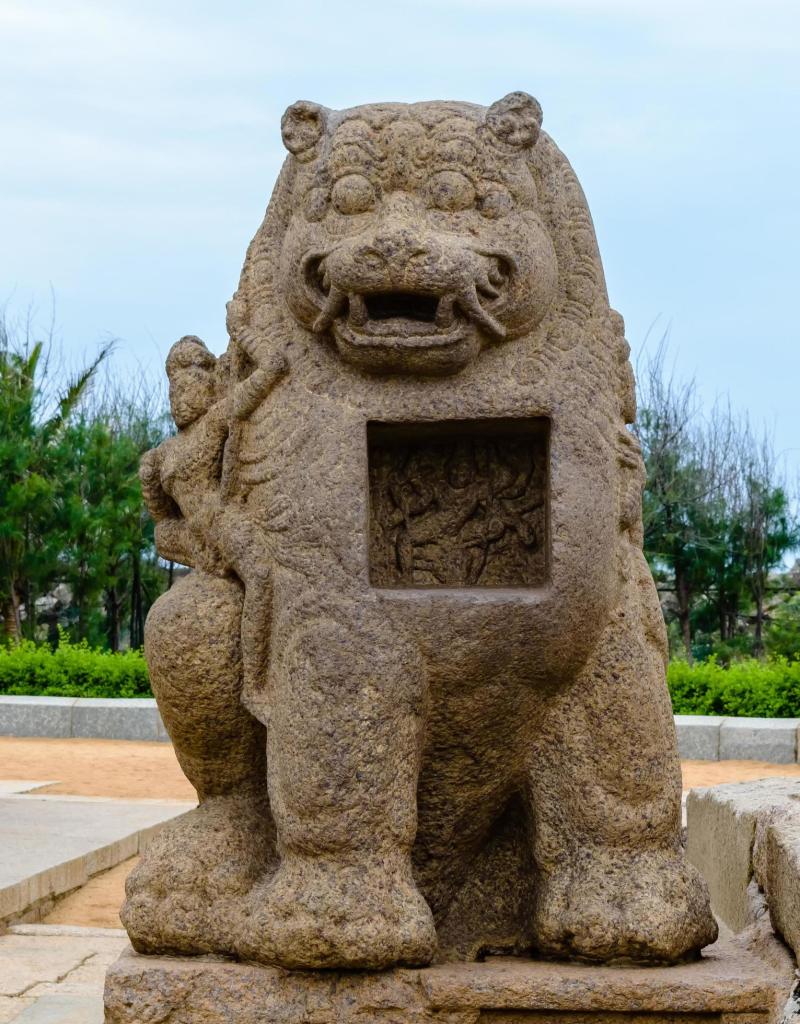
The first one is named after Draupadi and has a roof like a thatched hut. The sanctum has the sculpture of Durga .The second one called Arjuna’s chariot is shaped like a Buddhist vihara . The sanctum here is empty but the walls have sculptures of Shiva and Vishnu. A large monolithic lion stands in front of this. The Bhima Ratha is the largest structure here. Large sculptures of lion, elephant and bull also adorn the complex.

These were never consecrated as temples as they were not completed.

The Pancha Rathas and monolithic lion

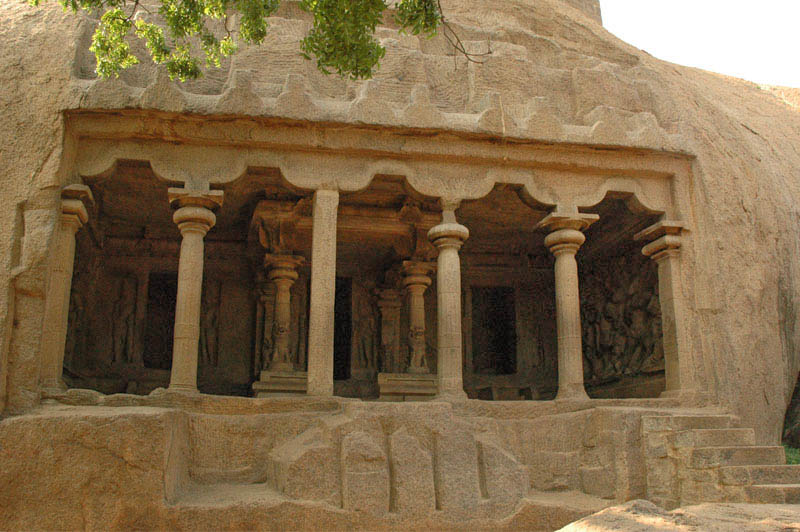
The Cave Temples or Mantapas

Mantapas are traditionally pillared halls or pavilions for people to gather socially or for ceremonies.

The cave temples at Mamallapuram were not completed and in depth analysis gives us an idea of how they were cut into the rock faces to create these pavilions and halls.

One of the main temples here is the Varaha Vishnu temple where Lord Vishnu is depicted in Varahavatara (like a boar) saving Bhumi(earth) from under the ocean.

Varaha Vishnu saving Bhumi devi

Gaja Lakshmi is another important depiction here where two elephants (Gaja) are seen sprinkling water on Goddess Durga.

Gajalakshmi with elephants

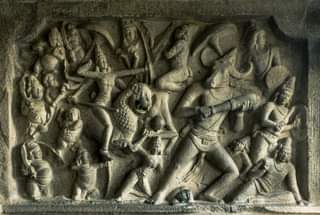
Mahishasuramardini cave has depictions of Goddess Durga destroying the demons.

The cave and the sculpture

Krishna Mantapa is another interesting cave temple here. Village life in Vrindavan is depicted here. Krishna holds the mountain Govardhana in his hand and protects the people. Krishna playing the flute, a cowherd milking the cow and such other legends are depicted here.

Krishna holding the mountain up and a cowherd milking the cow

There are many more such depictions here which need to be seen and enjoyed. One can enjoy it more if one is well versed in Hindu traditions and epics.

Arjuna’s Penance and Descent of the Ganga

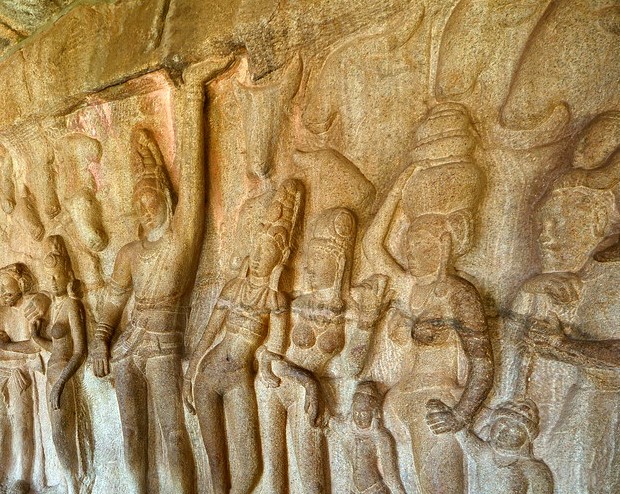
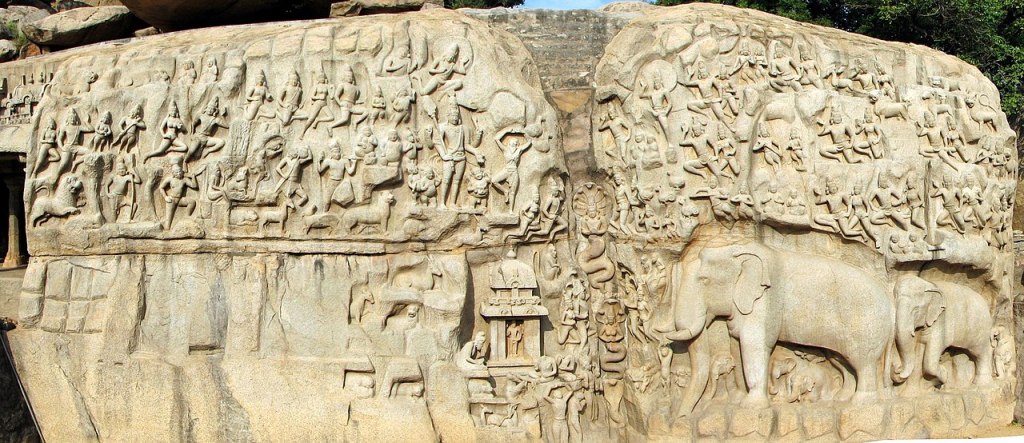
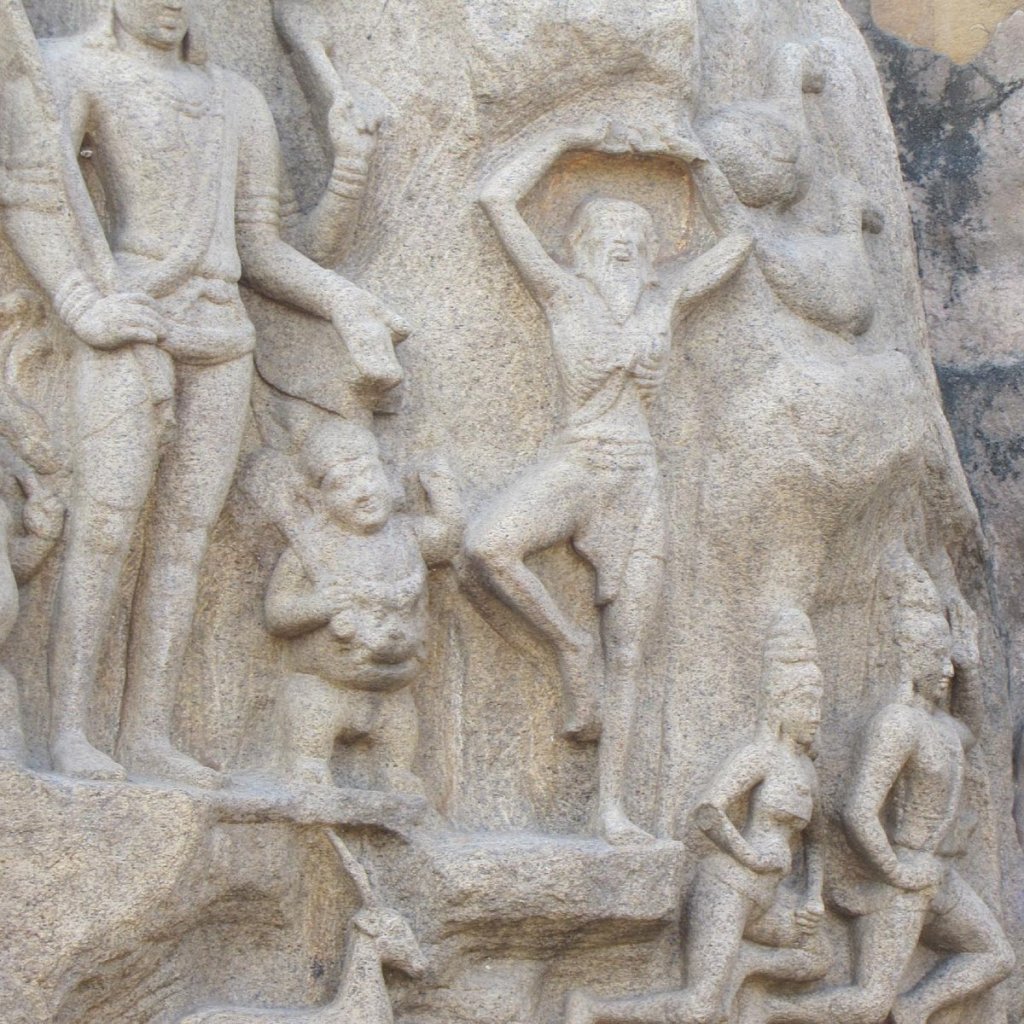
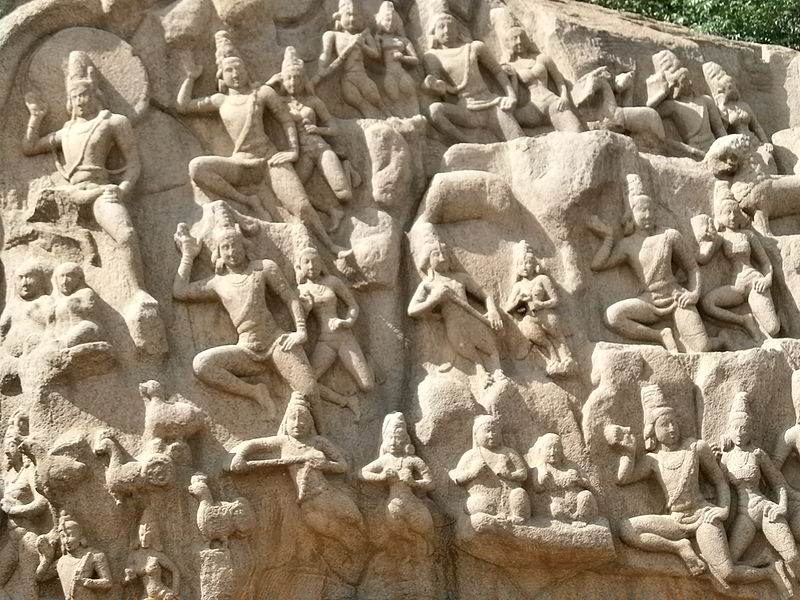
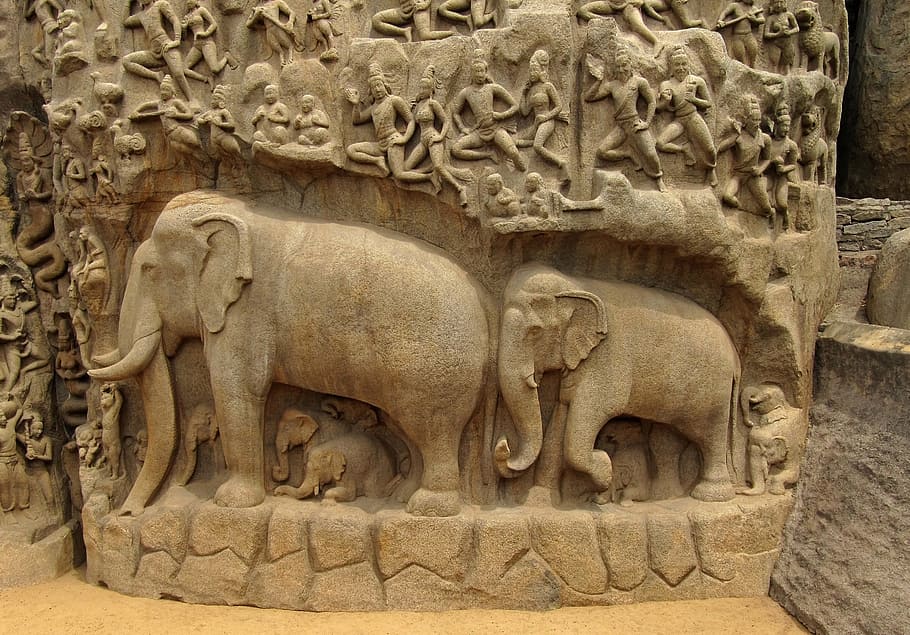
This is the largest bas relief in the world measuring 29 mt X 13 mt and is a relief carved on two open air rock faces. The legendary Arjuna standing in penance and the descent of the river Ganges is depicted here. During special occasions, the river Ganges was shown flowing down from Shiva’s hair. This was achieved with a water tank on top of the relief. There are more than hundred figurines in this relief and many of them are life size.

Arjuna’s Penance ..the largest open air bas relief in the world

More details of the bas relief

The Shore Temple

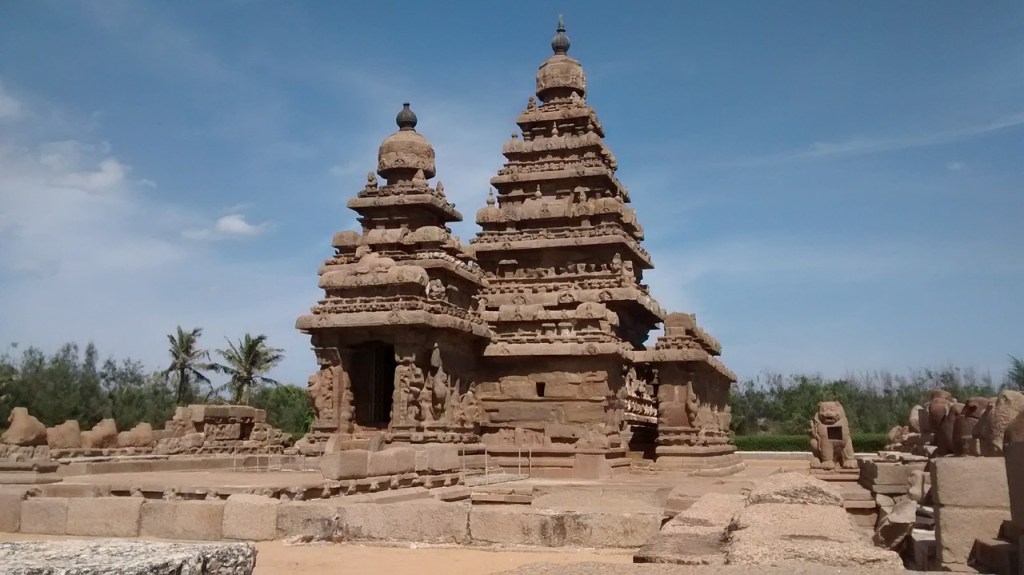
This complex is close to the seashore and hence called Shore Temple.

There are three temples in the main Shore temple complex built on a 15 mt platform. Two of these are Shiva shrines where Shiva and Parvati along with their sons Vinayaka and Kartikeya are honored . The main temple has a pyramidal tower 18 mt high and faces the east so that the sun rays fall on the Shiva linga here. A Vishnu shrine lies in between the two Shiva shrines. This is again an example of both Shaivism and Vaishnavism coming together.

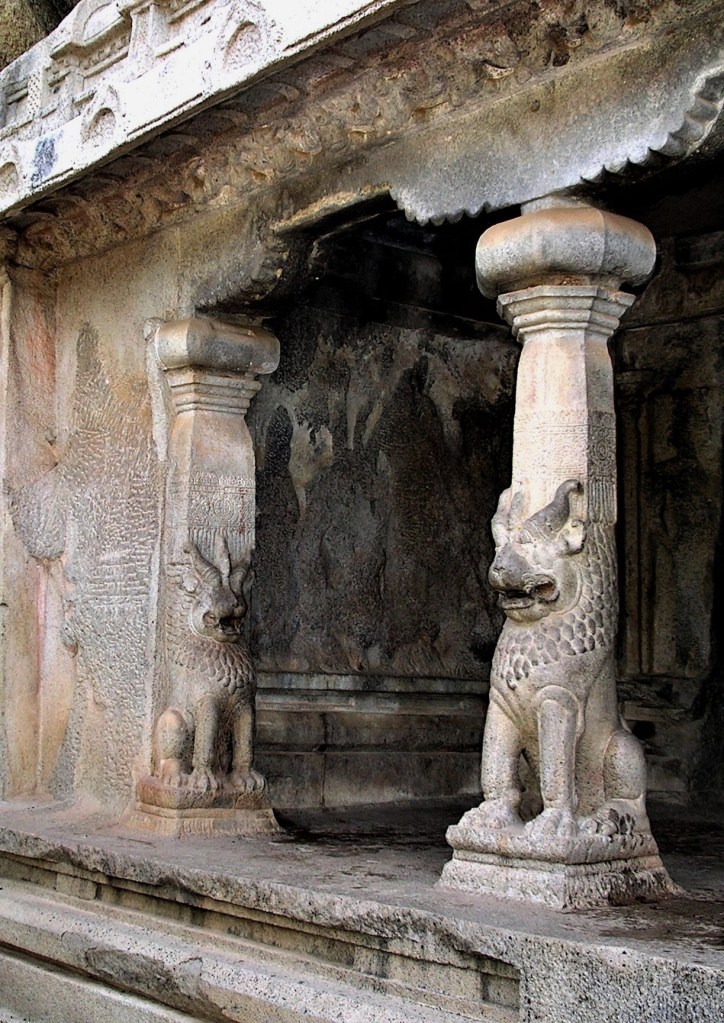
The temple and other monuments in the complex are excellent examples of Dravidian architecture. The roaring lions, a typical Pallava icon is seen on the pillars of this temple. Some of the sculptures have been damaged and some are missing. The compound wall of the temple is sculpted with Nandi (bull) and Varahas (boars).

The Shore Temple

Sculptures around the shore temple

Typical Pallava icon…the roaring lion pillars

Other rock monuments

Krishna’s Butterball

A gigantic rock seems to be resting precariously on a sloping rockface and is popularly called butter ball.

The precariously placed rock!!!

Butter Well

This is a deep excavation into the rocky surface which looks like a well.

The excavated well!!

Well, I have tried to put together the salient parts of the Mamallapuram complex. I hope it has given you a perspective of the architectural proficiency of the Pallava dynasty.

With this, the series on Great Temples of India will stop for some time. Continuous dose of art and architecture can get heady. So I move on to some natural wonders with my series on Alaskan Adventures.

Do give me your feedback and comments.

Goddess of Kodachadri

The strange legend of Swayambu Jyothirlinga has always intrigued me. I am talking about Mookambika Temple at Kollur in Karnataka. We have been regularly visiting this temple since many years. In fact, at one point of time, it was an annual “must-do” pilgrimage. I am an ardent devotee of Devi and firmly believe that SHE has been guiding me through the ups and downs of life.

This temple in Karnataka, located 135 kms from Mangalore and 80 kms from Udupi in the Kodachadri Valley of the Western Ghats was a charming and serene retreat once upon a time. The Sowparnika river flowing beside temple, was an added attraction .But sadly, over the years, like in most other places, commercialisation has spoilt the serene charm that attracted me once upon a time…

The Legend :

The legend of the Goddess is intimately connected to the Kodachadri hills near Kollur. There was once a demon here called Kaumasura who wanted to become invincible and towards this end, he prayed ardently to Lord Shiva. The Goddess in all her wisdom was aware of the evil designs of the demon and she made him dumb (mooka). Due to this, the demon was unable to ask Shiva for his wish to be fulfilled. This infuriated him and he harassed a sage by name Kola Maharishi who also used to pray to Lord Shiva. The Maharishi prayed to the Goddess for help and she vanquished the demon. Lord Shiva also appeared in front of the Maharishi who then requested that Lord Shiva and Devi should be there forever. The Maharishi’s wish was granted and that is how the Swayambu Jyothirlinga came to be. Significantly, this linga has a golden line in the middle. The right half stands for the conscious principle of Shiva, Vishnu and Brahma. The left half represents creativity in the form of Lakshmi, Saraswati and Parvati. This linga is now worshipped as Moola Devi.

Another legend says that the Goddess appeared before Adi Sankara during his penance at Kodachadri. When he requested HER to come down to bless the common people, she agreed on one condition. SHE would follow Adi Sankara but at no time should he look back to check on HER. After some time, the sound of the Devi’s anklets were inaudible and Sankara reflexly looked back. The agreement was broken and Devi stopped there. That is the spot where the temple is located today at Kollur.

Though I used to wonder how the swayambu linga appeared, I learnt about this legend much later. Scientifically and objectively speaking, this is difficult to accept. And there in lies my intrigue!!

Adi Sankara

This temple is also linked to Adi Sankara. Even today there is a small shrine inside the temple called Sankara Peeta. It is believed that Sankaracharya meditated here and had a vision of Devi Mookambika . The four armed idol of Goddess Mookambika was installed by Adi Shankaracharya.

The Temple

The sanctum and the entrance to this temple are believed to be over 1200 years old. The parikrama and various other portions have been added subsequently. The temple was patronised by the several Hindu kings particularly the Bednore Rajas and many of the jewels adorning the Goddess were presented by them and the Vijayanagara kings. Photography is not allowed inside the temple and so, the images of various Gods sculpted on the pillars of the mantapa in front of the shrine remain just descriptions. Besides the main sanctum housing both the swayambhu lingam and the idol of the Goddess, shrines of Balamuri Ganapati, Veerabhadra swamy and the Sankara Peeta lie along the inner parikrama (circumambulatory path)

A panoramic view of the temple complex from an adjoining building

The entrance to the main shrine

A beautiful Deepa Sthambha ( lamp tower) adorns the front of the parikrama as you enter the temple complex. All the lamps on this tower are lit in the evening giving a very divine feel.

The lit Deepa Sthambha

The Saraswati Mantapa

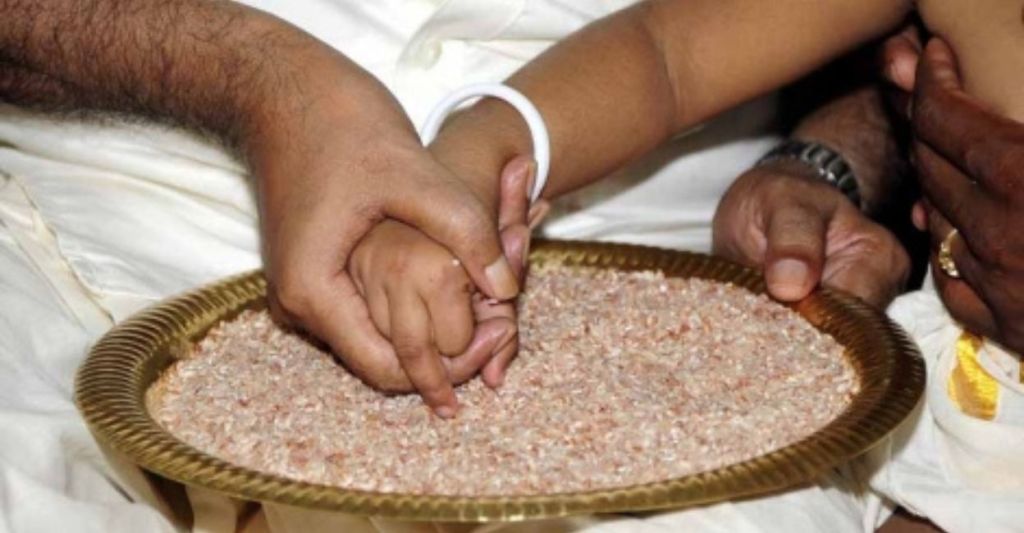
As we enter the main temple, there is a small shrine to our left which is in the form of a stage. This is the Saraswati mantapa. Goddess Saraswati is the God of learning and also of the various arts like dance and music. Many artists give performances here as an offering to Goddess Saraswati. The first stage performances of students of dance are also conducted here. During the festival of Navratri; Vidyarambham (children are initiated into learning by holding their hands and making them write on rice) is performed here.

Vidyarambham

The Shiveli (Ceremonial Procession)

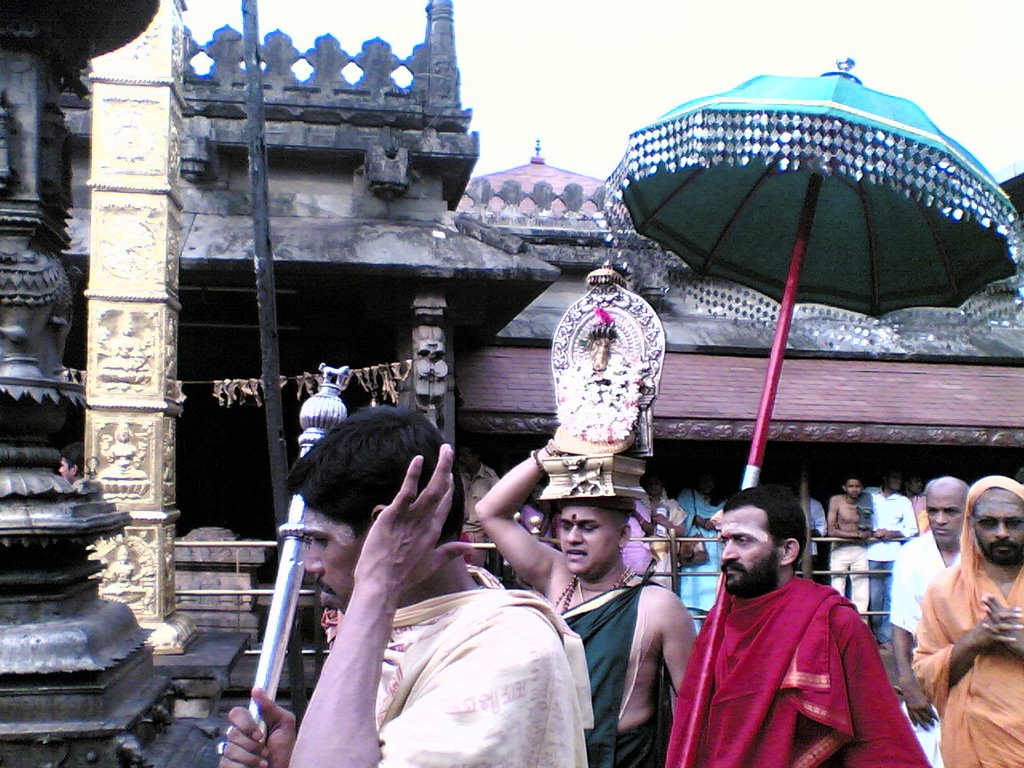
A smaller image of Goddess is taken in a ceremonial procession daily around the outer parikrama. Sometimes she is carried by one of the priests , at times in a palanquin and on special occasions on a chariot. These are all ceremonial rituals followed here.

The ceremonial procession

The Sowparnika River

This serene river that flows in front of the temple is as much a part of the temple as is the main shrine. Flowing down from the verdant forests of the Kodachadri hills, in the Western Ghats , it’s waters are enriched with the medicinal properties of the various plants that lie along it’s banks and a bath in this holy river is believed to relieve one of many diseases.

Sadly, the river today is polluted at various places and is a far cry from what she was a few decades ago!!

Sowparnika river

Olden times

During the early days of my visit to this temple, there were no hotels and lodges at Kollur like it is today. The priests of the temple would offer rooms in their house for us to stay and even the food was provided by them. Many of the conveniences we have today was a far cry then. But the serenity and peace used to fill us with devotion . Today, lot of hotels and commercial establishments have sprung up adding to the conveniences but the place has lost its old world charm!

The trek to Kodachadri

A visit to Mookambika temple is considered incomplete without a visit to Kodachadri.

As I said in my opening remarks, this temple and it’s legends have intrigued me for some reason. Even after several visits to the temple over the years, I had not been able to visit Kodachadri. Finally, we undertook this trek in 2018.

A jeep ride from the temple precincts takes one to the sarvagnya peetam (a small shrine) on the Kodachadri hill. That ride was one of its kind. A short distance on a normal tarred road and the driver took a turn on to a stone ridden path. There was no road and we were literally riding on some rocks and at places, the condition of the track had us call out to the Goddess from the bottom of our hearts. After this arduous drive of about an hour and a half, we reached the starting point of the trek.

One of the better parts of the road on the jeep ride

The trek itself was not as arduous as the ride. It was a mud road and we had to keep clear of stones and poky twigs from the bushes at places. After about an hour of this walk, the views of the valley below made us forget the difficulties of the trek.

Views of the valley from the Kodachadri hills

The trekkers and the destination at a distance on the hillock

Finally we could see the sarvagnya peetam and that instilled some more enthusiasm in us.

Sarvagnya peetam

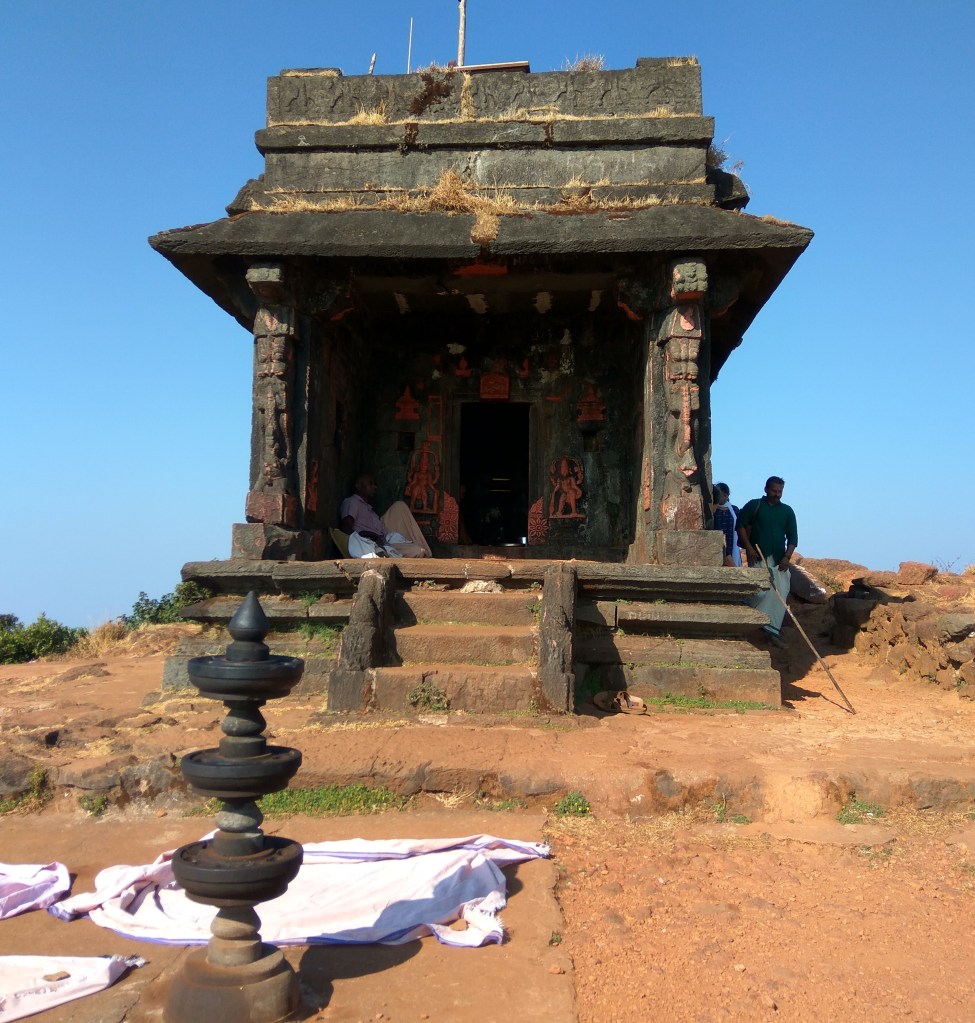
Sarvagnya peetam

A small temple at the peak in Kodachadri where Adi Sankara meditated is called the Sarvagnya peetam. It was while meditating here that the Goddess appeared in front of Adi Sankara and they started their journey to the valley from here. Thus this temple has a special significance .

We offered prayers there and meditated for some time and started our return trek . Coming down can be more tricky at places as we tend to slip on the slopes. However, we managed to reach back and took the jeep back to Kollur.

After a couple of days of stay at Kollur we returned back feeling rejuvenated after this spiritual experience.

I am an ardent devotee of Devi but I must admit that all that is said in the legends is difficult to accept entirely. But faith and religion are always like that and so, I leave it to you to follow your own minds….

After two episodes dedicated to Devi, coinciding with the Navratri festival, we move on next week to the glory of the Pallava dynasty…

Meanwhile, do continue your feedback and comments on my blog….

Meenakshi Temple ; Abode of the Princess

Meenakshi Amman as SHE is popularly known , was a princess who emerged out of the sacred fire, as a young child during the prayers by her parents to beget a child . SHE not only ruled over her father’s kingdom subsequently, but also captured several territories and finally met Lord Shiva at Kailash. So goes the legend of the Goddess, who presides over the temple city of Madurai in Tamil Nadu in south India. The association of Lord Vishnu in several legends associated with this Shaivite temple is one of its specialties. Lord Vishnu is considered to be the brother of Goddess Meenakshi.

History

The temple was built by Kulashekara Pandyan, a Pandya king during the 1st century and is believed to have been the central structure of the city ; which it continues to be even today. Plundered and looted by invaders like Malik Kafur in the 14th century, it was reduced to ruins and subsequently rebuilt by the Nayakars in the 16th and 17th centuries. The temple as we know it today is mainly the result of these revival efforts.

Structure

The temple occupies a large rectangular area of around 14 acres in central Madurai and is enclosed within huge walls . The entire structure is built like a mandala following the principles of loci and symmetry. Roads in the city radiate from the temple complex and ring roads form concentric circles around .

The presiding deities of the temple are Goddess Meenakshi ( Parvati) and Lord Sundareswarar (Lord Shiva) whose shrines lie parallelly in the innermost courtyard. Shrines to several Hindu Gods are also present .

The Gopurams

The most striking feature of the temple ; like most temples in south India ; are its towering majestic gopurams. A total of 14 gopurams decorate this complex with the tallest one rising to a height of 170 feet. This gopuram is curvilinear in shape .

The curvilinear Gopuram

Each of these gopurams have elaborate sculptures on them and are brightly coloured in various hues. The images on these gopurams are related to Hindu mythology. The outer gopurams are pyramidal ; serving as landmarks ; while the inner ones are smaller and adorn the gateways of the various shrines.

The pyramidal Gopuram

The multicoloured sculptures

The Shrines

Two east facing shrines house the presiding deities Goddess Meenakshi and Lord Sundareswarar. Goddess Meenakshi is depicted as a green stone image with a lotus in her hand on which sits a parrot. A metal copy of this image is kept outside the sanctum and is used for festive processions. The shrine of Lord Sundarewarar has a stone linga guarded by a hooded cobra. A metallic representation of the Lord in the form of feet embossed on a stool is kept near the sanctum .This is ceremoniously carried to the shrine of the Goddess every evening, so that both of them can symbolically spend the night together. In the morning the symbolic stool is brought back to HIS sanctum.

Several shrines dedicated to Ganesha, Murugan, Saraswati, Mahalakshmi and other Hindu Gods are located elsewhere in the complex.

The Porthamarai Kulam (Pond with golden lotus)

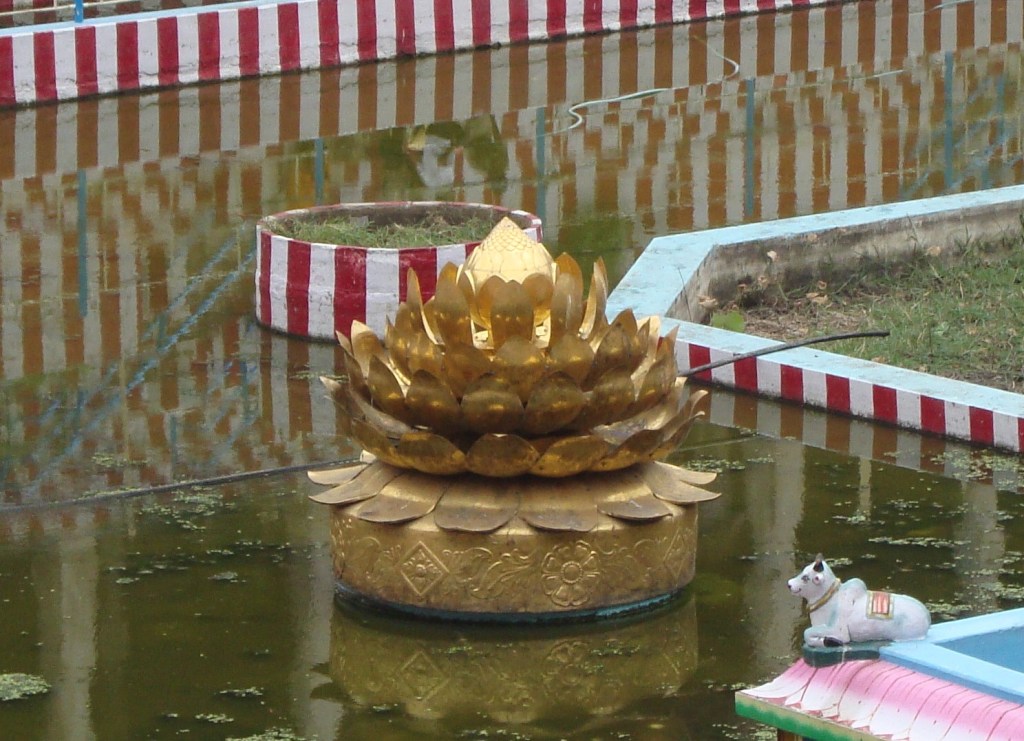
A large pond with a golden lotus in the center is used for pilgrims to bathe. The walls of the tank are painted in red stripes typically seen on temple walls of south India.

The Golden Lotus Pond

The Golden Lotus

Halls

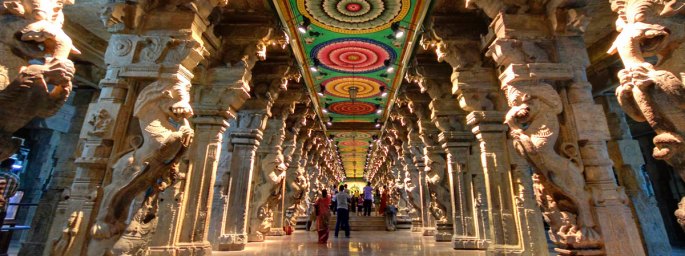
Though there are multiple halls or Mantapams, the Thousand Pillar hall is the most famous. It contains 985 pillars , each of which has a sculpture on them.

The Thousand pillar hall

The elaborate sculptures on the pillars

The artistic ceiling

Just outside this is are the Musical pillars where each pillar produces a different note when struck.

The threshold of the temple has an interesting sculpture which caught my attention. Here it is…

The divine marriage depicted in sculpture…

Cultural Significance.

The presiding deities being Lord Sundareswarar and Goddess Meenakshi, it is a Shaivite shrine. But Lord Vishnu is considered her brother and this temple brings both these Hindu sects together. In addition; since Goddess Meenakshi represents Shakti or power, this temple thus puts together the three Hindu sects of Shaivism, Vaishnavism and Shaktism.

Festivals

The temple hosts multiple festivals throughout the year , but the most popular one is the “Meenakshi Thirukalyanam”, a festival in the month Chithirai (April) symbolising the marriage of Meenakshi and Sundareswarar. This festival lasts for 12 days and there is a procession where the divine couple are taken around in a chariot pulled by devotees. Vishnu symbolically gives his sister in marriage.

The decorated chariot

Navaratri festival is another important festival celebrated here with the temple complex illuminated with hundreds of lights and a large Golu (doll arrangement) in the hall.

It has been my attempt to bring out the salient features of this great temple. It can be described much more; but that may get into too much detail. Hence, I end with the statement…

The Divine can never be totally described …it has to be experienced.

Till I am back with some more interesting destinations, do give your feedback and comments…

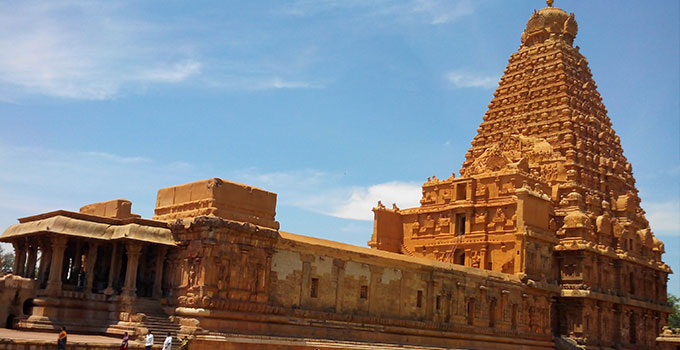
Chola Splendour ; Brihadishvara Temple

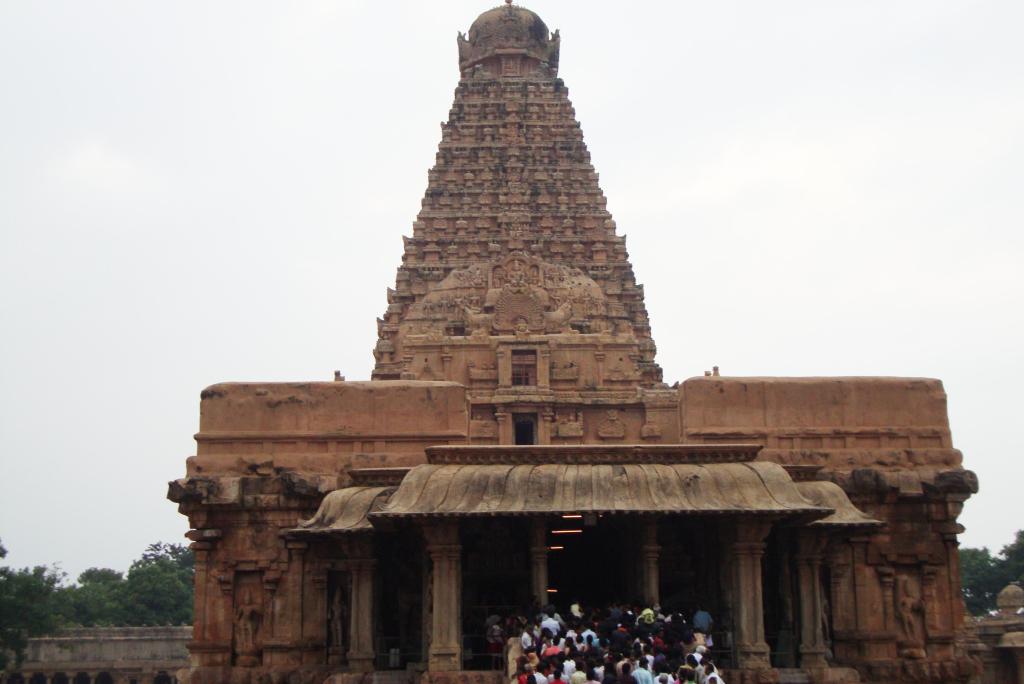
An outstanding example of Chola architecture, this temple dedicated to Lord Shiva is located in Thanjavur in Tamil Nadu. It is one of the biggest Hindu temples in India and is colloquially called Thanjai Periya Kovil (Thanjavur Big Temple). It was called “Dakshina Meru” comparing with Uttara Meru or Mt Kailas; the abode of Lord Shiva.

Built by the Chola Emperor Rajaraja I between 1003 and 1010 it is a designated UNESCO World Heritage site.

Looking back at history

Emperor Rajaraja I called the temple “Rajarajesvaram” meaning “temple of the God of Rajaraja”. Brihadishvara is a Sanskrit word meaning “Big Lord Siva”

The Chalukya and Pallava temple styles flourished from the fifth century onwards as evidenced by the Badami and Mamallapuram temples and similar monuments. The Chola dynasty flourished between 850 and 1280. It was during this period and specifically during the rule of Rajaraja I that this temple was built. It was specifically during this time that the huge ornate gopurams started adorning the temples.

The main temple with its gopurams are from the eleventh century while various additions and renovations took place subsequently . There were damages to the temple in various wars between the Muslim Sultans of Madurai and the Hindu rulers of Thanjavur. These were repaired and shrines of Murugan, Parvati, Nandi and Dakshinamurthy were added. The Thanjavur Maratha rulers took over and maintained the temple subsequently.

Structure

There are several sacred texts giving mythical accounts of the actual building of this temple. The Brihadeeswara Mahatmyam widely attributed to sage Veda Vyasa gives an account of 16 Chola rulers and the temples built by them.

The temple is built on a raised platform and is rectangular in shape with five distinct sections. The Sanctum with the main gopuram or tower called Vimana, the Nandi Mantapam, the Mukhamantapam and the Mahamantapam.

A large pillared and covered verandah surrounds this complex with a circumambulation path in between. This verandah is surrounded by two fortified walls outside. The outer one being higher and built by the French who used the temple as an arsenal.

Come along with me…let us enter the temple

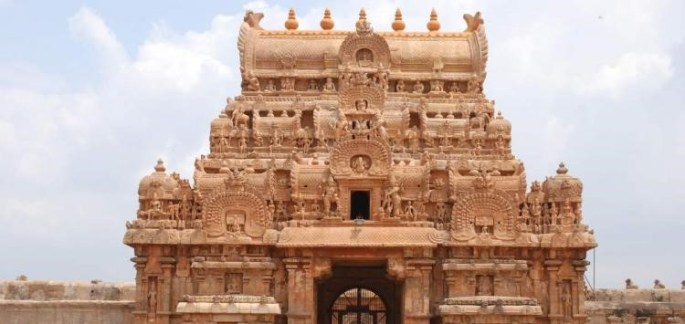
The Maratha Gate

The first gate as we enter the temple complex, built during the Maratha reign and served as a wall of defence. A gopuram with delicate carvings adorns this gate.

The Maratha Gate

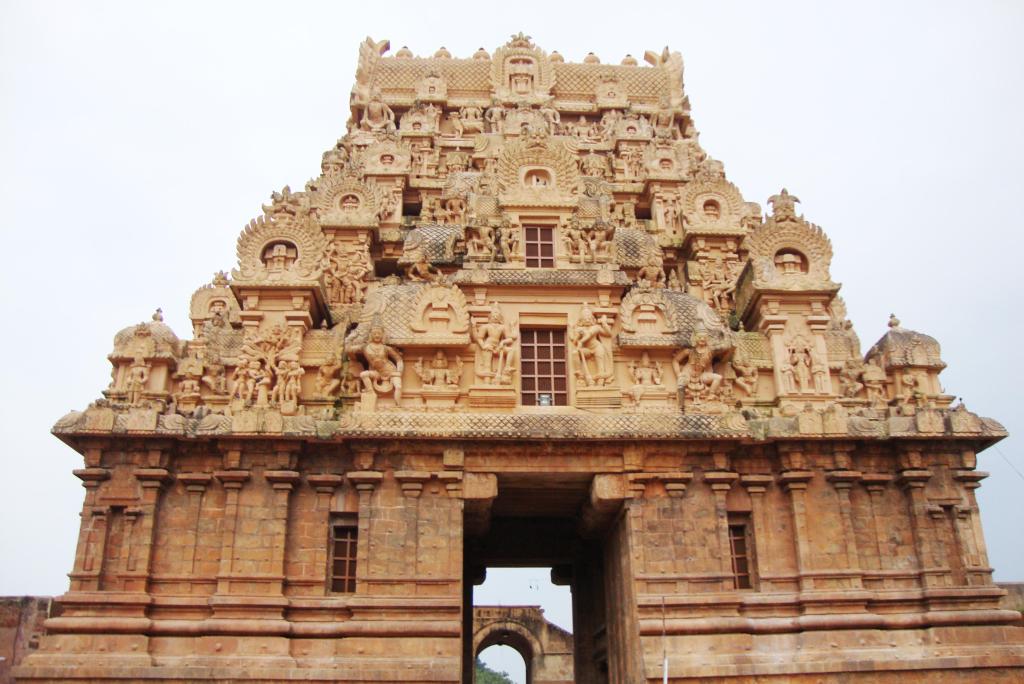
The Keralantaka Gate

Built to commemorate the victory of Rajaraja Chola I ,over the Cheras, this gate is highly decorated with carvings of Gods and Goddesses and is an ideal example of Chola architecture.

Keralantaka Gate

Under the second gate …

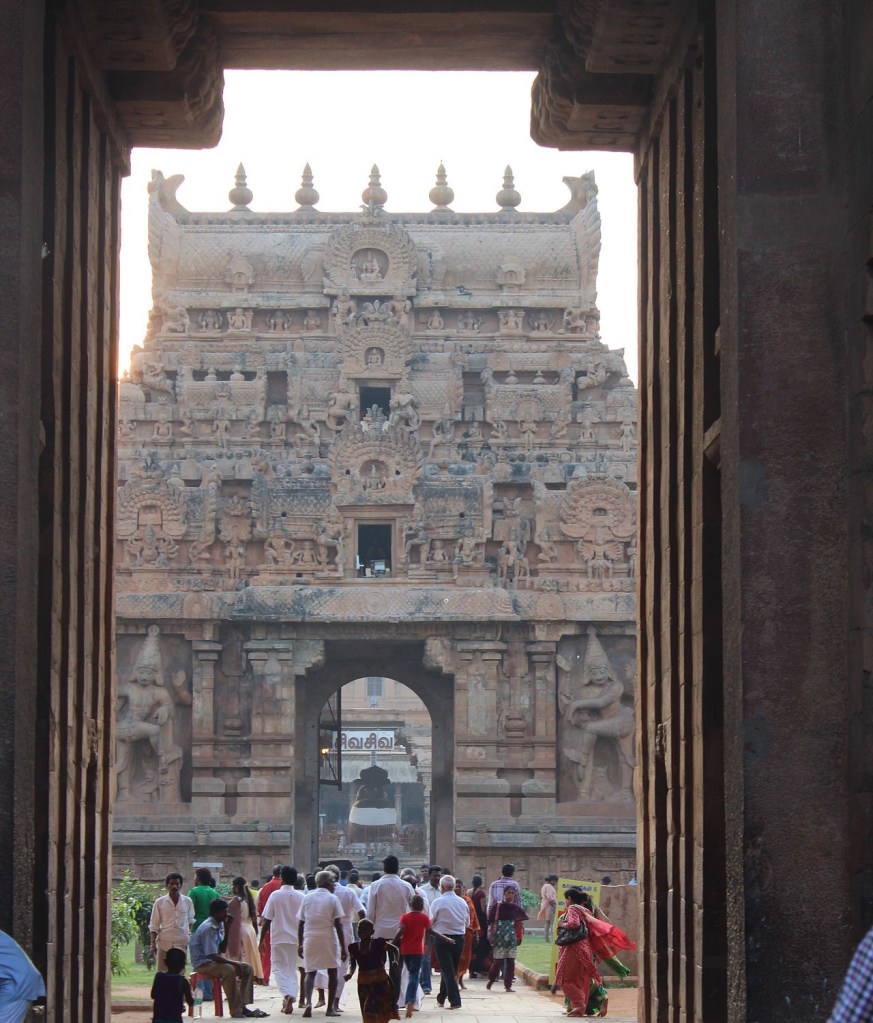
Rajaraja Gate

This is the third and final gate and is most ornate of all and marks the entrance to the innermost part of the temple complex. There are carvings at different levels on this gate and there are statues of two doorkeepers on either side of the entrance. Here too, there are carvings depicting various situations described in holy texts.

As you stand here, the Nandi is clearly visible inside the complex.

Rajarajan Gate ( note the two dwarapalakas)

Once you cross these three ornate gates with gopurams, you enter a courtyard with a huge Nandi ( Sacred Bull) and the Nandi Mantapam.

Nandi Mantapam is a raised platform with beautiful paintings on the ceiling and exquisitely carved pillars. A monolithic black Nandi weighing about 20 tons sits in the Nandi Mantapam looking towards the main deity. This Nandi is 16 ft long and 13 ft high.

The monolithic Nandi

The beautiful paintings on the ceiling of Nandi Mantapam

The main temple with gopuram or Vimana

Photography is not allowed in the main temple….

Nandi looks at the main deity inside the Sanctum, symbolic of Nandi guarding the temple.

The main deity is a huge Shiva Linga , 3.7 meters tall . This Linga is believed to house the powers of Brahma, Vishnu and Shiva. The Vimana or the main Gopuram (tower) is just above the sanctum. The space around the Linga and within the towering Vimana is believed to be permeated with the presence of Lord Shiva in subtlest form of space.

Only priests are allowed inside the main sanctum. The walls of the sanctum have beautiful paintings of the Chola period including that of Emperor Rajarajan I.

The exit from the main temple is through the side…

Exit from the main temple

From the pictures above, a fair idea of the beautiful carvings on the temple exteriors would have been obvious.

Most of the carvings and art work relate to various Hindu mythological characters and stories and feature various Gods and Goddesses.

Few more pictures to highlight the great art work on these walls…

The exquisite art work in stone….

The main Gopuram or Vimana is more than 200 ft high and built as 16 levels ; 13 of them tapering upwards. A huge dome or Kumbam measuring around 25 sq ft. sits on top of the tower and and weighs 80 tons. This Kumbam is also monolithic and how it was placed on top is still unclear.

The Vimana

The ornate Kumbam

The Mahamantapam and Mukhamantapam have shrines of eight deities symbolically guarding the eight directions. The walls of the mantapas have mural paintings and carvings mainly relating to Lord Shiva.

Murals on the walls

Stone Carvings

Music and Dance

From the time of the Cholas, the temple and its environs have been the arena of music and dance. Various inscriptions on the walls point to this. Elaborate rituals connected to dance and music have been described. Several endowments were bestowed on artists and many literary and musical compositions praising the deity were written here. The Chola rulers and the temple have long been credited with encouraging the growth of the art forms.

Mysterious facts about this masterpiece in stone

The whole temple is made of granite and the closest granite quarry was 50 kms away and so how all this stone was transported during those days is a mystery.

The design of the Vimana is such that it gives an illusion that it does not cast any shadow.

There were many underground passages through which the royalty moved around but now all those have been sealed.

The Nandi in front is monolithic.

Many inscriptions are found on the walls relating to details of administration of the temple.

Inscriptions

Well, one can never finish talking about such a masterpiece; but I leave it at that.

Hope you all enjoyed this visit to one of the greatest temples in India. See you next week with yet another such marvel. Till then, keep your comments flowing in.

Puri Jagannath Temple

The Jagannath Temple at Puri in Odisha is one of the most revered Hindu temples in India. The main deity is Lord Jagannath, an incarnation of Lord Vishnu.

[Though I have had the opportunity to visit this temple complex, I have not taken any pictures. Photography is prohibited and even the outer areas are difficult to photograph as we have to leave the camera/phone outside far away.] The pictures that I am putting up are file pictures.

A lot of uncertainty exists on the actual building of this temple. It is believed that King Indradyumna built the main temple sometime before the 10th century and King Anantavarman of the Ganga dynasty rebuilt the remaining part of the complex. The temple is claimed to have been plundered multiple times by invaders.

The temple is one of the magnificent remnants of Kalinga architecture of India.

A small introduction on JAGANNATH

The term Jagannath literally means “Lord of the Universe”. He is worshipped by the Hindus in India and Bangladesh , along with his brother Balabhadra and sister Subhadra. In a larger context , the Hindus in India are either Vaishnavites ( followers of Lord Krishna/Vishnu) or Shaivites (followers of Lord Shiva). The Vaishnavites call Him an incarnation of Vishnu while for the Shaivites , He is a tantric form of Bhairava, a fierce manifestation of Lord Shiva.

Lord Jagannath

Structure

The temple complex lies inside a 20 ft. high fortified wall and the main temple is surrounded by another smaller fortified wall. The main tower under which the principal deities reside is built on a platform and is 214 ft. high. Other shrines within the complex have roofs and towers that rise up in step like fashion to the main tower.

The main tower dominates the skyline in the vicinity.

The towers of the temple

Inside the wall, the complex has four main sections. The Sanctum Sanctorum where the main deities reside , The Frontal Porch, The Nata Mantap or dancing hall and Bhog Mantap or offerings hall.

Neela Chakra

An eight spoked wheel called the Neela Chakra is mounted on the top of the main tower. This is made of eight metals and is considered sacrosanct. The wheel is more than11 ft high and is the most revered iconic symbol of Jagannath.

Neela Chakra

The flag hoisted on the Chakra is called Patita Pavana and is considered equivalent to the deities placed in the Sanctum Santorum. This flag flutters in the direction opposite to the wind and this is one of the peculiarities of this temple. A priest climbs up to the top( as tall as a 45 storey building) and changes the flag every day.

The Singhadwar (Lion Gate)

This is one of the main entrances to the temple and has two huge crouching lion statues giving it the name. This is the gate that faces east and on to the main road. A giant monolithic pillar called Aruna Sthamba stands tall in front of this gate. This pillar was originally in the Sun Temple at Konark and was relocated here. It has the statue of Aruna, the charioteer of the Sun God on top.

The Singhadwar with ArunaSthamba

The gates in the remaining three directions are named after the animals guarding the gate .

When one enters the temple through the Eastern gate, one passes through a series of steps before we reach the Sanctum Sanctorum.

Sanctum Sanctorum

The three siblings … Jagannath, Balabhadra and Subhadra are the main deities at the Sanctum. The idols are not of stone as in other temples but carved out of Neem trees. They sit on a raised bejewelled platform.

The sibling deities

The idol of Jagannath is actually a carved and decorated wooden stump with large round eyes and conspicuous with absence of limbs and neck and the face merging with the chest. He is painted black and this feature is similar to Lord Krishna . The “U” shaped mark on his forehead is typical of Vaishnavite traditions.

The idol of Balabhadra is depicted with a white face and Subhadra with yellow face. Both of them have oval eyes.

The idols are made of neem wood and replaced every 12 or 19 years; depending on the Hindu calendar when the year has two months of Ashadha.

Multiple small shrines

Inside the temple complex are multiple shrines dedicated to various Gods.

Architecture

The architecture of the towers at the temple is simply outstanding. The detailed artistic work and images carved in stone are really marvellous. Unfortunately no pictures are available to depict this. In fact I visited this temple soon after I had visited Angkor Wat and I was amazed at the architecture and complexity of design of this complex. Due to lack of pictures, the artistry is lost to the world unlike Konark or Angkor Wat where photography is allowed.
The Temple Kitchen

The temple kitchen is considered one of the largest in the world. Cooking is done in earthen pots using water drawn from wells. The food is sold to devotees in the Anand Bazar within the temple after offering to the Lord.

Rath Yatra

The most famous festival of Jagannath Temple at Puri is the Rath Yatra. It is this festival that has been instrumental in bringing this temple global recognition. In fact the word Jagannath is also supposed to have etymologically originated from the word “Juggernaut” signifying the movement of the huge chariot and the people along the streets.

Every year, this festival is celebrated in the month of Ashadha (June/July) and the deities are brought out of the temple in chariots in a procession on to the main road and travel for about 3 kilometres to the Gundicha temple. The deities stay there for seven days and then are ceremoniously brought back to the main temple in the same chariots.

The chariots are wheeled wooden structures built newly every year and they are pulled by the devotees. The Chariot of Jagannath is the biggest and is approximately 45 feet high. It takes months of work on the building and decoration of these chariots.

Visuals of the Annual Puri Rath Yatra

Rath Yatra is not a temple festival for the locals but an integral part of their lives. They celebrate it with much fanfare and the whole area gets a festive look at the time of the Rath Yatra.

Some amazing facts about this temple :

The sacred flag on top of the tower flutters in the opposite direction of the wind. This flag is changed manually every day by climbing the tower which is as high as a 45 storey building.

The idols are made of wood and carved by carpenters. They are replaced periodically and the old idols are buried. This is called Nabakalebara
The temple casts no shadow in any direction of the sun.

The Mahaprasad consists of 56 delicacies and is available for sale to devotees.

The food is cooked in earthen pots placed one above the other and the food in the top most pot gets cooked first.

Though located close to the sea, the sound of the waves stop as soon as you enter the temple.

Nothing flies over the tower of the temple.

The Neela Chakra appears to be facing the same way when viewd from any direction.

Many scientists and religious leaders have tried to investigate these strange phenomenon but no one has as yet got an answer.

Well, let us leave it to the Glory of Lord Jagannath

See you next week with some other great temples. Till then, do like, comment and give your feedback.

Konark, an ode to the Sun

Poetry in stone dedicated to the Sun God; that’s a simplistic definition of the Sun Temple at Konark. Writing such a definition is so simple !! but building such a monument is definitely not !!! A visit to Konark will authenticate what I just said. So, come along with me on this virtual tour of this masterpiece in stone.

A brief history

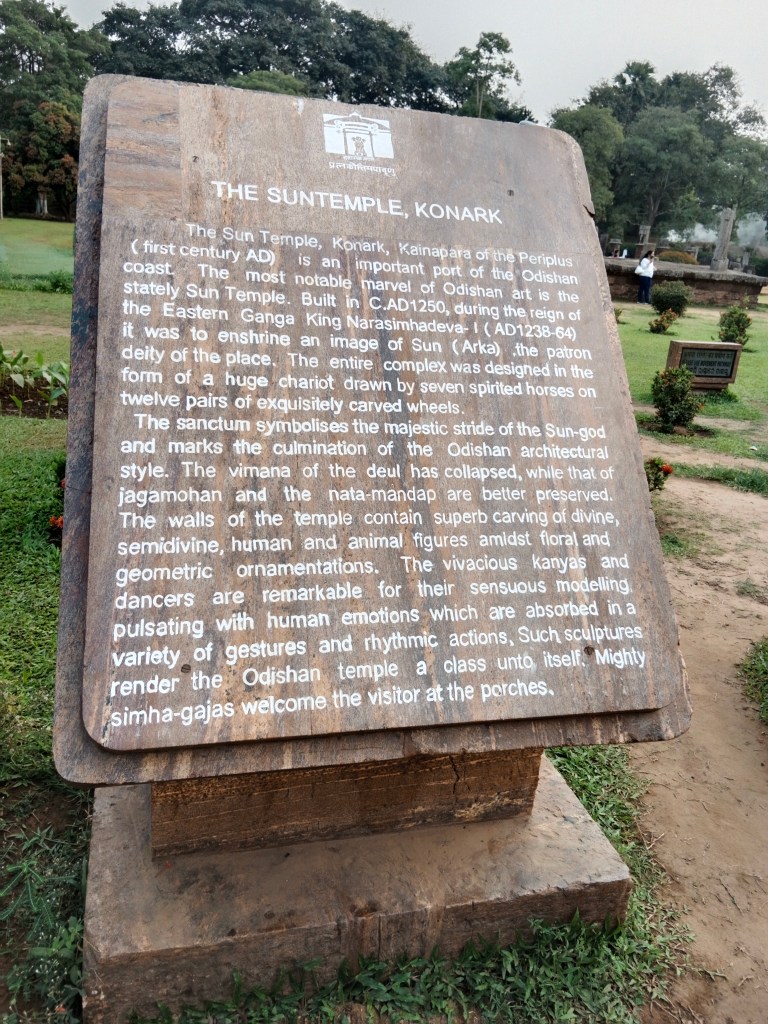
The Sun temple at Konark was built by King Narasimhadeva of the Ganga dynasty in the 13th century in typical Kalinga architectural style. Located 35 kms. from Puri city in Odisha , along the shores of the Bay of Bengal, the temple was built as a giant chariot of the Sun. Many parts of this masterpiece is in ruins and the cause of destruction of the temple remains a mystery with natural disasters at one end of the spectrum and deliberate destruction by Muslim invaders in the 15th to 17th centuries at the other end.

The Architecture

Known originally as Surya Devalaya ,the main temple is in the form of a huge chariot with 24 wheels drawn by seven horses. In Hindu mythology the Sun God is seen riding across the sky from east to west on a chariot . That is what is depicted here in Kalinga architecture . Surya (Sun God) is seen flanked by Goddesses Usha and Prathyusha shooting arrows to dispel the darkness . If you felt this is the depth of the symbolism ; hold your breath….the 12 pairs of wheels represent the 12 months of the Hindu calendar. The conceptualisation and realisation of this symbolism will find very few parallels !

When viewed from front, during sunrise, the Chariot appears to emerge from the sea carrying the Sun….. more symbolism for you!

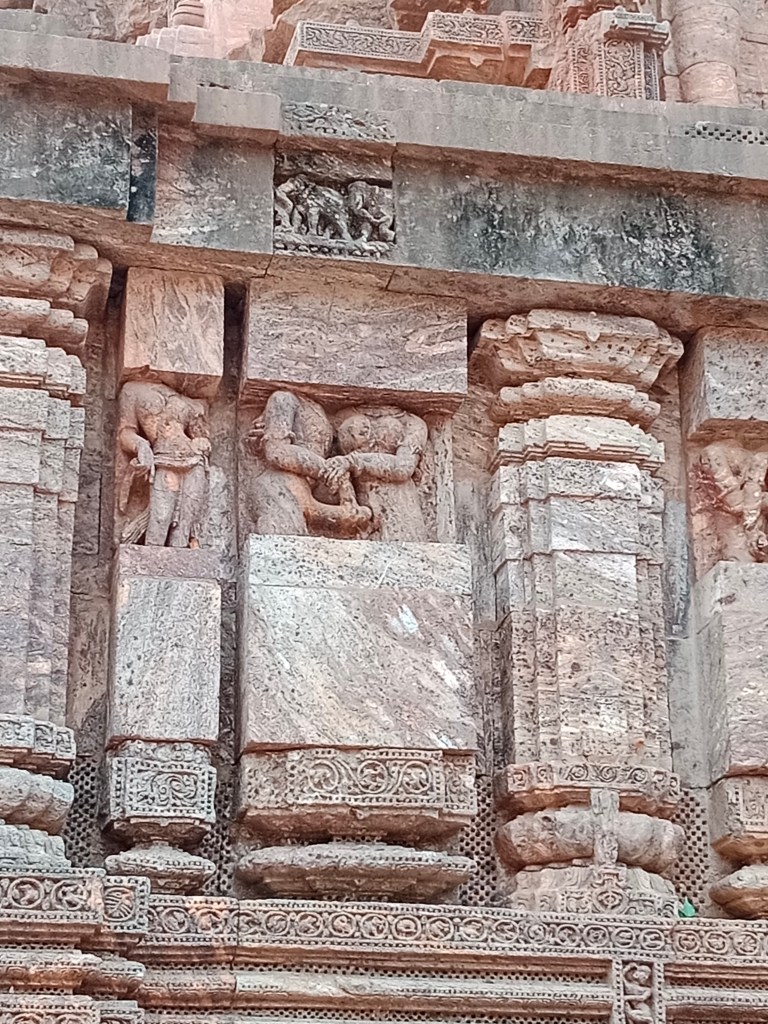
The intricate art work on the walls of the temple consist of various themes including scenes from contemporary life and erotic Kama scenes from the Kamashastra.

Any amount of description will not match the beauty of this stone marvel and so, let me just put up some pictures for you to decipher it….

Walking through the temple complex…

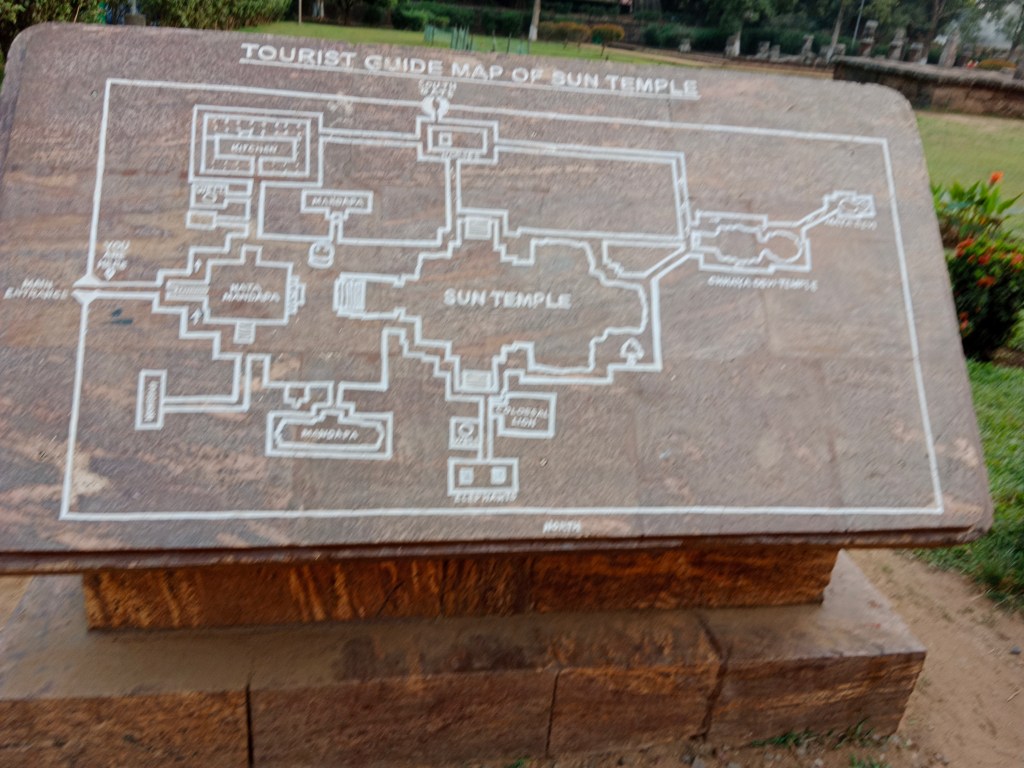
A stone plaque with the map of the temple complex guides the visitors at the entrance

A long neatly paved passage with well manicured lawns on either side leads one to the main temples. What one encounters first is the ruins of the Natya Mantap ( hall of dances ) with the main chariot behind it.

Standing in front of the Natya Mantap ruins with our guide

Right in front of the Natya Mandap is a unique sculpture. A lion on top of an elephant and a man below that. It signifies wealth, ego and pride crushing humanity.

The Natya Mantap stands on an intricately carved platform and the pillars forming the walls of the Mantap have delicately carved figurines similar to those found elsewhere in the complex. One can enter the Natya Mantap by climbing a flight of stairs.

View of the chariot standing on the Natya Mantap

Walking around the Natya Mantap we reach the Chariot .

In front of the Chariot

There was a pillar between the Natya Mantap and the Chariot which was known as the Aruna Stamba (Aruna Pillar) which has now been relocated to the Jagannath Temple at Puri. Aruna is considered the charioteer of Surya.

As we walk around the Chariot, the intricate patterns on the walls become clear. Some pictures…

A major part of the figurines depict musicians with various musical instruments and dancers in various poses…

The walls with reliefs depicting musicians and dancers

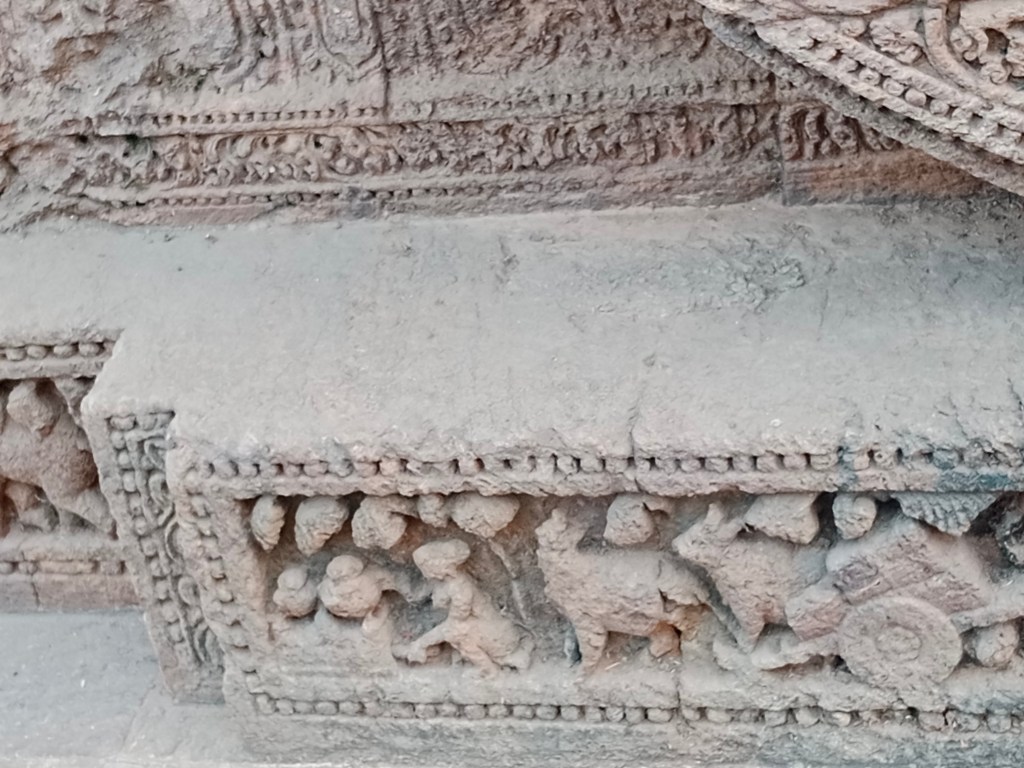
Apart from that, contemporary daily life is also depicted at many places….

Cooking on a choolah and pulling a chariot

There is a lot of emphasis on sexual life and the Kamashastra is also depicted by figurines on the walls including that of unnatural sex. This highlights the openness with which these were an accepted part of life in those times….

Kamashastra

Unnatural sex and punishment for infidelity

Wheels

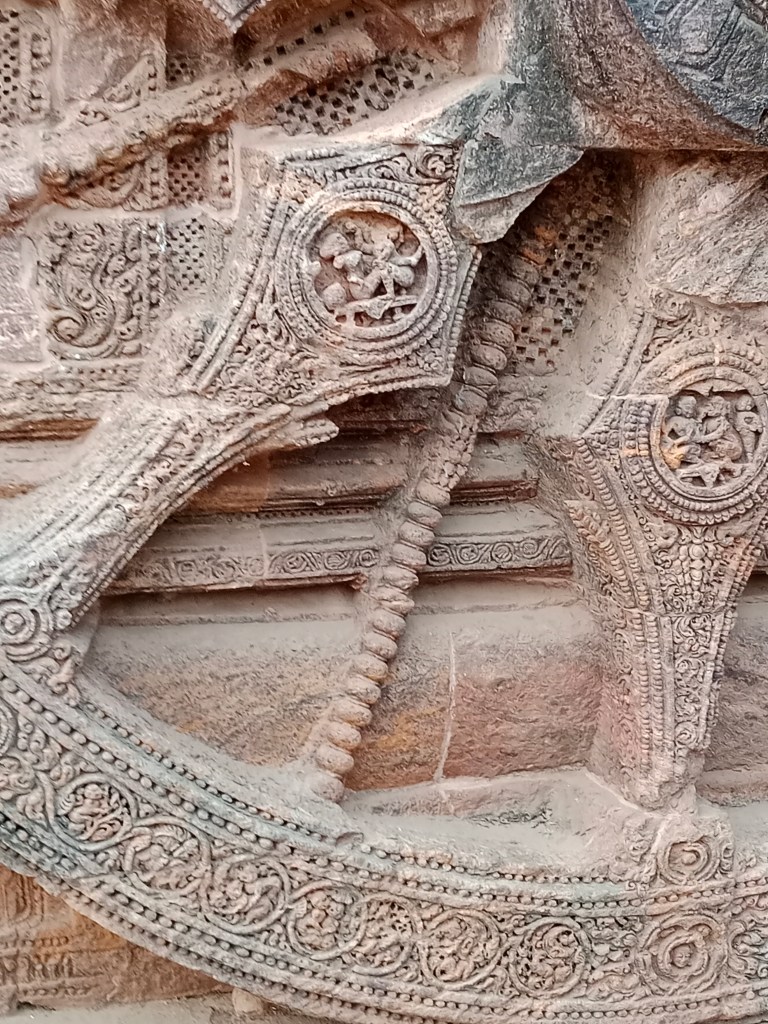
The chariot wheel is one of the iconic images of this temple. The 24 wheels of the chariot are so intricately designed with emphasis on time that it seems like they were used as sundials at one point of time and also for knowing the seasons and months.

One of the iconic wheels

The 24 wheels are 12 feet in diameter and intricately carved. Many of the wheels are in different stages of ruin.

Designs on the wheels and the small beads representing different units of time

The Chariot was shown as drawn by seven horses and many of the horses have been destroyed. One survivor….

One of the surviving horses literally on a walker!!

Metal strips

Another very interesting aspect of the temple is that many of the parts are held together by metal clips. A closer look at the junctions shows this …..

A metal block holds the top stone and metal clips between the stones

Now, one of the reasons attributed to the temple destruction is this particular element in its construction. The ships passing by with their powerful magnets may have disturbed these metal clamps and clips leading to the ruin.

Depiction of the different phases of the day

As one circumambulates the temple, the image of the Sun God changes corresponding to the different times of the day. Take a look….

Sun God in the morning in blue granite and in the afternoon shaded with a crown

Sun God in the evening, appearing tired and riding a horse. Beheaded Sun God.

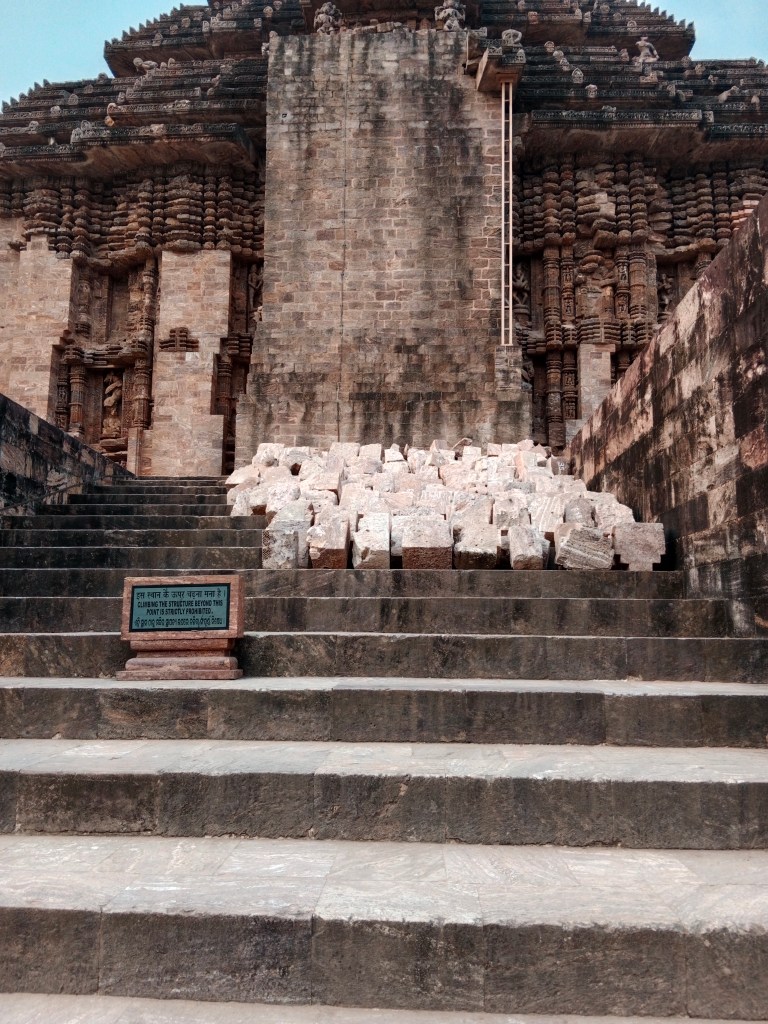
As one walks along, one realises the amount of destruction (natural or otherwise )that has taken place and the various restoration activities that are on.

The restoration work in progress.

Chhayadevi temple

At the back is the Chhayadevi temple which is roofless and in ruins

Chhayadevi Temple

The Monolithic lion

A monolithic Lion sculpture adorns the side of the chariot.

Monolithic Lion

In the evening, after sunset, the monuments get lit up and it presents another amazing sight…

The lit up Natyamantap entrance

A unique light and sound performance takes place here in the evenings after sunset.

It takes one through the history of the temple and also depicts various other historical events.

Glimpses from the show…..

Glimpses of the light and sound show

UNESCO World Heritage Site

The Konark Sun Temple is a proclaimed UNESCO World Heritage site and is being maintained so. Restoration work is on all over the temple and surrounding premises. The lawns and the environs are kept neat and clean and we find lot of evidence of restoration work going on…

Evidence of restoration work

Bisu Moharana

When we admire any artistic creation, we must always give credit to the creator. Well, the architect of this stone masterpiece is Bisu Moharana and in the later years, his son. So let me end this episode on The Sun Temple with reverence to the spirit of this man whose vision and conceptualisation has given us this marvel.

See you next week with more from Odisha. Till then do give your feedback and comments.

Farewell Bhutan

We will soon bid farewell to Bhutan ; but not before we have a round up of Paro and some of the places around.

Chuzom

Enroute Paro from Punakha, we had a short halt at Chuzom which is the place of confluence of two rivers ; Wong Chu and Paro Chu. One can see the confluence of the rivers from a bridge and the single river flowing off the other side.

Such confluence of rivers is considered inauspicious by the Bhutanese and hence four chortens have been built here to ward off the evil. These chortens are of different styles namely Bhutanese, Nepali, Ladakhi and Tibetan.

The two rivers and the Chortens

The other side of the confluence

There is also an ornate gate built near Chuzom where the pictures of the king and queen are painted. The spot marks the meeting point of roads to Thimpu, Paro , Haa and Chukkha.

The ornate gate with the picture of the King and Queen

A tribute to Indo Bhutan friendship and the confluence of the roads!

Paro

It is a historic town in Bhutan with many historic sites around. It is also home to the only international airport in Bhutan, the Paro International Airport. Located in a valley on the banks of the Paro river and surrounded by mountains ,it is considered one of the most dangerous airports in the world with less than 10 pilots certified to operate from Paro.

It was news to me that the first airstrip was built here in 1968 by the BRO from India. It has been expanded later.

Paro airport with the road and Paro river adjacent to it

The runway between the slopes and view of the entrance from our hotel room

Our hotel at Paro was next to the airport and there was this little stream flowing between the road and our hotel. This was part of the Paro river.

The riverside offered great ambience and enhanced the beauty of the place. Some pictures….

Some pictures from our resort

Tiger’s nest and Paro Dzong

Tiger’s nest, the cliff side monastery near Paro and the beautiful Paro Dzong are the main attractions at Paro. These have already been covered in my previous blogs.

Paro town

Traditional Bhutanese attire is available for hire here. Some of us tried this out and here are some pictures..

The dress centre and the beautiful ladies in front of the Paro dzong

Bhutanese Cultural Show

We were treated to some Bhutanese rice wine called Arra. It was clear and transparent like water but did not taste any great!

This was accompanied by a cultural show which showcased the traditional dances of Bhutan. The music was melodious and we also joined the dancers in the end the mark a happy ending to our Bhutan trip. Some pictures…

Arra and the dancers…

A video of the dance performance.

After a very enjoyable stay at Bhutan we were ready to say goodbye to this beautiful country. We drove back from Paro to Phuentsholing and further down to Siliguri. Enroute we again drove through some tea gardens ……

Driving back to Siliguri….

This marks the end of the Bhutan series. The next series is going to be on the famous temples of India. Before that, I will be on a holiday for a couple of weeks and there will be no updates during that time.

So , see you after the break. Till then do give your comments and feedback.

Tiger’s Nest hike

No trip to Bhutan is complete without a visit to this great monastery called Paro Taktsang or Tiger’s nest. Much like the Eiffel tower is to Paris or the Statue of Liberty is to New York, it is an iconic image of Bhutan. Located on a cliff side in the upper Paro valley, this Himalayan Buddhist site is one of the thirteen Tiger’s nest caves in historical Tibet where Padmasambhava practiced and taught Vajrayana Buddhism.

A brief history

Established in the 9th century as a Buddhist meditation cave, it was formally built into a monastery in the 17th century.

Legend has it that the Indian Guru Padmasambhava ( Guru Rinpoche) flew in to this cave on the back of a tigress and meditated here. Guru Rinpoche or the “Second Buddha” is believed to have had eight manifestations and to have banished the demons . He is believed to have brought Buddhism to Central Asia and anointed this place as the site for a future monastery. That explains why this place is so sacred to the locals and why such a monastery was built at this location.

Though we call it Tiger’s nest in English, Taktsang means a tigress’s lair.

Guru Padmasambhava or Guru Rinpoche ( a mural painting)

Structure

Though the structure itself is beautiful, what adds invincibility to the place making it more attractive to the tourists , is the isolated location on a steep slope overlooking the valley.

The monastery has white walls which stand out against the rocks and surrounding trees. The red and gold borders and circles provide a typical Bhutanese look to the buildings. There are four main buildings here in addition to smaller ones for various purposes. The buildings have rock steps connecting them making it look as if the buildings rose from the cliffs around.

Getting there

The monastery is more than 3000 metres above ground level. No vehicles can go up there and dense forests line both sides of the track. Hiking is the only way to reach the monastery. Ponies can be hired for part of the distance but the last part has to be done on foot. The total hike takes anywhere from 3 to 4 hours one way depending on one’s capability.

Our Hike

When we reached the place and the bus dropped us off at the parking lot, the monastery looked like a small building perched somewhere up on a cliff. It looked a little invincible but we were determined to make it to the top. We were all a little doubtful if we would really be able to reach up there; but the adventurous spirit egged us on…..

At the parking lot, we hired walking sticks and set off on this wonderful experience.

The first views of the monastery as we started our hike uphill.

Looking at this picture you would realise why we were all apprehensive!!!!!

The initial part of the walk was through a forested area with tall trees on either side. At most places the roots had spread out on the floor ….

All set for the hike!!

The initial track

The tall trees and their roots….

The path is actually a mud road around 10 feet wide with an uphill incline but not very steep.

Winding paths took us around trees and rocks and at one place there was a small stream and a shrine…

A small shrine enroute…

At places there are wooden steps and at places stone steps too and we did not find it very difficult . The company and the walking stick provided the much needed moral and physical support. The colourful prayer flags added to the charm…

The steps and the flags….

Every now and then there are small resting places strategically built in the shade and we made full use of them…

Taking a breather!!

The Midway Break…

Almost halfway up there is a restaurant where we halted for a short break and some food…

Some rest and food…

Continuing after the break, the path was narrower and there were more stony steps. The views of the valley from above was amazing indeed.

The Paro valley and the Cafetaria seen from above

As we ascended further up, we could see the monastery close up in between the trees.

The foliage parts to show us the monastery…

And finally we reached the view point that gives the best views of the monastery. Some pictures from there….

The hard work was really worth this amazing sight…

One as a memory of this great hike….

After the view point, it is a steep flight of stairs down and again up effectively crossing from one hill slope to the other

The Monastery

The monastery is decorated with Buddhist symbols and the most impressive is that of a tiger in :”The Hall of Thousand Buddhas”.

It is an active monastery today and many monks meditate here.

It was a special day in Bhutan, the death anniversary of Guru Rinpoche and so the monastery was out of bounds for tourists. So we could not enter the actual monastery building.
All along the way, we could see locals climbing up with family and even little children. Most of them greeted us with “Kuzu Zangpo la”, a traditional Bhutanese greeting meaning Hello ….how are you?

After a short rest, we started our descent down and that was more challenging than the climb. We had to be careful as at many places, it was slippery . Just as on our way up, we rested and took small breaks and enjoyed each other’s company and finally reached the parking lot where the bus awaited us.

Some of us reached our bus a little earlier and rested there for the others to come. The whole trek took around 9 hours with a short lunch break. So we were quite happy just sitting in the bus and resting our backs.

The sheer feeling of having done this challenging climb successfully washed away the tiredness and a feeling of achievement kept us pepped up and happy.

There is just one lesson to learn from this…however tough any task may feel, if your heart tells you to do it….just go ahead and DO IT…..

IF YOU TRY; YOU MAY ACHIEVE ; BUT IF YOU DON’T, YOU NEVER WILL.…..

I leave you with this thought….

See you next week with some more visuals and experiences from Bhutan before we wind up from there. Till then, do keep your comments and feedback coming…

Punakha

Beautiful Punakha is closely linked with Bhutanese history ; was the old capital of Bhutan and the seat of government till 1955. Located around 72 Kms from Thimpu , it is now the winter capital of Bhutan as it is warmer than Thimpu. Two rivers, Mo Chu and Pho Chu flow through this area making it a very fertile valley suitable for rice farming and Punakha rice is very famous. The Punakha Dzong, one of the most beautiful dzongs in Bhutan is located at the confluence of these two rivers.

A drive from Thimpu to Punakha offers great views of the Himalayas apart from the unique flora and fauna of this region. Dochula pass, which we visited in an earlier episode lies on this route. The area around Punakha is also an excellent birding and wildlife destination as it is home to over 500 species of birds apart from the black bear, panda, leopard and tiger.

The Punakha valley is a fertile region and paddy fields are a common sight here…

Farming activity in Punakha valley

Arriving late evening we checked in to our hotel at Punakha; Hotel Vara. A beautiful hotel located at a slight elevation from the town and overlooking the Mo Chu river, the views of the valley from the hotel were beautiful.

Hotel Vara , Punakha

Next day , after breakfast, we boarded our buses to go around Punakha. Our first halt was at Punakha Dzong about which we have already discussed. After seeing the Dzong, we visited the suspension bridge across the Mo Chu river.

Punakha Suspension Bridge

This second longest suspension bridge in Bhutan is about 180 metres in length across the Po Chhu river and connects the two parts of the valley. The bridge is beautifully draped with prayer flags and is a popular photo location. It was built in the 17th century and is anchored by suspension cables which tend to sway in the wind and when we walk on it. The floor is made of wooden planks. Walking across the bridge we reached a small restaurant where we had coffee and rested for a while.

The Suspension bridge from a distance

The coloured flags on the bridge

On the suspension bridge

The restaurant

Riverside Lunch

By the time we finished the dzong and the bridge, we were all ready for a nice meal. And what a surprise we had. A riverside lunch was organised . With the sound of the gurgling waters and the gentle breeze blowing in, we really enjoyed the lunch. Some pictures…

An enjoyable riverside lunch…

Post lunch we proceeded to the famous Punakha Nunnery.

Punakha Nunnery

Located on top of a small hillock with beautiful views of the valley, this is a training school for nuns. It also offers life skill training like Thangkha painting ,embroidery and tailoring.

The temple is an example of Bhutanese architecture and design and contains a 14 feet bronze statue of Avalokiteshwara . Statues of Padmasambhava and the Taras are also present apart from the meditation halls. Its unique location makes it visible as one drives into Punakha. Some pictures…
Punakha Nunnery seen from the road as one approaches Punakha

The Stupa

The main temple

The view from the nunnery with the chortens and the road on the hillside.

River Rafting

Let me now take you through some pictures of a River Rafting session on the Mo Chhu river we had earlier on at Punakha. The rafting was enjoyable and we had a great time. The river was not very rough and we encountered grade two rapids as we rowed along…

The rafts and rafters get ready

Starting off with excitement…

Soon we got used to the rapids

We sang and rowed along….

After the rafting session was over, we all wanted to get back as we were wet and shivering…

What better way to get over this than a warm bonfire?

The bonfire…

A video of the bonfire….

On our last night at Punakha, we had a bonfire at the hotel where we all sang and danced in the warmth of the fire. What an ending to our time at Punakha!!!!

Next we week we are at Paro. See you from Paro, till then, do give me your feedback and comments.